
AI Energy Consumption per 1000 Queries: Shocking Truth Every Business Must Know
Table of Contents
- AI Energy Consumption per 1000 Queries: What It Really Means
- Understanding AI Energy Consumption per 1000 Queries
- How Much Electricity Does ChatGPT Use per 1000 Queries?
- How Much Energy Does a Single AI Query Use?
- AI vs Google Search Energy Consumption Comparison
- Energy Consumption of GPT Models Explained
- AI Carbon Footprint per Query
- Real Example: Small Business Using AI in the U.S.
- How Much Power Does AI Consume per Request?
- Why AI Energy Consumption per 1000 Queries Matters for Businesses
- How This Topic Helps in SEO and Traffic Growth
- Trusted Data Sources and Research
- Final Thoughts on AI Energy Consumption per 1000 Queries
Let me be honest—when I first came across the topic AI energy consumption per 1000 queries, it didn’t look like something that could drive traffic or even matter for business decisions. But the moment I started digging deeper, things changed. This isn’t just a technical topic anymore. It’s becoming a real conversation among U.S. business owners, marketers, and even policymakers who care about cost, sustainability, and long-term growth. Right now, AI tools like ChatGPT, image generators, and automation platforms are being used daily by startups, LLC owners, and marketing teams across the United States.
From a small bakery in Texas using AI to write product descriptions to a digital agency in California generating client reports, AI is everywhere. But here’s the thing nobody talks about enough—every single AI query consumes electricity. And when you scale that to thousands of queries, the numbers start to matter. So in this article, I’m going to break down AI energy consumption per 1000 queries in a way that actually makes sense. Not just theory, but real-world implications, comparisons with Google search, and what it means for your business, your marketing budget, and even your brand positioning.
Why AI Energy Consumption per 1000 Queries Matters in 2026
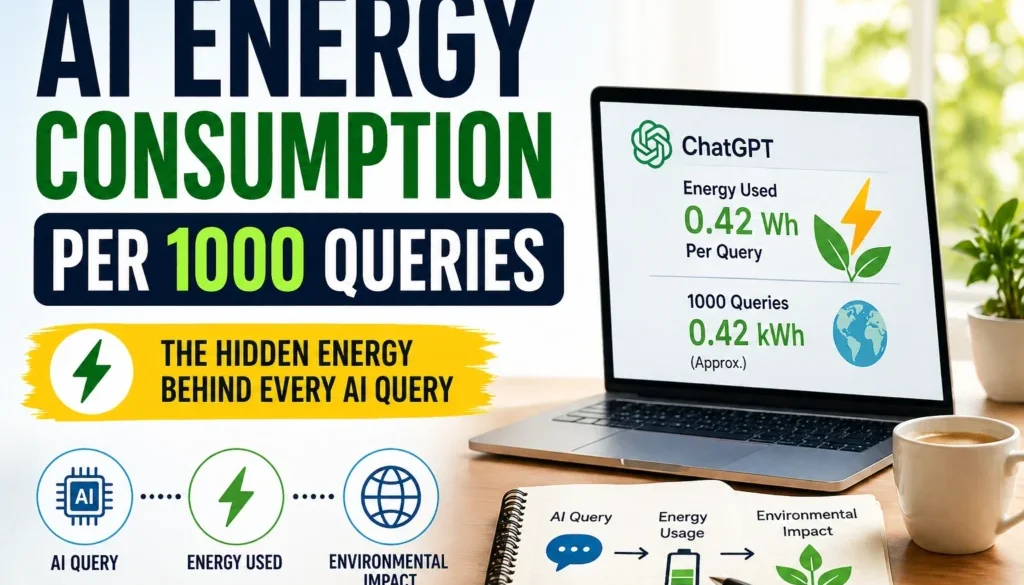
At its core, AI energy consumption per 1000 queries refers to how much electricity is used when an AI system processes one thousand requests. These requests can be anything—text generation, image creation, code writing, or even chatbot conversations. Now here’s where it gets interesting. A single AI query doesn’t seem like much. But multiply that by 1000, and suddenly you’re looking at measurable energy usage. Based on multiple research estimates, a single AI query can consume anywhere between 0.3 Wh to 2 Wh depending on complexity.
That means for 1000 queries, you’re looking at roughly 300 Wh to 2000 Wh, or 0.3 kWh to 2 kWh. To put that into perspective, that’s roughly the same amount of electricity needed to power a standard LED bulb for several hours or run a microwave multiple times. Now imagine a marketing team running thousands of AI queries daily—content generation, ad copy testing, email personalization—it adds up quickly.
How Much Electricity Does ChatGPT Use per 1000 Queries?
One of the most searched questions right now is how much electricity does ChatGPT use per 1000 queries, and honestly, it’s a fair question. Businesses want to know what they’re paying for—not just in dollars, but in energy and environmental impact. While exact numbers vary depending on the model and infrastructure, estimates suggest that ChatGPT falls within that same 0.3 kWh to 2 kWh range per 1000 queries.
However, more complex tasks—like generating long-form content or analyzing data—can push energy usage higher. What’s important here isn’t just the number. It’s the pattern. AI usage is growing exponentially, especially among U.S. small businesses trying to scale their marketing without hiring large teams. And that means energy consumption is growing too.
How Much Energy Does a Single AI Query Use?
Let’s zoom in for a moment. If you’re wondering how much energy does a single AI query use, the answer depends on what you’re asking the AI to do. A simple text response might use around 0.3 Wh. But if you’re generating high-quality images, running complex prompts, or processing large datasets, it can go much higher. Image generation, in particular, is one of the most energy-intensive tasks in AI today. This matters because many businesses are now using AI not just for writing, but for visuals, branding, and content creation. If you’re running an eCommerce store in the U.S. and generating product images using AI daily, your energy footprint is significantly higher than someone just using AI for blog writing.
AI vs Google Search Energy Consumption Comparison
Now let’s talk about something that really grabs attention—AI vs Google search energy consumption comparison. This is where things get interesting, especially from an SEO and marketing perspective. A traditional Google search is incredibly efficient. It typically consumes about 0.0003 kWh per query. That’s thousands of times lower than an AI query in some cases. Google has spent decades optimizing its infrastructure, making search extremely energy-efficient. On the other hand, AI models require heavy computation.
They process language, context, and patterns in real time, which demands more power. So when you compare AI vs Google search, AI clearly uses more energy per request. This doesn’t mean AI is bad—it just means it’s powerful. And power comes with cost. If you want a deeper breakdown of this comparison, you can check this detailed guide on AI vs Google energy usage comparison, where I explained how businesses should think about this shift.
Energy Consumption of GPT Models Explained
To truly understand energy consumption of GPT models explained, you need to look at how these models work behind the scenes. Unlike traditional software, GPT models run on massive data centers filled with GPUs and specialized hardware. These systems are designed to handle billions of parameters and generate responses instantly. But that speed comes at a cost—electricity. Companies like OpenAI and Google are constantly working on improving efficiency, but the demand for AI is growing faster than optimization efforts. So while each query might seem small, the cumulative energy usage across millions of users is massive.
AI Carbon Footprint per Query
Another angle that’s gaining attention is the AI carbon footprint per query. Energy consumption isn’t just about electricity—it’s also about environmental impact. Depending on how electricity is generated (coal, natural gas, renewable energy), each AI query contributes to carbon emissions. That means businesses using AI at scale are indirectly contributing to environmental impact. This is why sustainability is becoming a key factor in digital marketing strategies. U.S. customers are increasingly aware of environmental issues, and brands that ignore this trend risk losing trust. If you want to explore this topic further, I’ve already covered it in detail here: how AI impacts the environment.
Real Example: A Small Business in Texas Using AI
Let’s make this practical. Imagine a small bakery in Texas running as an LLC. They use AI daily for writing social media posts, generating product descriptions, and creating marketing emails. On average, they might run 500 to 1000 AI queries per day. Over a month, that’s 15,000 to 30,000 queries. Now apply the AI energy consumption per 1000 queries estimate, and suddenly you’re looking at noticeable electricity usage. For a single business, it might not seem huge. But multiply that by thousands of small businesses across the U.S., and the impact becomes significant.
How Much Power Does AI Consume per Request in Marketing Workflows?
When we talk about how much power does AI consume per request, we need to consider real workflows. In digital marketing, a single campaign might involve dozens of AI queries—headline generation, ad copy testing, email drafts, SEO content, and more. This means AI isn’t just a tool—it’s a system that runs continuously in the background. And every request adds to your overall energy footprint. If you’re serious about optimizing your marketing budget, understanding this hidden cost is crucial.
Why This Topic Matters for U.S. Businesses
Here’s the real reason you should care about AI energy consumption per 1000 queries—it’s not just about energy. It’s about strategy. Businesses in the U.S. are moving toward efficiency, sustainability, and smarter operations. Whether you’re managing a startup, running an eCommerce store, or scaling a marketing agency, understanding how AI impacts your operations gives you an edge. It helps you make better decisions, optimize usage, and even position your brand as environmentally conscious.
Connecting This with SEO and Traffic Strategy
This topic also opens up a huge opportunity for content creators and marketers. Articles like this aren’t just informational—they’re positioned for high visibility in Google and AI-driven search systems. If you’ve read my previous article on AI energy per query explained, you’ll notice a pattern. These topics are interconnected, and when you build content around them, you create topical authority. That’s exactly how U.S. small businesses get customers online today—not by chasing random keywords, but by building strong, interconnected content ecosystems.
External Research and Data Sources
To ensure accuracy and credibility, it’s important to rely on trusted data sources. Organizations like the International Energy Agency and research platforms like Nature regularly publish insights on energy consumption and technology trends. These sources confirm that data centers and AI workloads are becoming a major part of global electricity demand, reinforcing the importance of understanding this topic.
Final Thoughts: Should You Care About AI Energy Consumption?
Frequently Asked Questions (FAQs)
What is AI energy consumption per 1000 queries?
AI energy consumption per 1000 queries refers to the total electricity used when an AI system processes one thousand requests. On average, it ranges from 0.3 kWh to 2 kWh depending on the complexity of the tasks.
How much electricity does ChatGPT use per 1000 queries?
ChatGPT typically uses between 0.3 kWh and 2 kWh per 1000 queries. Simple text queries consume less energy, while complex tasks like long-form content or data analysis increase consumption.
How much energy does a single AI query use?
A single AI query usually consumes around 0.3 Wh to 2 Wh of electricity. The exact amount depends on the type of task, with image generation and advanced processing requiring more power.
Is AI more energy-intensive than Google search?
Yes, AI is significantly more energy-intensive than Google search. A single AI query can use up to several times more energy than a traditional search query due to higher computational requirements.
What is the AI carbon footprint per query?
The AI carbon footprint per query depends on the energy source used in data centers. Each AI request contributes to carbon emissions, especially if powered by non-renewable energy sources.
Why does AI consume more energy than traditional systems?
AI consumes more energy because it relies on complex models, large datasets, and high-performance hardware like GPUs, which require more computational power than traditional systems.
How can businesses reduce AI energy consumption?
Businesses can reduce AI energy consumption by optimizing prompts, limiting unnecessary queries, using efficient AI tools, and choosing platforms that rely on renewable energy-powered data centers.
Does AI energy consumption impact business costs?
Yes, AI energy consumption can impact business costs indirectly through infrastructure expenses and scaling usage. Higher AI usage means higher operational and energy costs over time.
Absolutely. AI energy consumption per 1000 queries is not just a technical metric—it’s a business insight. It tells you how efficient your operations are, how sustainable your strategy is, and how future-ready your business is. As AI continues to grow, businesses that understand both its power and its cost will be the ones that win. Not just in traffic, but in trust, authority, and long-term success. And if you’re building content around this topic, you’re already ahead of the curve.