Beyond ChatGPT: How Multi-Agent Systems 2026 Are Replacing Entire Marketing Teams for Solo Founders
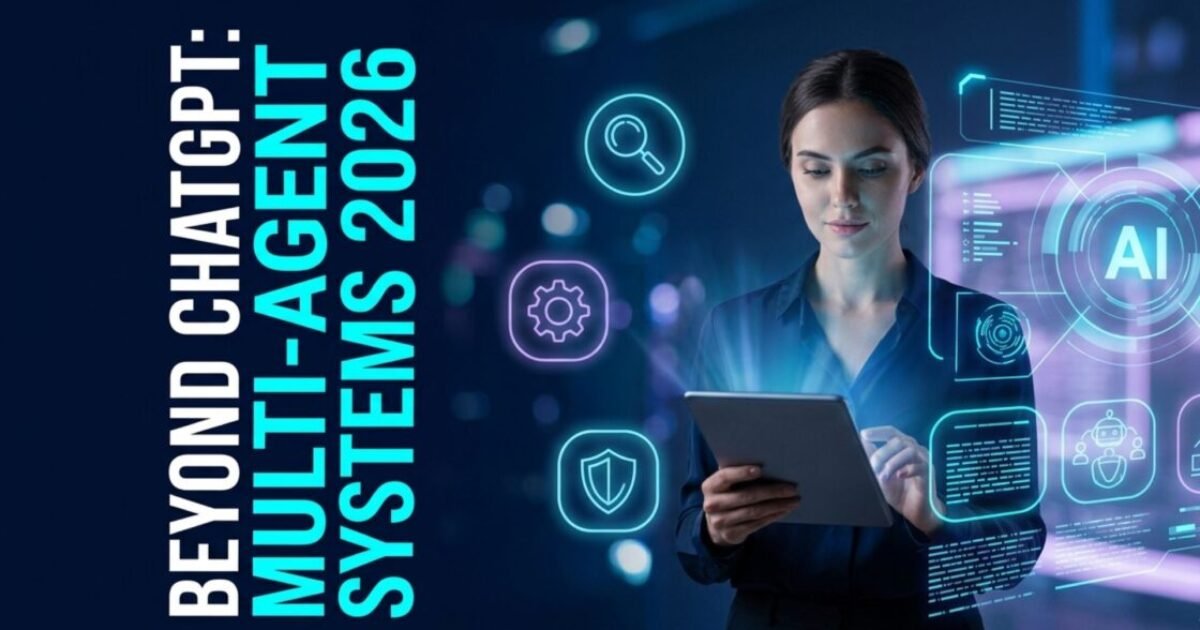
The digital marketing landscape has undergone a seismic shift. We have moved past the era of simple automation into the age of autonomous orchestration. For the modern individual creator, the challenge is no longer about writing a single post; it is about managing a synthetic workforce. Today, the most competitive advantage lies in deploying Multi-Agent Systems 2026—interconnected AI entities that don’t just “chat,” but execute, debate, and optimize entire business functions.
If you are just starting, I recommend checking out our guide on how to optimize your robots.txt to ensure your new AI-driven content is crawled effectively by search engines. This is a critical first step before deploying complex Multi-Agent Systems 2026.
1. The Architectural Evolution of Multi-Agent Systems 2026
Unlike the standalone Large Language Models (LLMs) of 2024, Multi-Agent Systems 2026 rely on a computational design where multiple specialized agents work together to solve problems that exceed the capacity of any single bot. For a deeper look at the underlying logic, the Google Search Central documentation provides excellent context on how modern web standards interact with automated systems.
A single LLM might be prone to hallucinations or limited by its context window. However, when you research a topic, verify facts, and generate content through Multi-Agent Systems 2026, you are essentially building a “Blackboard System”. In this setup, a shared knowledge space holds partial solutions that different agents—such as researchers, writers, and fact-checkers—refine incrementally until a high-quality final product is achieved.
One of the most effective patterns for solo founders is the **Supervisor-Worker** model. The supervisor agent assesses incoming requests, determines which specialists to invoke, and monitors their progress. This ensures that your Multi-Agent Systems 2026 setup remains focused on the primary objective without veering into inefficient feedback loops. This mirrors the precision found in our CSS Gradient Generator tool, where specific inputs yield predictable, high-quality visual results.
2. Specialized Agent Roles for SEO and Growth
To scale a website effectively, you cannot rely on generalist prompts. You must define specific roles within your Multi-Agent Systems 2026 ecosystem. Each agent operates independently, making decisions based on its narrow objective while coordinating with its peers.
The Scout (Trend Extraction)
The Scout agent is designed for real-time data ingestion. It monitors shifting search engine results pages (SERPs) and identifies high-intent topics. In the world of Multi-Agent Systems 2026, the Scout doesn’t just look for keywords; it predicts ranking shifts before they happen by analyzing patterns that traditional tools miss. You can cross-reference these trends with established authorities like Search Engine Journal to validate your AI’s findings.
The Architect (Semantic Structuring)
Once a topic is identified, the Architect agent maps out the content structure. Using stateful orchestration, it ensures the “state” flows through a directed graph—ensuring that every section of the article naturally follows the previous one. This level of precision in Multi-Agent Systems 2026 prevents the repetitive or disjointed paragraphs often found in basic AI-generated text.
The Critic (Governance & Quality Control)
The Critic is perhaps the most important agent in your Multi-Agent Systems 2026 stack. It acts as an internal auditor, critiquing the writer agent’s work to reduce bias and catch hallucinations. By implementing a reflective or “self-critique” structure, the system iterates on the draft until it meets a pre-defined quality threshold. This is why tools like our Blog Planner Template are essential; they provide the human-readable roadmap that the Critic agent uses to judge success.
3. Framework Comparison: Powering Your 2026 Workflow
| Framework | Logic Structure | Best Use Case | Complexity |
|---|---|---|---|
| LangGraph | Directed Cyclic Graphs | Stateful, high-control production | High |
| CrewAI | Role-Based Abstractions | Fast prototyping of “Crews” | Medium |
| Microsoft AutoGen | Conversational Patterns | Dynamic, multi-turn dialogue | Medium |
| Google ADK | Session/Memory Focused | Long-term personalized interactions | Low |
For those requiring absolute control over execution order and error recovery, LangGraph has become the default runtime for Multi-Agent Systems 2026. However, if your goal is to quickly simulate a team of human employees, CrewAI’s focus on “backstories” and “goals” for agents makes it the most intuitive entry point. For the technical documentation on these frameworks, you can visit the GitHub repositories where these open-source projects are maintained.
4. Operational Efficiency and Cost Management
Scaling a synthetic workforce isn’t free. Multi-Agent Systems 2026 can face coordination overhead that scales quadratically—more agents mean more communication paths and higher latency. Furthermore, running five high-end agents concurrently can burn through API tokens at five times the standard rate. To calculate your potential ROI before investing heavily, use a revenue calculator to estimate how much organic traffic growth you need to offset these API costs.
5. Legal Compliance: The EU AI Act 2026
As of August 2, 2026, the **EU AI Act** is fully applicable, bringing strict regulations to autonomous agents. Any Multi-Agent Systems 2026 deployment that utilizes facial recognition, emotion recognition in workplaces, or harmful behavioral manipulation is strictly prohibited. For the full text and compliance checklists, refer to the Official EU AI Act Portal.
Conclusion: The Path Forward
The adoption of Multi-Agent Systems 2026 is no longer a luxury; it is a survival mechanism. Brands that integrate these systems can produce deeply researched, optimized content at ten times the velocity of those relying on manual processes. By building your own agentic council, you ensure that your digital presence remains relevant in a world dominated by AI-driven search and generative answers.