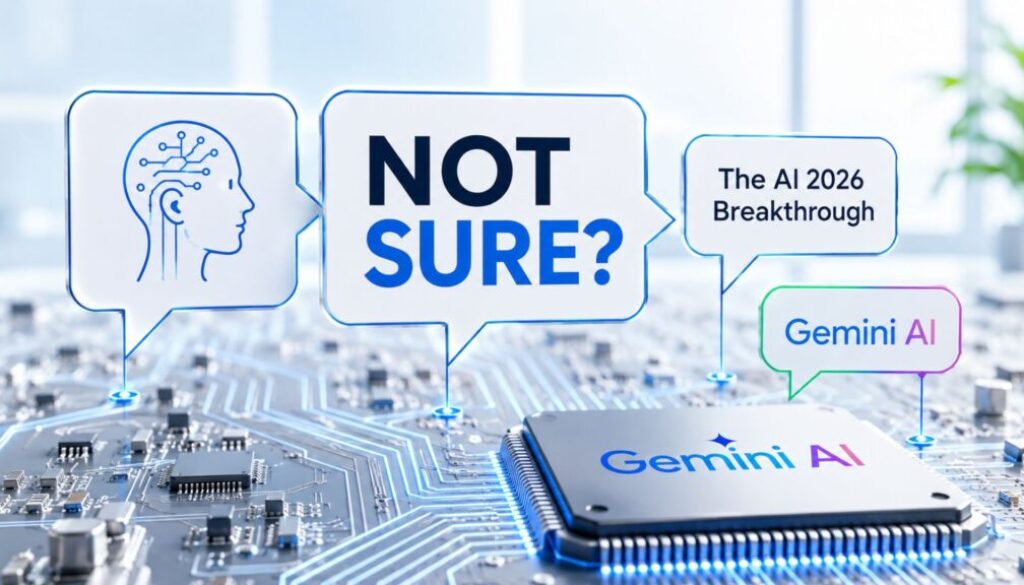
AI Model Says “I’m Not Sure” — The Shocking AI Breakthrough of 2026
The biggest AI breakthrough of 2026 may not be smarter answers — but AI finally admitting uncertainty.
Inside This Analysis
- ✓ AI Transparency Breakthrough: Why AI models are finally admitting uncertainty.
- ✓ Dangerous AI Hallucinations: The internet-wide problem AI companies are trying to solve.
- ✓ Real AI Data: New studies show honesty improves user trust dramatically.
- ✓ Peplio Insight: Why this changes the future of AI-powered search and SEO.
The moment an AI model says I’m not sure, the internet changes.
Seriously.
After years of AI systems confidently generating fake facts, incorrect answers, invented statistics, and completely made-up citations, major AI companies are finally teaching models to admit uncertainty instead of pretending to know everything.
At first, this sounds like a tiny update.
But after researching the latest AI transparency reports, hallucination studies, and AI search behavior trends, I realized this may actually become one of the biggest AI breakthroughs of 2026.
The reason is simple:
When an AI model says I’m not sure, users trust it more.
And honestly, that could solve one of the most dangerous AI problems on the internet today.
1. What Happens When AI model says I’m not sure? More Often in 2026
Most AI systems were never originally designed to admit uncertainty.
Large language models work using probability prediction. Their main goal is to predict the most likely next word based on massive training datasets.
That means older AI systems were optimized to always generate an answer — even when the answer was wrong.
This created the now-famous issue called AI hallucinations.
An AI hallucination happens when a chatbot confidently generates:
- Fake facts
- False statistics
- Imaginary sources
- Incorrect citations
- Completely invented information
According to Stanford University’s AI Index Report, hallucination reduction is now considered one of the biggest technical challenges in modern AI development.
That’s why the phrase AI model says I’m not sure is becoming so important in 2026.
AI companies are finally realizing that honesty may be more valuable than fake confidence.
2. AI Finally Becomes Honest? The Industry Shift Happening Right Now
One of the most shocking AI updates this year is that major AI companies are actively training systems to recognize uncertainty.
Instead of forcing confident answers, newer AI systems are beginning to:
- Express confidence levels
- Reject uncertain prompts
- Warn users about unreliable information
- Ask follow-up questions
- Admit when information is unclear
According to OpenAI’s official research updates, reducing hallucinations and improving factual accuracy has become a major development priority for advanced AI systems.
Google, Anthropic, Meta, and OpenAI are all investing heavily in AI transparency systems.
Honestly, this may be the first time AI companies are prioritizing trust over engagement.
And that changes everything.
3. How “AI model says I’m not sure” Helps Reduce Dangerous Hallucinations
The rise of generative AI created a massive internet trust problem.
People are now using AI for:
- Medical advice
- Legal summaries
- Financial research
- News analysis
- Academic information
But hallucinated AI answers quickly became dangerous.
In multiple real-world incidents, AI chatbots invented legal cases, fake medical studies, and incorrect financial data.
That’s why the phrase AI model says I’m not sure may actually represent one of the safest AI upgrades ever created.
Sometimes refusing to answer is smarter than generating misinformation.
This shift is also changing how search engines and AI assistants build credibility online.
I discussed similar AI search trust issues in my article on GPT-5.5 content humanization, where I explained why human trust signals are becoming essential in AI-generated content ecosystems.
4. What Happens When an AI Model Says “I’m Not Sure”?
Interestingly, users trust AI systems more when they admit uncertainty.
According to research from MIT and Carnegie Mellon University, AI systems that display confidence indicators are perceived as more reliable and trustworthy by users.
That means transparent AI behavior actually improves credibility.
In simple terms:
- Honest AI feels safer
- Transparent AI feels smarter
- Uncertain AI feels more human
This is why the phrase AI model says I’m not sure is becoming one of the biggest AI behavior changes happening in 2026.
Ironically, AI becomes more believable the moment it stops pretending to know everything.
5. Why the AI Model Says “I’m Not Sure” Is a Major Transparency Breakthrough
As someone deeply involved in SEO and AI search ecosystems, I think this shift matters far beyond chatbots.
Search itself is changing.
Google, OpenAI, and other AI companies are rapidly moving toward AI-generated answers instead of traditional blue links.
But here’s the problem:
If AI-generated answers are unreliable, users stop trusting the system.
That’s why this AI transparency breakthrough matters so much.
Companies now understand that long-term AI success depends on credibility, not just intelligence.
This is also why AI systems increasingly show:
- Citations
- Source links
- Confidence warnings
- Research transparency
I recently explored similar AI ecosystem changes in my article about ChatGPT Ads Manager, where I explained how AI platforms are evolving into full-scale internet ecosystems rather than simple chatbots.
6. Comparison Table: Older AI vs Transparent AI Systems
| AI Behavior | Older AI Models | New Transparent AI Models |
|---|---|---|
| Answer Style | Always confident | Confidence-aware responses |
| Hallucination Handling | Invents information | Admits uncertainty |
| User Trust | Lower over time | Higher transparency |
| Search Reliability | Questionable | Fact-aware systems |
7. AI Companies Are Quietly Fighting a Trust War
One thing I’ve personally noticed while tracking AI trends is that AI companies are no longer competing only on intelligence.
Now they are competing on trust.
The next generation of AI systems will likely be judged based on:
- Transparency
- Reliability
- Source quality
- Hallucination control
- Confidence calibration
This is exactly why the phrase AI model says I’m not sure keeps appearing across AI safety discussions in 2026.
Companies understand users are becoming skeptical.
And honestly, they should be.
I explored this changing AI ecosystem in my article on GPT-5.5 Instant, where I explained how AI-generated instant answers are already reshaping search behavior globally.
8. Europe’s AI Regulations Are Accelerating This Change
Another major reason why the AI model says I’m not sure trend is growing comes from regulation.
The European Union is aggressively pushing AI transparency rules through the EU AI Act.
These regulations require AI companies to improve:
- Transparency
- Content disclosure
- User safety
- Misinformation prevention
This means AI companies may soon face legal pressure to admit uncertainty rather than generating misleading information.
That’s why I believe the phrase AI model says I’m not sure could become normal internet behavior within the next few years.
I discussed this regulatory shift in detail in my article on EU AI Act compliance 2026, because these rules are already reshaping the future of AI development globally.
9. Peplio Reality Check: This Changes SEO and Content Forever
As the founder of Peplio, I honestly think this AI transparency breakthrough changes internet content itself.
For years, the internet rewarded:
- Fast answers
- Maximum engagement
- Confident headlines
- High-volume publishing
But now the internet is slowly shifting toward trust-first systems.
That means:
- Verified sources matter more
- Human experience matters more
- Transparency matters more
- EEAT matters more
Ironically, AI may force the internet to become more human again.
10. Final Thoughts on Why AI Model Says “I’m Not Sure” Matters
The rise of transparent AI systems may become one of the most important technology shifts of 2026.
Because honestly, intelligence without honesty becomes dangerous.
The moment an AI model says I’m not sure, it signals something much bigger:
- AI becoming safer
- AI becoming more trustworthy
- AI becoming more transparent
- AI becoming more human-aware
And strangely enough, the smartest thing AI learned this year…
…might simply be admitting uncertainty.
About the Author: Sougan Kumar Mandi is a digital marketing executive and founder of Peplio. He focuses on AI search behavior, SEO systems, and future internet trends shaping the next generation of digital growth.