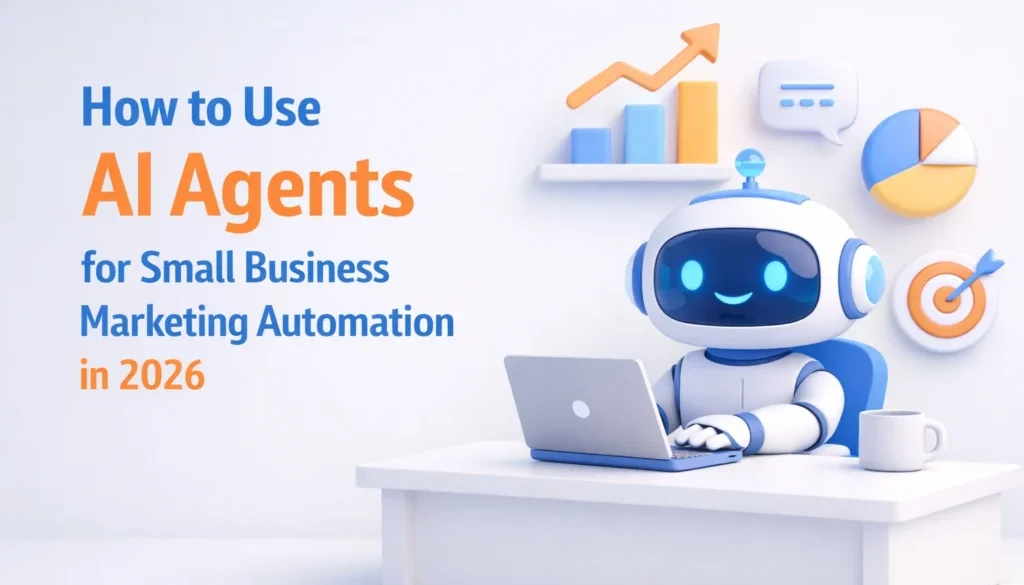
Powerful 2026 Guide: How to Use AI Agents for Small Business Marketing Automation in 2026
I remember sitting with my laptop open, analytics dashboard staring back at me, and honestly… nothing was happening. Traffic was low, leads were inconsistent, and customers? Almost invisible. I was doing everything manually—writing blogs, posting on social media, checking keywords, replying to emails—and still not seeing the kind of growth I expected. That’s when I started digging deep into how to use AI agents for small business marketing automation in 2026, not because it sounded trendy, but because I genuinely needed a system that worked without burning me out every day.
If you’re running a small business in the US—maybe an LLC, maybe a local service, maybe even an online brand—you’ve probably felt this too. Marketing feels like a full-time job on its own. And the truth is, most advice out there is either outdated or too generic. What actually works today is not “more effort,” it’s smarter systems. That’s exactly where understanding how to use AI agents for small business marketing automation in 2026 becomes a real advantage instead of just another buzzword.
What this article will NOT do
This article will not promise instant results, viral growth, or “set it and forget it” automation. It won’t tell you that AI replaces strategy or human thinking. Instead, it will walk you through what actually happens when you try to implement AI agents in real marketing systems—what works, what fails, and how to build something that improves over time instead of collapsing after a few weeks.
Peplio Reality Check
- Expected: AI agents will automatically generate customers
- Happened: Needed structure, testing, and adjustments
- Surprised: Once aligned properly, AI reduced most repetitive work
Why Learning How to Use AI Agents for Small Business Marketing Automation in 2026 Is Critical
Let’s not ignore the obvious—competition in the US market is intense. Whether you’re running a bakery in Texas, a plumbing service in Florida, or an online coaching business, your competitors are already investing in smarter marketing systems. Customers today don’t just search—they compare, evaluate, and decide quickly. If your business doesn’t show up at the right time with the right message, you’re simply not part of the decision.
This is exactly why understanding how to use AI agents for small business marketing automation in 2026 matters so much. AI agents are not just tools—they act like assistants that can analyze data, automate actions, and improve decisions over time. Platforms like :contentReference[oaicite:0]{index=0} and :contentReference[oaicite:1]{index=1} are already integrating these capabilities into everyday marketing workflows, making it easier for small business owners to compete without needing a full team.
But here’s the catch—tools alone don’t create results. Systems do. And that’s where most people fail.
The Biggest Mistake Most Small Business Owners Make with AI
When I first started exploring how to use AI agents for small business marketing automation in 2026, I made the same mistake most people make—I tried to automate tasks instead of building a system. I automated content creation, scheduled posts, and even set up email campaigns. Everything looked efficient on the surface, but the results were still inconsistent. Traffic came and went, leads were random, and conversions were unpredictable.
That’s when I realized something important: marketing is not about tasks—it’s about flow. If your customer journey is broken, no amount of automation will fix it. AI agents amplify what already exists. If the system is weak, they scale weakness. If the system is strong, they scale growth.
Decision Breakdown: What Others Say vs What Actually Worked
Most guides say: “Use AI to generate more content.” I tried that approach, and yes, it increased output. But output is not the same as results. More blogs didn’t mean more customers. It just meant more pages sitting online without impact.
So I changed the approach. Instead of asking “how much content can I produce,” I started asking “what content actually brings customers?” That shift changed everything. I focused on intent, not volume. I built content around real problems people were searching for, and that’s when things started to move.
This approach connects closely with what I explored in
how to build micro tools website traffic, where I realized that utility-based content often outperforms generic blogging when it comes to attracting serious users.
How to Use AI Agents for Small Business Marketing Automation in 2026 (Step-by-Step System)
Step 1: Build a Clear Customer Journey
Before using any AI agent, you need to define your customer journey. This is the backbone of everything. Without this, automation becomes random. A typical US small business flow looks like this: discovery → interest → trust → conversion → retention. AI agents plug into this flow, but they don’t replace it.
For example, instead of just trying to “get traffic,” think in terms of how US small businesses get customers online. They rank on search engines, capture leads, nurture trust through emails or content, and convert through offers. AI agents simply make each of these steps faster and smarter.
Step 2: Use AI Agents for SEO and Content Optimization
SEO is still one of the strongest long-term strategies, especially for US-based businesses. But SEO in 2026 is no longer about stuffing keywords—it’s about understanding intent and delivering value. AI agents can analyze search trends, optimize content, and even suggest updates based on performance.
When I applied this while working on
Google AI Overview Traffic, I noticed that AI helped structure content better, but the real improvement came when I aligned it with actual user behavior and search intent.
External insights from Forbes also highlight that AI-driven SEO is becoming a standard for small businesses trying to stay competitive.
Step 3: Automate Lead Capture with AI Agents
Getting traffic is one thing—converting it into leads is another. Many small businesses lose potential customers simply because they don’t capture information effectively. AI agents can track user behavior and trigger personalized lead capture forms, offers, or popups.
For example, platforms connected with :contentReference[oaicite:2]{index=2} allow businesses to score leads based on behavior, making follow-ups more targeted and effective.
Step 4: Use AI Agents for Email Marketing Automation
Email marketing remains one of the highest ROI channels in the US. But consistency is the challenge. AI agents can write, schedule, and personalize emails based on user actions. Instead of sending the same message to everyone, your system adapts automatically.
This aligns with insights shared by Statista, showing that personalized email campaigns driven by AI significantly improve engagement rates.
Step 5: Social Media Automation with Intelligence
Social media is no longer about posting daily—it’s about posting strategically. AI agents can analyze when your audience is active, what type of content performs best, and how users engage. This removes guesswork and improves consistency.
Instead of forcing daily content, you focus on impactful content at the right time. That alone changes engagement patterns significantly.
Step 6: Local SEO Optimization for US Businesses
If your business depends on local customers, AI agents can help optimize your presence on platforms like Google Business and review platforms. Managing reviews, updating information, and improving visibility becomes much easier with automation.
This becomes especially important for state-wise businesses trying to rank in competitive local markets across the US.
🧪 Peplio Experiment #1
Goal: Increase organic traffic
Action: AI-based SEO optimization
Result: Slow improvement
Next Change: Focused on intent-driven content
🧪 Peplio Experiment #2
Goal: Improve lead generation
Action: Automated lead capture
Result: Noticeable increase in leads
Next Change: Added personalization
🧪 Peplio Experiment #3
Goal: Improve engagement
Action: AI-driven scheduling
Result: Better engagement but inconsistent
Next Change: Improved content quality
If you’re a solo blogger with no audience, no money, and only a laptop…
Then you’re actually in a strong position. You don’t have complexity slowing you down. You can test faster, adapt quicker, and build systems gradually. Start with one part of your marketing—maybe SEO, maybe email—and automate it properly. Then expand step by step.
Questions I struggled with while building Peplio
Do AI agents replace human work?
No. They reduce repetitive tasks but still need direction.
Is this expensive?
Most tools are affordable for small businesses now.
How long before results?
Usually 30–90 days depending on execution.
Conclusion: What I’m Testing Next
Right now, I’m testing a combined system where AI agents, SEO, and micro tools work together as one ecosystem. The idea is simple—create a flow where traffic, leads, and conversions are connected instead of isolated. It’s not perfect yet, but it’s improving with every test.
If you take one action after reading this, let it be this: don’t try to automate everything at once. Pick one part of your system, apply AI agents properly, and test results. That’s how real growth happens.
Because in 2026, the businesses that win are not the ones doing more work—they’re the ones building smarter systems.