How AI Is Bad for the Environment in 2026: The Shocking Hidden Cost I Discovered
Table of Contents
- Direct Answer: How AI Is Bad for the Environment
- Peplio Reality Check
- Where This Thought Actually Started
- How AI Is Bad for the Environment (What I Realized)
- The Part We Never See
- The Illusion of Free AI
- Decision I Took While Building Peplio
- If You’re a Solo Blogger with No Audience, No Money, and Only a Laptop
- Another Thing I Noticed
- External Awareness That Changed My View
- Peplio Experiment Insights
- What This Article Will NOT Do
- Where I Stand Now
- What I’m Testing Next
- Final Thought
I still remember that phase very clearly. Late nights, laptop open, multiple tabs running, and AI quietly doing most of my work. Writing content, generating ideas, creating images, structuring strategies. Everything felt smooth, fast, and honestly, a little addictive.
I was using AI daily without thinking much about how AI is bad for the environment. It felt efficient, fast, and clean… At that time, I never questioned how ai is bad for the environment because everything felt fast, clean, and efficient from the surface.
I genuinely believed I was working in the most efficient way possible. It felt clean, digital, and almost harmless. But slowly, something started to feel off. Not a big realization, just small doubts that kept coming back.
How AI Is Bad for the Environment (What I Realized)
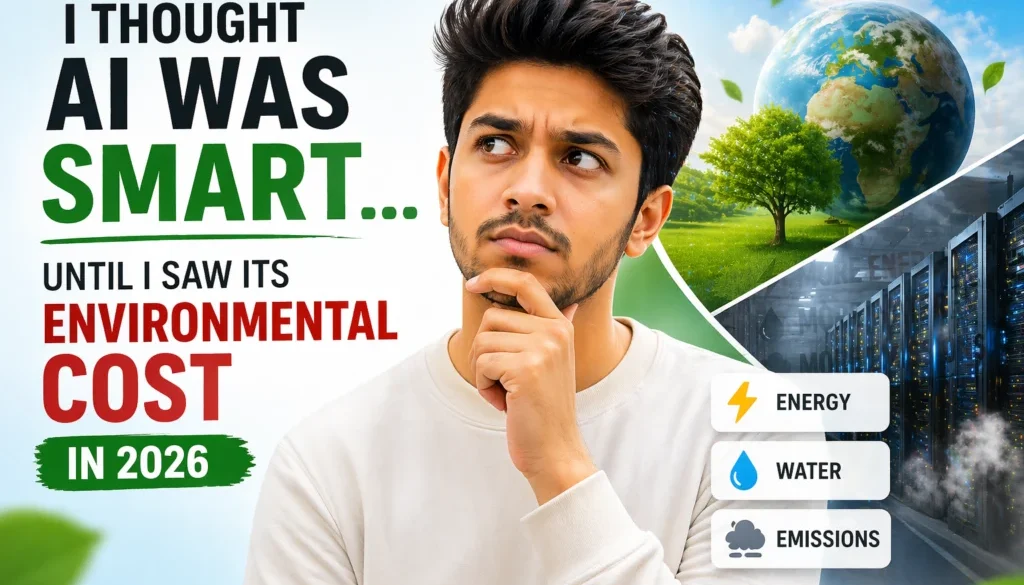
AI is not “bad” by itself, but understanding how AI is bad for the environment comes from the fact that it depends on large data centers that consume significant electricity, require powerful hardware, and run continuously.
Peplio Reality Check
Expected: AI makes work faster and cleaner, so it should be resource-efficient. Happened: Every AI task depends on heavy infrastructure running behind the scenes. Surprised: Even small actions like writing a prompt are not truly “free” for the environment.
Where This Thought Actually Started
While building Peplio, I was using AI everywhere. Blog drafts, SEO planning, image generation, even structuring my ideas. At one point, I noticed something strange. I wasn’t thinking deeply anymore. I was just prompting and accepting outputs. One day, while exploring topics around tech, I came across discussions about AI infrastructure. At first, I ignored it. It sounded like one of those technical debates that don’t really affect daily work. But curiosity pushed me to look a little deeper.
The Part We Never See
When I use AI, everything looks simple. There is no machine in front of us, no noise, no visible pollution. Just a clean interface. But behind that clean interface, there is a massive system running continuously. Large companies like OpenAI and Google operate huge data centers to support AI tools. These data centers run 24 hours a day, processing millions of requests at the same time. These systems use high-performance hardware, consume electricity, and require cooling systems to manage heat. None of this is visible when we type a prompt, but it is always happening in the background. This is exactly where people miss how AI is bad for the environment, because the entire impact stays hidden behind clean interfaces.
My First Shift in Thinking
I used to believe something very simple. If something is digital, it must be clean. That belief slowly broke. Digital does not mean zero cost. It just means the cost is hidden somewhere else. And in the case of AI, that hidden layer is infrastructure. Electricity does not come from nowhere. Servers do not run without energy. Cooling systems do not work without resources. The impact is indirect, but it exists.
Peplio Experiment #1
Goal: Understand how dependent I was on AI. Action: I reduced AI usage for a few days and worked manually. Result: Work became slower, but my thinking became clearer. Next Change: Use AI only when necessary, not automatically.
The Illusion of Free AI
One of my biggest mistakes was thinking that AI is free or cheap, so using it more does not matter. But every AI interaction requires processing power, electricity, and server support. The cost is not visible to the user, but it exists on the backend. This realization did not make me stop using AI, but it made me more aware. I started questioning how often I was using it and whether every usage was actually necessary.
Decision I Took While Building Peplio
Most advice online says to use AI as much as possible to grow faster. That works in many cases, but I did not follow it blindly. I made a small but important shift in my workflow. I started using AI for structuring ideas, but I wrote the main content myself. I used AI for refinement, not dependency. This helped me stay efficient while keeping my thinking active. While working on articles like how to build a micro tools website for traffic, I noticed that human input made the content more real compared to fully AI-generated drafts.
If You’re a Solo Blogger with No Audience, No Money, and Only a Laptop…
You will feel that AI is your biggest advantage. And honestly, it is. AI helped me a lot when I started building things alone. But there is a difference between using a tool and depending on it completely. That difference is small at the beginning, but it grows over time. And most people do not notice when that shift happens.
Another Thing I Noticed
When I used AI heavily, my thinking started becoming lazy. Content felt similar. Ideas did not feel personal anymore. Everything started sounding correct but not real. When I reduced AI usage, the opposite happened. Ideas became sharper, content felt more natural, and the connection improved. This was not theory. This was my own experience. Even while testing tools like free AI image generators without login, I noticed that using AI smartly gave better results than using it excessively.
External Awareness That Changed My View
I explored discussions on platforms like the International Energy Agency and research publications like Nature. I was not looking for exact numbers, but I wanted to understand the direction. One thing became clear. As digital systems grow, energy demand grows with them. AI is part of that system, and its usage is increasing rapidly.
Peplio Experiment #2
Goal: Reduce unnecessary AI usage. Action: Planned tasks before using AI instead of prompting randomly. Result: Fewer prompts, better clarity, and more control. Next Change: Use AI intentionally, not habitually.
What This Article Will NOT Do
This article will not tell you to stop using AI. It will not create unnecessary fear. It will not use fake data or exaggerated claims. This is simply my real experience while building Peplio.
Where I Stand Now
Right now, I am not against AI. I still use it every day. But my approach has changed. I do not use it blindly anymore. I use it with intention. While working on topics like Google AI Overview traffic, I realized that understanding systems deeply matters more than just using them.
What I’m Testing Next
I am currently experimenting with a minimal AI workflow. More human writing, selective automation, and clearer intent before using any tool. Not because AI is bad, but because balance is important.
Final Thought
AI is powerful, and I, Sougan, have benefited from it a lot while building Peplio. But when I looked beyond the surface, I realized something important. After everything I experienced, I can clearly say that understanding how AI is bad for the environment changed how I use it daily. Every convenience has a cost. Sometimes that cost is visible, and sometimes it is hidden. In the case of AI, it is mostly hidden. If you are building something like I am, just remember one thing. Use AI wisely, not blindly. — Sougan