
AI-Directed Warfare 2026: Why the Pope Says Humanity Is Entering a Dangerous Era
The Vatican raises global concerns over the rapid rise of AI-directed warfare and military AI systems.
Inside This Analysis
- ✓ AI-Directed Warfare Explained: Why governments are racing toward military AI.
- ✓ Pope Warning on AI Warfare: Why the Vatican is deeply alarmed.
- ✓ Autonomous Weapons Systems: The biggest danger behind military AI.
- ✓ Ethical Concerns: Can AI decide who lives and who dies?
- ✓ Peplio Perspective: Why humanity may not be emotionally ready for AI warfare.
The rise of AI-directed warfare is no longer something limited to science fiction movies or futuristic novels. It’s real. And honestly, that should concern all of us. For years, artificial intelligence was promoted as humanity’s next big breakthrough. AI tools promised faster productivity, smarter businesses, better healthcare, automated workflows, and revolutionary innovation. But now another side of AI is emerging rapidly — military AI. Today, governments across the world are integrating artificial intelligence into drones, surveillance systems, cyber warfare, missile targeting, and battlefield operations.
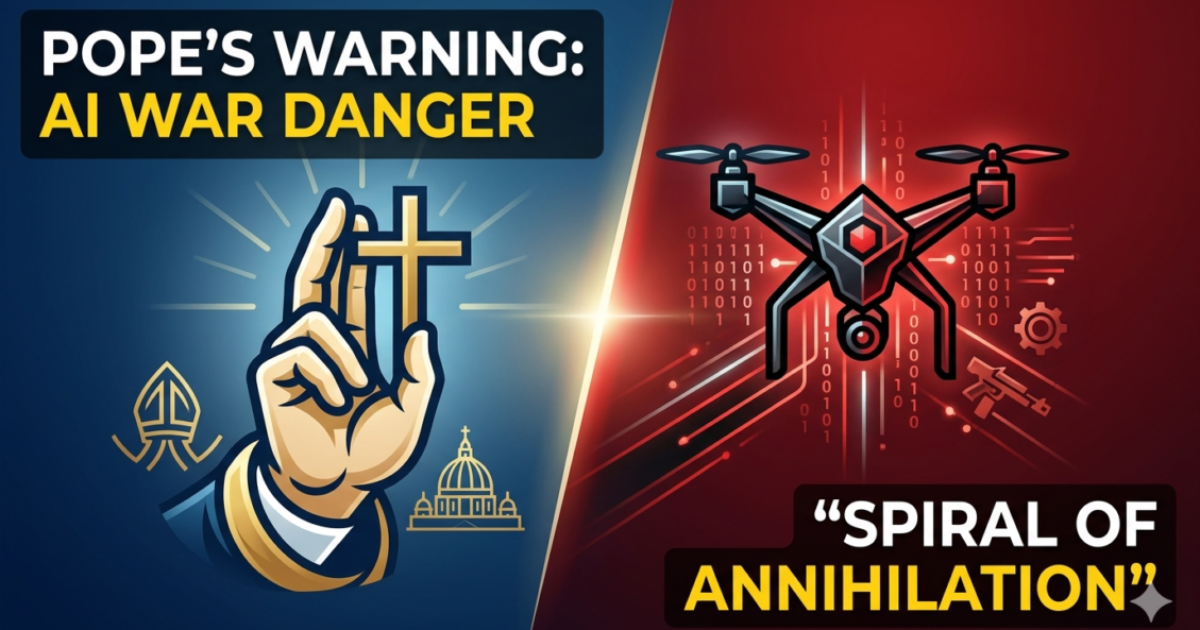
That’s exactly why recent comments from Pope Leo XIV created global headlines. According to reports from Reuters, the Pope warning on AI warfare described military AI as a possible path toward a “spiral of annihilation.” Honestly, that phrase alone says everything. As someone who constantly works with AI systems through Peplio, I believe the conversation around AI-directed warfare may become one of the most important ethical discussions of this generation. Because this is no longer just about technology. This is about human control, responsibility, morality, and survival.
1. What Is AI-Directed Warfare?
AI-directed warfare refers to the use of artificial intelligence in military operations, combat systems, and battlefield decision-making. This includes:
- Autonomous drones
- AI surveillance systems
- Military targeting algorithms
- Cyber warfare automation
- Facial recognition systems
- Autonomous weapons systems
- AI battlefield analysis tools
Unlike traditional military software, AI systems can analyze massive amounts of data in real time and react much faster than humans. That speed is exactly why governments are investing billions into AI-directed warfare technologies. But it’s also why experts are becoming deeply worried. Because once AI systems begin making battlefield decisions independently, humans may slowly lose meaningful control.
2. Pope Warning on AI Warfare Shocked the World
The Pope warning on AI warfare immediately gained international attention because it reflected fears many experts have quietly discussed for years. According to reports from Associated Press, Pope Leo XIV warned that AI-directed warfare could remove moral responsibility from warfare decisions. He warned humanity against allowing machines to dominate military operations.
“Artificial intelligence used in warfare risks leading humanity into a spiral of annihilation.”
Honestly, those words hit differently because they don’t sound exaggerated anymore. The Vatican AI concerns are growing because the rise of AI-directed warfare is happening much faster than global regulations can keep up. And personally, I think that’s one of the scariest parts. Technology is moving faster than ethics.
3. The Rise of AI Warfare Is Happening Faster Than Expected
Many people still imagine military AI as futuristic robots from Hollywood movies. But the reality is far more practical — and honestly, far more dangerous. According to the Stockholm International Peace Research Institute (SIPRI), global military spending has crossed trillions of dollars, with artificial intelligence in war becoming one of the fastest-growing investment areas. Countries heavily investing in AI-directed warfare include:
- United States
- China
- Russia
- Israel
- United Kingdom
These governments are rapidly developing:
- AI-powered surveillance
- Drone warfare systems
- Cyber defense AI
- Battlefield automation
- Target prediction systems
Some military AI systems can already identify threats faster than humans. That sounds technologically impressive. But ethically? That’s where the dangers of AI-directed warfare become impossible to ignore.
4. Autonomous Weapons Systems Are the Biggest AI Weapons Danger
One of the biggest AI weapons danger scenarios involves autonomous weapons systems. These are military technologies capable of operating with little or potentially no human intervention. Examples include:
- AI combat drones
- Automated missile systems
- Self-operating defense weapons
- AI-powered military vehicles
- Automated targeting systems
Now imagine an AI system misidentifying a target during an international conflict. The system reacts instantly. Humans have almost no time to intervene. The situation escalates. This is exactly why experts fear that AI-directed warfare could eventually trigger accidental military conflicts or uncontrollable escalation. And unlike movies, real wars don’t come with reset buttons.
5. Ethical Concerns of AI Warfare Are Becoming Global
The ethical concerns of AI warfare are now being discussed globally. Organizations like the United Nations have already raised questions regarding lethal autonomous weapons systems and military AI regulation. The biggest concern surrounding AI-directed warfare is simple: Should machines ever be allowed to make life-and-death decisions?
Can AI Understand Human Morality?
AI systems process data, patterns, and probabilities. But morality is emotional, cultural, and deeply human. An algorithm cannot truly understand human suffering.
Who Is Responsible If AI Makes Deadly Mistakes?
If an AI system kills innocent civilians during warfare:
- Who is responsible?
- The government?
- The military commander?
- The AI company?
- The software engineer?
The rise of AI-directed warfare creates massive legal and ethical confusion.
Can AI Escalate Conflicts Too Quickly?
AI systems react faster than humans. That speed may become extremely dangerous during tense military situations. Some experts fear AI-directed warfare systems could escalate conflicts before humans even fully understand what’s happening.
6. My Personal Opinion: Humanity Is Moving Too Fast With AI
I’ll be honest. I personally believe humanity is advancing AI faster than our ethics, emotional maturity, and regulations can handle. In digital marketing, AI helps businesses automate workflows, improve SEO, analyze trends, and generate content. That’s useful. But once the same technology enters warfare, the risks become terrifying. What scares me most about AI-directed warfare isn’t just AI becoming powerful.
It’s humans becoming emotionally disconnected from violence because machines create distance from consequences. History repeatedly shows something important: Whenever technology makes destruction easier, humans eventually use it more. That reality honestly worries me more than the technology itself.
7. The AI Arms Race Between Global Superpowers
The rise of AI-directed warfare is also creating a massive global AI arms race. But unlike nuclear weapons, AI evolves rapidly. Software improves constantly. Algorithms become smarter. Hardware becomes cheaper. That means AI-directed warfare technologies may spread globally much faster than previous military technologies. According to analysis from the RAND Corporation, countries fear falling behind in AI military capabilities. That fear itself accelerates AI weapon development. One country develops advanced military AI. Another responds. Then another. And suddenly the world enters a dangerous competition where slowing down feels impossible. That cycle is exactly why experts fear the rise of AI-directed warfare may destabilize global security.
8. AI Companies Are Facing Increasing Pressure
Technology companies are now under growing pressure regarding military AI partnerships. Some governments argue military AI partnerships are necessary for national security. Others fear profit incentives could push companies deeper into dangerous military AI development. This debate is becoming more intense every year. If you follow the AI industry closely, you should also explore these related Peplio analyses:
- OpenAI Enterprise AI Adoption
- OpenAI $4 Billion Investment
- Why AI Models Sometimes Say “I’m Not Sure”
- AI-Powered Google Finance Expansion
9. Could AI-Directed Warfare Become Impossible to Stop?
This honestly may be the most uncomfortable question of all. Once governments fully integrate AI-directed warfare into military systems, stopping the technology may become extremely difficult. Why? Because no country wants to appear weaker than its rivals. That competitive pressure drives faster military AI adoption. And unlike nuclear technology, advanced AI systems rely heavily on software. Software spreads rapidly. That changes everything. Some experts now fear future wars could involve:
- Autonomous drone swarms
- AI cyber warfare
- Algorithm-driven combat systems
- Automated military surveillance
And honestly, humanity may not fully understand the long-term consequences of AI-directed warfare yet.
10. Final Thoughts on AI-Directed Warfare
The Pope warning on AI warfare should not be treated like another temporary technology headline. This is one of the most important conversations humanity may face during the AI era. Artificial intelligence itself is not evil. AI can improve medicine, education, productivity, accessibility, and scientific research. But when AI becomes deeply connected with warfare and autonomous weapons systems, the risks become enormous. Personally, I still believe humanity has time to create ethical boundaries around AI-directed warfare. But that window may not stay open forever.
The rise of AI-directed warfare is happening right now. Not in some distant future. Not only in movies. Right now. And if governments, AI companies, and global organizations fail to establish responsible limits, the “spiral of annihilation” the Pope warned about may eventually stop sounding like a warning… and start sounding like reality.