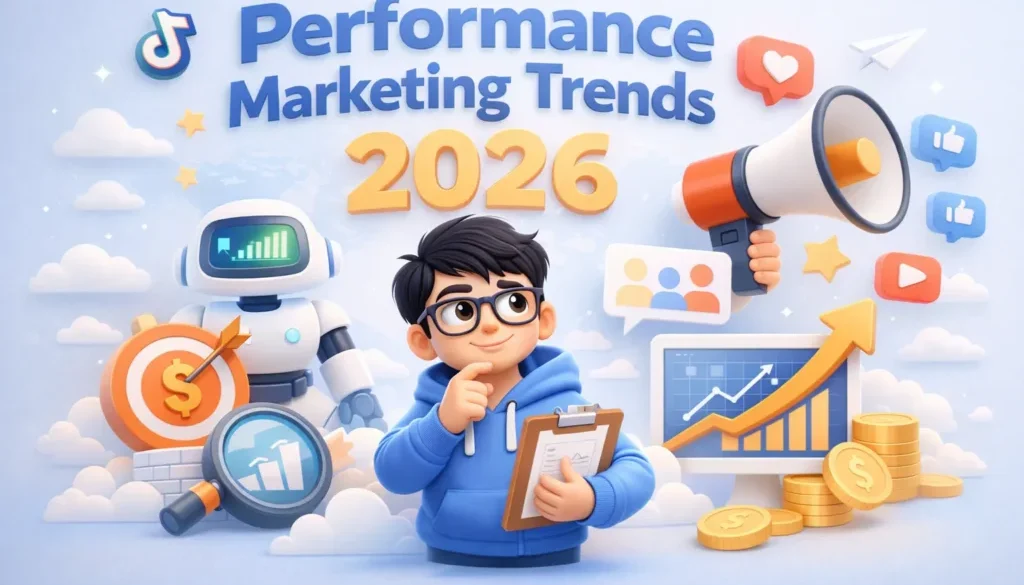
6 Performance Marketing Trends That Will Dominate 2026
While building Peplio and observing marketing ecosystems, I started noticing several performance marketing trends 2026 that could reshape how businesses acquire customers online.
The first time I seriously tried to understand performance marketing, I thought I was late.
Everyone on the internet looked like they already knew the system.
You open YouTube… someone claims they scaled a campaign to ₹50 lakh revenue.
You open LinkedIn… another person says their ROAS is 12x.
You read marketing blogs… everything sounds perfectly structured.
Funnels.
Retargeting.
Lookalike audiences.
It all looked clean.
So I did what most beginners do.
I started studying strategies instead of watching reality.
Then something funny happened while working on Peplio.
None of those clean theories behaved the way they were supposed to.
Traffic didn’t follow funnels.
Visitors didn’t behave logically.
Some posts got random clicks while other carefully optimized pages stayed invisible.
I remember one evening sitting with my laptop in Durgapur, staring at analytics thinking:
“Either I don’t understand performance marketing…
or the industry itself is changing.”
Slowly, after months of watching patterns, I realized something important.
Performance marketing is quietly transforming.
Not because marketers suddenly became smarter.
But because platforms, algorithms, privacy rules, and attention behavior are evolving at the same time.
And when those four forces move together, the entire system shifts.
So this article is not based on industry predictions.
It’s based on something else.
Patterns I’m noticing while building Peplio and studying digital ecosystems.
Six of those patterns look strong enough that they may define performance marketing in 2026.
What this article will NOT do
Before we start, let’s remove a few expectations.
This article will NOT:
-
Give secret Facebook Ads hacks
-
Promise instant ROI strategies
-
Pretend performance marketing is easy
-
Recommend expensive ad tools
-
Teach “growth hacks”
Because honestly…
The biggest marketing changes today are structural, not tactical.
Meaning the entire system is shifting — not just a few ad settings.
Peplio Reality Check
Expected
Performance marketing would be predictable if you follow the right strategy.
Happened
Even well-structured campaigns can behave unpredictably.
Surprised me
Sometimes creativity and distribution matter more than optimization.
6 Performance Marketing Trend 2026
Trend 1
One of the most important performance marketing trends 2026 is the shift toward algorithm-driven campaign optimization. A few years ago marketers controlled everything.
Campaign managers adjusted:
-
audience targeting
-
bidding strategies
-
placements
-
budget allocation
The marketer was basically the pilot.
But something subtle started happening across advertising platforms.
Controls began disappearing.
Manual targeting options started shrinking.
Platforms began recommending automation campaigns.
At first it looked like a convenience feature.
But after observing multiple platforms, I started seeing the real pattern.
Platforms are slowly shifting the responsibility of campaign optimization away from humans and toward algorithms.
This makes sense when you think about it.
Advertising platforms have access to:
-
billions of user behavior signals
-
device usage data
-
browsing history patterns
-
purchase probability models
-
engagement signals
No human marketer can process that level of complexity manually.
So the system is evolving toward something new.
Instead of marketers controlling delivery, we control inputs.
Those inputs include:
-
creative assets
-
messaging
-
conversion signals
-
landing page experience
The algorithm handles distribution.
At first this feels uncomfortable.
Because marketers like control.
But once you accept this shift, something interesting happens.
The skillset of performance marketing starts changing.
The Old Skillset
Performance marketing used to reward people who understood:
-
campaign structure
-
targeting tricks
-
bidding strategies
-
pixel tracking
But the new environment rewards something different.
The New Skillset
The future performance marketer focuses on:
-
creative psychology
-
audience insights
-
conversion experience
-
experimentation speed
In other words…
Less engineering.
More behavioral understanding.
Peplio Experiment #1
Goal
Understand whether campaign performance is more sensitive to targeting or creative.
Action
I compared campaigns where targeting remained broad but creative changed frequently.
Result
Creative variation affected engagement far more than audience changes.
Next Change
Focus more on creative experimentation instead of audience micromanagement.
Trend 2
Performance Marketing Is Becoming a Content Game
This realization took me a while.
Because traditionally we separate two worlds.
Content marketing
Performance marketing
One focuses on storytelling.
The other focuses on conversion.
But those worlds are slowly merging.
Think about how people behave online today.
When someone scrolls Instagram or YouTube, they are not looking for ads.
They are looking for interesting content.
If something feels like advertising, the reaction is immediate.
Skip.
Ignore.
Scroll.
So the only way ads can survive inside modern feeds is by behaving like content.
That’s why the best performing campaigns often look like:
-
short storytelling videos
-
product experiences
-
relatable problems
-
creator style content
Not traditional advertisements.
This is why many brands now operate like media companies.
They produce large volumes of content and then distribute the best performing pieces using performance campaigns.
Which leads to a strange reality.
The best performance marketing teams today are not just marketers.
They are content producers.
The Content Volume Advantage
A pattern I keep noticing across successful campaigns is volume.
Not budget.
Volume of creative ideas.
Instead of designing one perfect ad, successful teams test:
-
20 variations
-
different hooks
-
different storytelling angles
-
different emotional triggers
Most of them fail.
But the few that work produce disproportionate results.
Peplio Experiment #2
Goal
Understand how storytelling affects engagement.
Action
Compare purely informational posts with narrative-driven content.
Result
Story-based content held attention longer.
Next Change
Integrate storytelling formats more frequently inside Peplio articles and comics.
The Attention Economy Reality
The internet is no longer limited by information.
Information is everywhere.
What’s scarce now is attention.
Performance marketing in 2026 will likely revolve around a simple question:
“Can your content stop the scroll?”
Because if it cannot…
The best targeting in the world won’t save it.
The Creative Bottleneck
Interestingly, many companies struggle with this shift.
Because producing high-quality creative consistently is difficult.
It requires:
-
ideas
-
experimentation
-
understanding culture
-
understanding audience psychology
Which is why creators are starting to dominate certain marketing spaces.
Creators already know how to capture attention.
Brands are still learning.
Trend 3
Creators Are Becoming Performance Channels
At first I thought creators were mainly useful for brand awareness.
Big brands pay influencers.
Influencers post a photo.
Audience sees the brand.
End of story.
That’s how influencer marketing used to work.
But something has quietly changed. Among the emerging performance marketing trends 2026, the rise of creators as performance channels may become one of the most disruptive shifts. Creators are no longer just awareness channels. They are becoming performance channels And the shift is subtle but powerful.
The trust gap
Think about your own behavior online.
When you see an advertisement, your brain immediately activates skepticism.
“Okay… they want to sell me something.”
But when a creator you follow recommends something, the reaction is different.
You’re more curious.
Not because the product suddenly became better.
But because the trust layer already exists.
This trust layer is incredibly powerful for performance marketing.
The scale paradox
Large influencers often have huge audiences but lower engagement.
Smaller creators usually have:
-
tighter communities
-
stronger conversations
-
higher credibility
Which leads to an interesting discovery.
Many brands now work with hundreds of smaller creators instead of one large influencer.
The combined effect creates a distributed marketing engine.
And because each creator communicates in their own voice, the promotions feel more natural.
A pattern I noticed
While researching creator ecosystems, I noticed something unusual.
When multiple creators talk about the same product independently, the audience starts seeing a pattern.
The product feels everywhere.
Even if the brand didn’t run massive ad campaigns.
This effect is similar to paid advertising reach.
But instead of algorithm distribution, it happens through creator networks.
Peplio Experiment #3
Goal
Understand whether creator distribution can drive attention without paid ads.
Action
Observe how niche creators introduce digital tools to their audiences.
Result
Tools often spread through recommendation chains.
Next Change
Experiment with creator collaborations for Peplio tools in the future.
Why this trend matters for 2026
Advertising platforms are becoming crowded.
Ad costs increase every year.
But creator ecosystems are still expanding.
Which means many businesses will start treating creators not as influencers, but as performance partners.
The metric will no longer be likes or views.
It will be conversions.
Trend 4
Community Distribution Is Becoming a Hidden Growth Engine
When I started analyzing marketing systems, I assumed traffic mostly comes from three places.
Search.
Social media.
Paid ads.
But there’s another channel that rarely appears in analytics dashboards.
Communities.
Private digital communities are quietly shaping how information spreads online.
These communities include:
-
Discord servers
-
Telegram groups
-
WhatsApp groups
-
private forums
-
niche creator communities
What makes these environments special is context.
People inside communities already share a common interest.
Which changes how recommendations work.
The difference between exposure and recommendation
When someone sees an ad on social media, they experience exposure.
But when a product appears inside a community discussion, it becomes a recommendation.
That subtle difference dramatically changes behavior.
People trust recommendations more than advertisements.
The conversation effect
Another interesting observation about communities is conversation.
Unlike social media feeds where content quickly disappears, communities often have active discussions.
People ask questions.
Others share experiences.
Opinions evolve collectively.
When a product enters that conversation, it gains something valuable.
Contextual credibility.
Why communities matter for performance marketing
Performance marketing traditionally focuses on measurable clicks and conversions.
But communities influence something earlier in the funnel.
They shape perception.
By the time a person encounters a product through ads or search, their opinion may already be partially formed through community conversations.
Which means communities indirectly influence performance outcomes.
Peplio Experiment #4
Goal
Observe how tools or resources spread through niche communities.
Action
Track discussions in marketing and creator groups.
Result
Recommendations often travel through conversations rather than advertisements.
Next Change
Explore ways Peplio tools can be shared organically in communities.
The community advantage
Communities create something marketers struggle to manufacture.
Authenticity.
Inside communities, people usually speak honestly.
They share real experiences.
Positive and negative.
When a product receives genuine recommendations in that environment, the credibility is significantly stronger than traditional marketing.
A future possibility
In the coming years, I suspect performance marketers will begin treating communities as strategic distribution channels.
Not by spamming links.
But by participating genuinely.
Providing value.
Helping people solve problems.
When that happens, recommendations emerge naturally.
Trend 5
Short-Form Attention Is Reshaping Performance Marketing
One evening while scrolling through my phone, something strange happened.
I opened YouTube to watch a long marketing video.
Instead, I watched 15 short videos in a row.
Each one lasted maybe 20 seconds.
After that, I realized something uncomfortable.
My brain had completely switched modes.
Instead of learning slowly, it wanted quick bursts of information.
And if something didn’t become interesting in the first few seconds, I skipped it instantly.
That’s when I started noticing the same pattern everywhere.
People are no longer consuming content the way they used to.
They consume micro-content.
Small bursts.
Fast ideas.
Quick stories.
And that behavior change is slowly reshaping performance marketing.
The first-second battle
Traditional marketing focused on headlines.
But modern digital content faces a different challenge.
The first second.
Not the first paragraph.
Not the first line.
The first second.
Because when someone scrolls a feed, they decide almost instantly whether to stop. Another important part of performance marketing trends 2026 is the dominance of short-form video content, which captures user attention faster than traditional advertising formats. Research about video marketing behaviour can be seen here:
Which means performance marketing creatives now have to win the scroll battle.
Why short-form content performs differently
Short-form content works differently from traditional ads.
It focuses on:
-
curiosity
-
quick storytelling
-
relatable problems
-
emotional hooks
Instead of polished advertising.
Interestingly, many of the best performing pieces don’t even look like marketing.
They look like entertainment.
Which means brands are slowly shifting toward something unusual.
They are becoming content studios.
A shift in campaign thinking
Traditional campaigns often begin with questions like:
“Who is our target audience?”
“Which platform should we advertise on?”
But short-form content changes the starting point.
Now the first question becomes:
“What story will make someone stop scrolling?”
Only after that comes targeting and distribution.
Peplio Experiment #5
Goal
Understand whether storytelling hooks improve attention.
Action
Study how short storytelling formats hold viewer interest compared to informational formats.
Result
Narrative-style content tends to keep attention longer.
Next Change
Experiment with storytelling formats inside Peplio comic-based articles.
The interesting side effect
Short-form content has another unexpected advantage.
It produces rapid feedback.
Because content spreads quickly, marketers can observe reactions almost immediately.
If something resonates, the signals appear quickly.
If something fails, that becomes clear quickly as well.
This fast feedback loop allows marketers to experiment more aggressively.
Why this matters for 2026
Attention is becoming the scarcest resource online.
Platforms are competing for it.
Creators are competing for it.
Brands are competing for it.
In such an environment, the ability to capture attention quickly becomes one of the most valuable marketing skills.
Trend 6
Attribution Is Becoming Uncertain
There is a quiet frustration many marketers feel but rarely discuss openly. Tracking is becoming unreliable. A few years ago, marketers relied heavily on dashboards. Every click was tracked. Every conversion was attributed. Funnels looked neat and logical. But today the situation feels very different. Short-form storytelling is becoming one of the most visible performance marketing trends 2026 because it captures attention faster than traditional advertisements.
The messy journey
When someone discovers a product today, the journey often looks chaotic.
For example:
-
Someone watches a short video online.
-
Later they see a meme about the same topic.
-
A friend mentions the product in conversation.
-
They search for it days later.
-
Then they finally visit the website.
Which of those moments caused the purchase?
It’s difficult to know.
Traditional attribution models struggle to capture this complexity.
The illusion of perfect data
Many marketers still treat dashboards as perfect representations of reality.
But in truth, dashboards only show partial signals.
They capture measurable interactions.
They miss subtle influences.
For example:
-
conversations
-
recommendations
-
repeated exposures
-
community discussions
All of these shape decisions.
But they rarely appear clearly inside analytics reports.
The new approach
Because attribution is becoming uncertain, many marketers are shifting their mindset.
Instead of trying to track every interaction perfectly, they start looking for patterns. If you want to quickly analyze your website performance signals, you can use the Peplio free tool.
Patterns like:
-
rising brand searches
-
returning visitors
-
longer engagement time
-
repeated exposure signals
These patterns reveal growth trends even when individual attribution remains unclear.
Peplio Experiment #6
Goal
Observe whether certain content patterns influence returning visitors.
Action
Track engagement patterns rather than individual attribution.
Result
Some content types attract repeat visits even when initial traffic is small.
Next Change
Focus more on creating content ecosystems rather than isolated pages.
Peplio Mistake I Noticed
While studying performance marketing systems, I made a mistake.
I assumed that traffic automatically leads to growth.
But traffic alone doesn’t create momentum.
What matters more is attention quality.
If visitors arrive but leave immediately, the system resets.
No learning happens.
No relationship forms.
Which means the goal is not just attracting visitors.
The goal is earning attention long enough to create memory.
Another Peplio Reality
One interesting realization while building Peplio is this.
Many large companies move slowly.
They have structured processes.
Approval systems.
Budget planning cycles.
This stability helps them manage risk.
But it also creates limitations.
They cannot experiment rapidly.
A solo creator or small team often has a hidden advantage.
They can test ideas quickly.
Change direction instantly.
Launch experiments without meetings.
In a marketing environment where behavior shifts constantly, this agility becomes powerful.
The Experimenter Advantage
Large organizations often rely on proven systems.
Creators rely on experimentation.
This difference matters.
Because when marketing environments change quickly, proven systems may become outdated faster than expected.
Experimentation becomes the survival strategy.
The Invisible Pattern Behind All Six Trends
After observing all these shifts, a deeper pattern begins to appear.
Performance marketing is slowly moving away from mechanical optimization.
And moving toward human behavior understanding.
Earlier, marketers optimized campaigns like machines.
Adjust settings.
Analyze numbers.
Repeat.
But modern marketing environments reward a different skill.
Understanding how people:
-
pay attention
-
trust information
-
share ideas
-
form opinions
Which means the future performance marketer may look less like a media buyer and more like a behavior analyst.
The Hidden Pattern Behind These Trends
After observing all six trends, something interesting begins to appear.
At first they look unrelated.
AI automation.
Creator ecosystems.
Short-form content.
Community distribution.
Weak attribution.
But when you zoom out, the pattern becomes clearer.
Performance marketing is slowly shifting from technical optimization to behavioral influence.
Earlier, the system looked like this:
Optimize targeting → run ads → measure conversion.
But the modern environment behaves differently.
Attention spreads across multiple platforms.
Conversations influence decisions.
Communities shape opinions.
Creators build trust.
Algorithms control distribution.
Which means performance marketing is becoming more human and less mechanical.
One of the biggest performance marketing trends 2026 is the shift toward automation, where advertising platforms use machine learning to automatically optimize campaigns. Learn more about how this works in Google’s guide to campaign automation:
And that shift changes how marketers must think.
The Peplio Shortcut I Discovered
While studying these patterns, I realized something simple but powerful.
Instead of chasing every marketing tactic, it may be better to focus on three core capabilities.
Attention.
Trust.
Distribution.
If a system can consistently generate those three elements, performance marketing becomes easier.
Let’s break that down.
Attention
Without attention, nothing begins.
People must first notice something.
This is where creativity, storytelling, and short-form content become powerful.
Because they interrupt the scroll.
Trust
Attention alone doesn’t create conversions.
People must believe the message.
Trust often comes from:
-
creators
-
communities
-
recommendations
-
repeated exposure
That’s why creator ecosystems and community discussions are becoming powerful performance drivers.
Distribution
Even great content fails without distribution.
Distribution includes:
-
algorithms
-
creators
-
communities
-
search engines
The most successful marketing systems combine multiple distribution channels instead of relying on one.
Peplio Experiment #7
Goal
Understand how attention, trust, and distribution interact.
Action
Observe digital products that spread naturally online.
Result
Successful products often combine creator exposure, community discussion, and algorithm distribution.
Next Change
Design Peplio tools and content to interact with multiple distribution layers.
The Solo Creator Advantage
While studying performance marketing, I kept thinking about something important.
Large brands have resources.
Large budgets.
Large teams.
But they also have limitations.
Processes slow them down.
Ideas must pass through approvals.
Experiments require planning.
Solo creators operate differently.
They move quickly.
If an idea appears today, it can be tested tomorrow.
This speed creates an interesting advantage.
The agility effect
In fast-changing marketing environments, speed becomes powerful.
Creators can:
-
test ideas rapidly
-
pivot strategies quickly
-
experiment with new formats
While large organizations may take months to adapt.
This is why many breakthrough marketing ideas start with creators before brands adopt them later.
A Peplio Mistake I Almost Made
At one point I almost fell into a common marketing trap.
I thought success depended on finding the perfect strategy.
The perfect funnel.
The perfect distribution system.
But after watching many marketing ecosystems evolve, I realized something different.
There is no permanent strategy.
Every system eventually changes.
Platforms change algorithms.
Audiences change behavior.
New tools appear.
Old tactics stop working.
Which means the real advantage is not a specific tactic.
The real advantage is adaptability.
The Peplio Rule I’m Starting to Follow
Instead of trying to predict marketing perfectly, I’m starting to follow a simpler rule.
Observe patterns.
Test ideas.
Adjust quickly.
This cycle repeats continuously.
Because the internet evolves too quickly for rigid strategies.
The Long-Term View of Performance Marketing
Looking ahead to 2026 and beyond, I suspect performance marketing will evolve in three major directions.
Marketing will become more creator-driven
Creators understand attention.
They understand storytelling.
Brands increasingly collaborate with creators because they already know how to communicate with audiences.
Marketing will become more community-influenced
Communities shape perception before advertising ever begins.
People trust conversations more than campaigns.
Which means communities indirectly influence conversion behavior.
Marketing will become more experimentation-focused
Because algorithms change constantly, fixed strategies become fragile.
Experimentation becomes the safest approach.
The Real Skill Behind Performance Marketing
Many people think performance marketing is mainly about analytics.
But analytics only show what already happened.
The deeper skill is understanding why people behave the way they do online.
Why they stop scrolling.
Why they trust certain voices.
Why they share certain ideas.
Why they ignore certain advertisements.
The marketers who understand those behavioral triggers will have a significant advantage.
If you’re a solo blogger with no audience, no money, and only a laptop…
Performance marketing may look intimidating. Large brands spend massive budgets. Agencies run complex campaigns. But the internet has an interesting characteristic. Ideas spread unpredictably. If you are still learning the basics of SEO and traffic generation, you can also read this detailed guide on getting free traffic with SEO
Sometimes a small creator publishes something useful, and suddenly it spreads through communities, creators, and algorithms.
Not because the creator had a huge budget.
But because the idea resonated.
That possibility makes the internet exciting.
It means creativity can sometimes outperform scale.
Questions I Struggled With While Building Peplio
Is performance marketing only about ads?
Not really.
Ads are only one distribution method.
Performance marketing simply means marketing where results can be measured.
You can also explore this real digital marketing case study explaining how online strategies grow businesses: Zomato Case Study
Can creators compete with large brands?
Yes, especially when creativity and experimentation are involved.
Creators often move faster than organizations.
Is data becoming less reliable?
Data still provides useful signals.
But modern marketing environments involve many indirect influences that dashboards cannot fully capture.
The Six Trends Again (Simple Version)
If we simplify everything discussed in this article, the six trends shaping performance marketing in 2026 look like this:
-
Algorithms are taking control of campaign optimization.
-
Content quality is becoming more important than targeting tricks.
-
Creators are becoming powerful distribution partners.
-
Communities influence perception and recommendations.
-
Short-form content dominates attention online.
-
Attribution is becoming more uncertain.
These changes don’t mean performance marketing is disappearing.
It means the discipline is evolving. When you observe the digital ecosystem carefully, these performance marketing trends 2026 begin to connect with each other. Algorithms control distribution, creators build trust, communities influence decisions, and short-form content captures attention.
What I’m Testing Next on Peplio
After observing these trends, I want to test something interesting.
Instead of focusing only on traffic growth, I want to experiment with attention ecosystems.
The idea is simple.
Create content that naturally connects with:
-
creators
-
communities
-
search traffic
-
algorithm distribution
Peplio already experiments with something unusual.
Marketing education through comic storytelling.
The next step is to observe how those stories travel across different digital environments.
Because sometimes the most interesting marketing experiments begin with curiosity rather than strategy.
And honestly…
That curiosity is what keeps the journey exciting. Understanding these performance marketing trends 2026 early can help marketers adapt before the industry shifts completely.