
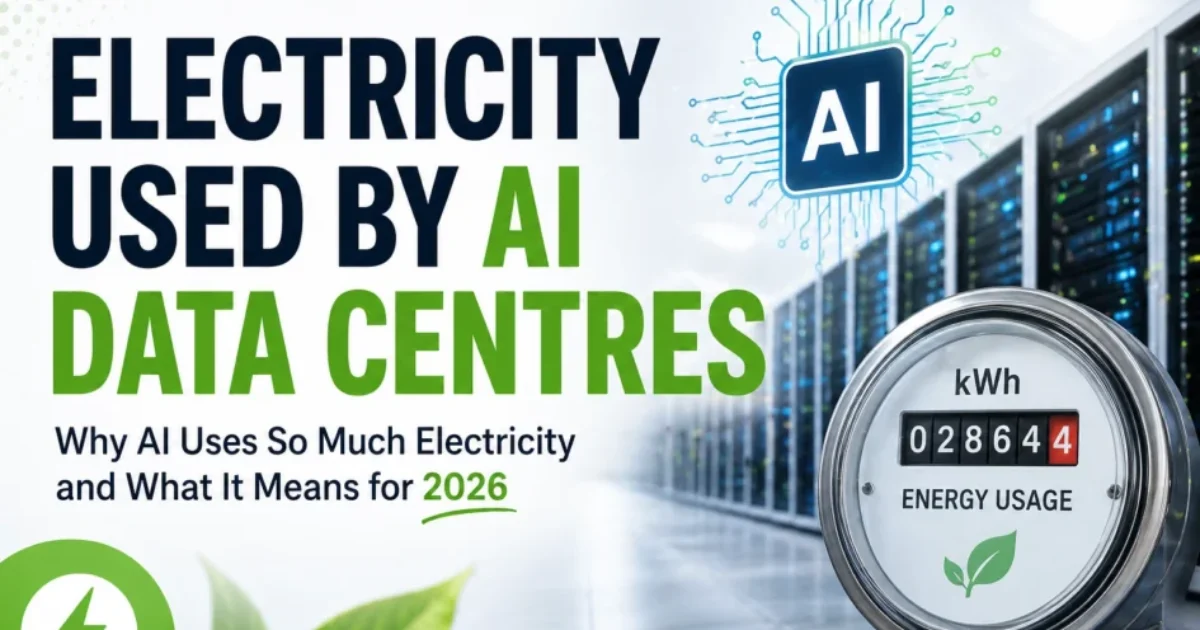
Electricity Used by AI Data Centres 2026: Shocking Truth About Why AI Uses So Much Electricity
Table of Contents
- Electricity used by AI data centres: The reality nobody talks about
- Peplio Reality Check
- Problem: Why AI uses so much electricity
- Explanation: How data centers consume electricity
- Example: Real-world AI tools and their energy impact
- Impact: Cost, environment, and AI carbon footprint
- Future: What’s coming next in AI energy demand
- What this article will NOT do
- If you’re a business owner using AI today
- Final direction
I still remember the moment I started digging deep into Electricity used by AI data centres. At first, it looked like just another tech topic, something only engineers or cloud companies care about. But the more I explored, the more uncomfortable it became. This isn’t just a “tech issue.” This is a business cost issue, a sustainability issue, and honestly, a future risk that most founders and marketers are ignoring while they chase AI tools blindly.
Right now, small business owners across the US are using AI tools every single day—content generation, customer support automation, product descriptions, SEO optimization, and even ad creatives. It feels cheap, fast, and efficient. But behind that smooth experience lies something massive: Electricity used by AI data centres is growing at a pace that most people don’t fully understand yet, and it’s quietly reshaping how the internet works. This article is not theory. This is a Peplio-style breakdown based on real observations, real usage patterns, and real-world implications. No fluff. No hype. Just clarity.
Peplio Reality Check
Expected: AI tools feel lightweight and efficient, so electricity use must be minimal. Happened: Electricity used by AI data centres is skyrocketing because AI models require massive computational power. Surprised: Even a single AI query can consume multiple times more energy than a traditional search engine request.
Problem: Why AI uses so much electricity
Let’s address the uncomfortable truth directly—why AI uses so much electricity isn’t complicated, but the scale is shocking. AI models don’t “think” like humans. They process massive datasets using billions of parameters. Every time you ask a question, generate an image, or create content, the system performs heavy mathematical operations across powerful GPUs and servers located inside data centers. This is exactly why the energy consumption of AI models is increasing rapidly, as shown in this study on energy consumption of AI models, which highlights how large-scale AI training requires massive computational resources. Unlike traditional software, AI models continuously calculate probabilities, patterns, and predictions. That means more processing, more hardware load, and ultimately, more electricity.
The energy consumption of AI models is not linear—it scales aggressively as models get more advanced. Larger models require more training data, more computation cycles, and more infrastructure, which directly increases the Electricity used by AI data centres. For example, when someone uses ChatGPT, they don’t realize the electricity required for ChatGPT includes server cooling, GPU processing, data storage, and network infrastructure. It’s not just “typing and getting answers.” It’s an entire ecosystem running in real time.
Explanation: How data centers consume electricity
To understand Electricity used by AI data centres, you need to understand how data centers consume electricity efficiently, because most people assume servers just run, but the reality is far more complex and energy-intensive. Data centers operate 24/7. They house thousands of servers, each powered by high-performance processors and GPUs. These machines generate heat—lots of it. To prevent overheating, data centers require advanced cooling systems, often consuming nearly as much electricity as the servers themselves. There are three major components driving electricity usage:
1. Compute Power
AI workloads rely heavily on GPUs rather than CPUs. GPUs are optimized for parallel processing, making them ideal for AI tasks, but they consume significantly more power. This directly increases the Electricity used by AI data centres.
2. Cooling Systems
Cooling is not optional. Without it, servers would fail within minutes. Large data centers use liquid cooling, air cooling, and even underwater cooling systems. All of these systems demand continuous electricity.
3. Data Storage and Transfer
AI models require constant access to massive datasets. Storing, retrieving, and transferring this data consumes additional energy, contributing to the overall AI electricity usage statistics we see today. If you want a deeper breakdown of environmental impact, you can check this related analysis on how AI is bad for the environment, where I explored how infrastructure decisions affect sustainability.
Example: Real-world AI tools and their energy impact
Now let’s move beyond theory and talk about real-world usage. Every time someone uses AI tools like :contentReference[oaicite:0]{index=0} or image generators, they contribute to the Electricity used by AI data centres. The impact may feel small individually, but at scale, it becomes massive.

Imagine a small bakery in Texas using AI to generate daily social media posts, product descriptions, and customer replies. That’s efficient, right? But multiply that by millions of businesses across the US. Suddenly, the energy consumption of AI models becomes a national-level concern. Even something as simple as generating 1,000 AI responses can consume significantly more electricity than traditional computing. If you want a detailed comparison, this article explains it clearly: does AI use more energy than Google search.
The difference between AI vs traditional computing energy usage is not just technical—it’s exponential. Traditional software retrieves data. AI generates new data. That difference alone explains why Electricity used by AI data centres is rising so fast. The gap between AI vs traditional computing energy usage is becoming more visible, and this comparison of AI vs traditional computing energy usage explains why AI systems demand significantly more power than traditional workloads.
Impact: Cost, environment, and AI carbon footprint
Now let’s talk about the real consequences. The rising Electricity used by AI data centres is not just an environmental issue—it’s a financial one. Energy costs directly impact cloud pricing, SaaS tools, and ultimately, your marketing budget. The AI carbon footprint is becoming a serious concern for companies aiming to meet sustainability goals. Large enterprises are already investing in renewable energy sources to offset their AI usage, but smaller businesses don’t have that luxury.
According to multiple industry reports, AI electricity usage statistics show that AI workloads can consume several times more power than standard cloud applications. This means higher operational costs, increased carbon emissions, and greater pressure on power grids. If you’re serious about understanding the numbers, I broke down query-level consumption here: how much energy AI consumes per query, and also analyzed batch usage here: AI energy consumption per 1000 queries. For US businesses, this isn’t just a tech trend. This is a cost structure shift. As AI adoption grows, electricity costs will influence pricing models, subscription plans, and even advertising ROI.
Future: What’s coming next in AI energy demand
Let’s be honest—the future energy demand of AI is not slowing down. It’s accelerating. Companies are building larger models, more complex systems, and more AI-driven products. That means the Electricity used by AI data centres will continue to grow. Major tech companies like :contentReference[oaicite:1]{index=1} and :contentReference[oaicite:2]{index=2} are already investing billions into sustainable infrastructure, including renewable-powered data centers and energy-efficient AI chips. But even with these advancements, demand is outpacing optimization.
The next phase of AI will likely include:
1. Energy-efficient AI models
Researchers are working on smaller, optimized models that deliver similar performance with lower energy consumption.
2. Green data centers
More facilities powered by solar, wind, and hydroelectric energy will reduce the AI carbon footprint.
3. Regulation and transparency
Governments may introduce policies requiring companies to disclose AI electricity usage statistics, especially for large-scale deployments.
What this article will NOT do
This article will not tell you to stop using AI. That’s unrealistic. AI is already integrated into how US businesses get customers online, optimize operations, and scale faster. Instead, this article helps you understand the hidden layer behind AI usage so you can make smarter decisions.
If you’re a business owner using AI today
If you’re a small business owner with an LLC, running marketing campaigns, managing customer interactions, and relying on AI tools daily, here’s the truth—you’re indirectly contributing to the Electricity used by AI data centres, whether you realize it or not. But that doesn’t mean you should stop. It means you should be aware. The smarter approach is optimization. Use AI where it adds real value. Avoid unnecessary usage. Focus on ROI-driven implementation rather than blind adoption. That’s the Peplio shortcut.
Final direction
Right now, I’m testing something inside Peplio—reducing unnecessary AI calls while maintaining output quality. The goal is simple: better results with lower resource consumption. Because at the end of the day, understanding Electricity used by AI data centres is not just about awareness—it’s about control. Your next step is simple. Audit your AI usage. Identify where it’s helping and where it’s just noise. Because the future of AI isn’t just about intelligence—it’s about efficiency.