Gymshark Influencer Marketing Case Study — From Garage to £646M With 1 Brilliant Strategy
Last updated: September 2026
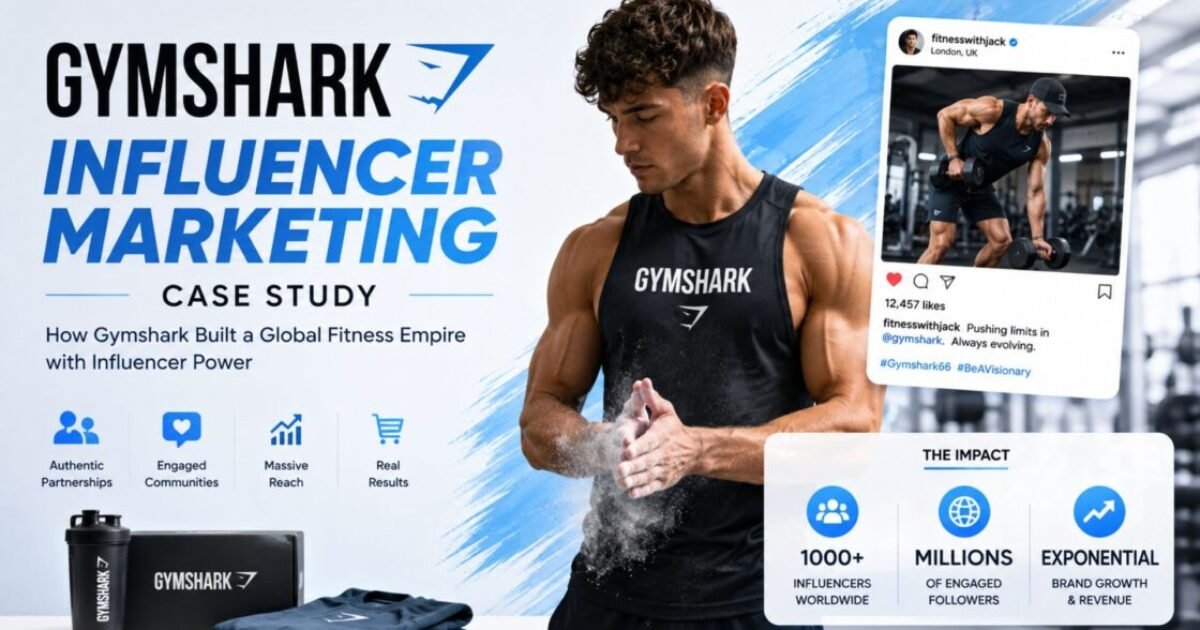
The Gymshark influencer marketing case study shows how a 19-year-old with zero advertising budget grew a garage startup to £646M revenue by 2025 — purely through authentic influencer relationships. The strategy: send free products to genuine fitness YouTubers, build long-term ambassador partnerships, and put community before sales. No paid ads for the first 8 years. Every growth milestone was driven by trust, not budget.
In 2012, a 19-year-old pizza delivery driver named Ben Francis was screen-printing gym wear in his mother’s garage in Birmingham. No investors. No marketing agency. No advertising budget. Just a domestic sewing machine and a very good understanding of one thing: people trust people — not brands.
By 2020, Gymshark was valued at over £1 billion. By 2025, annual revenue had hit £646 million — with zero traditional advertising spend for the first eight years of the company’s existence.
The Gymshark influencer marketing case study is the most important modern marketing story I have studied for Peplio. Not because Gymshark had extraordinary resources — they did not. But because the strategy that built them is entirely replicable at any budget, including zero. I will show you exactly how they did it, phase by phase, and what Indian small businesses and creators can take from it right now.
In Episode 5 of Peplio Originals, Mitu learned that how you respond to attention defines your brand more than the attention itself — not just how you get it. Gymshark built their entire empire on the same principle: authentic community response beats paid reach every single time.
- Background — from garage to global brand
- The core strategy explained
- Phase 1: Free apparel for YouTube creators (2012–2014)
- Phase 2: The Gymshark Athlete Program (2014–2018)
- Phase 3: Long-term ambassador partnerships (2018–present)
- Revenue results — the numbers that prove it worked
- Key campaigns and measurable outcomes
- What made Gymshark’s approach fundamentally different
- 5 lessons every Indian business can apply today
- My personal analysis — what Gymshark really teaches us
- People also asked
- Full FAQ
Gymshark Influencer Marketing Case Study — Background and the Garage Origin Story
The Gymshark influencer marketing case study begins not with a marketing strategy but with a problem. Ben Francis was deeply embedded in the online fitness community. He watched the same YouTube fitness creators his target audience trusted. He understood gym culture from the inside as a practitioner, not a marketer.
And he had one simple observation: the fitness apparel brands his audience followed were not talking to that community the way the community talked to itself.
He started Gymshark in 2012 with Lewis Morgan — initially dropshipping supplements, then pivoting to manufacturing their own fitness apparel with a domestic sewing machine. The products were genuinely good. The problem was nobody knew they existed.
The conventional approach would have been to buy advertising. Francis did none of that. What he did instead became the founding act of the modern fitness influencer marketing industry — and the reason the Gymshark influencer marketing case study is still the most studied example of community-first brand building a decade later.
The Core Gymshark Influencer Marketing Case Study Strategy — 3 Founding Principles
The central insight behind the entire Gymshark influencer marketing case study is deceptively simple: fitness communities on YouTube and Instagram trusted the people who created content about fitness far more than they trusted brands that advertised to them.
Francis built the entire strategy on three principles that remain at the core of Gymshark’s marketing in 2026:
Only partner with influencers who genuinely use and believe in the products. Never pay for manufactured enthusiasm — audiences detect it instantly and it destroys the trust you are trying to borrow.
Treat influencers as partners and brand ambassadors — not advertising channels to buy once and discard. Gymshark still works with many ambassadors from 2012. That continuity is the strategy.
Build a loyal community around fitness culture and the sales follow naturally. Gymshark never led with “buy our products” — they led with “join our community.” The product was almost secondary to the belonging.
Gymshark Influencer Marketing Case Study Phase 1 — Free Apparel for YouTube Creators (2012–2014)
The first phase of the Gymshark influencer marketing case study required almost no money and produced results most paid campaigns never achieve.
Ben Francis spent hours watching YouTube fitness videos. He made a list of creators he admired most — not the biggest names, but the ones with the most genuine, engaged communities. He sent them boxes of Gymshark apparel with a simple message: try these, and if you like them, mention them. No payment. No contract. No requirement to post. Just free products to people already influencing the purchasing decisions of the exact audience Gymshark wanted to reach.
After their first major expo appearance at Body Power in Birmingham — where the influencers they had been gifting attended and promoted Gymshark’s booth to their audiences — the brand’s website crashed from the traffic surge. When it came back online, they generated £30,000 in revenue in just 30 minutes. A 100x increase from normal daily revenue. This single event confirmed the strategy’s power. The model was proven. Now it needed to be formalised and scaled.
According to Enclaverse’s 2026 analysis of the Gymshark influencer marketing case study, the creators who genuinely liked the products — particularly Nik Blackketter and Lex Griffin — featured them organically in their videos. Their audiences, who trusted these creators deeply, responded immediately. This is the first and most important lesson of the entire case study: trust cannot be bought, but it can be borrowed from people who have already earned it.
Gymshark Influencer Marketing Case Study Phase 2 — The Athlete Program That Scaled Everything (2014–2018)
The second phase of the Gymshark influencer marketing case study transformed informal product gifting into a structured, scalable ambassador program — the blueprint other fitness brands still try to replicate today.
The Gymshark Athlete Program formalised the relationship between Gymshark and its influencer partners. Selected athletes became official brand ambassadors — receiving apparel, compensation, exclusive event invitations, and eventually co-created product lines. In return, they created consistent content featuring Gymshark products and attended events alongside the brand.
What made the Gymshark Athlete Program genuinely different from celebrity endorsements:
- Athletes were selected for genuine alignment with Gymshark’s community values — not fame or follower count alone
- Relationships were long-term by design — Gymshark invested in real partnerships, not one-off posts
- Athletes were involved in product development — their feedback shaped actual product design, creating genuine advocacy
- The program spanned micro and macro influencers — from creators with 50,000 followers to those with millions
The hashtag #GymsharkSquad became a community identifier that thousands of non-affiliated fitness enthusiasts adopted organically. User-generated content using this hashtag amplified the brand’s reach far beyond the paid ambassador network — for free. According to IIDE’s 2026 marketing analysis, this organic community growth was the multiplier that made the paid ambassador strategy economically extraordinary.
Revenue correlation: Gymshark’s revenue grew from approximately £1 million in 2013 to £100 million by 2018 — directly correlating with the scaling of the Gymshark Athlete Program. According to House of Marketers, every major revenue inflection point mapped to a new phase of the influencer strategy.
Gymshark Influencer Marketing Case Study Phase 3 — Professional Athletes and Platform Expansion (2018–2026)
The third phase of the Gymshark influencer marketing case study is the most relevant for modern marketers — because this is the phase that built the £646 million business that exists today.
As influencer marketing became mainstream and every fitness brand began copying Gymshark’s early approach, Gymshark doubled down on the one element competitors struggled to replicate: genuine long-term relationships built on trust rather than transactions.
- Professional athlete partnerships — Chris Bumstead, Francis Ngannou, Katie Taylor
- TikTok as a primary growth channel for 16–25 demographic
- Co-created product lines with Whitney Simmons, David Laid
- Performance-based affiliate compensation structures
- Physical retail — Manchester, Amsterdam, Long Island, Dubai
- Authenticity over follower count in ambassador selection
- Long-term relationships — many original ambassadors still active
- Community-first positioning — fitness culture before product
- USA remains #1 market at 37% of total revenue (£250.4M)
According to Enrich Labs’ 2026 Gymshark strategy analysis, the Whitney Simmons x Gymshark co-created collection became one of the brand’s fastest-selling product launches — because Simmons was genuinely involved in the design process, not just endorsing an existing product. Her promotion was authentic, and her audience’s response was immediate. The sell-out speed was a direct result of years of built trust — not marketing budget.
Gymshark Influencer Marketing Case Study Results — Revenue Timeline That Proves the Strategy
No Gymshark influencer marketing case study is complete without the hard financial data. Here is the verified revenue trajectory from garage to £646 million:
| Year | Revenue | Key Milestone |
|---|---|---|
| 2012 | ~$500K | Founded — first YouTube influencer gifting begins |
| 2013 | ~£1M | Body Power Expo — £30K in 30 minutes |
| 2016 | ~£40M | Gymshark Athlete Program at full scale |
| 2018 | ~£100M | Global expansion across 130+ countries |
| 2020 | £258M | £1B+ valuation — General Atlantic investment |
| 2023 | £556.2M | TikTok becomes primary growth channel |
| 2024 | £607.3M | 9.2% YoY growth |
| 2025 | £646M | Record revenue — 6.4% YoY growth |
Sources: Modaes Global, 2026 | AppBrew, 2026
What makes these numbers extraordinary: Gymshark reached £556 million in revenue with zero retail partnerships and zero VC funding for the first eight years. Every pound of revenue growth was driven by a community and influencer strategy that cost a fraction of traditional advertising. This is the defining proof point of the Gymshark influencer marketing case study — the ROI of authentic relationship-building at scale.
Gymshark Influencer Marketing Case Study — 4 Key Campaigns With Measurable Outcomes
The Gymshark influencer marketing case study becomes most instructive when you look at specific campaigns and their direct commercial outcomes — not just the overall revenue numbers.
Gymshark’s first major expo appearance — where their YouTube influencer partners attended and promoted the booth. Result: website crashed from traffic, then generated £30,000 in 30 minutes when it came back online. A single event triggered by influencer relationships, zero ad spend.
One of Gymshark’s earliest major influencer collaborations produced a limited-edition collection that sold out almost immediately. Long queues formed at pop-up events wherever Blackketter appeared. According to Enclaverse, the direct sales impact from a single authentic influencer relationship demonstrated the commercial power of the model beyond doubt.
Co-created (not just endorsed) collection became one of Gymshark’s fastest-selling product launches. Simmons was genuinely involved in the design process — her promotion was authentic and her audience’s response was immediate. The sell-out speed was a direct product of years of built trust, not marketing budget.
Community challenge encouraging followers to commit to 66 days of habit formation. Generated millions of organic impressions under the hashtag, associated Gymshark with personal transformation rather than product promotion. Entirely community-driven with influencers as catalysts — not a paid media buy. The Gymshark influencer marketing case study includes this as a masterclass in turning community into content engine.
What Made the Gymshark Influencer Marketing Case Study Fundamentally Different From Every Competitor
Hundreds of brands have tried to copy the Gymshark influencer marketing case study and failed. Understanding why Gymshark succeeded where copies fell short is the most instructive part of this analysis.
- Built genuine long-term relationships
- Chose relevance over follower count
- Involved ambassadors in product development
- Built community before building revenue
- Started in 2012 — before the market was crowded
- Paid for one-off posts and moved on
- Chased maximum follower counts
- Used influencers as advertising channels
- Led with product promotion, not community
- Tried to replicate the output without the foundation
According to Scaleup Collective’s brand strategy analysis, the most significant competitive advantage Gymshark built was not their product or their influencer roster — it was the genuine community trust that those relationships produced over years. That trust was impossible to fake and impossible to purchase. When competitors tried to copy the strategy by simply paying fitness influencers for posts, they found the trust Gymshark had built organically could not be bought retroactively.
They also started before influencer marketing had a name. In 2012, nobody called it “influencer marketing.” Ben Francis was just sending apparel to people he watched on YouTube. The timing gave Gymshark years of authentic relationship building before the market became crowded — a first-mover advantage that compounded into something competitors could not replicate even with much larger budgets.
5 Powerful Lessons Every Indian Business Can Apply From the Gymshark Influencer Marketing Case Study
I study the Gymshark influencer marketing case study not just academically but practically — because the core principles are directly applicable to Indian small businesses, bloggers, and creators working with limited budgets. Here is what I have personally applied to Peplio from this case study:
Gymshark did not try to reach everyone. They found the specific community where their customers already gathered — YouTube fitness channels in 2012. For Indian businesses, this means identifying the specific WhatsApp groups, Facebook communities, YouTube niches, or regional platforms where your actual customers are already active. Start there, not with broad national advertising.
Gymshark’s most powerful early move was giving products to people who genuinely used them — at zero cost. You do not need a big budget to do this. Find 5 people in your target community who would genuinely benefit from what you offer. Give it for free. Ask for honest feedback, not promotion. The authentic content that results will outperform any paid ad you could create. I have done this for Peplio with digital marketing tools and the results compound over months.
One influencer post drives one spike. A long-term ambassador relationship builds sustained brand awareness month after month, year after year. When I build genuine relationships with other digital marketing bloggers in India for Peplio — through collaboration and mutual support rather than paid promotions — the compound benefit over 12 months far exceeds any single paid arrangement.
Gymshark’s competitors could copy their products and aesthetic. They could not copy the community Gymshark had already built. For Peplio, building a genuine community of readers who trust the content and recommend it to others is worth more than any SEO technique or ad budget. The community is what no algorithm change can take away. Read my guide on organic social media growth to see how I approach this for Peplio.
The #GymsharkSquad hashtag was not created by Gymshark — it was adopted organically by their community. Every piece of genuine UGC is free marketing that your customers create because they want to, not because they were paid to. Encourage it. Feature it. Celebrate it. For Peplio, sharing reader success stories creates the same compound effect that #GymsharkSquad created for Gymshark.
The Gymshark lesson I keep coming back to is not about influencers — it’s about timing.
Ben Francis started in 2012 before influencer marketing had a name. By the time competitors understood what he was doing, Gymshark had years of authentic relationships they could not buy retroactively. I think about this every time I consider waiting to start something at Peplio. The comics universe, the AEO content, the Perplexity citation strategy — doing these now, before everyone else in India figures it out, is the same move Ben Francis made in his mother’s garage. First-mover advantage in a trust-based strategy compounds more powerfully than in any other type of marketing. Start before it feels ready.
My Personal Analysis — What the Gymshark Influencer Marketing Case Study Really Teaches Us
After studying the Gymshark influencer marketing case study in depth for Peplio, here is the observation that most analyses miss.
The surface reading is: “influencer marketing works.” True but incomplete. The deeper reading is: people have always trusted recommendations from people they respect more than advertising from brands they do not know. Gymshark did not invent this truth. They simply built a company on top of it at a time when new platforms made it scalable for the first time.
The fitness YouTube creators Ben Francis reached in 2012 were not influencers in the modern sense — they were enthusiasts sharing genuine knowledge with others who cared about the same things. The trust their communities placed in them was earned through years of honest content, not manufactured through follower counts or brand deals.
What I take from the Gymshark influencer marketing case study for Peplio is this: every article I publish is an attempt to be the equivalent of that 2012 fitness YouTuber — for digital marketing in India. Not to sell, but to share genuine knowledge with people trying to solve the same problems I have already worked through. If I do that consistently, the trust compounds. The community grows. And the business follows the community.
That is what Ben Francis understood in his mother’s garage in 2012. It is what every marketer — including me, including you — should understand now.
- Founded 2012 with zero traditional advertising — built to £646M revenue by 2025
- Core strategy: long-term authentic relationships with fitness influencers, not transactional posts
- Started with free product gifting to YouTube creators — no cash budget required
- #GymsharkSquad adopted organically — free UGC amplified the paid ambassador network
- 2013 Instagram ROI: 6.6× cost — validated the model from the very first year
- £30,000 in revenue in 30 minutes at 2013 Body Power Expo
- Key differentiator: chose relevance and authenticity over reach and follower count
- The Gymshark influencer marketing case study proves community-first always outperforms product-first
People Also Asked About the Gymshark Influencer Marketing Case Study
How much did Gymshark spend on influencer marketing in the beginning?
In the first phase of the Gymshark influencer marketing case study (2012–2014), the spend was essentially zero in cash. Ben Francis sent free product to YouTube creators he admired — no payment, no contracts. The only cost was the apparel itself. This is why the Gymshark case study is so instructive for small businesses: the strategy that built the first £1 million in revenue required no advertising budget. According to Enclaverse’s case study analysis, the 6.6× Instagram ROI in 2013 was achieved on what was effectively a product sampling budget, not a media buy.
What is Gymshark’s current influencer marketing strategy in 2026?
Gymshark’s 2026 influencer strategy maintains the original principles while operating at enterprise scale. Current ambassadors include Chris Bumstead (Mr. Olympia champion), Whitney Simmons, David Laid, Francis Ngannou, and Katie Taylor. The brand now operates performance-based affiliate structures — creators who drive genuine conversion earn more over time. TikTok has become a primary growth channel for the 16–25 demographic alongside YouTube and Instagram. The core of the Gymshark influencer marketing case study — long-term authentic relationships — remains unchanged. What changed is scale and platform mix. For deeper reading, my guide on Instagram growth strategy covers how these principles apply to smaller brands today.
Can Indian small businesses replicate Gymshark’s influencer marketing strategy?
Yes — and the early Gymshark playbook is specifically designed for zero-budget businesses. The strategy that built the first £1 million required only free product gifting to genuine community members. For Indian businesses, the equivalent is identifying 5–10 micro-influencers in your specific niche — fitness trainers, food bloggers, regional YouTube creators, Instagram educators — and offering genuine value rather than paid promotion. The key lesson from the Gymshark influencer marketing case study is to choose relevance over reach: a fitness trainer with 5,000 genuinely engaged followers in your target city is worth more than a celebrity with 500,000 passive ones. For a framework on building this, read my organic social media growth case study.
Frequently Asked Questions — Gymshark Influencer Marketing Case Study
How did Gymshark use influencer marketing to grow its business?
The Gymshark influencer marketing case study breaks into three phases. Phase 1 (2012–2014): free apparel gifting to genuine YouTube fitness creators — no payment required, just honest product reviews. Phase 2 (2014–2018): the Gymshark Athlete Program formalised long-term ambassador partnerships scaling the strategy globally. Phase 3 (2018–present): professional athlete partnerships, TikTok expansion, co-created product lines, and performance-based affiliate compensation. Revenue grew from $500K in 2012 to £646 million in 2025 — with zero traditional advertising for the first eight years.
What is Gymshark’s revenue in 2025?
Gymshark reported record revenue of £646 million in fiscal year 2025, up 6.4% from £607.3 million in 2024. Their largest market is the United States at £250.4 million (37% of total revenue), followed by Europe at £129.4 million and the UK at £111.7 million. EBITDA grew to £53.3 million with gross margins maintained at 62.3%. The brand now serves customers in over 230 countries. Source: Modaes Global, March 2026.
What made Gymshark’s influencer marketing different from other brands?
The Gymshark influencer marketing case study succeeded where competitors failed for four reasons. First, long-term authentic relationships instead of one-off paid posts. Second, creator selection based on genuine community relevance rather than maximum follower count. Third, ambassadors were involved in actual product development — creating real advocacy. Fourth, they started in 2012 before the market became crowded, earning authentic relationships before influencer marketing became transactional. Competitors who tried to copy by simply paying fitness influencers found the community trust Gymshark had built organically could not be purchased retroactively.
Who are Gymshark’s current brand ambassadors in 2026?
Gymshark’s 2026 ambassador roster includes Chris Bumstead (multiple Mr. Olympia champion), Whitney Simmons (fitness creator and product co-creator), David Laid (creative director and long-term ambassador), Francis Ngannou (former UFC heavyweight champion), and Katie Taylor (boxing world champion). The brand maintains 80–100 regular ambassador collaborations spanning micro-influencers to professional athletes — maintaining the diversity across fitness disciplines that has been central to the Gymshark influencer marketing case study from the beginning.
Can small businesses replicate Gymshark’s influencer marketing strategy?
Yes — and importantly, the strategy that built the first £1 million in the Gymshark influencer marketing case study required almost no budget. Ben Francis started by sending free products to YouTube creators he admired. Any business with a quality product can identify 5–10 genuine micro-influencers in their specific niche and offer free products in exchange for honest reviews. Key principles applicable at any budget: choose influencers for community relevance not follower count, focus on long-term relationships not one-off posts, and build community around shared values rather than product promotion. The budget version of the Gymshark strategy is entirely accessible — it requires authenticity and patience, not money.
What was Gymshark’s Instagram ROI and how did they measure influencer success?
In their very first year of structured influencer marketing (2013), the Gymshark influencer marketing case study reported a 6.6× return on Instagram spend — validating the approach with hard financial data from the beginning. As the program scaled, Gymshark moved toward affiliate and performance-based compensation structures, creating a self-selecting system where creators who drove genuine conversion earned more over time. This performance accountability — combined with authentic relationship building — is what made the economics sustainable at scale, not just in the early zero-budget phase.
Final Thoughts on the Gymshark Influencer Marketing Case Study
The Gymshark influencer marketing case study is ultimately a story about trust. Not the manufactured trust that advertising tries to create, but the genuine trust that communities build with people who show up consistently, share real knowledge, and create real value.
Ben Francis understood in 2012 what many marketers still struggle to accept in 2026: you cannot buy the kind of trust that drives real revenue. You have to earn it — by finding the right communities, partnering with the right people, and staying committed to genuine value over short-term transactions.
Whether you are building a fitness brand, a blog, or a local business in India — the Gymshark influencer marketing case study playbook is accessible to you. Start with your community. Find the people in it who your audience already trusts. Build relationships. Give more than you ask for. Stay patient while the trust compounds.
That is the entire strategy. And it built a £646 million company starting from a garage with a sewing machine.
For more on how to apply these principles, read my analysis of Zomato’s digital marketing growth strategy and my guide on Instagram growth strategy for beginners.
- Zomato Digital Marketing Case Study — Growth Strategy Breakdown
- Organic Social Media Growth Case Study — Real Results
- Instagram Growth Strategy for Beginners — Complete Guide
- How to Increase Instagram Followers Fast in 2026
- Why Is SEO Important? 10 Brutally Honest Reasons in 2026
- AEO vs SEO vs GEO — The Complete 2026 Comparison Guide
- B2B Digital Marketing Case Study — Demech Chemical, Durgapur