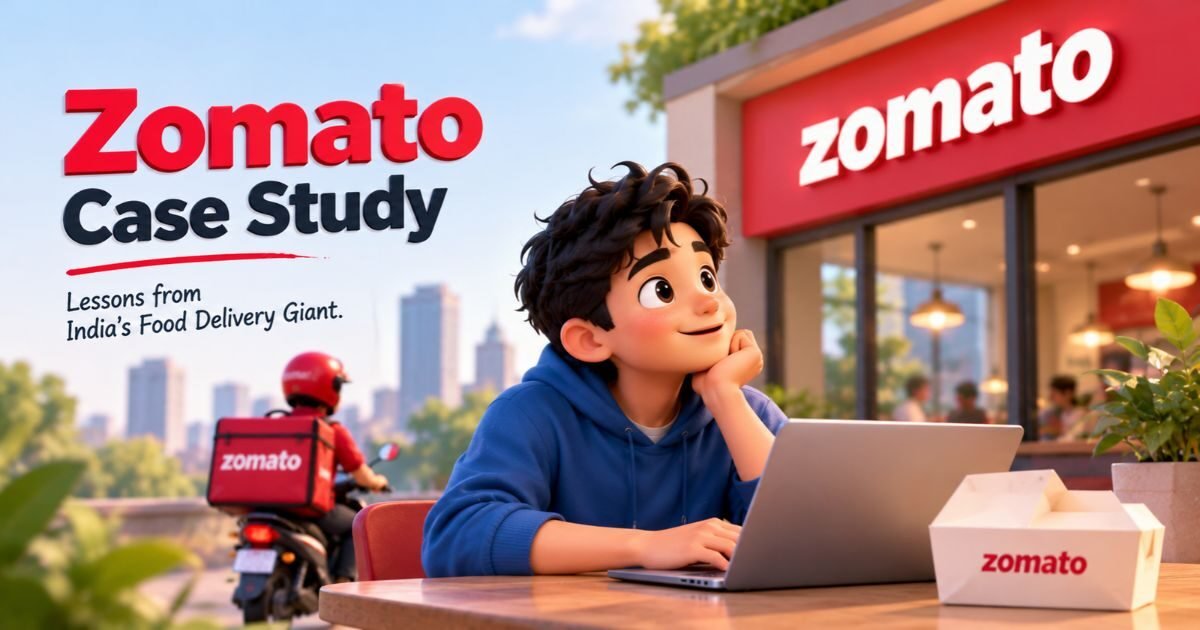
Case Study: Zomato’s Rise – Lessons from India’s Food-Tech Giant
What is the Zomato case study in brief? Zomato started in 2008 as Foodiebay — a simple restaurant menu website with zero delivery capability. By FY2025, its parent company Eternal reported ₹20,243 crore in revenue with 67% year-on-year growth, 80+ million monthly app users, and a 55-58% share of India’s food delivery market. The core lesson: authenticity and hyperlocal content at scale beats ad spend every time.
In Episode 2 of Peplio Originals, Sougan told Mitu that authenticity beats aesthetics every single time — and Zomato is the biggest proof of that in India. A brand that won not by looking fancy but by being everywhere people searched, talking like a real person, and building trust before spending on ads.
I spent weeks studying the Zomato case study because I wanted to understand one thing specifically: how does a brand go from a menu website with zero delivery capability to ₹20,243 crore in annual revenue — without losing its personality in the process??
The answer is not what most marketing textbooks tell you. It is not about the biggest ad budget or the most sophisticated technology. It is about one deceptively simple principle: be more useful to more people, in more situations, than any competitor.
Here is the complete Zomato case study — backed by verified data from Eternal’s FY2025 Annual Report analysis by The Strategy Story and what it actually means for Indian marketers and small business owners.
- How Zomato started — the menu website nobody expected to win
- The 4 growth strategies that actually built Zomato
- Zomato’s digital marketing strategy — what made it different
- The revenue model — how Zomato makes money in 2026
- The storms Zomato weathered — and how
- 5 lessons for Indian marketers from this Zomato case study
- FAQ
How Zomato Started — The Menu Website Nobody Expected to Win
The Zomato case study begins not with a billion-dollar vision but with a queue. In 2008, Deepinder Goyal and Pankaj Chaddah were working at Bain and Company in Delhi when they noticed colleagues lining up to borrow physical restaurant menus from the office cafeteria. The insight was simple: put those menus online.
Foodiebay launched in 2008 as exactly that — a restaurant menu aggregator with no delivery, no payments, and no technology beyond a basic website. According to IIDE’s Zomato business model analysis, by 2010 it had rebranded to Zomato and expanded from Delhi to 8 more Indian cities. By 2012 it was operating in 7 countries.
What the early Zomato case study shows is a pattern that most startup founders miss: prove the demand first, add the infrastructure later. Zomato spent years as a pure aggregator — building user trust, accumulating restaurant data, and growing organic traffic — before touching delivery operations at all. When it finally added delivery in 2015, it already had the audience, the data, and the brand recognition to make it work.
- 2008 — Launched as Foodiebay, restaurant menu aggregator, Delhi only
- 2010 — Rebranded to Zomato, expanded to 9 Indian cities
- 2012 — Expanded to 7 countries including UAE, UK, Philippines
- 2014 — Acquired Urbanspoon (US) for $52 million — first major international bet
- 2015 — Launched food delivery service in India
- 2019 — Acquired Uber Eats India, eliminating a major competitor overnight
- 2021 — IPO at ₹76/share, listed on BSE and NSE
- 2022 — Acquired Blinkit (quick commerce), entered 10-minute delivery
- 2024 — Launched District (movies, events, dining out) — became full lifestyle platform
- 2025 — Rebranded parent company to Eternal Limited
- Feb 2026 — Deepinder Goyal moved to Vice Chairman; Albinder Dhindsa took operational lead
Sources: Brineweb — Zomato Business Model 2026 | IIDE — Zomato Business Model Analysis
The 4 Growth Strategies That Actually Built Zomato
The Zomato case study is really a story about four overlapping growth strategies executed with unusual consistency over 17 years. Most companies do one or two. Zomato did all four simultaneously.
Zomato’s first and most underrated growth engine was content. Every restaurant listing — with menus, photos, hours, reviews — was a piece of SEO-optimised content. According to IIDE’s Zomato digital marketing strategy report, by 2025 Zomato ranked in the top 3 positions for over 3,500 food and delivery-related keywords and organic traffic accounts for 48% of total sessions — up from 40% in 2023. That is not an ad result. That is a decade of content compounding.
When Zomato faced a competitor it couldn’t easily outgrow, it bought them. Uber Eats India in 2019 — neutralised in one move. Blinkit in 2022 — entered quick commerce overnight without building the infrastructure from scratch. As Brineweb’s 2026 analysis notes, each acquisition solved a problem faster than organic growth could. The principle is clear: identify your fastest path to solving the next customer problem, even if it’s unconventional.
While Swiggy focused on metro markets, Zomato moved into Tier 2 and Tier 3 cities where competition was lighter and customer appetite was underserved. According to IIDE’s marketing research, Tier 2 and 3 market campaigns delivered a 28% boost in app growth. By the time competitors arrived, Zomato had brand recognition, restaurant relationships, and delivery infrastructure already in place.
The most recent chapter of the Zomato case study is the transition from food delivery app to full lifestyle platform. Blinkit for quick commerce, District for movies and events, Hyperpure for restaurant B2B supply. According to The Strategy Story’s FY2025 analysis, the parent entity Eternal now has four distinct revenue streams, each profitable or approaching profitability. Each built on top of the existing user base without requiring new customer acquisition.
Zomato’s Digital Marketing Strategy — What Made It Different
The most studied part of the Zomato case study for marketers is not the revenue model — it is the marketing. Zomato built one of India’s most recognisable brand voices without being the biggest spender in the room.
The core principle: talk like a person, not a brand.
Zomato’s push notifications became famous in India — not for promoting discounts, but for being funny. Their social media posts feel like a friend texting you at midnight about hunger. According to IIDE’s comprehensive Zomato marketing strategy report, the #ZomatoMemes campaign achieved 120 million impressions, 2 million shares, and 300,000 user-generated posts in one month. No paid media could buy that reach at that cost.
Key elements of Zomato’s digital marketing strategy that this Zomato case study identifies:
- Conversational brand voice — push notifications, social posts, and emails written like a friend, not a corporation
- User-generated content — reviews, photos, and ratings made every user a content creator for the platform
- SEO-first restaurant listings — every listing page structured for search; 48% of sessions now come from organic search (Source: IIDE 2026)
- Micro-influencer strategy — food influencers in Tier 2 cities at 11% average engagement rate vs 1-3% for macro influencers
- Meme marketing — one of the first Indian brands to treat memes as a legitimate marketing channel at scale
- Zomato Gold / Pro subscription — loyalty programme that converted one-time users into habitual ones
- Bounce rate at 27% — down from industry average of 40-50%, showing content quality keeps users on the platform
The single most important marketing lesson from this Zomato case study: Zomato’s brand voice is a competitive moat. Swiggy has similar technology, similar delivery infrastructure, similar restaurant coverage — but Zomato’s brand is distinctly more recognisable because of 17 years of consistent personality. That cannot be bought with ad spend.
The Revenue Model — How Zomato Makes Money in 2026
A complete Zomato case study must explain the revenue model. According to Miracuves’ detailed Zomato revenue model breakdown, understanding how Zomato makes money explains why every strategic decision it has made is connected.
| Revenue Stream | How It Works | % of Revenue |
|---|---|---|
| Food Delivery Commission | 20-25% commission from restaurants on every order value | ~60% |
| Blinkit (Quick Commerce) | Commission on 10-minute grocery/essentials delivery via dark stores | Growing fast |
| Advertising and Promotions | Restaurants pay for priority placement, promotional slots, and visibility boosts | Significant |
| Zomato Gold / Pro Subscriptions | User subscriptions for free delivery, discounts, priority access | Recurring |
| Hyperpure (B2B Supply) | Fresh produce and ingredients supplied directly to restaurant kitchens | 99% YoY growth |
| District (Events and Dining) | Ticketing commission for movies, shows, restaurants, staycations | Expanding |
Source: Miracuves — Zomato Revenue Model 2026 | The Strategy Story — Eternal FY2025 Report
In FY2025, Eternal reported total revenue of ₹20,243 crore — a 67% year-on-year increase. According to The Strategy Story’s FY2025 analysis, food delivery generated Net Order Value of ₹32,862 crore (up 20% YoY) and processed 853 million orders with an average monthly transacting customer base of 20.6 million, served by approximately 297,000 restaurant partners.
The key insight from the revenue model in this Zomato case study: subscription is the most undervalued revenue layer. A Gold/Pro subscriber orders more frequently, churns less, and costs less to acquire than a non-subscriber. Every strategic decision Zomato has made ultimately funnels users toward subscription. That is the real business model hiding inside the food delivery case study.
The Storms Zomato Weathered — and How
No honest Zomato case study skips the hard parts. Zomato has faced and survived challenges that killed several competitors.
Restaurant owners gaming the review system, fake photos, inflated ratings. Zomato’s solution was gradual but systematic — verified reviews, photo authentication, and transparency reports. Trust is slow to build and fast to destroy. They chose slow and it paid off.
Zomato expanded aggressively to 24 countries — then retreated from most of them when unit economics didn’t work. They exited the US, UK, Canada, Australia and others. A painful but strategically correct decision. As Brineweb’s analysis notes, knowing when to exit a market is as important as knowing when to enter one.
Delivery partner working conditions, pay structures, and gig economy ethics became public flashpoints. Zomato responded with insurance programs, income guarantees, and transparency reports — not perfectly, but consistently enough to maintain public trust.
Zomato operated at a loss for years — a deliberate growth-over-profit strategy. According to Miracuves’ revenue analysis, FY2025 finally showed ₹527 crore PAT. Sustainable profitability came not from cutting growth but from layering revenue streams until the model became self-funding.
The Zomato lesson that hit me hardest wasn’t about SEO or ads — it was about tone.
Zomato talks like a person, not a brand. Their push notifications are memes. Their social media feels like a friend texting you. That’s exactly what I’m trying to do with Peplio — make digital marketing feel human through comics instead of feeling like a corporate textbook. When I was writing for Demech Chemical, everything was formal and stiff. The day I applied the Zomato principle there — conversational product descriptions, real stories about what the coating actually does on a cement plant floor — engagement went up immediately. Tone is strategy. Most people treat it as decoration.
5 Lessons for Indian Marketers From This Zomato Case Study
The most useful part of any Zomato case study for a working marketer or small business owner is the transferable principles. Here are the five I apply directly to Peplio and Demech Chemical.
Zomato’s restaurant listings were not marketing material — they were a utility that users needed and searched for. 48% organic traffic today is the result of that infrastructure investment. Ask yourself: what content does my audience need to find — not want to see — and am I building that?? For Peplio, that means SEO guides and tools, not just comic stories.
Zomato’s conversational tone started when it had very few users. By the time it had 80 million, the voice was established and impossible to copy without looking like an imitation. Small businesses and solo creators have a window to establish a distinctive voice before they’re too big to be authentic. Use that window now.
While competitors fought over metro users, Zomato moved to where competition was lighter. The same principle applies to SEO keywords, content niches, and social media audiences. The most crowded market is rarely the best one. Find where your audience is underserved and own that space first.
Zomato Gold converts a one-time user into a habitual one. For any content creator or small business, the equivalent is a newsletter, a membership, or a digital product. Something that keeps your best audience close without requiring new acquisition spend every month. Peplio’s comic eBooks and planned StorySkills app follow exactly this principle.
Zomato exited 17 countries when the unit economics didn’t work. Most founders and marketers hold on too long to strategies, content types, or channels that aren’t converting. The Zomato lesson is not “be aggressive” — it is “be honest about what the data is telling you, and act on it quickly.”
- ✅ Started as a menu aggregator in 2008 — no delivery, no payments, just content
- ✅ FY2025 revenue: ₹20,243 crore — 67% YoY growth under parent company Eternal
- ✅ 853 million orders processed, 20.6 million monthly transacting customers, 297,000 restaurant partners
- ✅ 55-58% India food delivery market share vs Swiggy’s 42-45%
- ✅ 48% of sessions from organic search — result of a decade of content compounding
- ✅ Brand voice is the real competitive moat — conversational, human, meme-forward
- ✅ Four revenue streams: food delivery, Blinkit, Hyperpure, District — each profitable or near it
- ✅ Five transferable lessons: content as infrastructure, brand voice early, Tier 2 first, subscription always, exit quickly when data says so
People Also Asked About the Zomato Case Study
What is Zomato’s growth strategy in simple terms??
Zomato’s growth strategy has four parts: hyperlocal content at scale, strategic acquisitions to neutralise competitors, Tier 2 and 3 city expansion before competitors, and platform expansion from food delivery to a full lifestyle ecosystem. According to The Strategy Story’s FY2025 analysis, the result was ₹20,243 crore revenue with 67% year-on-year growth.
How did Zomato’s digital marketing strategy work??
Zomato’s digital marketing strategy is built on a conversational brand voice — push notifications that read like memes, social media that feels like a friend, user-generated reviews as content. The #ZomatoMemes campaign alone achieved 120 million impressions with 300,000 user-generated posts according to IIDE’s marketing strategy report. Combined with SEO-first restaurant listings that now drive 48% of sessions from organic search, this Zomato case study shows how brand voice and content infrastructure compound over time.
What can small businesses learn from the Zomato case study??
The five transferable lessons: build content as infrastructure not decoration; establish a distinctive brand voice early; expand into underserved markets before competitors; layer subscription revenue before you need it; and exit strategies or channels quickly when data says they are not working. None of these require a large budget — they require clarity and consistency.
Frequently Asked Questions — Zomato Case Study
When did Zomato start and who founded it??
Zomato was founded by Deepinder Goyal and Pankaj Chaddah in 2008, originally under the name Foodiebay. It launched as a restaurant menu aggregator in Delhi. It rebranded to Zomato in 2010. As of February 2026, Deepinder Goyal moved to Vice Chairman with Albinder Dhindsa taking operational leadership. Source: IIDE — Zomato Business Model.
What is Zomato’s revenue in 2026??
According to Miracuves’ revenue analysis, Zomato’s parent company Eternal reported FY2025 revenue of ₹20,243 crore — a 67% year-on-year increase. Q1 FY27 consolidated adjusted revenue reached ₹20,648 crore. The company achieved ₹527 crore profit after tax in FY2025 after years of operating at a loss.
How does Zomato make money??
According to Miracuves’ Zomato revenue model breakdown, Zomato makes money through six main streams: restaurant commission (20-25% take rate, approximately 60% of revenue); Blinkit quick commerce commission; restaurant advertising and placement fees; Zomato Gold/Pro subscription fees; Hyperpure B2B supply to restaurant kitchens; and District ticketing commission for movies and events.
What is Zomato’s market share in India in 2026??
According to Brineweb’s 2026 market analysis, Zomato holds 55-58% of India’s food delivery market compared to Swiggy’s 42-45%. This is supported by 80+ million monthly active app users, 297,000 restaurant partners, and 853 million orders processed in FY2025.
Why did Zomato exit international markets??
Zomato expanded aggressively to 24 countries between 2012-2016, then retreated from most including the US, UK, Canada, and Australia when unit economics proved unworkable. As Brineweb notes, the decision to exit was strategic — concentrating resources on India where competitive dynamics and unit economics were more favourable.
What is Blinkit and how does it fit the Zomato case study??
Blinkit is Zomato’s quick commerce platform — 10-minute delivery of groceries, medicines, and everyday essentials via dark stores. According to MatrixBCG’s growth strategy analysis, Blinkit achieved EBITDA positive status in March 2024 and plans to establish 2,000 dark stores by end of 2026. It represents Zomato’s platform expansion strategy — using an existing user base to enter adjacent verticals without new customer acquisition costs.
Data Sources Used in This Zomato Case Study: The Strategy Story — Eternal FY2025 Annual Report Analysis | IIDE — Zomato Digital Marketing Strategy 2026 | Brineweb — Zomato Business Model and Market Share 2026 | Miracuves — Zomato Revenue Model Breakdown | MatrixBCG — Zomato Growth Strategy and Blinkit Analysis | IIDE — Zomato Business Model Analysis
- Gymshark Influencer Marketing Case Study — From Garage to £646M
- B2B Digital Marketing Case Study — Demech Chemical, Durgapur
- SEO vs Paid Ads — Which One When in 2026
- What Are Backlinks and Why Do They Matter??
- How to Choose Low Competition Keywords — My Exact Process
- Is SEO Important in 2026?? The Honest Answer