


Episode 14Mitu & Seema Bakery
The ₹500 Ad That Almost Ruined the Bakery | Peplio Comic Episode 14
Previously on Peplio
After all the Pujo buzz, the bakery is busy again. Now Mitu wants even more customers, fast, so she tries something new: a paid boost.
Read the previous episode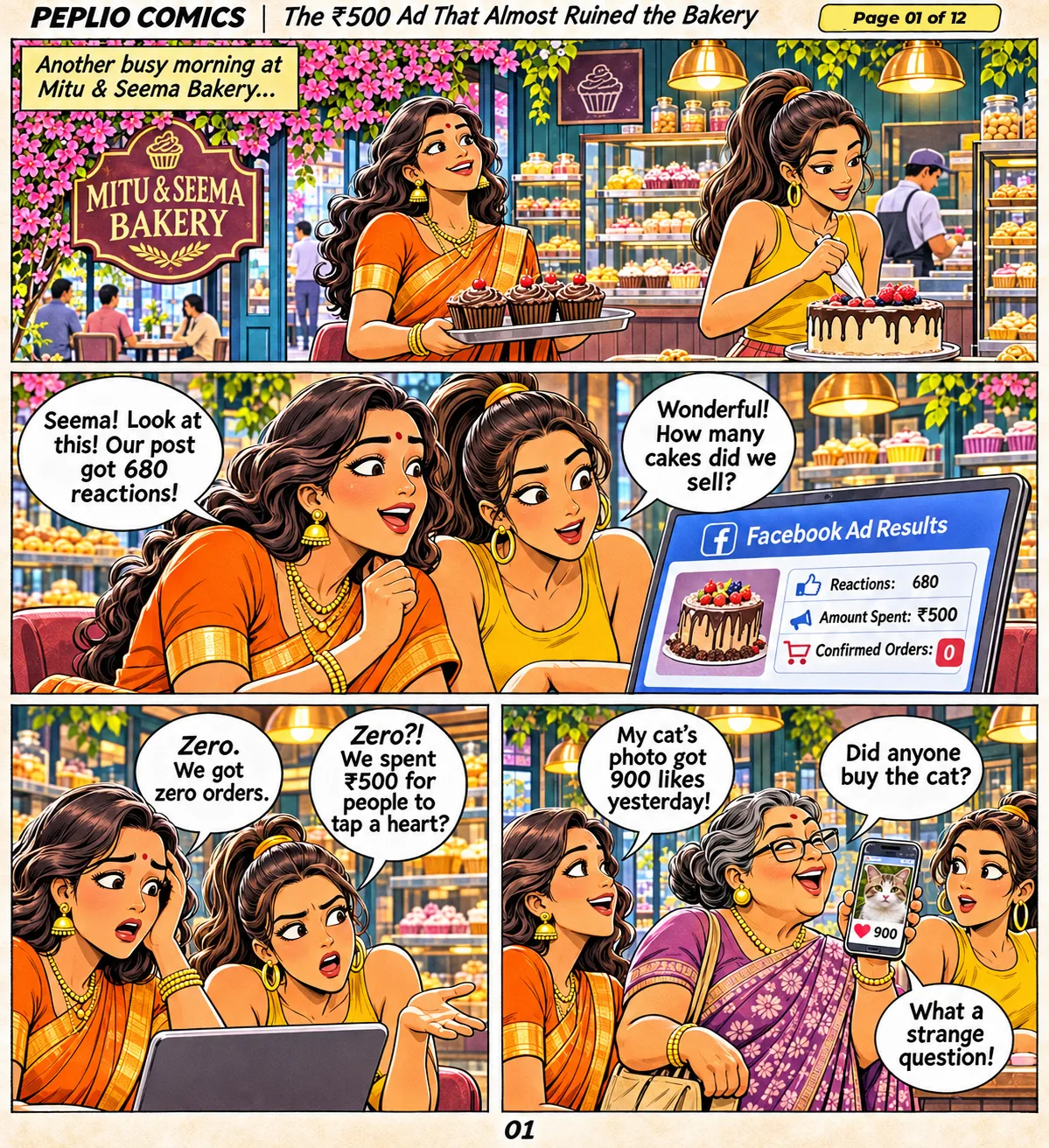
It is a busy morning at Mitu & Seema Bakery, but the order screen is empty. Mitu proudly shows off 680 reactions on a boosted post. Seema asks the only question that matters: how many cakes did we sell? The answer is zero. Then Noisy Aunty walks in bragging that her cat photo got 900 likes. Seema asks if anyone bought the cat.
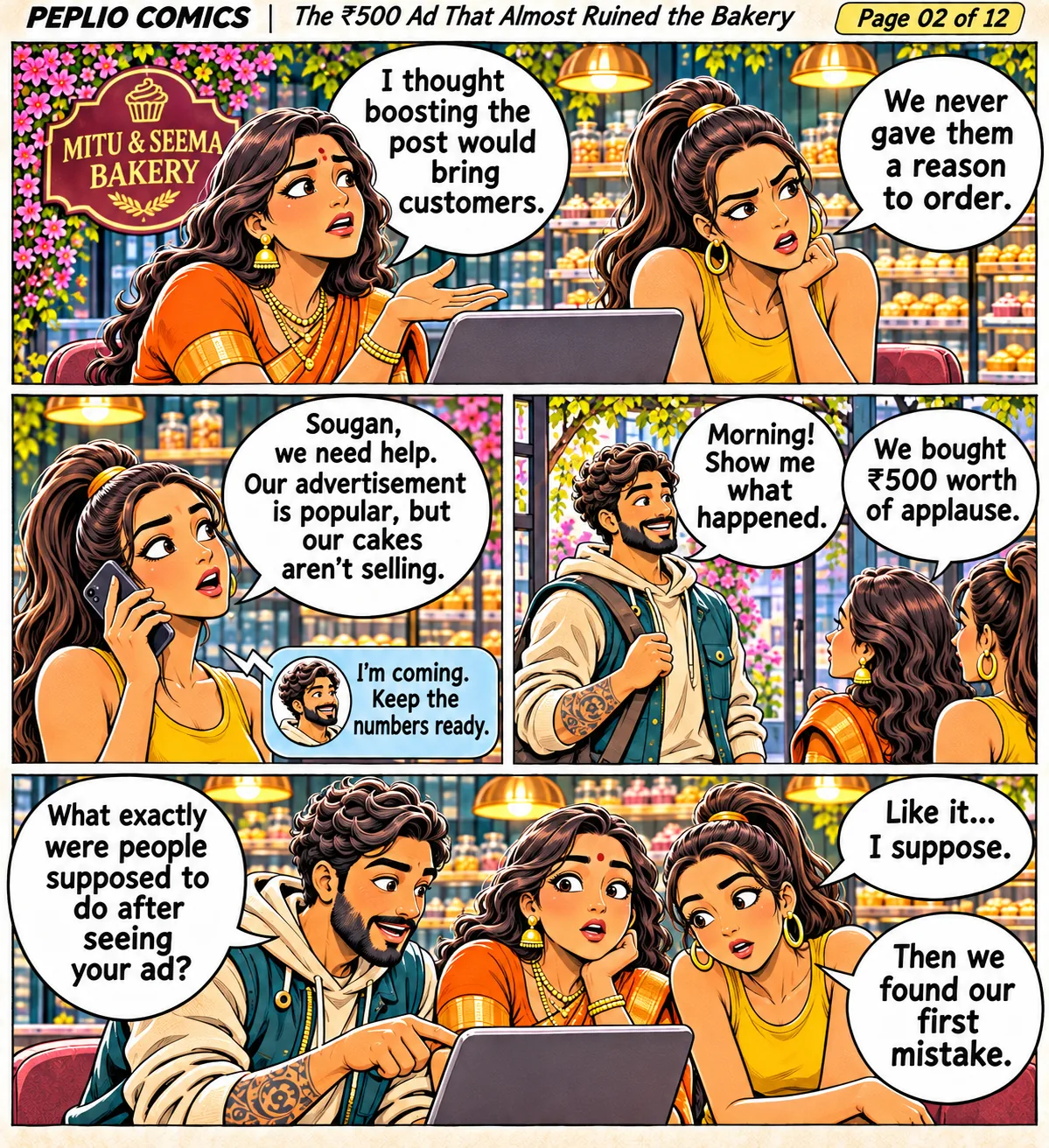
Mitu admits she thought boosting a post would bring customers. Seema puts it plainly: they never gave anyone a reason to order. She calls Sougan, who arrives with his tablet. His first question changes everything: what exactly were people supposed to do after seeing the ad? Nobody had an answer.
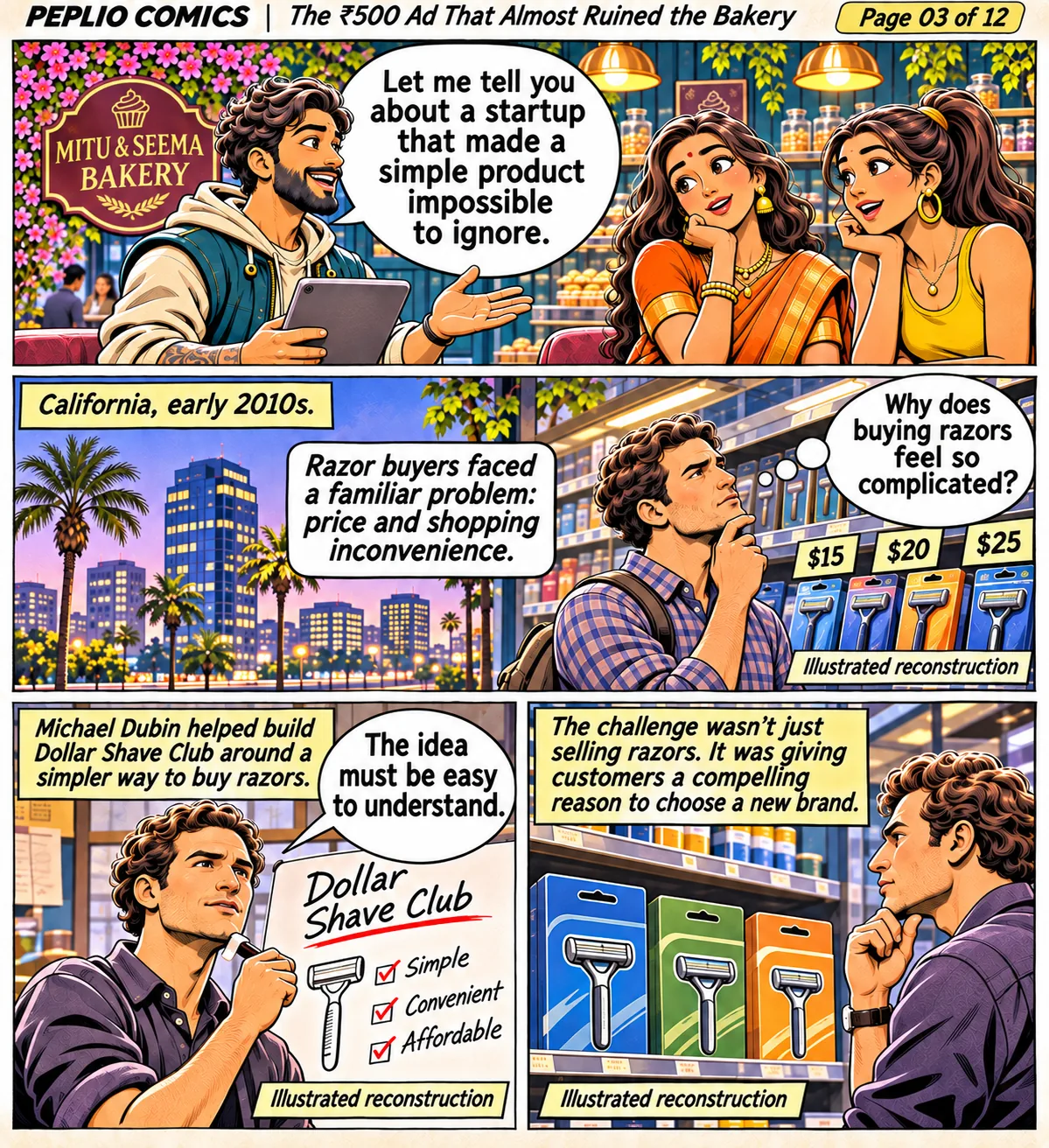
Sougan tells them about a startup that made a simple product impossible to ignore. In the early 2010s, buying razors felt expensive and annoying. Michael Dubin built Dollar Shave Club around a simpler way to buy them. His challenge was not just selling razors. It was giving people a reason to switch to a brand nobody knew.
Read the rest of Episode 14 now
This episode is in early access. Unlock the full comic today for ₹29, or read it free for everyone from 26 Nov.
Secure payment by Razorpay: UPI, cards, net banking and wallets. Your support keeps Peplio comics coming.
End of Episode 14
The bakery now knows its real cost per order. Can a stronger video opening and faster replies turn ₹58 into a profit worth repeating? Find out in Episode 15.
What we learned today
- Likes are attention, orders are the business result
- Every ad needs one product, one price and one next step
- Show ads only to people you can actually serve
- Track conversations, serious inquiries and confirmed orders
- Subtract ad and product costs before calling it a win
- Change one thing at a time, then compare results
Learn it and use it
Read the story and dialogue
It is a busy morning at Mitu & Seema Bakery, but the order screen is empty. Mitu proudly shows off 680 reactions on a boosted post. Seema asks the only question that matters: how many cakes did we sell? The answer is zero. Then Noisy Aunty walks in bragging that her cat photo got 900 likes. Seema asks if anyone bought the cat.
Mitu admits she thought boosting a post would bring customers. Seema puts it plainly: they never gave anyone a reason to order. She calls Sougan, who arrives with his tablet. His first question changes everything: what exactly were people supposed to do after seeing the ad? Nobody had an answer.
Sougan tells them about a startup that made a simple product impossible to ignore. In the early 2010s, buying razors felt expensive and annoying. Michael Dubin built Dollar Shave Club around a simpler way to buy them. His challenge was not just selling razors. It was giving people a reason to switch to a brand nobody knew.
The offer was simple: razors delivered every month, with plans starting at $1. Dubin used his comedy background and decided the founder himself would star in the launch video. Director Lucia Aniello helped shoot it in a warehouse. The core line was easy to remember: buying razors should not be complicated.
The jokes grabbed attention, but the offer told people what they could actually buy. The launch was planned so the video, the website relaunch and a funding announcement all landed together on March 6, 2012. When the video went live, people shared it fast.
Demand was so high that the website crashed soon after launch. The small team got it back online and started shipping. Within about 48 hours, Dollar Shave Club reported roughly 12,000 orders. Back in the bakery, Seema gets it: their video brought customers, not just views, because there was a clear offer and a way to order.
Sougan draws a simple funnel: likes create attention, but orders create revenue. The old post said only "Fresh cakes! Like and share!" with no price and no way to order. So they pick one bestseller, the chocolate cake, and write a clear offer: 500 g for ₹499.
Next, Sougan limits the ad to people inside their delivery area. Seema films Mitu piping icing on the cake for a short video, and Mitu reminds her not to forget the price. The draft ad shows the cake, the price and one button: Message us on WhatsApp. Sougan sets it up as a messaging campaign.
Before spending a rupee, Seema writes a testing plan: spend, conversations, qualified inquiries and confirmed orders. The team checks the video, the offer, WhatsApp and the delivery area. Then it is lights, camera, cake, until Paanwala wanders in asking if someone is giving away free chocolate cake.
Paanwala is sad there is no free cake, but Seema says he just gave them a funny ending. The final video ends with the price and a WhatsApp button. Seema publishes the campaign, Mitu wants to refresh every ten seconds, and Sougan says please don't. Soon the first real questions come in about delivery and Saturday orders.
Not every message is an order. Some people were curious, some lived too far away. Mitu adds delivery details to the ad and Seema writes a reply template. The fictional test shows ₹500 spent, 14 conversations, 6 serious inquiries and 2 confirmed orders. Sougan does the math: ₹998 revenue minus ₹500 ads and ₹440 cake costs leaves only ₹58.
They learned something useful and can now improve with evidence, not guesses. Next time they will test one change at a time: a stronger video opening, clearer delivery info and faster replies. Noisy Aunty's cat now has two thousand likes, and Paanwala asks how many cakes he sold. The lesson: likes feel nice, but orders keep the bakery running.
Sougan's TakeWhat this episode teaches, in plain words
A like costs you money. An order makes you money. Only one of them should decide your next ad.
Mitu spends ₹500 boosting a bakery post and gets 680 likes but zero orders. Sougan explains the real Dollar Shave Club marketing strategy from 2012, then helps the bakery build a clear offer, target nearby buyers and count real orders instead of likes.
I run digital marketing for a chemical company in Durgapur, and I keep seeing local shops pay to boost a pretty photo, collect likes and wonder why the phone never rings. This comic is about that exact mistake, and about the Dollar Shave Club marketing strategy that shows what a small ad budget should really buy.
Read all 12 pages below. If you are new, catch up on all Peplio comic episodes first.
Why a Boosted Post Got Likes but No Orders
Mitu paid to show a nice photo to more people, but the post had no price, no product and no way to order. A boost mostly buys reach and reactions. If the ad does not tell people what to buy and how to buy it, likes are all you get. I compare the two big platforms for small shops in my guide on Instagram vs Facebook ads for small businesses, and Hootsuite explains the difference between a boosted post and an ad.
What the Dollar Shave Club Marketing Strategy Got Right
The video was funny, but humour was not the whole Dollar Shave Club marketing strategy. It had one clear product, a simple monthly price, a founder people trusted and a website ready to take orders. It cost about $4,500 to make and brought roughly 12,000 orders in two days, as reported by NBC News and Entrepreneur. In 2016 Unilever bought the company. Read the background on Wikipedia.
Turn Likes Into Orders: Offer, Audience, Action
This is the Dollar Shave Club marketing strategy shrunk to bakery size. Pick one product, write one clear price, show the ad only to people you can actually deliver to, and give one next step, like a WhatsApp message. Meta's guide to ads that click to WhatsApp shows how the messaging setup works. Make the ad picture in minutes with the Peplio Free AI Image Generator.
Do the Order Math Before You Celebrate
Two orders felt like a win, but after ad spend and cake costs only ₹58 was left, and that is before rent and gas. Always track spend, conversations, serious inquiries and confirmed orders, then subtract your real costs. Cost per order here was ₹250. If paid ads feel too expensive, see my honest comparison of SEO vs paid ads for Indian small businesses.
When I run ads, the first thing I set up is not the creative, it is the tracking sheet: spend, messages, serious leads, confirmed sales. The Dollar Shave Club marketing strategy worked because every laugh pointed to a product, a price and a checkout. Small shops can copy that with ₹500 and a WhatsApp number, as long as they count orders and costs, not hearts.
That is the end of this marketing comic. The Dollar Shave Club marketing strategy is simple to remember: make the offer clear, make ordering easy, and measure orders. Any small business can test the Dollar Shave Club marketing strategy with a tiny budget, and Mitu and Seema just proved the Dollar Shave Club marketing strategy works even for one chocolate cake. Use this Dollar Shave Club marketing strategy on your next ad before you spend another rupee on likes. Catch Episode 15 next.
Quick questions
What was the Dollar Shave Club marketing strategy?
The Dollar Shave Club marketing strategy combined a funny founder-led launch video with a very simple offer: razors delivered monthly from $1. The video launched on March 6, 2012 together with a website relaunch, and the company reported about 12,000 orders in the first 48 hours.
How much did the Dollar Shave Club video cost?
The launch video cost about $4,500 to produce. Its director later estimated that a similar polished video would normally cost companies around $50,000.
Why does a boosted Facebook post get likes but no orders?
A boost mostly buys reach and reactions. If the post has no product, no price and no clear next step, people react and scroll on. Add an offer and a direct action, like a WhatsApp message button.
How can a small shop use the Dollar Shave Club marketing strategy?
Pick one bestseller, write one clear price, show the ad only to people in your delivery area, and give one simple way to order. Then track real orders and costs, not likes.
What should a small business track when running ads?
Track ad spend, conversations or messages, qualified inquiries, confirmed orders, revenue and product costs. Divide spend by confirmed orders to get your cost per order.
Is the bakery's ₹500 test result real?
No. Mitu and Seema's bakery and its campaign numbers are a fictional example made to teach the lesson. The Dollar Shave Club story is real, and the historical pages are illustrated reconstructions with dramatized dialogue.
Sources: Dollar Shave Club (Wikipedia), Michael Dubin (Wikipedia), NBC News: How Dollar Shave Club's ad went viral, Entrepreneur: How Dollar Shave Club's founder built a $1 billion company, Business Wire: Unilever acquires Dollar Shave Club (2016), Hootsuite: Boosted post vs ad, Meta: Ads that click to WhatsApp, Google SEO Starter Guide. The bakery story and its campaign numbers are fictional. Historical scenes are illustrated reconstructions and their dialogue is dramatized.