Digital Growth Strategy for Demech Chemical
Demech Chemical Products Pvt. Ltd. is a 25+ year old B2B industrial chemical manufacturer serving cement, steel, and power sectors across India. When I joined as Digital Marketing Executive in 2022, the company had under 100 monthly website visitors, zero structured digital reporting, and less than 5% of deals originating from online channels. Over 4 years, applying SEO, content marketing, IndiaMART catalog optimisation, LinkedIn strategy, and CRM integration, website traffic doubled, IndiaMART leads grew 130%, online sales increased 25% month-on-month, and the company now generates approximately 15-18 lakhs INR per quarter from digital channels alone.
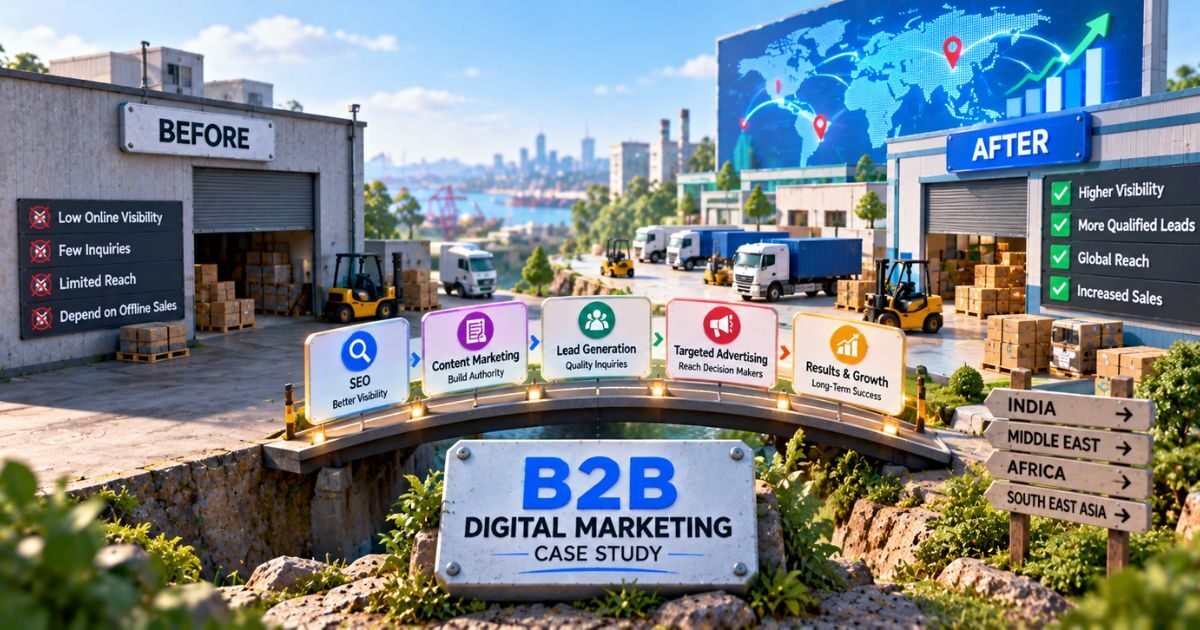
Before — 2022
- Under 100 monthly website visitors
- IndiaMART catalog outdated, no SEO
- LinkedIn — sporadic posts, near-zero engagement
- No structured data or reporting
- 90% sales from offline relationships only
- Less than 5% deals from online channels
After — 4 Years Later
- Website traffic doubled (95% from organic search)
- IndiaMART leads up 130%
- LinkedIn engagement tripled, 15+ direct buyer messages
- Page 1 rankings for key industry terms
- Online sales up 25% month-on-month
- 15-18 lakhs INR quarterly revenue from digital
Case Study Contents
- Company background and the digital gap I found
- The three-part strategy: SEO, content, and sales integration
- Phase-by-phase execution over 4 years
- Results: the numbers that changed everything
- Challenges and what I learned from each one
- Tools used throughout the project
- What I am building next
- Sougan’s Reflection
- FAQ: B2B digital marketing case study
Company background and the digital gap I found in 2022
Demech Chemical Products Pvt. Ltd. is based in Durgapur, West Bengal, and has been serving industrial clients in the cement, steel, and power sectors for over 25 years. The company’s product range includes corrosion inhibitors, epoxy floor coatings, waterproofing compounds, and protective coatings — all backed by technical data sheets, laboratory testing, and on-site application support.
When I joined as Digital Marketing Executive in 2022, all of that expertise existed almost entirely offline. The company had a functional website but it had under 100 monthly visitors, no optimised content, and no structured reporting. Every sale came from long-standing trade relationships, referrals, and field visits. The digital presence was not just weak — it was essentially absent for any buyer who discovered the category through a Google search rather than an industry contact.
The starting point — Demech’s digital snapshot in 2022
IndiaMART: Outdated listings, inconsistent images, no keyword strategy
LinkedIn: Sporadic posts, engagement near zero
Online sales: Less than 5% of deals from online lead forms
CRM: No automated follow-up for digital enquiries
The challenge was not convincing the company that their products were good — they clearly were. The challenge was making those products discoverable to buyers who were searching online, and converting that digital discovery into structured enquiries that the sales team could act on. That required building a system where none existed.
The three-part strategy: SEO, content, and sales integration
I built the digital strategy around three connected pillars. Each one was designed to work on its own, but the real compounding effect came when all three started feeding into each other — organic traffic generating IndiaMART discovery, LinkedIn content building brand trust, and CRM automation ensuring no enquiry went unanswered.
Phase-by-phase execution over 4 years
Year 1 — Foundation (2022-2023)
- Audited entire website — identified thin content, missing meta tags, broken URLs
- Optimised key product pages for industrial search terms: “industrial corrosion inhibitor”, “epoxy floor coating for power plants”
- Built and submitted XML sitemap, fixed technical SEO issues
- Compressed and renamed product images, added descriptive alt text throughout
- Improved page load speed by 30% through image compression and caching
- Set up Google Analytics and Search Console — established baseline reporting
Year 2 — Platform Expansion (2023-2024)
- Manually curated 30 IndiaMART product pages — optimised titles, descriptions, pricing, uploaded high-quality images and TDS datasheets
- Implemented 2-hour inquiry response protocol on IndiaMART — led to 40% rise in managed conversations
- Launched LinkedIn weekly content series: corrosion case studies, technical Q&As, behind-the-scenes chemical testing
- Integrated lead capture forms for “Protective Coatings TDS” brochure downloads
- Aligned CRM so every enquiry from website, IndiaMART, and LinkedIn triggered automated 24-hour follow-up
Year 3 — Results and Refinement (2024-2025)
- First Page 1 Google rankings for key industry terms including “industrial corrosion inhibitor in India”
- Website traffic doubled — 95% of new visitors from organic search
- IndiaMART leads grew 130% — directly attributed to optimised catalog listings
- LinkedIn engagement tripled — 15 direct messages from industrial buyers in cement and power sectors
- Monthly online sales up 25% — first quarter with 15-18 lakhs INR from digital channels
- Internal sales team adoption — weekly dashboard reviews converted sceptics into active users of digital leads
Year 4 — Scaling and Systematising (2025-2026)
- Expanded content marketing — blog guides on industrial applications and coating case studies
- CRM automation deepened — email nurture sequences tied to IndiaMART engagement stages
- Google Ads testing initiated for high-intent terms like “waterproof coating suppliers India”
- Monthly catalog review process formalised — pricing, TDS files, and images updated on a fixed schedule
- Digital revenue now a consistent, predictable line item in quarterly business reporting
Results: the numbers that changed everything
The conversion funnel data below shows how digital channels now function as a structured lead pipeline — not just a traffic source:
| Source | Monthly Visitors | Leads Generated | Conversions | Conversion Rate |
|---|---|---|---|---|
| Organic Search | 1,200 | 45 | 15 | 1.25% |
| IndiaMART | 900 | 50 | 17 | 1.89% |
| 600 | 20 | 7 | 1.17% | |
| Total | 2,700 | 115 | 39 | 1.44% |
Data represents representative monthly figures after strategy maturation. Conversions = confirmed sales orders or purchase enquiries progressed to quote stage.
The overall outcome: approximately 15-18 lakhs INR per quarter in revenue directly attributable to digital channels. In a company where 90% of sales had come from offline relationships for 25 years, this is a structural shift — not a campaign result.
Challenges and what I learned from each one
Challenge 1 — Internal resistance from the sales team
Several sales reps doubted whether online leads were real buyers or just tyre-kickers. The concern was legitimate — industrial B2B buyers have long relationship cycles and online enquiries felt impersonal compared to trade contacts.
What worked: Weekly dashboard demos showing real enquiries, real conversations, and closed deals that had originated from digital channels. Several reps who were sceptical in month one closed their first digital deals by month four.
Challenge 2 — Catalog accuracy at scale
IndiaMART required constant updates — pricing changed, product formulations evolved, TDS files were updated. Letting even one product page go stale affected enquiry quality and buyer trust.
What worked: A monthly catalog review process with a fixed checklist — pricing, images, TDS files, and descriptions checked against the latest product updates. Took 2-3 hours per month and eliminated the accuracy problem entirely.
Challenge 3 — Limited content bandwidth
As a solo digital marketing function, there was no content team. Creating blog content, LinkedIn posts, product updates, and email follow-ups simultaneously was not sustainable from the start.
What worked: Starting with LinkedIn posts only — one per week, written around real problems I had seen on site visits. Once the LinkedIn content pattern was established and producing results, I expanded to blog guides. Sequence mattered more than volume.
Tools used throughout the 4-year project
| Tool | Purpose | Phase Used |
|---|---|---|
| Google Search Console | Keyword ranking tracking, indexing, crawl error monitoring | Year 1 onwards — still active |
| Google Analytics | Traffic source analysis, user behaviour, conversion tracking | Year 1 onwards — still active |
| SEMrush | Competitor keyword analysis, content gap identification | Year 1-2 for initial keyword strategy |
| Canva | LinkedIn graphics, product visual updates, brochure design | Year 2 onwards |
| Salesforce CRM | Lead tracking, automated follow-up workflows, sales pipeline | Year 2 onwards — core to sales integration |
| IndiaMART Seller Panel | Catalog management, inquiry tracking, response analytics | Year 2 onwards |
| Peplio Backlink Prospector | Identifying competitor backlink gaps and B2B link opportunities | Year 3-4 for link building strategy |
What I am building next for Demech
YouTube Technical Channel
Product walkthroughs, application demos, and corrosion case study videos. Industrial buyers research visually — video is the next trust layer after catalog and LinkedIn.
Blog Content at Scale
Industry application guides — “how to select the right corrosion inhibitor for cement plants”, “epoxy vs polyurethane coating comparison”. These target industrial buyers doing research before purchase.
Google Ads Testing
High-intent terms like “waterproof coating suppliers India” and “industrial floor coating Durgapur” to complement organic rankings and capture buyers with immediate procurement intent.
Deepened CRM Automation
Email nurture sequences triggered by IndiaMART engagement stages — buyers who viewed but did not enquire, buyers who enquired but did not convert, and re-engagement for lapsed accounts.
The hardest part of this project was not the SEO or the content. It was convincing people who had sold industrial chemicals face-to-face for 25 years that a buyer who found them through Google was just as real as one who walked in through a referral.
That trust problem inside the organisation was the actual bottleneck — not the digital strategy. Once the data became visible and the sales team started closing deals from digital enquiries themselves, the culture shifted. The lesson I carry from Demech into every digital project including Peplio: the system has to produce visible, undeniable results before it earns internal buy-in. Start with the smallest piece that can produce a result in 30 days. Show it to the people who are sceptical. Let the data do the convincing. Then expand.
See how a small business goes from invisible to found — in comic form
Episode 2 of the Peplio comic series shows Mitu realising that her bakery’s biggest competitor is not the new cafe across the street — it is her own invisibility online. The lessons from that comic are the same ones that drove every decision in the Demech case study. Follow the full series to see how every concept in B2B digital marketing comes to life through real characters and real consequences.
Key takeaways from this B2B digital marketing case study
- Even 25-year-old B2B companies with zero digital presence can build consistent online revenue in 12-18 months with the right system
- SEO, IndiaMART optimisation, and LinkedIn work best when connected through CRM — not as isolated activities
- Fast inquiry response (2-hour protocol) was the single highest-ROI change on IndiaMART — led to 40% rise in managed conversations
- Internal resistance is a bigger obstacle than technical implementation — make the data visible early and often
- Start with one content format (LinkedIn posts) and establish a pattern before adding more channels
- Monthly catalog review prevented the accuracy decay that kills IndiaMART performance over time
- Digital revenue in B2B is not campaign revenue — it is structural revenue that grows and compounds
People Also Asked
Does digital marketing work for B2B industrial companies in India?
Yes — and this case study is direct evidence. Demech Chemical Products operates in industrial segments (cement, steel, power) where most buyer-seller relationships have been built offline for decades. By applying SEO to product pages, optimising the IndiaMART catalog, and building LinkedIn content authority, the company generated 15-18 lakhs INR per quarter from digital channels within 3 years — in a sector where most competitors still have no structured digital strategy. The opportunity gap in Indian B2B industrial marketing is significant precisely because adoption is still low.
What is the most important digital marketing channel for B2B in India?
Based on four years at Demech, IndiaMART and organic search are the two highest-ROI channels for B2B industrial companies in India. IndiaMART because it is where active buyers with immediate procurement intent search for suppliers — the conversion rate there (1.89% in this case study) is higher than organic search because the buyer intent is more specific. Organic search because it captures buyers earlier in their research process and builds brand authority that IndiaMART alone cannot. LinkedIn is secondary but valuable for brand trust — it directly influenced 15 buyer conversations that led to sales in this case.
How long does it take to see results from B2B digital marketing?
From zero to first measurable results: 3-6 months with consistent execution. From first results to a structured revenue contribution: 12-18 months. From structured revenue to a predictable quarterly line item in business reporting: 24-36 months. These timelines assume consistent monthly effort — the companies that see slower results are almost always the ones that start strong for 3 months and then let the strategy lapse when results are not yet visible. B2B digital marketing compounds over time in the same way that trade relationships compound — the early months build the foundation, the later months produce the returns.
FAQ: B2B digital marketing case study
What made IndiaMART the highest-converting channel in this case study?
Three factors combined: first, IndiaMART buyers are active procurement professionals with specific purchase intent — they are not browsing, they are sourcing. Second, the 2-hour inquiry response protocol meant Demech was consistently the first supplier to engage, which gives a significant advantage in B2B selling. Third, high-quality TDS files and product images built trust before the first conversation — buyers could evaluate technical fit before contacting. The 130% lead increase from IndiaMART optimisation confirms that the platform’s value was always there — it just needed the right catalog structure and response system to unlock it.
How did LinkedIn contribute to B2B sales for an industrial chemical company?
LinkedIn’s contribution was primarily trust-building rather than direct lead generation. The weekly content series — real corrosion case studies, technical Q&As, behind-the-scenes of chemical testing — established Demech as a company with genuine technical expertise, not just a product catalog. When a buyer who had seen three LinkedIn posts received an IndiaMART inquiry response from Demech, the brand was already familiar. That familiarity shortened the trust-building phase of the sale. The 15 direct messages from buyers were secondary — the primary value was the credibility that made every other channel’s conversions easier.
Can a small B2B business implement this strategy without a dedicated marketing team?
Yes — the Demech strategy was built and executed by one person across four years. The key to making it work as a solo function is sequencing: foundation first (SEO and analytics setup), then one platform at a time (IndiaMART before LinkedIn, LinkedIn before blog), then automation (CRM workflows to reduce the manual follow-up burden). The monthly time investment for a solo B2B digital marketer maintaining this system at maturity is approximately 15-20 hours per month — comparable to what a traditional sales rep spends on prospecting, but producing compounding returns rather than one-off transactions.
What SEO keywords work best for B2B industrial companies in India?
For industrial B2B companies in India, the keywords that produce the highest-quality leads are specific product-application combinations rather than generic product names. “Industrial corrosion inhibitor for cement plants” outperforms “corrosion inhibitor” because it attracts buyers from the specific sector who are more likely to match the company’s actual customer profile. Keywords including “suppliers in India”, specific city names, and technical specifications (grade, application method, industry standard compliance) consistently outperform broad category terms. Long-tail, high-specificity keywords in B2B industrial have lower monthly search volume but conversion rates 3-5x higher than broad terms.
External references: IndiaMART Seller Platform | SEO for Small Business India | How to Build Micro Tools Website Traffic. All performance data from Demech Chemical Products’ internal reporting. Updated September 2026.
This B2B digital marketing case study from Demech Chemical Products proves that even traditional industrial companies with no digital history can build consistent online revenue through structured SEO, platform optimisation, and CRM integration. The B2B digital marketing case study approach documented here — starting with SEO foundations, expanding to IndiaMART and LinkedIn, and connecting everything through automated CRM workflows — is replicable for any B2B company in India regardless of sector or size.
The most important insight from this B2B digital marketing case study is that digital marketing in industrial B2B is not about volume — it is about precision. Every decision in this B2B digital marketing case study was made to attract the right buyer at the right stage of their procurement process, respond faster than competitors, and build the kind of technical credibility that converts a digital enquiry into a long-term industrial supply relationship.