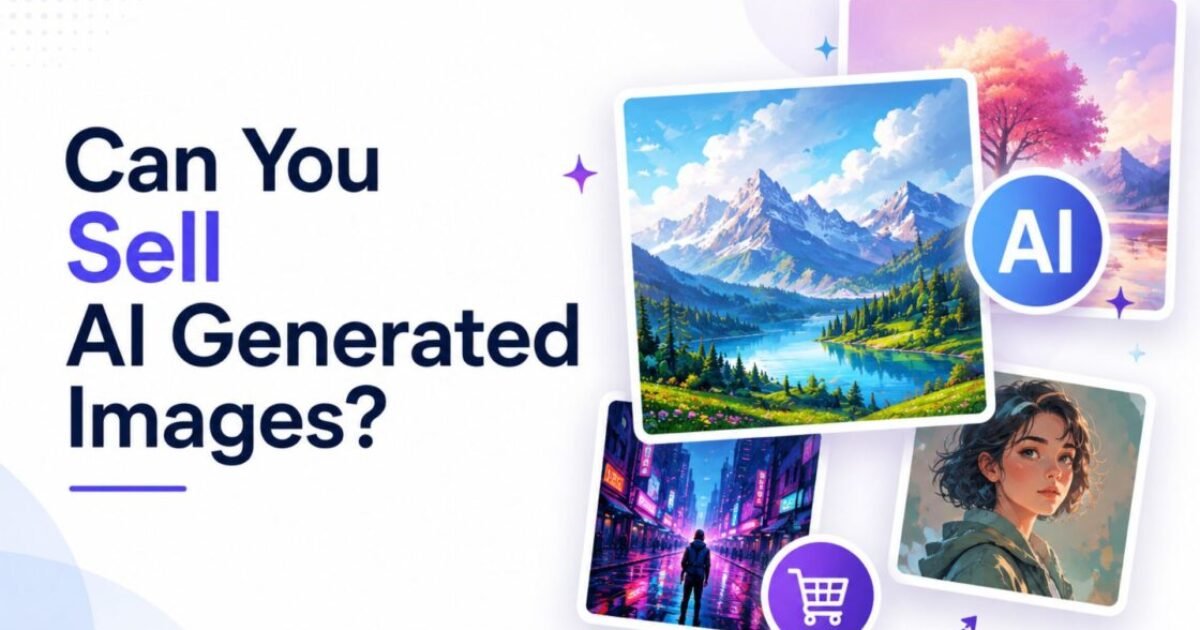
Can You Sell AI-Generated Images? Copyright Rules Explained (2026)
Sources: US Copyright Office (2023–2026), Etsy Seller Policies (2026), platform terms of service reviewed June 2026
Can you sell AI generated images? Yes, in most cases — but the legal protection differs from traditional artwork. I get asked this every week from bloggers, Etsy sellers, and small business owners experimenting with AI art as a side income. I get asked this every week from bloggers, Etsy sellers, and small business owners experimenting with AI art as a side income. The honest answer is more nuanced than a simple yes or no — and most guides online conflate two completely different questions: “is it legal to sell” and “do you legally own it.”
I personally generate and sell AI generated images and use AI images across Peplio every week — hero images, social graphics, product mockups. Before relying on them commercially, I researched exactly where the legal lines sit in 2026. This guide gives you the complete picture: what the US Copyright Office actually says, what major AI tools permit, what marketplaces like Etsy and Shutterstock require, and the practical steps to protect yourself if you want to sell AI generated images as part of your business.
If you’re scaling AI visuals as part of a broader business strategy, also read our guide on AI image generation for businesses — it covers the workflow side of what this article covers legally.
- The short answer — can you sell AI generated images?
- Why AI images sit in a copyright gray zone
- What major AI tools say about commercial use
- Selling on Etsy, Shutterstock, and print-on-demand sites
- The training data lawsuit risk
- How to protect yourself when selling AI images
- What you should NOT sell as AI art
- FAQ
The Short Answer — Can You Sell AI-Generated Images?
Yes — in most cases you can sell AI generated images, and many creators already do this successfully. Selling them is widely done across Etsy, Redbubble, stock photo sites, and print-on-demand stores, and the practice is generally permitted by both AI tools and major marketplaces. But “can you sell AI generated images” and “can you legally protect AI generated images from being copied” are two separate questions, and the gap between them is what this guide is really about.
Here’s the core issue: in the United States, the Copyright Office has repeatedly stated that works generated entirely by AI, with no meaningful human creative input, cannot be copyrighted. That doesn’t make selling them illegal — it means you may not be able to stop someone else from copying and reselling the exact same image, because there is no copyright to enforce in the first place.
So the practical answer to “can you sell AI generated images” breaks down into three separate questions — and understanding can you sell AI generated images legally starts with separating them:
- Is it legal to sell? — Generally yes, with platform-specific exceptions.
- Can you protect it from being copied? — Often no, unless you’ve added substantial human edits.
- Could the underlying AI model create legal exposure? — Possibly, depending on ongoing training-data lawsuits.
I want to be direct about why this question matters so much right now. Thousands of people are asking “can you sell AI generated images” because AI art has become a genuine income stream — Etsy shops full of AI-generated printables, Redbubble stores stocked with AI t-shirt designs, stock portfolios padded with AI-generated lifestyle photos. The volume is enormous, and for the most part it’s allowed. But “allowed” and “fully protected” aren’t the same thing, and understanding that gap is what separates a sustainable AI image business from one that gets blindsided later.
Why AI Images Sit in a Copyright Gray Zone
Copyright law was built around the idea of human authorship. The US Copyright Office’s guidance on AI and copyright clarified that copyright protection requires a human author — and a text prompt alone typically isn’t considered enough “creative control” to qualify on its own.
This means if you type “a fox in a forest, watercolor style” into an AI generator and get an image, that raw output likely cannot be copyrighted by you. Anyone else could generate something nearly identical, or simply screenshot and reuse your image, and you would have limited legal recourse based on copyright alone.
However — if you take that AI output and meaningfully edit it (compositing, painting over sections, combining multiple generations, significant manual adjustment), the resulting work may qualify for copyright protection on the human-authored portions. This is why many sellers treat AI generation as a “first draft” and add real editing work on top.
Can You Sell AI Generated Images in Practice? What This Means
Can you sell AI generated images as a small seller without issues? For most small sellers — Etsy shops, print-on-demand stores, stock photo contributors — this gray zone rarely causes real problems day to day. The volume of AI content being sold commercially is enormous, and enforcement against individual sellers for “lack of originality” is not currently a major risk. The bigger risks in practice are platform-specific rules and the training-data lawsuits covered later in this guide.
I think of it this way: “can you sell AI generated images” has a much lower bar than “can you build a defensible portfolio out of AI generated images.” The first is almost always yes. The second requires real work — editing, compositing, combining your own photography or illustration with AI elements, and developing a consistent style that becomes recognisable as yours regardless of the underlying tool.
There’s also a practical reality worth naming: the market for AI images is so saturated that the bigger business risk usually isn’t legal — it’s competitive. If anyone can generate something visually similar with a free tool and a five-word prompt, your differentiation has to come from curation, niche selection, bundling, or customisation — not from the image itself being legally unique.
What Major AI Tools Say About Commercial Use (Can You Sell AI Generated Images From Each One?)
Every AI image tool has its own terms of service regarding commercial use — and they vary significantly. Here is how the major free tools I cover regularly on Peplio generally handle it:
| Tool | Commercial Use Allowed? | Notes |
|---|---|---|
| Bing Image Creator | Yes | Microsoft’s terms explicitly permit commercial use of outputs on the free tier |
| Perchance | Generally yes | Broad usage rights stated; verify current terms before large commercial runs |
| Craiyon | Generally yes | Permissive terms; images considered usable for most purposes |
| Hugging Face Spaces | Varies by space | Depends on the underlying model’s license — check each space individually |
| DeepAI | Check current terms | Commercial terms have changed historically; verify before relying on it |
Can you sell AI generated images made with these tools commercially? The pattern across most tools: if you generated the image yourself using your own prompts, you generally have permission to use it commercially, including selling it. The exception is when a tool explicitly reserves commercial rights or requires a paid tier for commercial licensing — always read the specific terms before building a business around one tool. For the no-login, no-watermark options I rely on most, see my guide on the best free AI image generators without login.
Where Can You Sell AI Generated Images? Etsy, Shutterstock, and Print-on-Demand
Even if a tool permits commercial use, the marketplace you’re selling on may have its own AI-specific rules. This is where sellers most often get caught off guard.
Can You Sell AI Generated Images on Etsy?
Etsy’s seller policies allow AI-generated items but require sellers to disclose that an item was made using AI tools. Failing to disclose this can result in listing removal. The disclosure requirement applies to both physical products and digital downloads.
Can You Sell AI Generated Images on Stock Photo Platforms?
Major stock platforms have introduced AI-specific submission categories and metadata tagging requirements. Some platforms restrict AI content from certain categories — particularly images depicting real, identifiable people — due to likeness and consent concerns. Always check the current AI content policy of any stock platform before submitting, as these policies have changed multiple times since 2023 and continue to evolve.
Can You Sell AI Generated Images via Print-on-Demand?
Most print-on-demand platforms allow AI-generated designs but enforce strict content policies around copyrighted characters, trademarked logos, and recognisable celebrity likenesses — regardless of whether the image was AI-generated or hand-drawn. The AI origin doesn’t exempt you from these underlying IP rules.
The Training Data Lawsuit Risk — Does It Affect Whether You Can Sell AI Generated Images?
Several ongoing lawsuits involve AI companies and the data used to train their image models — artists and rights holders arguing that training on copyrighted images without permission infringes their rights. These cases are still working through courts and the outcomes could affect AI image tools going forward.
Can you sell AI generated images while these lawsuits are ongoing? What does this mean for someone trying to sell AI generated images today? For most individual sellers, the practical exposure is low — these lawsuits target the AI companies themselves, not end users generating images through their tools. However, it’s worth being aware that:
- The legal landscape around AI training data is actively evolving and could affect tool availability or terms in the future
- Some AI companies have begun offering “indemnification” for enterprise or paid users — meaning they’ll cover legal costs if a generated image is challenged. Free tiers typically don’t include this
- If your business depends heavily on AI-generated content, diversifying across multiple tools reduces your exposure if any single tool faces legal restrictions
If your business relies heavily on AI visuals — for example, if you’re scaling AI image generation for your business — this is worth monitoring as the legal landscape develops through 2026 and beyond.
How to Protect Yourself When You Sell AI Generated Images
If you’re still asking can you sell AI generated images safely, here is a practical checklist before you sell AI generated images commercially:
- Read the specific tool’s commercial use terms — not the general terms of service, but the section specifically addressing commercial rights and ownership of outputs.
- Disclose AI usage where required — Etsy and similar platforms require this. Disclosure protects you from policy violations even if it feels unnecessary.
- Add meaningful human edits — compositing, colour correction, combining elements, or manual touch-ups strengthen any copyright claim and differentiate your product.
- Avoid generating recognisable people, characters, or logos — this creates separate legal issues (publicity rights, trademark) that exist regardless of AI involvement.
- Keep records of your prompts and process — if you ever need to demonstrate the creative process behind a piece, your prompt history and iteration steps help.
- Diversify your tools — don’t build an entire business on a single AI tool’s outputs if that tool’s terms could change.
Can you sell AI generated images as a long-term business rather than a one-off experiment? The diversification point matters most. Building a shop entirely around one tool’s free tier means your business is exposed to that single tool’s terms-of-service changes. I’ve seen this happen — a tool quietly updates its commercial use policy, and sellers who built entire catalogues around it suddenly have to re-evaluate everything they’ve listed.
A more resilient approach: use AI generation as the starting point, but build a repeatable editing or curation process on top of it. That process — your selection criteria, your editing style, your niche focus — is the part of the business that’s actually yours, regardless of how the underlying copyright questions around AI images eventually get resolved.
Can You Sell AI-Generated Images Without Any Edits at All?
This is worth addressing directly because it’s the version of the question most people actually mean. Technically, yes — many marketplaces permit listing raw, unedited AI output for sale, and millions of such listings exist right now across Etsy, Redbubble, and stock platforms. The legal permission to sell exists independent of how much editing you’ve done.
So can you sell AI generated images with zero edits and still build a business? What changes with zero edits is your competitive position, not your legal standing. An unedited AI image is trivially reproducible by anyone with the same tool and a similar prompt — so “can you sell AI generated images” with no modifications is really a question about whether that’s a viable long-term strategy, not whether it’s allowed.
What You Should NOT Sell — Even If You Can Sell AI Generated Images Generally
Even where you generally can sell AI generated images, these categories create legal risk independent of how the image was made:
- Recognisable real people — even AI-generated, images depicting identifiable individuals can violate right-of-publicity laws, especially for commercial use
- Copyrighted characters — an AI generated image “in the style of” a Disney or Marvel character is still potentially infringing; AI origin doesn’t change that
- Trademarked logos or brand elements — same principle; trademark law doesn’t care how the infringing image was created
- Direct copies of existing artworks — prompts designed to closely replicate a specific living artist’s distinctive style and signature work sit in particularly contested legal territory
Whether or not you can sell AI generated images in a given category, these restrictions exist whether you’re selling a hand-painted piece or an AI generation — the AI doesn’t add risk here, but it also doesn’t remove it.
- Yes — you can sell AI generated images on most marketplaces, but legal protection differs from traditional artwork
- Pure AI output with no human input generally cannot be copyrighted in the US
- Meaningful human edits strengthen any ownership claim and improve differentiation
- Etsy requires AI-use disclosure; stock and print-on-demand platforms have their own AI policies
- Avoid recognisable people, copyrighted characters, and trademarked logos regardless of AI involvement
- Diversify tools — don’t build a business entirely on one AI provider’s free-tier terms
- Differentiation comes from curation and editing, not from the raw image being legally unique
Frequently Asked Questions
Can you sell AI generated images on Etsy?
Yes, but Etsy requires you to disclose that the item was created using AI tools. This applies to both physical products and digital downloads. Failure to disclose can result in listing removal, so check Etsy’s current AI disclosure policy before listing.Do I own the copyright to AI generated images?
In the US, purely AI generated images with no meaningful human creative input generally cannot be copyrighted, according to US Copyright Office guidance. If you significantly edit or combine AI outputs with your own creative work, the human-authored portions may be protectable. Rules vary by country, so check your local copyright office for jurisdiction-specific guidance.Can someone else legally copy and sell my AI generated image?
Potentially, yes — if the image lacks copyright protection because it was purely AI-generated with minimal human input, there may be no copyright for you to enforce against a copy. This is why many sellers add substantial manual edits to AI outputs before selling, to strengthen any ownership claim.Is it illegal to sell AI art that looks like a specific artist’s style?
Generating images “in the style of” a living artist sits in contested legal territory, particularly when it closely mimics distinctive, recognisable characteristics of that artist’s signature work. While style itself isn’t traditionally copyrightable, courts are actively examining AI-specific cases. The safer approach is to use AI tools for original concepts rather than explicitly replicating a named artist’s style for commercial sale.Which AI image generators have the clearest commercial use policy?
Bing Image Creator has one of the clearest stated commercial use policies among free tools, explicitly permitting commercial use of generated images. Always verify current terms directly on the tool’s website before relying on this for business use, as policies can change.Do I need to disclose AI use when selling stock photos?
Most major stock photo platforms now require AI content to be tagged or submitted through dedicated AI categories, separate from traditional photography. Some platforms also restrict AI submissions in certain categories, particularly those involving recognisable people. Check the specific platform’s AI content policy before submitting.
- AI Image Generation for Businesses
- Best Free AI Image Generator Without Login Unlimited (2026)
- Why Do AI Images Look Fake?
- How to Write Prompts for AI Image Generators — 25 Examples
- Perchance AI Image Generator Review 2026
- 🎨 Try the Best Free AI Image Generator Without Login — unlimited generations, no signup needed.
- 🛠️ Explore Free SEO & Marketing Tools — built for bloggers and small businesses.
- 📖 Read Digital Marketing Comics — learn SEO and marketing through fun stories.
Want to Use AI for Your Marketing?
Now that you know how to use AI image tools, here’s what to do next on Peplio: