
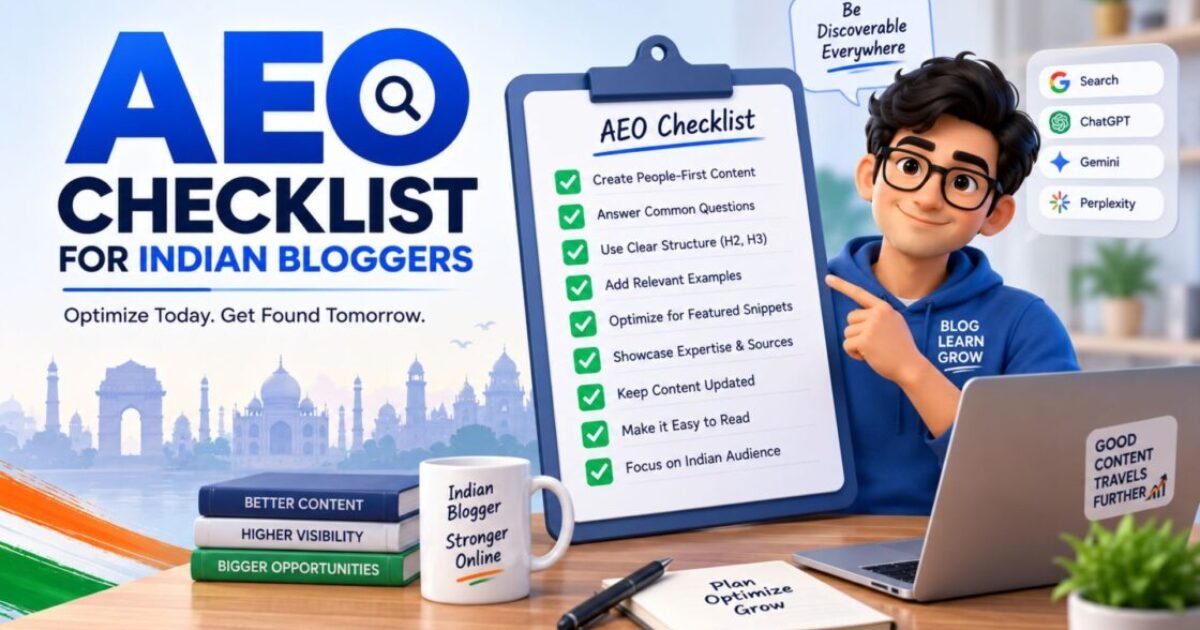
AEO Checklist for Indian Bloggers: 18 Proven & Powerful Fixes for 2026
Founder, Peplio · Digital Marketing Executive, Demech Chemical Products, Durgapur · Published: September 2026
This AEO checklist for Indian bloggers covers every fix needed to move from Medium to High AI Overview readiness — based on real data from our audit of 15 Indian digital marketing blogs. Average audit score: 61.4/100. This checklist closes every gap we found. Use it on any existing article in 30 minutes or less.
Over the past week, I published two data-driven articles that exposed a hard truth about Indian digital marketing blogs. First, India’s first AEO audit showed the average AEO score across 15 Indian blogs is just 61.4/100. Then, the 5 AEO mistakes Indian blogs make broke down exactly what is going wrong — site by site, mistake by mistake.
Every reader of those articles asked the same question: “Okay — so what do I actually do?”
This is that answer. A complete, step-by-step AEO checklist for Indian bloggers that covers every single fix — in the exact order to apply them — so you can move any existing article from Medium AI Overview readiness to High readiness in one sitting.
This AEO checklist for Indian bloggers is built entirely on the real audit data. Not theory. Not generic global advice. Every item on this checklist directly addresses a weakness found in the 15-blog dataset. If a fix is on this list, there is data behind it.
- Before you start — score your article first
- Section 1 — Direct Answer fixes (0–10 minutes)
- Section 2 — Structure fixes (5–10 minutes)
- Section 3 — FAQ and schema fixes (2–5 minutes)
- Section 4 — Citations and stats fixes (3–5 minutes)
- Section 5 — Entity and freshness fixes (5 minutes)
- Section 6 — Readability fixes (10 minutes)
- After the checklist — verify and resubmit
- Which articles to fix first — the priority order
What This AEO Checklist for Indian Bloggers Is Based On
This AEO checklist for Indian bloggers is the direct output of a structured audit I ran in September 2026. I scored 15 Indian digital marketing blogs using the Peplio AEO Content Scorer across 6 AEO signal categories. The full dataset, findings, and site-by-site scores are published in India’s first AEO score audit.
The 5 specific mistakes that appeared across the dataset are detailed in 5 AEO mistakes Indian blogs make. This checklist translates those mistakes into actionable fixes — one item per gap, in order of impact.
To understand why AEO matters alongside SEO and GEO, read the complete AEO vs SEO vs GEO guide for Indian bloggers.
Before You Start — Score Your Article First
Before running this AEO checklist for Indian bloggers on any article, get a baseline score. This tells you which sections to prioritise and shows you the before/after improvement when you rescore at the end.
How to get your baseline score:
- Go to the Peplio AEO Content Scorer
- Paste your article URL or paste the content directly
- Note your score in all 6 categories — write them down
- Run through this checklist fixing each item
- Rescore at the end to verify improvement
The average baseline for Indian blogs in our audit was 61.4/100. If your score is above that — great, you start ahead. If it is below — this checklist will help even more.
Section 1 — Direct Answer Fixes (0–10 Minutes)
Direct Answer averaged just 29.5% across all 15 audited sites — the weakest category in the entire dataset. This section of the AEO checklist for Indian bloggers fixes that gap. It was found lacking on 13 of 15 sites.
Your article’s first 2 sentences must answer the title question completely. Use this template: “[Subject] is [definition]. It works by [key mechanism].” No storytelling, no scene-setting — answer first, context second. Worth 8–10 points on Direct Answer score.
A dedicated Quick Answer box (2–3 bullet points) placed before the intro paragraph gives AI Overviews a clean, extractable answer block. This is the single highest-impact structural change in this entire AEO checklist for Indian bloggers. Peplio uses this on every article — the blue box you see at the top of this page is exactly that.
AI Overviews do not only pull from the article opening — they also extract section-level answers. The first sentence under every H2 should directly address what that section promises. If your H2 says “What is keyword research” — your first sentence should define keyword research immediately, not set context.
Section 2 — Structure Fixes (5–10 Minutes)
Structured Format averaged 13.9 out of 20 across the 15 audited sites — the second strongest category overall. But 4 sites scored below 10 here. This section of the AEO checklist for Indian bloggers ensures your structure fully signals content organisation to AI systems.
AI systems use H2 headings as navigation anchors when extracting cited sections. If your article has long unbroken paragraphs without H2 breaks, AI cannot reliably identify where one topic ends and another begins. Aim for one H2 per 250–300 words of content minimum.
List formats are extracted by AI Overviews preferentially over prose for procedural and enumeration content. If your article explains steps, mistakes, or tips — convert at least one section to a numbered list and one to bullets. Digital Deepak scored 20/20 on Structure with 7 numbered lists and 4 bullet lists in one article.
Tables are highly valued by AEO scoring because they present structured data in a machine-readable format. Even one comparison table — comparing two tools, two approaches, or two time periods — adds significant Structured Format score. If your article compares anything, put it in a table.
Section 3 — FAQ and Schema Fixes (2–5 Minutes)
This is the fastest highest-impact section of the entire AEO checklist for Indian bloggers. In our audit, sites with FAQ schema averaged 74.2/100 vs 57.1/100 without it — a 17-point gap from 2 minutes of work. 11 of 15 sites had no FAQ schema.
Add a dedicated FAQ section at the bottom of every article. Use real questions from Google’s “People Also Ask” for your target keyword. Minimum 6 questions with full-sentence answers. Each answer should be self-contained — answerable without reading the rest of the article. This is what AI Overviews extract directly.
Use the Peplio AEO Content Scorer to auto-generate FAQPage JSON-LD from your question headings. Paste the output into a Custom HTML block via WPCode. Takes under 2 minutes. Without this schema, even perfect FAQ content is invisible to AI citation systems. This is the single fastest fix in this entire AEO checklist for Indian bloggers relative to its impact.
At least 3 of your H2 headings should be phrased as questions that match your target keyword’s People Also Ask results. “What is AEO?” scores better than “Understanding AEO” because AI Overviews match question-format headings to question-format queries more reliably. This is how Teja Nair scored 20/20 on FAQ Coverage — every heading was a searchable question.
Section 4 — Citations and Stats Fixes (3–5 Minutes)
Citations and Stats was the strongest category in our audit — averaging 82% across all 15 sites. But placement was the problem: most Indian blogs bury statistics in the middle of the article, not in the opening 200 words where AI Overviews scan first. This section of the AEO checklist for Indian bloggers fixes that.
Add one statistic from a credible named source before your first H2 heading. Format: “[X]% of [audience] [finding] — [Source, Year].” Link the source name. Use Statista, HubSpot, Semrush, or Think with Google. This was the most common omission in our audit — only 3 of 15 sites had this in their opening section.
External links to authoritative sources signal editorial credibility to AI citation algorithms. Minimum 5 outbound links to real sources — not random sites, but Google, Ahrefs, Semrush, HubSpot, Statista, or government/research institutions. These should be placed naturally in the body where you reference data, not clustered at the bottom.
Original data is the highest-value citation signal of all. If you have conducted a survey, run a tool audit, or collected any first-party data — cite it explicitly. “Based on our audit of 15 Indian blogs, the average AEO score was 61.4/100 (Peplio, September 2026)” carries more AI citation weight than any third-party statistic because it is unique and cannot be found elsewhere. This is why the AEO audit article has strong AEO credentials — it contains data that only exists on Peplio.
Section 5 — Entity and Freshness Fixes (5 Minutes)
Entity Coverage averaged 80% in our audit — the second strongest category. But even strong scorers missed simple entity signals that this section of the AEO checklist for Indian bloggers addresses.
AI systems understand topic context through named entities — tools, brands, people, organisations. An article about SEO that mentions Google Search Console, Semrush, and Ahrefs by name is contextually richer than one that says “use analytics tools.” Name specific entities relevant to your topic throughout the article — minimum 3 named brands or tools.
Recent year mentions are a direct AEO signal — they tell AI systems your content is current. Include the current year naturally in the opening section. “In 2026, over 48% of Google queries trigger an AI Overview” is better than “AI Overviews are becoming common.” One year mention in the first 200 words plus one more mention in the conclusion is sufficient.
For existing articles, add a visible “Last Updated: September 2026” line in the author box or intro. Google Discover and AI systems weight content freshness heavily. Even a minor update — adding one new statistic, fixing one fact — justifies updating the “Last Updated” date. This is a quick win on any existing article. Use the Peplio Website Speed Analyzer after updating to verify your page still loads fast.
Section 6 — Readability Fixes (10 Minutes)
Readability averaged 59% across all 15 audited sites — the second weakest category. This section of the AEO checklist for Indian bloggers takes the most time but delivers lasting improvement across all future articles once you develop the habit.
Do one editing pass through the entire article with this single rule: if a sentence is over 25 words, split it at a natural break point. Use a period where you currently use “and,” “which,” “because,” or a comma. You are not changing your argument — you are making each idea its own extractable unit. Digital Deepak averaged 13 words per sentence and scored 10/10 on Readability. IIDE averaged 52 words and scored 5/10.
Several sites in our audit failed Readability partly due to thin content — their main article content was under 800 words. AI Overviews prefer citing comprehensive content. If your article is under 800 words, expand it — add one more section, a case study, or a step-by-step breakdown. The Peplio AEO Scorer shows your word count in the Readability section.
AI systems extract and present content to users who asked questions in natural language. Content that uses clear, direct vocabulary is preferred over content heavy with jargon — not because jargon is wrong, but because clear vocabulary makes extraction more reliable. Say “search engines” before “organic search engines with crawl-based indexing mechanisms.” Introduce technical terms, then use plain language equivalents.
After the Checklist — Verify and Resubmit
Once you have worked through all 18 items in this AEO checklist for Indian bloggers, do these three things before you are done.
Step 1 — Rescore your article. Go back to the Peplio AEO Content Scorer and score the same article again. You should see a meaningful improvement — typically 10–20 points if you have fixed all 18 items. If a specific category is still low, re-read that section of this checklist and check what you missed.
Step 2 — Check AI visibility. Use the Peplio AI Visibility Tracker to check whether your article’s topic is already appearing in ChatGPT, Gemini, or Perplexity. If it is, your article is now a competitor for those citations. If it is not, your article is entering an uncrowded citation pool.
Step 3 — Request reindexing in Google Search Console. Go to GSC → URL Inspection → paste your article URL → Request Indexing. After significant updates, Google needs to recrawl your article to pick up the changes. Do this for every article you update using this AEO checklist for Indian bloggers.
Which Articles to Fix First — The Priority Order
You have 130+ articles on Peplio. Running this full AEO checklist for Indian bloggers on all 130 would take weeks. Here is the order of priority based on which articles will benefit most.
In GSC → Performance → filter by Impressions descending. Articles with 500+ impressions but under 2% CTR are ranking but not getting clicked. AEO fixes here deliver the fastest traffic increase.
Articles ranking position 11–20 are on page 2 of Google. AEO fixes — especially FAQ schema — can push these into AI Overviews even without moving organic ranking position.
Run this checklist on every new article BEFORE publishing. Starting AEO-ready is easier than retrofitting. Check your score in the Peplio AEO Scorer before you hit publish on anything new.
Mitu ran this AEO checklist on her bakery blog 📋
Follow India’s first Digital Marketing Comic Universe — Mitu, Seema, Sougan, and the whole Peplio cast learning digital marketing the hard way. Real lessons, comic format.
Read Comics → Get eBooks →☐ Quick Answer box above intro
☐ Direct answer at start of each H2
Structure (Items 4–6) ☐ H2 every 250–300 words
☐ One numbered + one bullet list
☐ One comparison table
FAQ and Schema (Items 7–9) ☐ 6+ question FAQ section
☐ FAQPage JSON-LD schema
☐ Question-phrased H2/H3 headings
☐ 5+ external authority links
☐ Original data cited if available
Entity and Freshness (Items 13–15) ☐ 3+ named tools/brands
☐ Current year in first 200 words
☐ Last Updated date visible
Readability (Items 16–18) ☐ Sentences under 25 words
☐ Minimum 800 words content
☐ Plain vocabulary throughout
What is an AEO checklist for Indian bloggers?
An AEO checklist for Indian bloggers is a structured list of fixes that improve how AI search engines — Google AI Overviews, ChatGPT, and Perplexity — evaluate and cite your blog content. This checklist contains 18 items across 6 categories — Direct Answer, Structure, FAQ Schema, Citations, Entity, and Readability — all based on real audit data from 15 Indian digital marketing blogs. Check your current score at Peplio’s free AEO Content Scorer.
How long does the AEO checklist take to complete?
The complete AEO checklist for Indian bloggers takes 25–35 minutes per article when applied to existing content. The fastest items — FAQ schema generation and adding a Quick Answer box — take under 5 minutes combined. The longest item — the sentence length editing pass — takes 10–15 minutes. The full checklist is worth running on your top 10 highest-impression articles first for maximum immediate impact.
Does completing the AEO checklist guarantee Google AI Overview citations?
No tool or checklist guarantees AI Overview citations — Google makes the final selection. But completing this AEO checklist for Indian bloggers significantly improves eligibility. In our audit, the 4 sites that scored above 70 — the High AI Overview readiness threshold — all had at least 14 of the 18 checklist items covered. The checklist moves you from “unlikely to be cited” to “eligible to be cited.” Citation then depends on how well your content matches specific user queries.
Frequently Asked Questions — AEO Checklist for Indian Bloggers
What is the most important item on the AEO checklist for Indian bloggers?
The most important item in this AEO checklist for Indian bloggers is Item 1 — writing a direct answer in the first 2 sentences of every article. This was the weakest signal in our entire 15-blog audit, averaging just 29.5% and missing on 13 of 15 sites. AI Overviews pull citations from article openings first. If no direct answer exists in the first 100 words, the content is typically skipped for citation regardless of how good the rest of the article is.
Can I use this AEO checklist on old articles or only new ones?
This AEO checklist for Indian bloggers was specifically designed for existing articles. All 18 items are edits, not rewrites — you apply them to content that already exists without changing your core arguments or structure. In fact, applying this checklist to older articles that already have some search visibility often delivers faster results than applying it to brand new content, because the article is already partially trusted by Google.
How do I know if my AEO checklist fixes are working?
Two ways to measure. First — rescore the article in the Peplio AEO Content Scorer after applying the checklist. You should see a score increase of 10–20 points if all 18 items are addressed. Second — check Google Search Console 2–4 weeks after updating and resubmitting. Look for improvement in the article’s average position and impressions. AI Overview citations typically start appearing within 2–6 weeks of a comprehensive AEO update.
Do I need technical knowledge to complete this AEO checklist?
No technical knowledge is required for 16 of the 18 items. They are content edits — rewriting sentences, adding questions, inserting statistics. Item 8 (adding FAQPage JSON-LD schema) requires pasting a code block into WordPress using WPCode, which takes under 5 minutes even for non-technical users. The Peplio AEO Content Scorer generates the JSON-LD code automatically — you just copy and paste it.
How is this AEO checklist different from a standard SEO checklist?
A standard SEO checklist focuses on keyword density, meta tags, backlinks, and page speed — signals that affect Google’s blue-link ranking algorithm. This AEO checklist for Indian bloggers focuses on Direct Answer structure, FAQ schema, sentence extractability, and entity signals — the factors that determine whether AI Overviews, ChatGPT, and Perplexity cite your content. Some items overlap (external links, readability) but the purpose and targets are different. Read the complete AEO vs SEO vs GEO guide to understand both frameworks together.
Where does this AEO checklist data come from?
Every item in this AEO checklist for Indian bloggers is based on findings from Peplio’s September 2026 audit of 15 Indian digital marketing blogs. The full dataset is published in India’s first AEO score audit. The specific mistakes this checklist addresses are detailed in 5 AEO mistakes Indian blogs make. All scores were generated using the Peplio AEO Content Scorer on real published articles.
- → Part 1: AEO Score of Indian Blogs — India’s First Audit (Full Data)
- → Part 2: AEO vs SEO vs GEO — The Complete 2026 Framework
- → Part 3: 5 AEO Mistakes Indian Blogs Make (Found in 15 Audits)
- → Part 4: AEO Checklist for Indian Bloggers (You Are Here)
- → Free AEO Content Scorer — Check Your Article Right Now
- → Free AI Visibility Tracker — Are You Being Cited by ChatGPT?
- → How to Get Cited by Perplexity AI — 9 Steps
- → Digital Marketing Comic Stories by Peplio
Data and sources referenced in this AEO checklist for Indian bloggers: Statista (recommended for cited statistics), HubSpot Marketing Statistics, Semrush SEO Statistics 2026, Think with Google, Google FAQPage Schema Documentation. Audit data from Peplio’s September 2026 review of 15 Indian digital marketing blogs using the Peplio AEO Content Scorer.


