
Google AI Mode India: 7 Things Every Indian Blogger Must Do Right Now (2026)
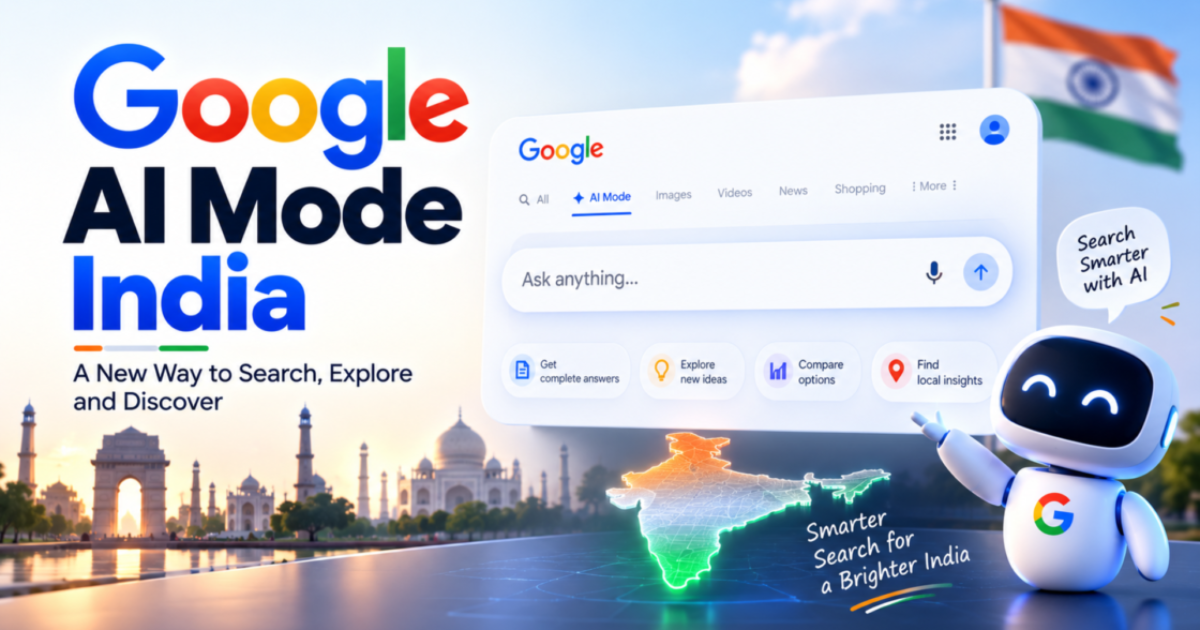
Google AI Mode India is now live for all Indian users without login or signup — powered by Gemini 2.5. It replaces blue links with AI-generated answers that cite sources directly. For Indian bloggers, this means your content must be structured for citation, not just ranking. The blogs that get cited in Google AI Mode India answers will dominate Indian search in 2026 — and the structure required is different from traditional SEO.
I opened Google on my phone this morning the way I do every day. But instead of seeing the usual list of blue links, the entire top section was a flowing AI-generated answer — complete, conversational, and citing 4 sources I had never heard of. None of them were major Indian blogs. All of them were structured differently from every article I have ever written. That was my first real experience with Google AI Mode India — not as a feature I had read about, but as a blogger watching my potential audience read AI-generated answers instead of clicking through to my site. Google AI Mode India passed 1 billion monthly users globally as of May 2026. It is now available to every Indian user without any login or signup requirement. And it is changing which content gets seen — not based on keyword rankings, but based on how your content is structured for AI citation. In this guide I break down exactly what Google AI Mode India means for Indian bloggers and digital marketers — and the specific changes you need to make right now to stay visible in it.
- What is Google AI Mode India — explained simply
- How it is different from regular Google Search
- What Google AI Mode India means for Indian bloggers
- Who gets cited in Google AI Mode — the real ranking signals
- What Indian bloggers must do right now — 7 specific actions
- How to check if Google AI Mode India is citing your blog
What Is Google AI Mode India — Explained Simply
Google AI Mode India is a conversational search experience built into Google Search that replaces the traditional list of blue links with an AI-generated answer. It is powered by Gemini 2.5 — Google’s most advanced language model — and is now available to every Indian user through the Google app and Google.com, with no login or subscription required. When you use Google AI Mode India, instead of seeing 10 ranked links and choosing which one to click, you see a direct, structured answer that synthesises information from multiple sources — with citations shown inline. You can ask follow-up questions and the AI remembers the context of the entire conversation. Think of it as the difference between a search engine (which shows you doors to walk through) and a research assistant (which reads everything behind all the doors and tells you the answer directly).
User types query → sees 10 blue links → clicks one → reads article → goes back → clicks another → pieces together answer manually
User types query → AI reads multiple sources → returns complete structured answer with citations → user asks follow-up in same conversation
Google AI Mode India was first launched through Search Labs in India on June 24, 2025. By July 2025 it expanded to all Indian users. By September 2025, Hindi support was added. By Google I/O 2026, it reached nearly 200 countries across 98 languages with no paid subscription requirement.
How Google AI Mode India Is Different from Regular Google Search
Understanding the difference between Google AI Mode India and standard Google Search is essential for every Indian blogger. They look similar on the surface but work completely differently — and require different content strategies.
| Dimension | Regular Google Search | Google AI Mode India |
|---|---|---|
| What user sees | 10 ranked blue links | AI-generated answer with inline citations |
| How user interacts | Clicks links, reads sites | Asks follow-up questions in conversation |
| Sources shown | All 10 links visible | 3–5 cited sources in the answer |
| What determines visibility | Keyword ranking position | Citation eligibility — content structure + E-E-A-T |
| Position 11–20 content | Almost no traffic | Can be cited in AI answers — real opportunity |
| Input types | Text keywords | Text, voice, images, camera (Google Lens) |
| Follow-up queries | Each query starts fresh | AI remembers full conversation context |
The most important difference for Indian bloggers: in regular Google Search, if you do not rank in positions 1–10, you get almost no traffic. In Google AI Mode India, content ranking in positions 11–20 can be cited in AI answers just as often as position 1–3 content — because the AI selects for citation quality, not ranking position. This is the single biggest opportunity Google AI Mode India creates for smaller Indian blogs. Your page 2 content can now appear at the very top of search — if it is structured correctly.
What Google AI Mode India Means for Indian Bloggers — The Real Impact
Google AI Mode India changes the search game in three specific ways for Indian content creators. Impact 1 — Less organic click-through from traditional rankings. When a user gets a complete AI-generated answer at the top of the page, they often do not need to click through to any website. This reduces organic CTR for traditional keyword rankings — especially for informational queries like “what is digital marketing” or “how to do SEO.” According to research from LLM Pulse, AI Overviews now reach more than 2.5 billion monthly users and have measurably reduced click-through rates on non-featured content. Impact 2 — New visibility opportunity for cited content. The 3–5 sources cited in a Google AI Mode India answer get prominent placement — often more visible than traditional position 1. If your blog is one of the cited sources, users see your site name and link inside the AI-generated answer itself. This is a new traffic channel that did not exist two years ago and is currently undercaptured by Indian blogs. Impact 3 — Content ranking position 11–20 can now get AI visibility. Research consistently shows that AI answers frequently cite content that ranks position 11–20 in traditional organic results — not just position 1–3. This means Indian blogs that have been stuck on page 2 of Google for months now have a genuine path to visibility through Google AI Mode India citation — without needing to climb traditional rankings first. To understand the full context of where Google AI Mode India fits in your overall strategy, read the complete AEO vs SEO vs GEO guide for Indian bloggers.
Who Gets Cited in Google AI Mode India — The Real Ranking Signals
Google AI Mode India does not cite randomly. It uses specific signals to decide which content is worth including in its AI-generated answers. Based on research from multiple sources, here are the factors that determine citation eligibility. Signal 1 — Answer-first content structure. Google AI Mode India breaks every query into sub-questions and then extracts answers from content that addresses those sub-questions directly. Content that leads with the answer — not with context or storytelling — gets extracted more reliably. If your opening paragraph does not answer the query within the first 100 words, Google AI Mode India typically skips it. This is the same Direct Answer signal measured in our AEO audit of Indian blogs — where it averaged just 29.5% across 15 sites. Signal 2 — Self-contained passage structure. Google AI Mode India extracts individual passages, not entire articles. Each paragraph and H2 section needs to be self-contained — answering one question completely without requiring the user to read the surrounding sections for context. Think of each H2 section as a standalone answer to a specific sub-query. Signal 3 — E-E-A-T and source trust. According to SEOptimate’s AI Mode analysis, Google’s AI citation system evaluates source credibility as a primary filter. A clear author bio with real credentials, transparent editorial standards, and first-hand experience signals are all factored into whether Google AI Mode India trusts your content enough to cite it. Signal 4 — FAQ schema and structured data. Structured data — particularly FAQPage JSON-LD — helps Google AI Mode India identify question-answer pairs that can be extracted reliably. In our audit, every site that scored above 70 on AEO had FAQ schema. Use the free Peplio AEO Content Scorer to generate FAQ schema for any article in 2 minutes. Signal 5 — Content freshness. Google AI Mode India strongly prefers recently updated content — especially for fast-moving topics like AI tools, SEO strategies, and digital marketing trends. A visible “Last Updated” date in your author box and regular content refreshes (adding new statistics, updating facts) significantly improve citation eligibility.
What Indian Bloggers Must Do Right Now for Google AI Mode India — 7 Specific Actions
Based on the citation signals above and the real data from our AEO mistakes audit of 15 Indian blogs, here are the 7 specific actions that will make your content eligible for Google AI Mode India citation. Action 1 — Rewrite your article openings to answer first. Every article needs a direct answer to its title question in the first 2 sentences. No storytelling, no scene-setting — answer first. This is the #1 signal Google AI Mode India uses to identify citation-worthy content, and it was missing on 13 of the 15 Indian blogs we audited. Action 2 — Add a Quick Answer box above your intro. A dedicated 2–3 sentence Quick Answer box placed before the article body gives Google AI Mode India a clean, extractable summary block. This is the same Quick Answer box format used on every Peplio article — and it is the first thing the AI Mode extraction system scans. Action 3 — Structure every H2 section as a self-contained answer. The first sentence under every H2 should directly address what that section promises. If your H2 says “What is Google AI Mode India” — your first sentence should define it completely. Each section should work as a standalone answer without needing the rest of the article for context. Action 4 — Add FAQPage JSON-LD schema to every article. Use the free Peplio AEO Content Scorer to auto-generate FAQ schema from your question headings. Paste the JSON-LD into WordPress using WPCode. This takes under 2 minutes and was found missing on 11 of 15 Indian blogs in our audit. Sites with FAQ schema averaged 74.2/100 on AEO vs 57.1 without — a 17-point gap. Action 5 — Add one cited statistic in your first 200 words. Google AI Mode India strongly prefers content that leads with verifiable data. Add one statistic from Statista, Semrush, or Think with Google in the opening section — with a link to the source. One sentence. One number. Worth 5–8 points on your AEO score. Action 6 — Check your robots.txt allows AI crawlers. Google AI Mode India uses Googlebot for crawling — so standard robots.txt rules apply. But also check that you have not accidentally blocked Googlebot-extended or other crawlers. Use Peplio’s free robots.txt generator to verify your file is correct and allows all necessary crawlers. Action 7 — Update your top 10 articles with “Last Updated: September 2026.” Content freshness is a direct citation signal for Google AI Mode India. Go to your top 10 most-visited articles, add one new statistic or fact, and update the “Last Updated” date in your author box. Resubmit each one to Google Search Console after updating. This signals recency to Google AI Mode India without requiring a full rewrite. For the complete checklist of all 18 AEO fixes — including every signal that improves Google AI Mode India citation eligibility — read the AEO checklist for Indian bloggers.
How to Check If Google AI Mode India Is Citing Your Blog
Once you have implemented the 7 actions above, here is exactly how to verify whether Google AI Mode India is citing your content. Method 1 — Manual Google AI Mode test. Open Google on your phone → tap the “AI” tab at the top of search → type a query your blog targets → look for your site name in the cited sources panel. Do this for your top 5 target keywords. Note which sources are being cited — this tells you who your AI citation competitors are. Method 2 — Peplio AI Visibility Tracker. Use the free Peplio AI Visibility Tracker to check simultaneously whether your site appears in ChatGPT, Gemini, and Perplexity answers for your target topics. This covers the full AI search landscape — not just Google AI Mode India but all AI citation surfaces. Method 3 — Google Search Console AI Overview tracking. GSC now shows AI Overview impressions and clicks separately. Go to GSC → Performance → toggle “Search type” → select “Web” → filter for your target URLs. Look for impressions that come from AI Overview positions — these indicate your content is being considered for AI Mode citation. Method 4 — GA4 referral source monitoring. In GA4, filter referral traffic for sources that include “google” with landing page visits that are shorter than average — this pattern often indicates an AI Mode citation visit where the user verified your content after seeing it cited, rather than a traditional organic search click.
Mitu just found out Google AI Mode India exists 😱
Follow India’s first Digital Marketing Comic Universe — where Mitu, Seema, Sougan, and the whole neighbourhood navigate the AI search era together. Real lessons, comic format, zero corporate speak.
Read Comics → Get eBooks →- ✅ Google AI Mode India is live for all Indian users — no login, no cost, powered by Gemini 2.5
- ✅ It passed 1 billion monthly users globally as of May 2026 — not optional to ignore
- ✅ Content ranking position 11–20 can be cited in AI Mode — page 2 content now has real value
- ✅ Citation depends on structure — Direct Answer, FAQ schema, self-contained passages
- ✅ 7 specific actions will make your blog eligible — direct answers, FAQ schema, cited stats are top 3
- ✅ Use AI Visibility Tracker + GSC AI Overview data to measure your citation progress
- ✅ Indian blogs currently undercited in AI Mode — first-mover window is open right now
What is Google AI Mode India?
Google AI Mode India is a conversational AI-powered search experience available to all Indian users — free, without login — that replaces blue link results with Gemini 2.5-generated answers citing multiple sources. It was launched in India through Search Labs on June 24, 2025, and expanded to all users by July 2025. Users can ask follow-up questions in the same conversation, use voice, images, and camera inputs, and get structured answers for complex multi-part queries. Check your blog’s AI citation readiness using the Peplio AEO Content Scorer.
How do I rank in Google AI Mode India?
Ranking in Google AI Mode India means getting cited in AI-generated answers — not just appearing in blue link results. The key signals are: direct answer in the first 100 words, FAQ schema markup, self-contained H2 sections, cited statistics in the opening 200 words, and strong E-E-A-T signals. Content ranking position 11–20 can be cited as frequently as position 1–3 content — so the opportunity is available even to smaller blogs. Read the complete AEO checklist for Indian bloggers for all 18 actionable fixes.
How is Google AI Mode different from AI Overviews?
AI Overviews appear automatically at the top of standard Google Search results for eligible queries — users do not opt in. Google AI Mode India is a dedicated conversational interface users switch to intentionally via an “AI” tab. AI Mode supports multi-turn conversations, follow-up questions, and personalised context. AI Overviews are brief one-query summaries. Both cite sources from the web, but AI Mode goes deeper — synthesising information from many more sources per answer. For Indian bloggers, both require the same AEO content structure to be eligible for citation.
Frequently Asked Questions — Google AI Mode India
Is Google AI Mode India free to use?
Yes — Google AI Mode India is completely free for all Indian users. No login, no subscription, and no signup required. It is accessible through the Google app and Google.com by tapping the “AI” tab in search results or the “AI Mode chip” in the search bar. It was initially a Labs experiment but expanded to all Indian users by July 2025 without any paywall.
Does Google AI Mode India support Hindi?
Yes — Hindi support was added to Google AI Mode India in September 2025. By Google I/O 2026, AI Mode expanded across 98 languages including Hindi, Indonesian, Japanese, Korean, and Brazilian Portuguese. The initial rollout was English-only, but full multilingual support is now available to Indian users.
Will Google AI Mode India reduce traffic to my blog?
It can reduce traffic from traditional blue-link clicks for informational queries — because users get complete answers without clicking through. But Google AI Mode India also creates a new traffic opportunity: citation traffic. Blogs cited in AI Mode answers receive prominent placement inside the answer itself — often more visible than position 1 in traditional results. The blogs that adapt their content for AI citation eligibility will gain traffic while those that do not may see a net decline.
How do I know which of my articles are being cited in Google AI Mode India?
Three methods: manually search your target keywords in Google AI Mode India and check the cited sources; use the free Peplio AI Visibility Tracker to check your site across AI platforms; or check GSC Performance data filtered for AI Overview positions. Doing a weekly manual test of your top 5 target keywords in AI Mode is the most direct approach.
What content gets cited most in Google AI Mode India?
Content with direct answers in the first 100 words, FAQ schema markup, self-contained H2 sections, cited statistics with named sources, and strong E-E-A-T signals gets cited most frequently in Google AI Mode India. Content ranking in positions 11–20 is cited as frequently as position 1–3 content — the AI selects for citation quality, not ranking position. Run any article through the Peplio AEO Content Scorer to see your citation readiness score.
How does Google AI Mode India relate to AEO?
AEO — Answer Engine Optimization — is the content strategy that makes your blog eligible for citation in Google AI Mode India and other AI search surfaces. The same structural signals that get you cited in AI Mode (direct answers, FAQ schema, self-contained passages) are the core elements of AEO. In our audit of 15 Indian blogs, the average AEO score was just 61.4/100 — meaning most Indian blogs are not yet structured for AI Mode citation. Read India’s first AEO audit and the AEO checklist for Indian bloggers to fix your content.
- → AEO Score of Indian Blogs — India’s First Audit (15 Sites, Real Data)
- → 5 AEO Mistakes Indian Blogs Make That Kill AI Visibility
- → AEO Checklist for Indian Bloggers — 18 Fixes in 30 Minutes
- → AEO vs SEO vs GEO — The Complete 2026 Guide
- → Free AEO Content Scorer — Check Your Citation Readiness
- → Free AI Visibility Tracker — Are You Cited in Google AI Mode?
- → Digital Marketing Comic Stories by Peplio
Sources referenced in this article: LLM Pulse — How to Rank in Google AI Overviews 2026 (1 billion AI Mode users stat), SEOptimate — Google AI Mode Explained, Search Atlas — What is Google AI Mode (India launch date and expansion timeline), Business Today — Google AI Mode Goes Live in India, Statista, Semrush SEO Statistics 2026.


