
How Does SEO Work? 7 Proven Steps From Crawl to Rank in 2026
Founder, Peplio · Digital Marketing Executive, Demech Chemical Products · Last updated: October 2026 — Updated with 2026 AI Overview data and real Peplio crawl, index, and ranking experiments
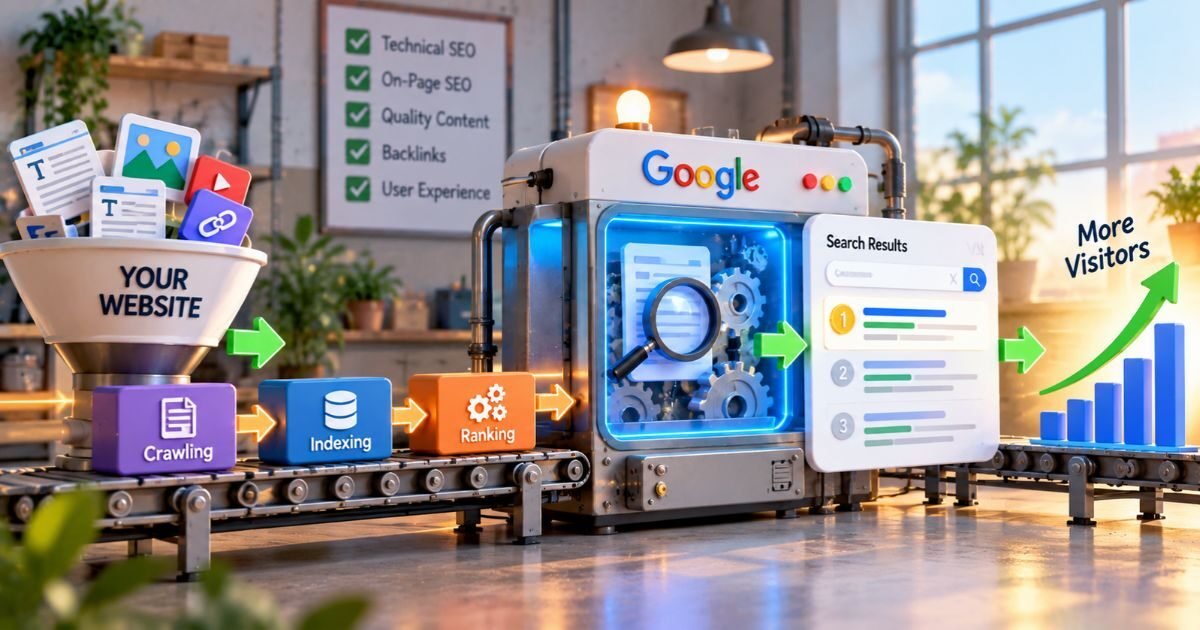
- SEO works in three stages: Crawl (Google discovers your page), Index (Google stores and categorises your content), and Rank (Google decides which pages to show for which queries based on 200+ signals)
- A failure at any stage blocks ranking — a great article on a poorly crawled site will never rank
- The three pillars of how SEO works: Technical SEO (crawl and index), On-Page SEO (index and rank), Off-Page SEO (rank)
- AI Overviews now appear on 48% of queries — being cited inside one increases CTR by up to 80%
- Pages with strong E-E-A-T signals are 2.3x more likely to be cited in AI Overviews
- Meaningful SEO results take 3 to 6 months minimum — consistency is the actual competitive advantage
How does SEO work? It is the question I kept searching when Peplio had zero traffic, what I thought was good content, and absolutely no idea why Google was ignoring me. I had published articles. I had done keyword research. I had read every SEO guide I could find. But nothing was clicking. I am Sougan Kumar Mandi, founder of Peplio.com and Digital Marketing Executive at Demech Chemical Products in Durgapur, West Bengal. The honest answer to how does SEO work took me months of failure to find. This guide gives you the complete picture — plain English, real data, actual examples from Peplio, and zero fluff.
- How search engines actually work — the 3-stage model
- Step 1 — Crawling: how Google finds your pages
- Step 2 — Indexing: how Google understands and stores your content
- Step 3 — Ranking: how Google decides who appears first
- The 3 pillars that determine how SEO works for your site
- The most important Google ranking factors in 2026
- How AI Overviews changed how SEO works in 2026
- My SEO failures — what taught me how SEO really works
- How does SEO work for beginners — your first 7 steps
- Sougan’s Take
- FAQ
How Search Engines Actually Work — The 3-Stage Model
Before you can understand how does SEO work for your website, you need to understand what Google is actually trying to do. Google’s entire business model depends on showing users the most relevant, trustworthy result for every search query. Every algorithm update, every ranking signal, every rule — it all exists in service of that single goal. Google achieves this through a three-stage pipeline: Crawl (discover what exists on the web), Index (understand and file what was discovered), and Rank (decide which results to show for which queries). Understanding each stage is non-negotiable if you want to understand how does SEO work in practice. An error at Stage 1 means your page can never reach Stage 3 — no matter how good your content is.
Peplio Reality Check: I once published 11 articles in a single month and got impressions on zero of them. The problem was not the content — I had accidentally blocked Googlebot in my robots.txt file. Every article was invisible to Google because the crawler could not enter the site. Stage 1 failure means no rankings, full stop. This is why understanding how does SEO work at the technical level matters before anything else.
Step 1 — Crawling: How Google Finds Your Pages
Crawling is the discovery phase of how does SEO work. Google deploys automated programs called Googlebot that constantly travel the web, visiting URLs and following links from page to page. The key thing most beginners miss: Google does not crawl every page equally or immediately. It has a concept called crawl budget — a limit to how many pages it will crawl on your site within a given timeframe. If your site wastes crawl budget on unimportant pages (thin content, duplicate URLs, broken links), Google may never get to your important pages.
Googlebot discovers pages in two primary ways: by following links (if another website links to your page, Googlebot can follow that link and find you — this is why backlinks matter even beyond authority, they are literally how Google discovers new content), and through XML Sitemaps submitted in Google Search Console. Use Peplio’s free Robots.txt and Sitemap Generator to create a clean sitemap that accelerates discovery.
| Crawl Blocker | What It Does | How to Fix It |
|---|---|---|
| robots.txt block | Tells Googlebot do not enter this section | Check robots.txt via Google Search Console; ensure important pages are not blocked |
| No inbound links and no sitemap | Google may never find the page | Submit an XML sitemap; add internal links from existing pages |
| Slow server response | Googlebot gives up and moves on | Improve hosting, use caching, compress resources |
| Redirect chains of 3 or more hops | Wastes crawl budget and dilutes link equity | Consolidate to direct 301 redirects |
| Orphan pages with no internal links | Googlebot cannot find or prioritise the page | Add internal links from related articles to every page |
Step 2 — Indexing: How Google Understands and Stores Your Content
Once Googlebot visits a page, it enters the indexing phase. Google renders the page, analyses the content, and decides whether to add it to its index — an enormous database of every webpage it considers eligible to rank. A page can be crawled but not indexed. If Google determines your content is thin, duplicate, low-quality, or unhelpful, it may crawl the URL but choose not to store it. No index means no ranking, ever. This is one of the most important things to understand about how does SEO work — Google has editorial discretion at the indexing stage.
What Google analyses during indexing: page content and topic (what is this page actually about), content quality signals (is this page original, does it add value, does it demonstrate expertise), technical signals (is the page canonical, does it have a noindex tag, are there duplicate content issues), and internal linking context (which other pages on your site link to this page and what anchor text do they use). The fastest way to check if your pages are indexed: type site:yourdomain.com/your-page-slug into Google. If the page appears it is indexed. If not, open Google Search Console, URL Inspection, paste the URL, then click Request Indexing.
Peplio Lesson Learned: For three months I was confused about why a specific article had zero impressions in Search Console. Eventually I found it was marked “Crawled — currently not indexed.” Google had visited the page but decided it was not worth adding to the index. The fix: I rewrote the article with more depth, original data, and proper H2 structure. It was indexed within two weeks and hit page two within six weeks. This is how does SEO work at the indexing stage in practice.
Step 3 — Ranking: How Google Decides Who Appears First
This is where how does SEO work gets competitive. Once a page is indexed, it enters a pool of thousands of indexed pages competing for the same queries. Google’s algorithm evaluates every indexed page against every relevant search and decides the ranking order — in milliseconds, for billions of queries every day. Google uses over 200 confirmed ranking signals, but they largely group into three core pillars: Relevance, Authority, and Experience.
Relevance — does your page match what the user is looking for? Google’s AI systems (BERT, MUM, and Gemini) now understand semantic intent — the actual meaning behind a query. When someone searches “how does SEO work,” Google understands they want a step-by-step explanation, probably for beginners, probably including the crawl-index-rank model. It does not just look for pages containing those words — it looks for pages that comprehensively satisfy that intent.
Authority — does Google trust your site? Authority is built primarily through backlinks. Each backlink is a vote of confidence. A single link from a high-authority, relevant domain is worth more than hundreds of links from low-quality sites. In 2026, domain authority, topical authority, and E-E-A-T signals all contribute to how much trust Google places in your content.
Experience — is your page good for users? Since 2021 Google has formally incorporated page experience signals into its ranking algorithm: Core Web Vitals (LCP under 2.5s, INP under 200ms, CLS under 0.1), mobile-friendliness (Google uses mobile-first indexing), HTTPS security, and no intrusive interstitials. Google also reads behavioural data — how long users stay on your page and whether they return to search results after clicking.
The 3 Pillars That Determine How SEO Works for Your Site
Now that you understand the three stages, here is how how does SEO work translates into the three types of work you actually do. All three pillars are necessary — technical SEO without content is a well-built house with nothing inside; content without technical SEO is a great book locked in a room Google cannot enter; off-page authority without either means no foundation to rank from.
| SEO Pillar | What It Covers | Stage It Serves | Key Actions |
|---|---|---|---|
| Technical SEO | Site speed, crawlability, mobile, structured data, HTTPS, Core Web Vitals | Crawl and Index | Fix robots.txt, submit sitemap, compress images, improve page speed |
| On-Page SEO | Content quality, keyword usage, title tags, meta descriptions, headings, internal links, image alt text | Index and Rank | Write depth content, use focus keyword naturally, structure with H2 and H3, add internal links |
| Off-Page SEO | Backlinks, brand mentions, social signals, reviews, authority building | Rank | Earn links from relevant sites, guest post, build brand mentions |
For a full breakdown of on-page vs off-page SEO, read the complete SEO fundamentals guide and the on-page SEO checklist with 15 steps.
The Most Important Google Ranking Factors in 2026
Google has confirmed it uses over 200 ranking signals. Understanding how does SEO work means knowing which signals matter most in 2026.
Content Quality and E-E-A-T — since the December 2025 Core Update, Google’s crackdown on generic AI-paraphrased content intensified. Pages that merely restated existing information lost up to 71% of their traffic. Content that demonstrated real Experience, Expertise, Authoritativeness, and Trustworthiness gained. E-E-A-T is not a single ranking factor — it is a quality framework that shapes the signals algorithms reward. The practical implication: your content needs firsthand experience, original insight, and clear authorship.
Search Intent Match — Google categorises every query by intent type: informational (what, how, why), navigational (brand names), commercial (best, reviews, vs), and transactional (buy, get, sign up). If your content type does not match the dominant intent for a query, it will not rank regardless of how well-written it is. This is one of the most underrated aspects of how does SEO work that beginners consistently miss.
Backlinks — quality over quantity — a single link from a relevant, high-authority site outperforms hundreds of links from low-quality directories. Google’s systems now also evaluate topical relevance of linking pages. A backlink from a digital marketing blog to your SEO article carries more weight than a link from an unrelated travel site.
Core Web Vitals — LCP under 2.5 seconds, INP under 200ms, CLS under 0.1 — are confirmed ranking factors. Pages with poor scores are at a structural disadvantage in competitive niches. Check and fix your scores using Peplio’s free Website Speed Analyzer.
| Ranking Signal | Impact Level | Confirmed by Google | Beginner Priority |
|---|---|---|---|
| Content quality and E-E-A-T | Very High | Yes | Do this first |
| Search intent match | Very High | Yes | Do this first |
| Backlinks (quality) | Very High | Yes | Build gradually |
| Title tag and H1 optimisation | High | Yes | Do on every page |
| Core Web Vitals (LCP, INP, CLS) | High | Yes | Fix after content |
| Internal linking | High | Yes | Do on every page |
| Mobile-friendliness | High | Yes | Essential baseline |
| Structured data and Schema | Medium | Yes (for rich results) | Add for FAQs and articles |
| Domain authority | Medium | Indirect | Builds over time |
| Social signals | Low | Not confirmed | Secondary benefit |
How AI Overviews Changed How SEO Works in 2026
If you want to fully understand how does SEO work in 2026, you cannot ignore Google’s AI Overviews. These are AI-generated answer summaries that appear above traditional organic results for certain queries. As of March 2026, they appear on 48% of all search queries — up 58% from December 2025. For informational and “how to” queries specifically, they appear on over 70% of results pages.
The CTR impact is significant. When an AI Overview is present, Seer Interactive found a 61% drop in organic CTR. Ahrefs found a 58% drop for position 1. But here is what most articles miss: being cited inside an AI Overview increases your CTR by up to 80% compared to non-cited results at the same position. And pages with strong E-E-A-T signals are 2.3 times more likely to be cited. This means the SEO work that earns traditional rankings — genuine expertise, original data, clear authorship — is the exact same work that earns AI citations. Understanding how does SEO work with AI Overviews means recognising that the two channels are not separate — one feeds the other.
How to adapt your SEO for the AI Overview era: target commercial and transactional queries that are far less affected by AI Overviews than informational queries, write content only you could write (original data and personal case studies AI cannot summarise away), use structured data and FAQ sections that increase AI citation rates, and track AI citations in Search Console. Read the complete guide on how to optimise content for Google AI Overviews and the AEO vs SEO vs GEO comparison.
My SEO Failures — What Taught Me How SEO Really Works
Failure 1 — I Confused Keyword Presence With Keyword Relevance
Early on I thought I understood how does SEO work: put the keyword in the title, use it in the article, rank. I wrote an article targeting “digital marketing strategy” and stuffed it everywhere. Google ranked it for nothing. Because the content did not actually address what someone searching that phrase wanted to find. I had the keyword but not the intent. The fix: I rewrote the article around the actual questions people were asking — and it started picking up rankings within 5 weeks.
Failure 2 — I Published Orphan Pages and Wondered Why They Did Not Rank
For the first six months at Peplio, I published articles without linking to them from anywhere else on the site. Each article existed in isolation. No internal links pointing to it, no cluster structure. Google crawled a few of them because of my sitemap, but most got very low crawl priority. The moment I built a proper internal linking structure, impressions started growing within weeks. Internal links are not optional decoration — they are how SEO works at the architecture level.
Failure 3 — I Ignored Technical SEO Until It Cost Me 3 Months
I was so focused on content that I never checked the technical side. When I finally audited the site, I found broken internal links, redirect chains of 4 or more hops, and pages loading in over 8 seconds on mobile. None of my articles had a chance to rank properly because Google’s experience signals for the site were terrible. Fixing the technical issues removed the ceiling that had been suppressing everything. This is a critical part of understanding how does SEO work — technical health is domain-wide, not page-level.
Failure 4 — I Thought Ranking Was the End Goal
I chased rankings obsessively. When I finally hit position 4 for a target keyword, I expected traffic to flood in. It did not — because my title and meta description were terrible. CTR from position 4 was 0.8% when it should have been 4 to 6%. Understanding how does SEO work means understanding that ranking and traffic are not the same thing. A page at position 6 with a compelling title often gets more clicks than a page at position 3 with a generic one.
How Does SEO Work for Beginners — Your First 7 Steps
The businesses winning at SEO in 2026 are not doing the most complex things. They are the ones who correctly understood how does SEO work at a foundational level and executed the basics consistently.
I spent months making every mistake described in this guide — blocking Googlebot accidentally, publishing orphan pages, ignoring technical health, optimising for rankings but not for clicks. Each failure taught me something specific about how does SEO work that no guide could have taught me as effectively. What I know now from building Peplio and managing content at Demech Chemical Products simultaneously: the crawl-index-rank model is not just theory. Every single ranking problem I have ever diagnosed traces back to a failure in one of those three stages.
Fix Stage 1 first (crawlability), then Stage 2 (indexability), then Stage 3 (ranking signals). That order matters. And within Stage 3, content quality and search intent match matter far more than any technical optimisation. Get those two right, and everything else accelerates. SEO is not magic. It is a system. Understand the system and work it consistently.
Mitu’s bakery website was live — but invisible to Google. Episode 3 shows exactly how SEO works in the real world.
Follow India’s first Digital Marketing Comic Universe — where every SEO lesson comes to life through story.
- SEO works through three stages: Crawl, Index, Rank — a failure at any stage blocks ranking
- Google uses 200+ signals grouped into Relevance, Authority, and Experience
- Content quality and E-E-A-T are the most important ranking factors in 2026
- Technical SEO, on-page SEO, and off-page SEO must all work together
- AI Overviews now appear on 48% of queries — being cited boosts CTR by up to 80%
- Pages with strong E-E-A-T are 2.3x more likely to be cited in AI Overviews
- Internal links are one of the highest-ROI improvements any beginner can make
- 96.55% of all web pages get zero traffic from Google — most fail at crawl or index stage
- Results take 3 to 6 months minimum — consistency is the actual competitive advantage
How does SEO work for a brand new website?
For a brand new website, how does SEO work starts with getting Google to discover and index your pages. Submit an XML sitemap in Google Search Console, add internal links between pages, and get at least one external site to link to you. Then publish high-quality content targeting specific long-tail keywords with KD under 15. New sites typically see initial indexing within days to weeks, but meaningful rankings take 3 to 6 months of consistent publishing and optimisation to develop. Read the complete guide to increasing website traffic.
How does SEO work differently from paid ads?
SEO earns organic rankings through content quality, authority, and technical optimisation — you do not pay per click, and traffic continues after you stop actively investing. Paid ads deliver immediate traffic but stop the moment the budget runs out. Organic results receive approximately 90% of all Google clicks versus 10% for paid ads. The tradeoff is time: SEO takes 3 to 12 months to build, while paid ads work immediately. Read the SEO vs paid ads comparison.
How does SEO work with Google’s AI Overviews?
AI Overviews do not replace how does SEO work — they add a new layer on top of it. Google’s AI still discovers and evaluates content through the traditional crawl-index-rank model. The difference is that AI Overviews now appear on 48% of queries, and being cited within one increases your CTR by up to 80%. Pages with strong E-E-A-T signals are 2.3x more likely to be cited. The strategy: demonstrate firsthand experience, cite original data, use structured data markup, and target commercial and transactional queries that AI Overviews affect less.
Frequently Asked Questions — How Does SEO Work?
How does SEO work for a brand new website with no authority?
For a brand new website, how does SEO work starts with crawlability — submit an XML sitemap to Google Search Console, ensure robots.txt does not block important pages, and add internal links between every published page. Then target long-tail keywords with keyword difficulty under 15 where forums are currently ranking (these are open slots). New sites should expect 6 to 8 weeks for initial indexing and 3 to 6 months for meaningful traffic growth. Domain authority builds slowly — targeting low-competition keywords first is the correct strategy.
How does SEO work with keywords in 2026?
Keywords signal to Google what your content is about, but how does SEO work with keywords has evolved significantly. Modern SEO is about search intent, not keyword density. Use your focus keyword naturally in the title, H1, first paragraph, at least one H2, URL slug, meta description, and image alt text. Then write comprehensive content covering the topic fully using related terms naturally. Keyword density of 1 to 2% in visible body text is a healthy target. Never stuff keywords — if it feels forced, your keyword targeting is off.
How long does it take for SEO to work?
How does SEO work on a timeline depends on domain age, competition level, content quality, and link profile. For a new site targeting low-competition keywords, initial rankings can appear within 6 to 8 weeks. Meaningful traffic growth typically takes 3 to 6 months. For competitive keywords in established niches, 12 to 18 months of consistent effort is realistic. The most important thing: do not stop publishing and optimising during this period. Consistency is what separates sites that compound their SEO gains from sites that plateau.
How does SEO work for local businesses?
How does SEO work for local businesses involves an additional layer beyond traditional SEO: local search optimisation. The most important steps are: claim and fully optimise your Google Business Profile, build local citations (consistent Name, Address, Phone across directories), earn local backlinks from community sites and local press, create location-specific content on your website, and actively collect customer reviews. Over 50% of “near me” searches result in a store visit within 24 hours, making local SEO one of the highest-ROI activities for any business with a physical location.
What is the crawl budget and how does it affect SEO?
Crawl budget is Google’s limit for how many pages it will crawl on your site within a given timeframe. If your site has hundreds of thin, duplicate, or low-quality pages — paginated archives, tag pages, parameter URLs, old date-format duplicates — Google spends its crawl budget on those instead of your real articles. The practical implication of understanding how does SEO work with crawl budget: noindex thin pages, fix redirect chains, block junk URLs in robots.txt, and make sure every crawl visit Google makes to your site lands on a page worth indexing.
How does SEO work with AI tools like ChatGPT and Perplexity?
AI tools like ChatGPT and Perplexity pull answers from indexed, well-structured, authoritative content — the same content that ranks in traditional search. How does SEO work with AI tools: the structural signals that earn Google rankings (clear headings, FAQ schema, named statistics, E-E-A-T signals, topical authority) are the same signals that increase the probability of being cited by AI systems. SEO is the foundation of AI visibility, not a separate channel. Read the complete guide on how to get cited by Perplexity AI.
- What Is SEO and Why Is It Important — The Complete 2026 Guide
- On-Page SEO Checklist — 15 Steps Before Every Publish
- Importance of SEO in 2026 — Why It Matters More Than Ever
- Technical SEO for Beginners — What You Need to Know
- AEO vs SEO vs GEO — The Complete 2026 Comparison
- How to Optimise Content for Google AI Overviews
- How to Increase Website Traffic — 9 Strategies That Actually Work
Data sources: Ahrefs web page traffic study, Backlinko CTR research, Search Engine Journal AI Overview data, Google Helpful Content Guidelines, Google Search Console documentation. Updated October 2026.
Understanding how does SEO work is the most important foundation any blogger, business owner, or digital marketer can build in 2026. How does SEO work in its simplest form: Googlebot crawls your page, Google indexes your content if it meets quality standards, and Google’s algorithm ranks your indexed page against competing pages using 200+ signals. The reason 96.55% of all web pages get zero traffic from Google is not because their content is bad — it is because they fail at one of these three stages, usually without knowing it. How does SEO work for the remaining 3.45% who do get traffic: they have crawlable sites, indexable content with genuine E-E-A-T signals, and ranking authority built through quality backlinks and topical expertise.
How does SEO work in 2026 specifically differs from previous years in one critical way: AI Overviews now appear on 48% of all Google queries, fundamentally changing how traffic flows from search to websites. But how does SEO work with AI Overviews is not as complicated as most guides suggest — the same E-E-A-T signals that earn traditional rankings also earn AI citations. Pages with named authors, first-hand experience, cited statistics, and FAQ schema are 2.3 times more likely to be cited in AI Overviews. Understanding how does SEO work at this level — where technical health enables crawling, quality content enables indexing, and E-E-A-T signals enable both traditional ranking and AI citation — is what separates the sites growing in 2026 from the sites stuck at zero traffic despite consistent publishing.


