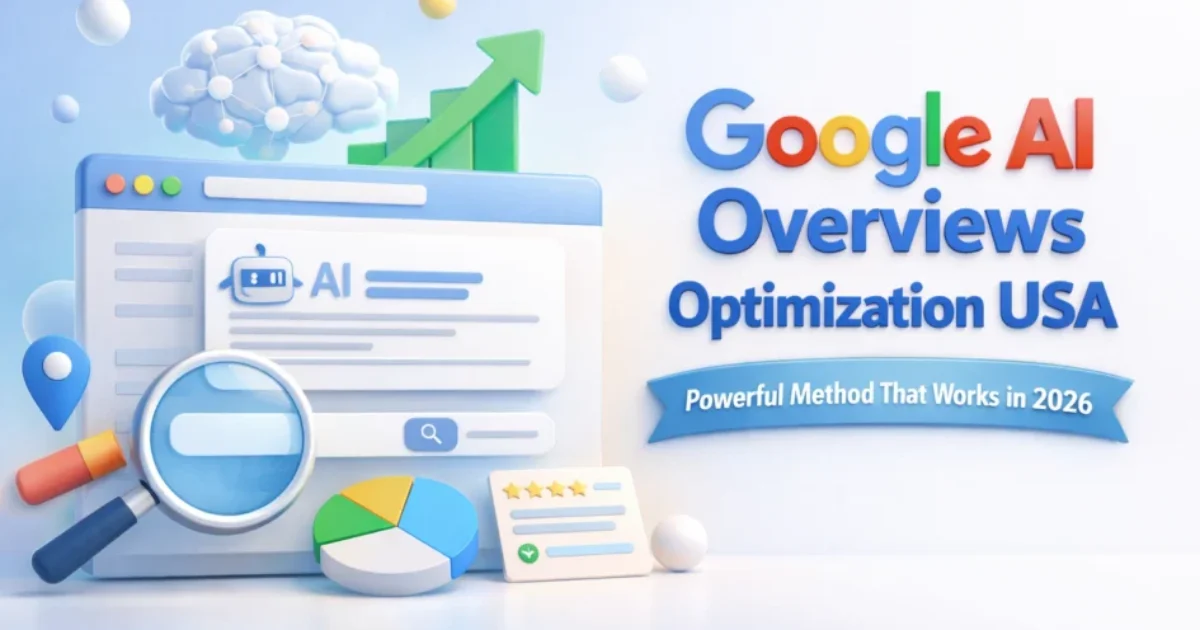
Google AI Overviews Optimization USA: Powerful Method That Works in 2026
I didn’t realize how serious this shift was until one simple thing happened — my content started ranking, but customers weren’t coming. Not clicks, not inquiries, not even basic engagement. That’s when it hit me hard… Google had quietly changed the game. It wasn’t just about rankings anymore. It was about being chosen by AI. And if your content wasn’t structured for that, you were basically invisible.
That moment pushed me into deeply understanding google ai overviews optimization usa, not from theory, but from actual testing. I wasn’t building content for “traffic” anymore. I was building content to help US business owners get customers online — because that’s what really matters in the United States market where marketing budgets, ROI, and customer acquisition are everything.
So in this article, I’m not giving you generic SEO advice. I’m showing you what actually worked, what failed badly, and what I’m still testing — all focused on the US market.
Peplio Reality Check
- Expected: Ranking on Google = more customers
- Happened: AI Overviews answered everything before users clicked
- Surprised: Content clarity mattered more than backlinks
What Changed in Google Search (And Why It Matters in the USA)
Search behavior in the United States has always been intent-driven. People don’t search randomly. They search with purpose — “how to get more customers,” “how to reduce ad spend,” “best SEO strategy for small business,” things like that. But now, Google AI Overviews are stepping in and answering those questions directly.
So instead of sending users to your website, Google summarizes answers from multiple sources. And if your content isn’t part of that summary, you lose visibility completely. That’s why google ai overviews optimization usa is no longer optional — it’s survival.
For example, imagine a small bakery in Texas trying to attract local customers. Earlier, they would search blogs, compare strategies, and maybe visit multiple websites. Now, Google gives them a summarized answer instantly. If your content isn’t included there, you’re not even in the competition.
🧪 Peplio Experiment #1: Traditional SEO Didn’t Work
Goal: Rank articles and get traffic from the US
Action: I followed standard SEO — keywords, headings, backlinks, everything by the book
Result: Rankings improved, impressions increased… but clicks stayed low
Next Change: Shift focus from ranking to AI inclusion
This was the turning point. I realized ranking is not the end goal anymore. Being selected by AI is.
Understanding Google AI Overviews Optimization USA (Simple but Powerful)
Let me break this down in the simplest way possible. Google AI Overviews pick content that is clear, structured, trustworthy, and directly useful for users — especially in the US market where decisions are data-driven.
So when optimizing for google ai overviews optimization usa, you’re not just writing content. You’re training Google to trust your answers. And trust comes from three things: clarity, experience, and consistency.
This is where most people fail. They try to impress Google instead of helping users. But Google AI doesn’t care about fancy writing — it cares about usefulness.
Why Most Content Fails in AI Overviews
The biggest mistake I see is people writing content like it’s still 2018. Long introductions, generic advice, no real examples, and zero clarity. That doesn’t work anymore, especially in the US where users expect direct, actionable information.
Another major issue is lack of real-world context. If your content doesn’t reflect actual US business scenarios — like managing an LLC, handling IRS compliance, or optimizing a marketing budget — it won’t connect with the audience or the algorithm.
When I started focusing on google ai overviews optimization usa, I stopped writing for “everyone” and started writing specifically for US business owners.
🧪 Peplio Experiment #2: Answer-First Writing
Goal: Get featured in AI summaries
Action: Every section started with a direct answer, followed by explanation
Result: Higher visibility in AI-related queries
Next Change: Add deeper authority signals
This small shift made a huge difference. Instead of making users search for answers inside the content, I gave them immediately.
EEAT Strategy That Actually Works in the USA
EEAT — Experience, Expertise, Authoritativeness, Trustworthiness — is not just a concept anymore. It’s the backbone of google ai overviews optimization usa. Especially in the US, where users rely heavily on credibility before making decisions.
I started adding real experiences, actual tools, and trusted references. For example, when tracking performance, I used Google Search Console to analyze impressions and clicks. This wasn’t just theory — it was real data.
Similarly, when researching keywords for US audiences, I relied on SEMrush, which helped me understand what US business owners are actually searching for.
This approach made my content stronger, more reliable, and more aligned with what Google AI looks for.
How Internal Linking Builds Authority (Without Looking Forced)
One thing that changed my SEO game completely was how I handled internal links. Instead of dumping them in one place, I started using them naturally inside relevant sections.
For example, while analyzing why AI Overviews reduce clicks, I explored this deeper in my breakdown on Google AI Overview traffic, where I explained how impressions can increase without actual customer growth.
Later, when discussing how to attract targeted users, I naturally connected it with micro tool websites, because tools solve real problems and attract high-intent users.
When it came to structuring websites for US audiences, I applied lessons from building websites for US customers, where localization and intent alignment played a key role.
Similarly, understanding ranking behavior required deeper analysis, which I documented in ranking in Google AI Overview USA, focusing on structured content and answer clarity.
And finally, adapting to data privacy changes led me toward strategies discussed in first-party data marketing, which is becoming essential for US-based campaigns.
External Linking That Builds Trust (Not Spam)
External links are not just references — they are trust signals. When used correctly, they strengthen your content.
For example, while understanding Google’s guidelines, I referred to Google Search Central, which provides official insights into how search works.
For SEO fundamentals and industry insights, I explored Moz, which helped me understand how authority is built over time.
Backlink analysis became clearer after studying Ahrefs, especially for competitive niches in the US.
And when it came to marketing strategies, HubSpot provided practical frameworks aligned with US business needs.
SERM: The Hidden Factor Behind AI Visibility
Search Engine Reputation Management (SERM) is something most people ignore, but it plays a huge role in google ai overviews optimization usa. Google prefers brands that appear consistently across platforms.
This means your name, your content, your presence — everything should be aligned. Whether it’s your website, social profiles, or mentions, consistency builds trust.
🧪 Peplio Experiment #3: Building Authority Signals
Goal: Increase trust and visibility
Action: Consistent content + external mentions + structured linking
Result: Improved AI inclusion
Next Change: Focus on deeper content
What This Article Will NOT Do
This article will not promise instant results, overnight rankings, or shortcuts. It also won’t suggest outdated tactics like keyword stuffing or fake backlinks. Everything here is based on real testing focused on long-term growth.
Content Structure That Wins in AI Overviews
To succeed in google ai overviews optimization usa, your content must be structured clearly. Start with answers, expand with explanations, use real US examples, and support everything with authority.
Long, detailed paragraphs help AI understand context better. Short, shallow content doesn’t work anymore.
If you’re a solo blogger with no audience, no money, and only a laptop…
Then this is actually your opportunity. Because AI Overviews don’t prioritize big brands alone — they prioritize useful content. If you can solve real problems for US business owners, you can compete.
Final Thoughts: What I’m Testing Next
Right now, I’m focusing on building deeper content clusters around google ai overviews optimization usa, combining tools, structured answers, and real case studies. The goal is simple — become a source Google trusts.
If you take one action today, rewrite one article with answer-first structure, add real US examples, and improve clarity. That alone can change your results.