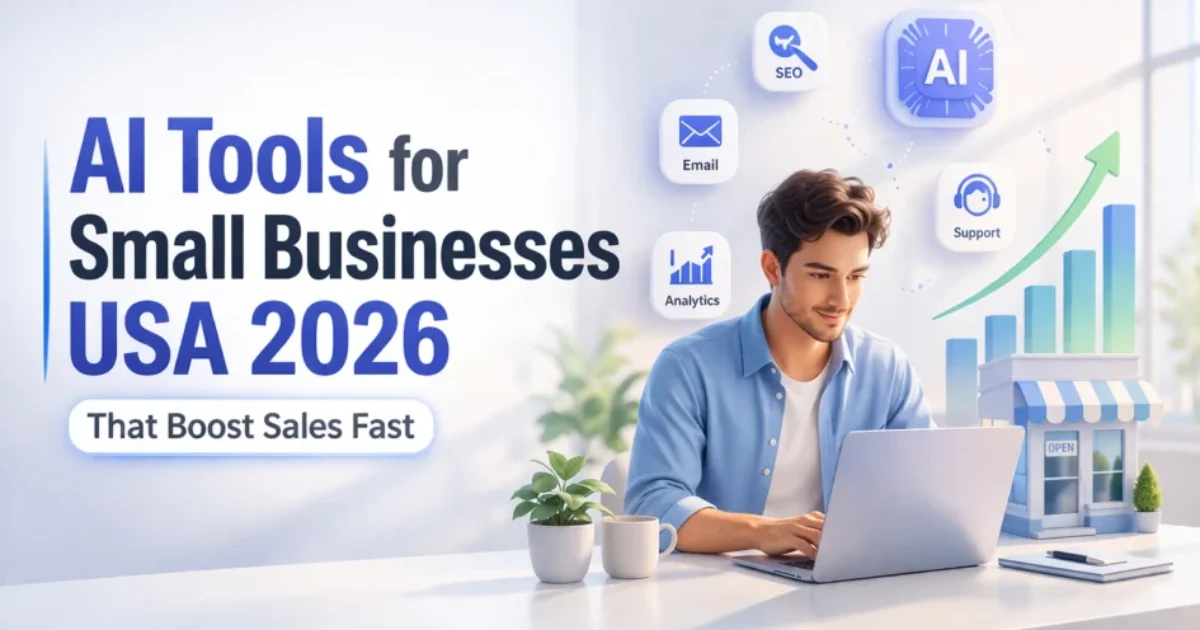
AI Tools for Small Businesses USA 2026: What Actually Works (Tested, Not Theorised)
Last updated: September 2026
The best AI tools for small businesses USA 2026 fall into five categories: content and SEO tools (ChatGPT, Jasper), marketing automation (HubSpot, Mailchimp), design and creative (Canva AI, Adobe Firefly), customer support (Zendesk AI, Tidio), and analytics (Google Analytics 4 with AI insights). The mistake most US small business owners make is trying all of them at once. What works is picking one tool per category, mastering it for 30 days, and only then expanding. AI amplifies the operator — it does not replace the thinking behind the business.
I still remember the moment I realised something was fundamentally off. I was publishing content, testing marketing strategies, spending hours on SEO, and still — results were slow. Not zero, but nowhere near what the effort deserved. That is when I started seriously looking into AI tools for small businesses, not as a trend to follow but as a structural problem to solve.
What I found after months of actual testing — not YouTube tutorials, but real use against real outcomes — was this: most AI tools waste time until you filter for the right use case. A few of the right ones genuinely replaced 5 to 6 hours of daily work. The difference between the ones that helped and the ones that did not had nothing to do with price or hype and everything to do with fit: the right tool for the right bottleneck in the right business context.
This guide covers AI tools for small businesses USA 2026 from that lens — what I actually tested, what failed, what worked, and the framework I use to decide which tools earn a permanent place in a small business workflow targeting US customers.
- Why AI tools for small businesses USA 2026 are no longer optional
- AI content and SEO tools — what works for US search intent
- AI marketing automation tools for US customer journeys
- AI design and creative tools for US audience expectations
- AI customer support tools — why response time decides conversions in the US
- AI analytics and decision tools for small business owners
- The 3-tool framework — how to choose without overwhelm
- Common mistakes US small businesses make with AI
- Sougan’s Take
- Summary
- Full FAQ
Why AI Tools for Small Businesses USA 2026 Are No Longer Optional
If you are running a business in the US — whether it is a bakery in Texas, a cleaning service in California, a solo LLC selling digital products, or a freelance agency operating remotely — your biggest challenge is not getting traffic. It is getting consistent customers without burning your marketing budget or your working hours.
The US market is structurally different from most markets in one critical way: the cost of attention is high and the patience of customers is low. A US consumer who does not get a response within the hour will move to a competitor. A US buyer who cannot find clear information on your website will leave in under 10 seconds. A US small business that is inconsistent in its content, messaging, or follow-up will lose to a competitor that is not better — just more present.
AI tools for small businesses USA 2026 address exactly this structural gap. They do not make decisions for you. They do not build your brand or develop your strategy. What they do is remove the friction between decisions and execution — content drafting in minutes instead of hours, customer responses in seconds instead of days, data insights available without a data analyst on staff.
The businesses winning in the US in 2026 are not necessarily the ones with the biggest budgets. They are the ones that have eliminated the manual bottlenecks that used to require a full team to manage. For a solo founder or a small team, AI tools are what level that playing field.
AI Content and SEO Tools — What Actually Works for US Search Intent
Content is still the primary channel through which US small businesses get discovered online — through search, through social, through referrals that start with a Google search. But producing consistent, high-quality content that matches US search intent is one of the most time-consuming tasks a small business owner faces. This is where AI content tools provide genuine leverage.
ChatGPT (OpenAI)
Best for: Drafts, outlines, ideation, research synthesis
The most versatile content AI available. The key is not using it to write finished content — it is using it to eliminate the blank page problem. Give it a keyword, a target audience, and a structure, and get a working draft in minutes. Then edit for your brand voice and US-specific intent. What took 5 hours now takes under 2.
Jasper AI
Best for: Long-form SEO content with brand voice consistency
Jasper is built specifically for marketing content — ads, landing pages, blog posts, email sequences. It has brand voice training built in, which matters for US audiences where tone consistency across touchpoints builds trust. More expensive than ChatGPT but saves significant editing time on marketing-specific content.
SurferSEO
Best for: US keyword research and on-page optimisation
SurferSEO analyses what is ranking in the US for your target keyword and tells you exactly what your content needs to compete — word count, keyword density, heading structure, internal links. For small businesses targeting US organic traffic, this removes the guesswork from content optimisation entirely.
The hybrid approach I settled on after testing: use ChatGPT for the first draft and outline, use SurferSEO for optimisation guidance, and do the final pass manually to add real experience and US-specific examples. This combination produces content that is competitive in US search without requiring a full content team.
AI Marketing Automation Tools for US Customer Journeys
Marketing automation is where AI tools for small businesses USA 2026 provide the highest return on time investment. In the US market, where customer follow-up directly determines conversion rates, the ability to automate personalised sequences without a dedicated marketing manager is a structural advantage for small businesses.
What manual marketing looks like
- Sending the same email to your entire list
- Following up manually when you remember to
- No visibility into which leads are most engaged
- Inconsistent messaging across touchpoints
What AI marketing automation does
- Triggers personalised emails based on user behaviour
- Sends follow-ups automatically at optimal times
- Scores leads and prioritises your attention
- Keeps messaging consistent 24 hours a day
HubSpot is the most complete option for US small businesses — CRM, email, automation, and reporting in one platform with a free tier that is genuinely useful before you need to upgrade. Mailchimp remains the best entry-level email automation tool for businesses under 500 contacts. ActiveCampaign is the step up when you need more sophisticated behaviour-based sequences for e-commerce or service businesses with longer sales cycles.
The practical example that changed my thinking: a small fitness coach in New York using AI-triggered email sequences for non-converting leads saw a 34% increase in booked consultations without changing a single thing about their offer — just by consistently following up at the right moment. That is what AI marketing automation actually does in practice.
AI Design and Creative Tools for US Audience Expectations
Visual content expectations in the US are high. Social media ads, website banners, email headers, product images, YouTube thumbnails — US audiences have been conditioned by professionally designed content from large brands and will judge a small business’s credibility partly on the quality of its visual presentation. AI design tools have made professional-level output accessible without a design team.
Canva AI
The best starting point for small businesses. The AI features — Magic Design, text-to-image, background removal, brand kit — handle 90% of social media and marketing design needs without any design skill. The free tier is genuinely functional; Pro unlocks the features that save the most time.
Adobe Firefly
Adobe’s AI image generation tool trained on licensed content — which matters for commercial use in the US market where copyright issues around AI-generated images are an active legal consideration. For businesses producing ad creatives or product visuals, Firefly’s commercially safe outputs are worth the additional cost.
Midjourney
Best for unique, brand-specific imagery that generic stock photos cannot provide. US audiences have become skilled at recognising stock photo aesthetics — original AI-generated visuals that match your brand feel more authentic. The learning curve is steeper than Canva but the output quality ceiling is much higher.
The approach that works for US small businesses: use Canva for speed and consistency across social media and templates, use Adobe Firefly or Midjourney for hero images and ad creatives where visual quality directly affects click-through rates. The distinction is worth keeping clear — the right tool for the right output type.
AI Customer Support Tools — Why Response Time Decides Conversions in the US
Sixty percent of US consumers expect a response from a business within one hour. That expectation does not flex based on business size — a solo operator is held to the same standard as a corporation. AI customer support tools are the only way a small team meets that bar without dedicated support staff available around the clock.
Tidio
Best for: Small e-commerce and service businesses
Live chat with AI chatbot fallback — when you are not available, Tidio’s AI handles FAQs, pricing questions, and lead capture automatically. Integrates directly with Shopify, WordPress, and most US e-commerce platforms. The free tier handles basic chat; paid tiers add AI response intelligence.
Zendesk AI
Best for: Businesses with higher support volume
Zendesk’s AI automates ticket categorisation, suggests responses, and resolves common issues without human intervention. For businesses receiving more than 20 support queries per day, the time savings justify the cost quickly. US customers value efficient, organised support — Zendesk makes a small team look like a full support department.
Intercom
Best for: SaaS and digital product businesses
Intercom combines AI-powered chat, product tours, and support documentation in one platform. For US digital businesses where onboarding and retention support drive revenue, Intercom’s AI features handle the repetitive questions that would otherwise consume founder time.
AI Analytics and Decision Tools — Making Data Usable for Small Business Owners
Most small business owners in the US have access to data — Google Analytics, social media insights, ad platform reports — but no time or expertise to extract actionable conclusions from it. AI analytics tools solve this by translating raw data into plain-language decisions: what is working, what is not, and what to do next.
| Tool | Best For | Cost | US Small Business Use Case |
|---|---|---|---|
| Google Analytics 4 | Website traffic and conversion tracking | Free | Understanding where US customers come from and which pages convert |
| Hotjar | User behaviour on website | Free tier available | Heatmaps and session recordings to see where US visitors drop off |
| Triple Whale | E-commerce attribution | Paid | Understanding true ROI across paid and organic US channels |
| Looker Studio | Custom reporting dashboards | Free | Building visual reports for US market performance without a data team |
Pricing as of September 2026. Free tiers are functional for most small businesses starting out.
The starting point I recommend for every US small business: Google Analytics 4 and Google Search Console together. Both are free, both are essential, and the combination shows you exactly which search queries are bringing US visitors and which pages are converting them. Master these two before paying for anything else in the analytics category.
The 3-Tool Framework — How to Choose AI Tools Without Overwhelm
The most common mistake US small business owners make with AI tools is trying too many at once. Tool fatigue is real — switching between five different AI platforms creates context-switching costs that eliminate the time savings the tools were supposed to provide. The framework I settled on after testing:
What I actually use for Peplio targeting US customers: ChatGPT for content drafts, HubSpot for email automation, Canva AI for visual content, Google Analytics 4 for performance tracking, and Peplio’s AI Visibility Tracker to monitor whether our content is being cited by US-facing AI tools. Five tools, each with a clear lane, zero overlap.
Common Mistakes US Small Businesses Make with AI Tools in 2026
After a year of testing and observing other small businesses in the US market make the same errors repeatedly, these are the patterns worth naming directly:
Chasing the latest tool instead of mastering the current one
A new AI tool launches every week. Each one promises to replace the last. Most US small business owners cycle through tools without ever implementing any of them deeply enough to get the return. Depth beats breadth every time.
Over-automating the brand voice
US audiences are extremely sensitive to robotic-sounding content. When emails, social posts, and customer responses all sound like they were generated by the same template, trust erodes. AI should handle the structure; you should handle the voice. Automate the repetitive tasks, not the personality.
Using AI to replace strategy instead of execute it
AI tools are execution tools, not strategy tools. Asking ChatGPT to tell you what business to run or which market to enter produces generic output that does not account for your specific situation. The strategic decisions — niche, positioning, offer — must come from you. AI executes the decisions you make; it does not make them for you.
Ignoring AI visibility as a new traffic channel
In 2026, US customers increasingly ask AI tools — ChatGPT, Perplexity, Google AI — for business recommendations, product comparisons, and service provider suggestions. If your business is not showing up in those AI-generated answers, you are invisible to a growing segment of US buyers. Monitoring and building your AI visibility is now a separate task from traditional SEO.
AI tools for small businesses USA 2026 are not about tools. They are about leverage. And leverage without a clear goal just accelerates in the wrong direction.
When I first started testing AI tools for US-targeted content, I made the classic mistake: I tested everything. I had subscriptions to six different tools within a month. My workflow was slower than before because I was constantly switching contexts and learning new interfaces. The turnaround came when I stopped asking “what can this tool do” and started asking “what is the one thing in my business that costs the most time and has the clearest outcome if I fix it.”
That question pointed to content creation, then to email follow-up, then to analytics. Three problems, three tools, in that order. The tools did not change my business. The clarity about which problem each tool was solving did. That is the real lesson from a year of AI tool testing: specificity of application beats breadth of adoption every time.
See how a small business learns to use AI tools the right way
In Episode 9 — Jab Speed Ruki — Mitu’s bakery is losing AI visibility and Sougan explains why the tools are not the problem. The strategy behind the tools is. Follow the full Peplio comic universe to see every digital marketing and AI lesson played out through a small business story that anyone can relate to.
Summary: AI Tools for Small Businesses USA 2026
- AI tools for small businesses USA 2026 fall into 5 categories: content/SEO, marketing automation, design, customer support, and analytics
- The optimal number of tools for a solo US small business owner is 3 to 5 — more creates tool fatigue that eliminates time savings
- Content tools: ChatGPT for drafts, Jasper for brand-consistent marketing copy, SurferSEO for US keyword optimisation
- Marketing automation: HubSpot for full CRM + automation, Mailchimp for entry-level email, ActiveCampaign for complex sequences
- Design tools: Canva AI for speed and consistency, Adobe Firefly for commercially safe AI images, Midjourney for brand-specific visuals
- Customer support: Tidio for small e-commerce, Zendesk AI for higher support volume, Intercom for SaaS and digital products
- Analytics: Start with Google Analytics 4 and Search Console (both free) before investing in paid analytics tools
- AI visibility is a new traffic channel — US buyers are increasingly asking AI tools for recommendations; your business needs to appear there
People Also Asked
What is the best AI tool for a US small business starting from zero?
Start with ChatGPT for content creation and Google Analytics 4 for performance tracking — both are either free or low cost, and together they address the two most universal bottlenecks: producing content consistently and understanding whether it is working. Add HubSpot’s free CRM once you have regular customer inquiries. These three tools cover the most important functions before spending money on anything more specialised.
How much should a US small business budget for AI tools in 2026?
A practical starting budget is $50 to $150 per month for a solo operator or very small team. At that budget you can access ChatGPT Plus ($20/month), Canva Pro ($13/month), Mailchimp’s entry paid tier ($13/month), and keep Google Analytics and Search Console free. Scale the budget as each tool demonstrably saves time or generates revenue — never pay for a tool renewal whose ROI you cannot articulate in hours saved or conversions generated.
Can AI tools help a small business compete with larger US competitors?
Yes — this is one of the most significant structural shifts AI tools for small businesses USA 2026 represent. Tasks that previously required a content team, a marketing manager, a designer, and a data analyst can now be handled by one person with the right tools. The quality ceiling has risen significantly: a solo founder using AI tools well can produce content, campaigns, and customer experiences that would have required a five-person team three years ago. The advantage is real, but it requires choosing tools deliberately and using them deeply.
FAQ: AI Tools for Small Businesses USA 2026
Are AI tools safe for US small businesses to use for customer-facing content?
Yes, with the right workflow. AI tools are safe for drafting and ideation when a human reviews and edits the output before it is published or sent. The risk is publishing AI-generated content without review — in the US market, content that sounds generic or robotic damages brand trust with audiences that have high expectations for authenticity. Always treat AI output as a first draft, not a finished product.
What AI tools work best for local US service businesses like cleaning, landscaping, or home repair?
For local US service businesses, the highest-ROI tools are: Google Business Profile AI features (free, optimises your local search appearance), Tidio for automated customer chat responses on your website, Canva AI for creating before-and-after posts and local social media content, and Mailchimp for follow-up email sequences to past customers. These four tools address the specific needs of local service businesses — local visibility, quick response, social proof, and customer retention.
How do I know if an AI tool is actually saving me time or just adding complexity?
Track it simply: before adopting a tool, note how long the target task takes you. After 30 days of using the tool, measure the same task again. If the tool has not reduced the time by at least 40% — or if the quality of the output requires so much editing that the net time is unchanged — the tool is not the right fit for that task. Apply this measurement to every tool you adopt and cut the ones that fail it without sentimentality.
Do AI tools for small businesses USA 2026 work for non-tech-savvy owners?
The best ones are designed specifically for non-technical users. Canva AI, ChatGPT, Mailchimp, Tidio, and HubSpot’s free tier all have interfaces built for business owners without technical backgrounds. The barrier to entry for AI tools in 2026 is lower than it has ever been — most require no installation, no coding, and no technical setup beyond creating an account. The challenge is not the technology; it is identifying which task to start with.
What is AI visibility and why does it matter for US small businesses?
AI visibility refers to whether your business appears in answers generated by AI tools — ChatGPT, Perplexity, Google AI Overviews — when US customers ask for recommendations, comparisons, or service providers in your category. In 2026, a growing share of US buyers start their research in AI tools rather than Google. If your business is not being cited in those AI-generated answers, you are missing a channel that did not exist two years ago. Tools like Peplio’s AI Visibility Tracker let you check this for free.
Is there a risk of US competitors using AI tools to outpace me?
Yes, and it is already happening. US competitors in most categories are already using AI tools to produce content faster, respond to customers more quickly, and analyse performance data more accurately than was possible three years ago. The businesses that are not adopting these tools are not standing still — they are falling behind relative to competitors who are. The good news: the most effective AI tools are affordable enough that budget is not the limiting factor. The limiting factor is knowing which tools to adopt and how to use them effectively, which is what this guide addresses.
Data sources and references: Salesforce — Small Business AI Trends 2026 | McKinsey — The State of AI 2026 | HubSpot — State of Marketing Report 2026 | Statista — AI in Marketing 2026. All tool recommendations reflect personal testing and publicly available product information as of September 2026. Peplio is not affiliated with any tool vendor referenced and receives no commission for recommendations.
Related Articles from Peplio
AI tools for small businesses USA 2026 have moved from optional productivity experiments to structural competitive requirements. The US market in 2026 rewards consistency, speed, and personalisation — three things that are nearly impossible to deliver manually at the scale a growing business requires. AI tools for small businesses USA 2026 solve each of these problems specifically: content tools deliver consistent publishing, automation tools deliver speed and personalised follow-up, and analytics tools deliver the data clarity that turns random effort into systematic growth. The question for US small business owners is no longer whether to use AI tools but which ones to start with and in what order.
The best AI tools for small businesses USA 2026 are not the most expensive or the most feature-rich. They are the ones that remove the specific bottleneck that is costing the most time in a given business at a given stage. A local cleaning service in Texas and a solo digital product creator in New York both need AI tools in 2026 — but they need different ones, deployed against different problems. Understanding this distinction is what separates the business owners who find that AI tools for small businesses USA 2026 transform their operations from the ones who find they have spent money on subscriptions that collect dust.
AI tools for small businesses USA 2026 also create a new visibility consideration that most small business owners have not yet recognised: AI search. When a US customer asks ChatGPT or Perplexity to recommend a cleaning service, a content writer, or a fitness coach, the businesses that appear in those answers are the ones that have built the kind of authoritative, structured, well-indexed content that AI systems can cite. AI tools for small businesses USA 2026 should therefore include visibility monitoring alongside the traditional categories of content, automation, design, and analytics — because the channel where US buyers discover businesses is actively shifting toward AI-generated recommendations.