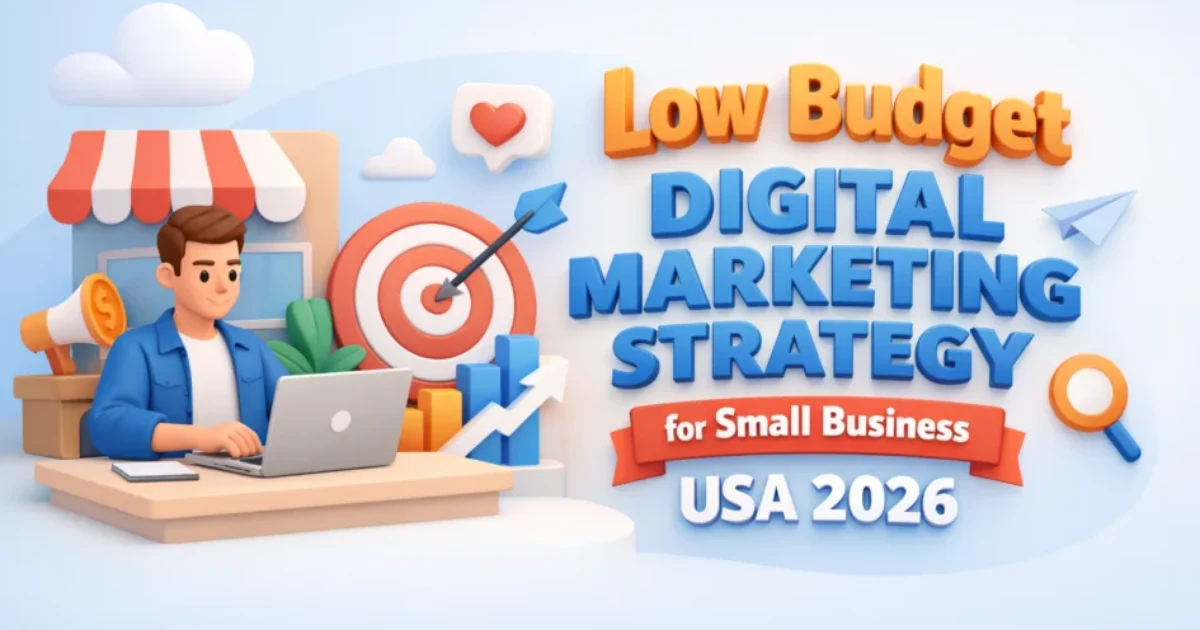
Unlock Success with a Low Budget Digital Marketing Strategy for Small Business USA 2026
I still remember sitting with a small bakery owner in Texas who told me, “I don’t have a big marketing budget, but I need more customers.” That moment changed how I look at marketing. Because the truth is, most small business owners in the United States don’t have thousands of dollars to burn on ads. They’re working with tight budgets, handling operations, dealing with IRS filings, managing LLC compliance, and still trying to figure out how to get customers online.
If you’re searching for a low budget digital marketing strategy for small business USA 2026, you’re not alone. Most US business owners are trying to get customers online without burning their entire marketing budget…
That’s exactly why this low budget digital marketing strategy for small business USA 2026 exists. Not theory. Not agency fluff. Just real strategies that actually work for US-based businesses who want customers without wasting money. And trust me, after testing multiple approaches, failing, and adjusting, I realized one thing — low budget doesn’t mean low results. It just means smarter decisions.
Peplio Reality Check
- Expected: Quick traffic and leads in 30 days
- Happened: Slow growth, almost no traffic initially
- Surprised: Organic strategies worked better than ads
Why Most Small Businesses in the USA Fail at Digital Marketing
Let’s be honest — most US small business owners don’t fail because they lack effort. They fail because they follow generic advice that doesn’t match their reality. You’ll often hear “run Facebook ads” or “hire an agency,” but no one talks about budget limitations. If you’re running a local bakery, plumbing service, or a small consulting LLC, your priority is not impressions — it’s getting real customers.
I’ve seen business owners spend $500–$1000 on ads and get almost nothing in return. Why? Because they skipped the foundation. No SEO, no content, no trust signals. That’s why this low budget digital marketing strategy for small business USA 2026 focuses on building assets, not just traffic spikes.
What This Article Will NOT Do
This article will not promise overnight success, viral growth, or instant leads. It won’t tell you to blindly invest in paid ads or hire expensive agencies. And it definitely won’t give you “top 10 hacks” that don’t work in real business scenarios. Instead, it will show you how US small businesses actually get customers online using a practical and sustainable approach.
Strategy #1: Build a Search-First Website (Your Digital Asset)
Most small business websites in the US are just digital brochures. They look nice but don’t bring customers. That’s a mistake. Your website should be your main customer acquisition channel. When I worked on building a website for US customers, I realized that design matters less than intent.
Instead of focusing only on design, focus on search intent. Ask yourself — what are your customers searching for? A bakery in Texas might target “best custom cakes near me” or “affordable birthday cakes Texas.” That’s how your website starts attracting real customers.
To understand how Google ranks websites, I highly recommend checking Google SEO Starter Guide. It’s one of the most practical resources out there.
Strategy #2: Content That Solves Real Problems
Here’s a mistake I made early — writing content just for traffic. It didn’t work. Then I shifted to solving real problems, and everything changed. When you create content that answers actual customer questions, you don’t just get traffic — you get trust.
For example, instead of writing “best marketing tips,” write something like “how US small businesses get customers online without ads.” That’s specific, relatable, and valuable.
If you want a deeper understanding, check my breakdown on how to build micro tools for website traffic. This approach alone can bring consistent organic visitors.

🧪 Peplio Experiment #1
Goal: Increase organic traffic without spending money
Action: Published 10 problem-solving articles targeting US keywords
Result: Traffic increased slowly but consistently
Next Change: Focus more on long-tail keywords with buying intent
Strategy #3: Local SEO (Your Hidden Goldmine)
If you’re a US-based business, local SEO is your biggest advantage. Yet most business owners ignore it. Setting up your Google Business Profile, optimizing for “near me” searches, and collecting reviews can bring more customers than paid ads.
I’ve seen businesses rank locally just by optimizing their listings. You can also learn more from Moz Local SEO Guide, which explains how local rankings actually work.
This is where low budget digital marketing strategy for small business USA 2026 becomes powerful — because local SEO costs almost nothing but delivers high-intent customers.
Strategy #4: First-Party Data & Email Marketing
With privacy updates and changes in tracking, relying on third-party data is risky. That’s why US businesses are shifting towards first-party data. Collect emails, build your own audience, and communicate directly.
I covered this in detail in this strategy guide, where I explained how businesses can build long-term assets instead of depending on ads.
Tools like Mailchimp or ConvertKit can help you start email marketing without heavy investment.
Strategy #5: AI + Automation (But Smart Use Only)
Everyone is talking about AI, but most people are using it the wrong way. They generate content without strategy. That doesn’t work anymore. Instead, use AI for support — not replacement.
For example, I use AI for structuring ideas, but real thinking, testing, and execution come from experience. If you want to understand how AI affects search, read this article on Google AI Overview traffic.
This balance is crucial in a low budget digital marketing strategy for small business USA 2026, because it saves time without compromising quality.
🧪 Peplio Experiment #2
Goal: Improve content production speed
Action: Used AI for outlines and drafts
Result: Faster output but required heavy editing
Next Change: Combine AI with human experience
Strategy #6: Social Proof & Trust Building
In the US market, trust is everything. Customers don’t buy from unknown brands. They look for reviews, testimonials, and credibility signals. If your business has zero reviews, you’re already losing customers.
Encourage happy customers to leave reviews. Showcase testimonials. Add case studies. Even simple screenshots can make a difference. This is part of E-E-A-T (Experience, Expertise, Authority, Trust), which Google values heavily.
Strategy #7: Organic Distribution Over Paid Ads
Instead of spending money on ads, focus on distribution. Share your content in communities, forums, and social platforms. Engage with your audience. Build relationships.
For example, platforms like Reddit or niche Facebook groups can bring highly targeted traffic if used correctly.
This is one of the most underrated parts of a low budget digital marketing strategy for small business USA 2026, yet it can drive consistent growth without spending a dollar.
If You’re a Solo Business Owner…
If you’re a solo business owner with no audience, no money, and only a laptop, here’s the truth — you don’t need a big budget to succeed. You need consistency, patience, and the right strategy. Focus on building assets, not chasing shortcuts.
Questions I Struggled With While Building This Strategy
One of the biggest questions I had was whether SEO still works in 2026. After testing multiple strategies, the answer is yes — but only if done correctly. Another question was whether paid ads are necessary. In most cases, no. Organic strategies can outperform ads if executed properly.
I also struggled with consistency. Publishing content regularly is hard, especially when results are slow. But that’s exactly where most people quit — and that’s why those who stay consistent win.
Final Thoughts + What I’m Testing Next
This low budget digital marketing strategy for small business USA 2026 is not about quick wins. It’s about building something that lasts. From SEO to content, from local optimization to email marketing, every step is designed to bring real customers, not just traffic.
Right now, I’m testing micro-tools as a traffic source and focusing more on AI-driven search visibility. The goal is simple — build systems that work even when I’m not actively promoting.
If you take one action today, start with your website. Optimize it for search. Create one piece of content that solves a real problem. And repeat. That’s how growth begins.