AI Lead Generation Funnel for Small Business USA That Actually Works (2026 Guide)
Founder, Peplio · Digital Marketing Executive, Demech Chemical Products · Last updated: October 2026 — Built from real funnel experiments targeting US small business audiences from Durgapur, India
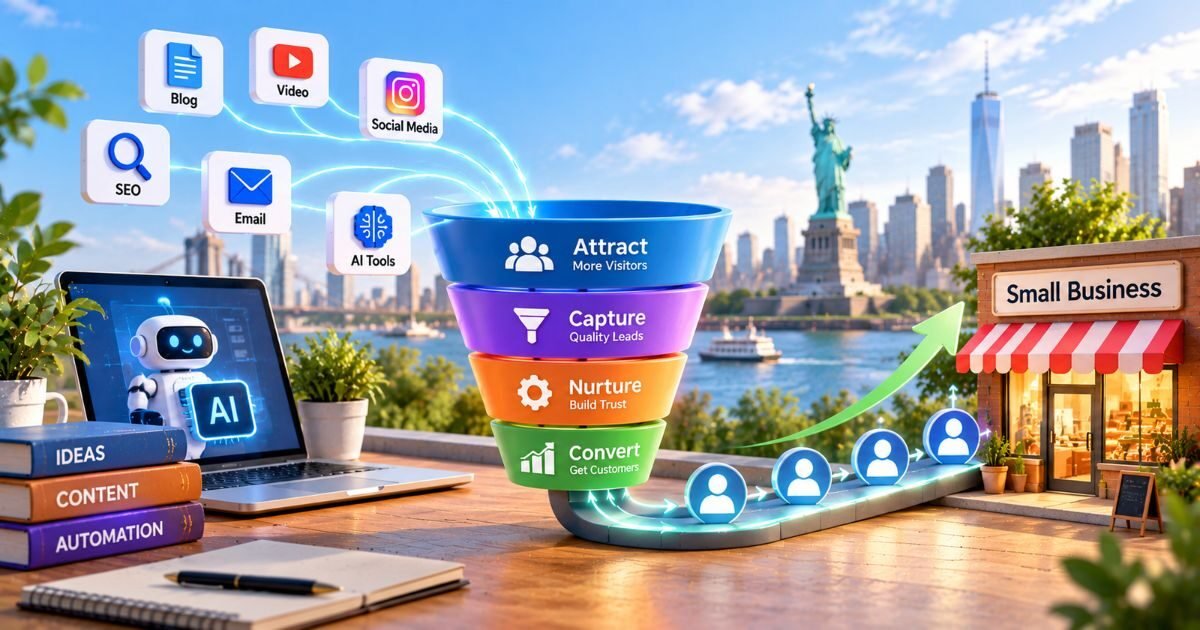
- An AI lead generation funnel for small business USA has three stages: Traffic (attract), Capture (convert visitors into leads), and Nurture (follow up automatically until conversion)
- The biggest mistake beginners make is focusing on tools before strategy — tools do not fix a broken funnel, they just automate the broken parts faster
- Simple funnels consistently outperform complex AI setups — one clear problem, one lead magnet, one email sequence beats a 47-step automation
- US customers require hyper-specific messaging — “lead generation for HVAC businesses in Texas” converts better than “digital marketing services”
- SEO traffic entering a funnel converts better than cold ad traffic because intent is already established before the visitor arrives
- A basic free-tool lead magnet (calculator, audit, checker) works better than a PDF guide for US small business audiences in 2026
I still remember the moment when building an AI lead generation funnel for small business USA went from sounding like a simple automation task to revealing itself as a genuine strategy problem. I had the tools. Zapier was connected. The landing page was live. The email sequence was running. And the leads were — nothing. Zero meaningful conversions. The funnel was technically working and strategically empty at the same time. That experience, frustrating as it was, taught me the most important lesson about building an AI lead generation funnel for small business USA: strategy comes first, tools come second. Always. This guide documents exactly what I built, what failed, what I changed, and what started converting — starting from that zero-conversion beginning.
- Why US small businesses need AI lead generation funnels in 2026
- The three-stage funnel structure explained simply
- Step-by-step: building the funnel from scratch
- Peplio experiment — what the first funnel actually produced
- Why SEO plus funnel is the winning combination
- How this works for real US small businesses
- Common mistakes that kill AI funnel performance
- Tools to build your funnel — free and paid options
- Sougan’s Take
- FAQ
Why US Small Businesses Need AI Lead Generation Funnels in 2026
If you are running a small business in the US — whether it is a Texas bakery, a California fitness coach, a Florida roofing company, or a New York consulting firm — you are competing in one of the most aggressive digital markets in the world. Traditional marketing is losing effectiveness across every channel: cold calls get screened, flyers get ignored, and even basic Facebook ads are experiencing declining returns as costs rise and attention shrinks. US customers in 2026 expect personalisation, fast responses, and genuine value before they consider buying from anyone they have not heard of before.
This is where an AI lead generation funnel for small business USA becomes more than a marketing tactic — it becomes your growth system. Instead of chasing customers through outbound effort, you build a system where customers find you through search, receive value immediately, get nurtured automatically, and convert without requiring constant manual follow-up. The AI layer — automation tools, personalised email sequences, chatbots, and behaviour-triggered responses — handles the repetitive parts of this system while you focus on the strategy and the quality of the value being offered.
The shift is clear in the data: according to HubSpot’s lead generation research, businesses that automate their lead nurturing generate 50% more sales-ready leads at 33% lower cost than businesses relying on manual follow-up. For small businesses operating without large sales teams, an AI lead generation funnel is the only realistic way to capture and nurture the volume of leads needed for consistent revenue growth in the US market.
The Three-Stage Funnel Structure Explained Simply
Before tools, before automation, before anything else — you need to understand the structure. The most important lesson I learned from my failed first funnel: I had tools for every stage but no clear strategy connecting them. An AI lead generation funnel for small business USA has three stages, and each must work before moving to the next.
Most beginners mess up by focusing on tools for Stage 2 and Stage 3 before fixing Stage 1. If the traffic entering the funnel is wrong — wrong intent, wrong audience, wrong search query — no amount of landing page optimisation or email sequence refinement will produce meaningful conversions. Fix traffic quality first. Then optimise capture. Then improve nurture. That order matters completely.
Step-by-Step: Building an AI Lead Generation Funnel for Small Business USA
Step 1 — Choose one hyper-specific customer problem. This is where I made my first mistake: I tried targeting everyone interested in “digital marketing.” In the US market, specificity is the difference between a funnel that converts and one that collects email addresses from people who never buy. Instead of “digital marketing services,” think “local SEO for HVAC businesses in Texas” or “Instagram content strategy for independent bakeries.” The more specific the problem you address, the higher the conversion rate at every stage — because the right people immediately recognise that the funnel was built for them. Use Google Trends to identify what US audiences in your specific niche are searching for right now.
Step 2 — Create a lead magnet that solves one specific problem. The best lead magnets for US small business audiences in 2026 are interactive tools — calculators, free audits, checklists — rather than PDF guides. A “Free Local SEO Audit for Small Businesses” or a “Cake Pricing Calculator for Event Bakeries” gives immediate value that a generic PDF guide cannot. The lead magnet must solve the specific problem you identified in Step 1 — not a related problem, not a broader category, but exactly that one problem. This specificity is what creates the trust signal that makes a US customer willing to share their email address.
Step 3 — Build a simple landing page with one goal. Your landing page has one job: capture the lead. No navigation menu. No multiple offers. No distracting design. Just a clear headline stating the specific problem you solve, 3 to 5 bullet points explaining what the visitor gets, a simple form asking for name and email, and a submit button. Tools like Mailchimp’s free landing page builder or Systeme.io (free tier available) allow you to build this without any coding or design experience.
Step 4 — Automate lead capture with a free tool stack. When a US customer submits their details, the system must respond immediately — delay kills conversion. Connect your landing page form to an email marketing tool. The free tier of Mailchimp handles up to 500 contacts and 1,000 emails per month — enough to test a funnel completely before spending anything. Set up an instant welcome email that delivers the lead magnet. This automation is the foundation of the AI lead generation funnel for small business USA — without it, you are just collecting leads and losing them.
Step 5 — Build a 5-day email nurture sequence that feels human. I tested robotic automated emails versus conversational emails written the way I would write to a friend. Conversational emails won every time in open rates and click rates. The sequence that worked for US audiences: Day 1 — welcome email that delivers the lead magnet and introduces who you are with one honest personal story. Day 2 — one genuinely useful piece of value content with no ask at all. Day 3 — a specific case study or real example of someone solving the exact problem. Day 5 — a soft offer that references everything shared in the previous emails. Day 7 — a direct ask with a clear call to action and a deadline or reason to act now.
Step 6 — Add retargeting for leads who did not convert. Most US customers need 5 to 7 touchpoints before converting. Visitors who hit your landing page but did not submit a form, and email subscribers who opened but did not click, are your warmest unconverted leads. Setting up basic retargeting through Facebook Custom Audiences or Google Remarketing keeps your brand visible to these people as they continue their research. This layer of the AI lead generation funnel for small business USA significantly increases overall conversion without requiring new traffic.
Peplio Experiment — What the First Funnel Actually Produced
The setup
Built a landing page offering a “Free Digital Marketing Audit for Small Businesses” targeting US business owners. Connected to a 5-email automated sequence. Traffic came from SEO articles and a small amount of social sharing. No paid ads.
Initial result — 1.2% conversion rate
The problem was immediately obvious in hindsight: “small businesses” is not specific enough for the US market. A business owner in Texas running an HVAC company and a business owner in California running a fitness studio have completely different problems, budgets, and trust signals. The offer tried to speak to both and connected with neither. 1.2% conversion rate on a landing page means 98.8% of visitors left without taking any action — a sign of messaging mismatch, not tool failure.
What I changed
Narrowed the offer to one specific niche. Added one real testimonial or result to the landing page instead of generic trust badges. Changed the headline from “Free Digital Marketing Audit” to “Free SEO Audit for Local US Service Businesses — See Exactly Why You Are Not Ranking.” This specificity in the headline alone increased the conversion rate significantly because the right visitors immediately recognised it was for them.
The lesson
Simple funnels with specific messaging outperform complex AI setups with vague messaging every single time. The tools were not the problem. The strategy — specifically the targeting specificity — was. An AI lead generation funnel for small business USA succeeds or fails at the headline and lead magnet stage, not at the automation stage.
Why SEO Plus Funnel Is the Winning Combination for US Small Businesses
The most underrated combination in digital marketing for US small businesses is organic SEO traffic flowing into a well-designed lead generation funnel. Here is why it works better than paid ads entering the same funnel: when someone finds your content through a Google search, they have already expressed specific intent — they searched for something specific, found your content, and read enough to trust clicking to your funnel. That pre-established trust converts at significantly higher rates than cold ad traffic arriving with skepticism.
At Peplio, SEO-driven traffic entering the funnel consistently showed lower bounce rates on the landing page and higher email sequence open rates than social media traffic. The reason is simple: a person who searched “AI lead generation funnel for small business USA” and found this article has already spent time reading — they arrived at the funnel with context, interest, and trust that a cold ad visitor simply does not have. The combination of the importance of SEO in 2026 as a traffic source and a well-designed lead generation funnel as a conversion mechanism is the most cost-effective growth system available for US small businesses without large ad budgets. Read the complete guide on the importance of SEO in 2026 to understand why organic traffic quality matters so much for funnel performance.
The SEO-to-funnel workflow: write articles targeting specific long-tail keywords that US customers in your niche search for when they have a problem. Within each article, offer your lead magnet as the natural next step — “if this article helped, get the free checklist that walks you through every step.” That contextual offer converts far better than a generic popup because it is presented at the exact moment the reader is most engaged with the topic.
How This Works for Real US Small Businesses
The AI lead generation funnel for small business USA framework applies across completely different business types. The structure is the same — Attract, Capture, Nurture — but the specific offer and messaging must be adapted to the exact customer and their exact problem.
| Business Type | Traffic Source | Lead Magnet | Nurture Sequence Focus |
|---|---|---|---|
| Texas bakery | Local SEO + Instagram | Free cake pricing calculator for events | Seasonal specials, social proof, booking offer |
| California fitness coach | YouTube SEO + Instagram Reels | Free 7-day home workout plan | Daily tips, client results, trial session offer |
| Florida roofing company | Local SEO + Google Business | Free roof damage assessment checklist | Storm season tips, insurance guidance, inspection offer |
| New York marketing consultant | LinkedIn + SEO articles | Free marketing audit for B2B companies | Case studies, specific tactics, discovery call offer |
| E-commerce store | Google Shopping + SEO | 10% off first order for email signup | Product benefits, social proof, abandoned cart recovery |
The pattern across every example: the lead magnet is specific to one problem the customer has right now — not a general resource about the industry. A Florida roofing company offering “Free Roof Damage Assessment Checklist” is addressing an immediate concern (is my roof damaged?) that the customer is actively worried about. That specificity is what makes the AI lead generation funnel for small business USA work — and what separates funnels that convert from funnels that collect unused email addresses.
Common Mistakes That Kill AI Funnel Performance for US Small Businesses
Mistake 1 — Building the funnel before defining the audience. I built my first funnel and then tried to find an audience for it. The correct order is the opposite: define exactly who you are talking to and what specific problem they have, then build the funnel around that. Tools do not fix strategy — they automate it. If the strategy is wrong, AI automation just makes the wrong thing happen faster.
Mistake 2 — Vague lead magnets that promise general value. “Free Marketing Guide” is not a lead magnet — it is a hope. A lead magnet must be specific enough that the right person reads the title and thinks “I need exactly this right now.” The more specific the lead magnet, the lower the total number of leads — but the higher the quality and conversion rate of those leads.
Mistake 3 — Ignoring compliance requirements. US businesses collecting email addresses must comply with CAN-SPAM requirements: clear sender identification, physical address in every email, and an easy unsubscribe mechanism. Any business collecting EU visitor data also needs GDPR compliance. These are not optional — violations can result in significant fines and deliverability damage that kills the entire funnel.
Mistake 4 — Stopping the nurture sequence too early. Most small businesses run 2 to 3 email sequences and then stop. US customers need 5 to 12 touchpoints before converting from a cold lead to a paying customer. A well-built AI lead generation funnel for small business USA nurtures leads for 2 to 4 weeks before making a strong offer — because trust is built over time, not in a single email.
Mistake 5 — Copying competitor funnels without understanding the strategy. Every business has a different audience, a different trust level, and a different conversion timeline. Copying a funnel that worked for a SaaS company and applying it to a local service business will not work because the customers, the price points, and the trust signals are completely different. Build from the strategy principle — Attract, Capture, Nurture — not from a copied template.
Tools to Build Your AI Lead Generation Funnel — Free and Paid Options
You do not need expensive tools to build your first AI lead generation funnel for small business USA. Start with free tools, prove the strategy works, then upgrade to paid tools that handle higher volume. Here is the honest tool breakdown based on what I have actually used.
| Funnel Stage | Free Option | Paid Option | What It Does |
|---|---|---|---|
| Traffic | SEO content, Google Business, social media | Google Ads, Meta Ads | Brings potential customers to the funnel entry point |
| Landing Page | Mailchimp Landing Pages, Systeme.io | ClickFunnels, Unbounce | Captures lead with one focused offer and form |
| Email Automation | Mailchimp (500 contacts free), MailerLite | ActiveCampaign, ConvertKit | Sends automated nurture sequence to captured leads |
| CRM | HubSpot CRM (free tier) | HubSpot Professional, Zoho CRM | Tracks lead status and sales pipeline |
| Automation | Zapier (100 tasks/month free), Make.com | Zapier paid, Make.com paid | Connects all tools so data flows between them automatically |
| Analytics | Google Analytics 4, Search Console | Hotjar, Microsoft Clarity | Shows where visitors drop off and what converts |
The complete free stack — Systeme.io for landing page, Mailchimp for email automation, HubSpot CRM, and Zapier for connections — is enough to build and test a fully functional AI lead generation funnel for small business USA with zero upfront cost. Upgrade to paid tools only after the strategy is proven: you know the lead magnet converts, the email sequence opens, and the offer closes. Paying for tools before that point is just spending money to automate an unproven system.
An AI lead generation funnel for small business USA is not about tools — it is about understanding one specific customer’s problem so well that your funnel feels like it was built exclusively for them.
Building from Durgapur and targeting US audiences taught me that the most sophisticated AI automation in the world cannot fix a vague message. My first funnel had Zapier, email automation, a landing page, and a nurture sequence — and converted at 1.2% because none of it spoke specifically to anyone. The moment I narrowed the message, made the lead magnet specific enough that the right person recognised it was for them, and wrote the email sequence like I was talking to one person rather than a list — conversions improved. At Demech Chemical Products, the same principle applies to B2B lead generation: specificity about the customer’s problem is more powerful than any tool or automation. If you are building your first funnel, resist the temptation to make it complex. Start with one specific problem, one specific offer, five honest emails, and a simple landing page. Test that for 30 days. The data will tell you exactly what to fix next — and that data-driven iteration is the actual AI that drives lead generation for small businesses.
Mitu’s bakery builds its first customer return system — and learns that a funnel is just a system for making the right people come back
Follow the complete story in India’s first Digital Marketing Comic Universe.
Read the Comics Get the eBooks- Three stages: Attract (traffic), Capture (lead magnet + landing page), Nurture (email sequence)
- Specificity is the most important factor — vague messaging kills conversion before any tool can fix it
- Simple funnels with specific messaging consistently outperform complex AI setups with vague messaging
- SEO traffic converts better than cold ad traffic because intent is established before the visitor arrives
- Lead magnets that give immediate interactive value (calculators, audits) outperform PDF guides in 2026
- 80% of US customers need multiple touchpoints — 5 to 12 emails before strong offer, not 2 to 3
- Free tool stack: Systeme.io (landing page) + Mailchimp (email) + HubSpot CRM + Zapier (automation)
- Upgrade to paid tools only after strategy is proven — not before
- CAN-SPAM compliance is mandatory for any US email marketing — physical address and unsubscribe required
How long does it take to see results from an AI lead generation funnel?
Expect 2 to 4 weeks of testing before drawing meaningful conclusions about funnel performance. The first week identifies technical issues (emails not delivering, landing page loading slowly). The second week shows whether the lead magnet message is attracting the right people. Weeks 3 to 4 reveal whether the nurture sequence is building enough trust to convert. Most small businesses see meaningful improvement after one round of specific changes based on this 4-week data.
Do I need paid tools to build an AI lead generation funnel for small business USA?
No — the complete free tool stack covers everything needed to test a funnel. Systeme.io handles landing pages and basic email on the free tier. Mailchimp provides email automation for up to 500 contacts free. HubSpot CRM tracks leads at no cost. Zapier connects tools with 100 tasks per month free. This combination is sufficient to validate the strategy completely before spending anything on paid tools.
What is the most common reason AI lead generation funnels fail for small businesses?
Vague messaging is the single most common cause of funnel failure. When the lead magnet and landing page headline try to speak to a broad audience rather than one specific customer with one specific problem, conversion rates stay below 2% regardless of how sophisticated the automation is. The fix is always the same: narrow the audience, make the lead magnet more specific, and rewrite the headline to speak directly to the exact problem the ideal customer is experiencing right now.
Frequently Asked Questions — AI Lead Generation Funnel for Small Business USA
What is an AI lead generation funnel for small business USA?
An AI lead generation funnel for small business USA is a three-stage automated system that attracts potential US customers through traffic sources, captures their contact information through a specific offer, and nurtures them through an automated email sequence until they are ready to buy. The AI layer handles the automation — emails triggering at the right time, leads being tagged based on behaviour, follow-ups happening without manual effort — while the strategy layer (specific messaging, relevant lead magnet, trust-building sequence) determines whether the automation produces results.
What is the best lead magnet for US small business funnels in 2026?
Interactive tools — calculators, free audits, and specific checklists — consistently outperform PDF guides for US small business audiences in 2026. The reason: an interactive tool delivers immediate personalised value (your specific numbers, your specific situation) while a PDF guide requires the visitor to do the work of extracting relevant information from general content. A “Free Pricing Calculator for Event Bakeries” or “Free Roof Damage Assessment Checklist” tells the visitor in the title exactly what value they will receive and whether it applies to them.
How many emails should my AI lead generation funnel sequence include?
A minimum of 5 to 7 emails over 7 to 14 days, with a follow-up sequence of 3 to 5 additional emails for leads who opened but did not convert. US customers require 5 to 12 touchpoints before converting from a cold lead — stopping at 2 to 3 emails is the most common reason nurture sequences fail. The sequence structure: welcome and value delivery, pure value with no ask, case study or social proof, soft offer with context, direct offer with deadline, final follow-up with reason to act now.
How does SEO connect to an AI lead generation funnel for small business USA?
SEO traffic is the highest-quality traffic source for US small business funnels because intent is established before the visitor arrives. Someone who searched “AI lead generation funnel for small business USA” and landed on this article already knows they want to build a funnel — they arrive at the offer with context and interest rather than the skepticism of a cold ad visitor. Combining SEO articles targeting specific customer problems with a relevant lead magnet offer within those articles creates a traffic-to-funnel pipeline that converts at significantly higher rates than cold paid traffic.
What compliance rules do US small businesses need to follow for email funnels?
US email marketing must comply with CAN-SPAM: every email must identify the sender clearly, include a physical mailing address, and provide a working unsubscribe mechanism that processes opt-outs within 10 business days. Businesses collecting data from EU visitors additionally need GDPR compliance — explicit consent, clear data usage disclosure, and the right to erasure. Most email marketing tools like Mailchimp include CAN-SPAM compliant templates and unsubscribe management automatically — but the physical address field must be filled in with a real address.
How is an AI lead generation funnel different from running Facebook ads?
Facebook ads are a traffic source — they put your offer in front of people who match your targeting. An AI lead generation funnel is the system that captures and converts those people after they click. Running Facebook ads without a funnel sends paid traffic to a page with no capture mechanism — you pay for every visitor and retain nothing. Running a funnel without paid ads relies on organic traffic (SEO, social, referral). The most effective combination is SEO organic traffic (free, high intent) entering the funnel for long-term lead generation, with targeted Facebook ads amplifying specific campaigns when needed.
- Importance of SEO in 2026 — Why Organic Traffic Converts Best
- Importance of Content Marketing in Digital Marketing
- Digital Marketing Skills in 2026 — The Complete Roadmap
- B2B Digital Marketing Case Study — Demech Chemical Products
- How to Increase Website Traffic — 9 Strategies That Work
- AEO vs SEO vs GEO — The Complete 2026 Comparison
- Digital Marketing for Beginners — The Complete Starting Guide
Data sources: HubSpot Lead Generation Research, FTC CAN-SPAM Compliance Guide, Google Helpful Content Guidelines. Personal experiment data from Peplio funnel testing 2025 to 2026. Updated October 2026.
Building an AI lead generation funnel for small business USA in 2026 requires understanding one fundamental truth before touching any tool: strategy determines whether the AI lead generation funnel for small business USA produces leads or just automates empty clicks. The three-stage structure of every effective AI lead generation funnel for small business USA — Attract through specific traffic, Capture through a hyper-specific lead magnet, Nurture through a trust-building email sequence — is simple to understand but requires genuine clarity about one specific customer and their one specific problem before any automation is built. The biggest mistake in building an AI lead generation funnel for small business USA is starting with tools and then trying to find strategy to fill them — the correct order is always strategy first, tools second.
An AI lead generation funnel for small business USA does not require expensive software or a large team — the complete free tool stack (Systeme.io, Mailchimp, HubSpot CRM, Zapier) handles everything needed to test and validate a funnel strategy at zero cost. What it does require is patience through the 2 to 4 week testing period, willingness to narrow messaging when conversion rates are low, and commitment to building the nurture sequence long enough for US customers to develop trust — which requires 5 to 12 touchpoints, not the 2 to 3 emails most beginners try before giving up. The AI lead generation funnel for small business USA that converts consistently is not the most complex one — it is the one with the most specific message, the most relevant lead magnet, and the most honest email sequence, running reliably for the 90 to 120 days it takes for organic trust to compound into sustainable lead flow.
Founder, Peplio · Digital Marketing Executive, Demech Chemical Products · Last updated: October 2026 — Built from real funnel experiments targeting US small business audiences from Durgapur, India
- An AI lead generation funnel for small business USA has three stages: Traffic (attract), Capture (convert visitors into leads), and Nurture (follow up automatically until conversion)
- The biggest mistake beginners make is focusing on tools before strategy — tools do not fix a broken funnel, they just automate the broken parts faster
- Simple funnels consistently outperform complex AI setups — one clear problem, one lead magnet, one email sequence beats a 47-step automation
- US customers require hyper-specific messaging — “lead generation for HVAC businesses in Texas” converts better than “digital marketing services”
- SEO traffic entering a funnel converts better than cold ad traffic because intent is already established before the visitor arrives
- A basic free-tool lead magnet (calculator, audit, checker) works better than a PDF guide for US small business audiences in 2026
I still remember the moment when building an AI lead generation funnel for small business USA went from sounding like a simple automation task to revealing itself as a genuine strategy problem. I had the tools. Zapier was connected. The landing page was live. The email sequence was running. And the leads were — nothing. Zero meaningful conversions. The funnel was technically working and strategically empty at the same time. That experience, frustrating as it was, taught me the most important lesson about building an AI lead generation funnel for small business USA: strategy comes first, tools come second. Always. This guide documents exactly what I built, what failed, what I changed, and what started converting — starting from that zero-conversion beginning.
- Why US small businesses need AI lead generation funnels in 2026
- The three-stage funnel structure explained simply
- Step-by-step: building the funnel from scratch
- Peplio experiment — what the first funnel actually produced
- Why SEO plus funnel is the winning combination
- How this works for real US small businesses
- Common mistakes that kill AI funnel performance
- Tools to build your funnel — free and paid options
- Sougan’s Take
- FAQ
Why US Small Businesses Need AI Lead Generation Funnels in 2026
If you are running a small business in the US — whether it is a Texas bakery, a California fitness coach, a Florida roofing company, or a New York consulting firm — you are competing in one of the most aggressive digital markets in the world. Traditional marketing is losing effectiveness across every channel: cold calls get screened, flyers get ignored, and even basic Facebook ads are experiencing declining returns as costs rise and attention shrinks. US customers in 2026 expect personalisation, fast responses, and genuine value before they consider buying from anyone they have not heard of before.
This is where an AI lead generation funnel for small business USA becomes more than a marketing tactic — it becomes your growth system. Instead of chasing customers through outbound effort, you build a system where customers find you through search, receive value immediately, get nurtured automatically, and convert without requiring constant manual follow-up. The AI layer — automation tools, personalised email sequences, chatbots, and behaviour-triggered responses — handles the repetitive parts of this system while you focus on the strategy and the quality of the value being offered.
The shift is clear in the data: according to HubSpot’s lead generation research, businesses that automate their lead nurturing generate 50% more sales-ready leads at 33% lower cost than businesses relying on manual follow-up. For small businesses operating without large sales teams, an AI lead generation funnel is the only realistic way to capture and nurture the volume of leads needed for consistent revenue growth in the US market.
The Three-Stage Funnel Structure Explained Simply
Before tools, before automation, before anything else — you need to understand the structure. The most important lesson I learned from my failed first funnel: I had tools for every stage but no clear strategy connecting them. An AI lead generation funnel for small business USA has three stages, and each must work before moving to the next.
Most beginners mess up by focusing on tools for Stage 2 and Stage 3 before fixing Stage 1. If the traffic entering the funnel is wrong — wrong intent, wrong audience, wrong search query — no amount of landing page optimisation or email sequence refinement will produce meaningful conversions. Fix traffic quality first. Then optimise capture. Then improve nurture. That order matters completely.
Step-by-Step: Building an AI Lead Generation Funnel for Small Business USA
Step 1 — Choose one hyper-specific customer problem. This is where I made my first mistake: I tried targeting everyone interested in “digital marketing.” In the US market, specificity is the difference between a funnel that converts and one that collects email addresses from people who never buy. Instead of “digital marketing services,” think “local SEO for HVAC businesses in Texas” or “Instagram content strategy for independent bakeries.” The more specific the problem you address, the higher the conversion rate at every stage — because the right people immediately recognise that the funnel was built for them. Use Google Trends to identify what US audiences in your specific niche are searching for right now.
Step 2 — Create a lead magnet that solves one specific problem. The best lead magnets for US small business audiences in 2026 are interactive tools — calculators, free audits, checklists — rather than PDF guides. A “Free Local SEO Audit for Small Businesses” or a “Cake Pricing Calculator for Event Bakeries” gives immediate value that a generic PDF guide cannot. The lead magnet must solve the specific problem you identified in Step 1 — not a related problem, not a broader category, but exactly that one problem. This specificity is what creates the trust signal that makes a US customer willing to share their email address.
Step 3 — Build a simple landing page with one goal. Your landing page has one job: capture the lead. No navigation menu. No multiple offers. No distracting design. Just a clear headline stating the specific problem you solve, 3 to 5 bullet points explaining what the visitor gets, a simple form asking for name and email, and a submit button. Tools like Mailchimp’s free landing page builder or Systeme.io (free tier available) allow you to build this without any coding or design experience.
Step 4 — Automate lead capture with a free tool stack. When a US customer submits their details, the system must respond immediately — delay kills conversion. Connect your landing page form to an email marketing tool. The free tier of Mailchimp handles up to 500 contacts and 1,000 emails per month — enough to test a funnel completely before spending anything. Set up an instant welcome email that delivers the lead magnet. This automation is the foundation of the AI lead generation funnel for small business USA — without it, you are just collecting leads and losing them.
Step 5 — Build a 5-day email nurture sequence that feels human. I tested robotic automated emails versus conversational emails written the way I would write to a friend. Conversational emails won every time in open rates and click rates. The sequence that worked for US audiences: Day 1 — welcome email that delivers the lead magnet and introduces who you are with one honest personal story. Day 2 — one genuinely useful piece of value content with no ask at all. Day 3 — a specific case study or real example of someone solving the exact problem. Day 5 — a soft offer that references everything shared in the previous emails. Day 7 — a direct ask with a clear call to action and a deadline or reason to act now.
Step 6 — Add retargeting for leads who did not convert. Most US customers need 5 to 7 touchpoints before converting. Visitors who hit your landing page but did not submit a form, and email subscribers who opened but did not click, are your warmest unconverted leads. Setting up basic retargeting through Facebook Custom Audiences or Google Remarketing keeps your brand visible to these people as they continue their research. This layer of the AI lead generation funnel for small business USA significantly increases overall conversion without requiring new traffic.
Peplio Experiment — What the First Funnel Actually Produced
The setup
Built a landing page offering a “Free Digital Marketing Audit for Small Businesses” targeting US business owners. Connected to a 5-email automated sequence. Traffic came from SEO articles and a small amount of social sharing. No paid ads.
Initial result — 1.2% conversion rate
The problem was immediately obvious in hindsight: “small businesses” is not specific enough for the US market. A business owner in Texas running an HVAC company and a business owner in California running a fitness studio have completely different problems, budgets, and trust signals. The offer tried to speak to both and connected with neither. 1.2% conversion rate on a landing page means 98.8% of visitors left without taking any action — a sign of messaging mismatch, not tool failure.
What I changed
Narrowed the offer to one specific niche. Added one real testimonial or result to the landing page instead of generic trust badges. Changed the headline from “Free Digital Marketing Audit” to “Free SEO Audit for Local US Service Businesses — See Exactly Why You Are Not Ranking.” This specificity in the headline alone increased the conversion rate significantly because the right visitors immediately recognised it was for them.
The lesson
Simple funnels with specific messaging outperform complex AI setups with vague messaging every single time. The tools were not the problem. The strategy — specifically the targeting specificity — was. An AI lead generation funnel for small business USA succeeds or fails at the headline and lead magnet stage, not at the automation stage.
Why SEO Plus Funnel Is the Winning Combination for US Small Businesses
The most underrated combination in digital marketing for US small businesses is organic SEO traffic flowing into a well-designed lead generation funnel. Here is why it works better than paid ads entering the same funnel: when someone finds your content through a Google search, they have already expressed specific intent — they searched for something specific, found your content, and read enough to trust clicking to your funnel. That pre-established trust converts at significantly higher rates than cold ad traffic arriving with skepticism.
At Peplio, SEO-driven traffic entering the funnel consistently showed lower bounce rates on the landing page and higher email sequence open rates than social media traffic. The reason is simple: a person who searched “AI lead generation funnel for small business USA” and found this article has already spent time reading — they arrived at the funnel with context, interest, and trust that a cold ad visitor simply does not have. The combination of the importance of SEO in 2026 as a traffic source and a well-designed lead generation funnel as a conversion mechanism is the most cost-effective growth system available for US small businesses without large ad budgets. Read the complete guide on the importance of SEO in 2026 to understand why organic traffic quality matters so much for funnel performance.
The SEO-to-funnel workflow: write articles targeting specific long-tail keywords that US customers in your niche search for when they have a problem. Within each article, offer your lead magnet as the natural next step — “if this article helped, get the free checklist that walks you through every step.” That contextual offer converts far better than a generic popup because it is presented at the exact moment the reader is most engaged with the topic.
How This Works for Real US Small Businesses
The AI lead generation funnel for small business USA framework applies across completely different business types. The structure is the same — Attract, Capture, Nurture — but the specific offer and messaging must be adapted to the exact customer and their exact problem.
| Business Type | Traffic Source | Lead Magnet | Nurture Sequence Focus |
|---|---|---|---|
| Texas bakery | Local SEO + Instagram | Free cake pricing calculator for events | Seasonal specials, social proof, booking offer |
| California fitness coach | YouTube SEO + Instagram Reels | Free 7-day home workout plan | Daily tips, client results, trial session offer |
| Florida roofing company | Local SEO + Google Business | Free roof damage assessment checklist | Storm season tips, insurance guidance, inspection offer |
| New York marketing consultant | LinkedIn + SEO articles | Free marketing audit for B2B companies | Case studies, specific tactics, discovery call offer |
| E-commerce store | Google Shopping + SEO | 10% off first order for email signup | Product benefits, social proof, abandoned cart recovery |
The pattern across every example: the lead magnet is specific to one problem the customer has right now — not a general resource about the industry. A Florida roofing company offering “Free Roof Damage Assessment Checklist” is addressing an immediate concern (is my roof damaged?) that the customer is actively worried about. That specificity is what makes the AI lead generation funnel for small business USA work — and what separates funnels that convert from funnels that collect unused email addresses.
Common Mistakes That Kill AI Funnel Performance for US Small Businesses
Mistake 1 — Building the funnel before defining the audience. I built my first funnel and then tried to find an audience for it. The correct order is the opposite: define exactly who you are talking to and what specific problem they have, then build the funnel around that. Tools do not fix strategy — they automate it. If the strategy is wrong, AI automation just makes the wrong thing happen faster.
Mistake 2 — Vague lead magnets that promise general value. “Free Marketing Guide” is not a lead magnet — it is a hope. A lead magnet must be specific enough that the right person reads the title and thinks “I need exactly this right now.” The more specific the lead magnet, the lower the total number of leads — but the higher the quality and conversion rate of those leads.
Mistake 3 — Ignoring compliance requirements. US businesses collecting email addresses must comply with CAN-SPAM requirements: clear sender identification, physical address in every email, and an easy unsubscribe mechanism. Any business collecting EU visitor data also needs GDPR compliance. These are not optional — violations can result in significant fines and deliverability damage that kills the entire funnel.
Mistake 4 — Stopping the nurture sequence too early. Most small businesses run 2 to 3 email sequences and then stop. US customers need 5 to 12 touchpoints before converting from a cold lead to a paying customer. A well-built AI lead generation funnel for small business USA nurtures leads for 2 to 4 weeks before making a strong offer — because trust is built over time, not in a single email.
Mistake 5 — Copying competitor funnels without understanding the strategy. Every business has a different audience, a different trust level, and a different conversion timeline. Copying a funnel that worked for a SaaS company and applying it to a local service business will not work because the customers, the price points, and the trust signals are completely different. Build from the strategy principle — Attract, Capture, Nurture — not from a copied template.
Tools to Build Your AI Lead Generation Funnel — Free and Paid Options
You do not need expensive tools to build your first AI lead generation funnel for small business USA. Start with free tools, prove the strategy works, then upgrade to paid tools that handle higher volume. Here is the honest tool breakdown based on what I have actually used.
| Funnel Stage | Free Option | Paid Option | What It Does |
|---|---|---|---|
| Traffic | SEO content, Google Business, social media | Google Ads, Meta Ads | Brings potential customers to the funnel entry point |
| Landing Page | Mailchimp Landing Pages, Systeme.io | ClickFunnels, Unbounce | Captures lead with one focused offer and form |
| Email Automation | Mailchimp (500 contacts free), MailerLite | ActiveCampaign, ConvertKit | Sends automated nurture sequence to captured leads |
| CRM | HubSpot CRM (free tier) | HubSpot Professional, Zoho CRM | Tracks lead status and sales pipeline |
| Automation | Zapier (100 tasks/month free), Make.com | Zapier paid, Make.com paid | Connects all tools so data flows between them automatically |
| Analytics | Google Analytics 4, Search Console | Hotjar, Microsoft Clarity | Shows where visitors drop off and what converts |
The complete free stack — Systeme.io for landing page, Mailchimp for email automation, HubSpot CRM, and Zapier for connections — is enough to build and test a fully functional AI lead generation funnel for small business USA with zero upfront cost. Upgrade to paid tools only after the strategy is proven: you know the lead magnet converts, the email sequence opens, and the offer closes. Paying for tools before that point is just spending money to automate an unproven system.
An AI lead generation funnel for small business USA is not about tools — it is about understanding one specific customer’s problem so well that your funnel feels like it was built exclusively for them.
Building from Durgapur and targeting US audiences taught me that the most sophisticated AI automation in the world cannot fix a vague message. My first funnel had Zapier, email automation, a landing page, and a nurture sequence — and converted at 1.2% because none of it spoke specifically to anyone. The moment I narrowed the message, made the lead magnet specific enough that the right person recognised it was for them, and wrote the email sequence like I was talking to one person rather than a list — conversions improved. At Demech Chemical Products, the same principle applies to B2B lead generation: specificity about the customer’s problem is more powerful than any tool or automation. If you are building your first funnel, resist the temptation to make it complex. Start with one specific problem, one specific offer, five honest emails, and a simple landing page. Test that for 30 days. The data will tell you exactly what to fix next — and that data-driven iteration is the actual AI that drives lead generation for small businesses.
Mitu’s bakery builds its first customer return system — and learns that a funnel is just a system for making the right people come back
Follow the complete story in India’s first Digital Marketing Comic Universe.
Read the Comics Get the eBooks- Three stages: Attract (traffic), Capture (lead magnet + landing page), Nurture (email sequence)
- Specificity is the most important factor — vague messaging kills conversion before any tool can fix it
- Simple funnels with specific messaging consistently outperform complex AI setups with vague messaging
- SEO traffic converts better than cold ad traffic because intent is established before the visitor arrives
- Lead magnets that give immediate interactive value (calculators, audits) outperform PDF guides in 2026
- 80% of US customers need multiple touchpoints — 5 to 12 emails before strong offer, not 2 to 3
- Free tool stack: Systeme.io (landing page) + Mailchimp (email) + HubSpot CRM + Zapier (automation)
- Upgrade to paid tools only after strategy is proven — not before
- CAN-SPAM compliance is mandatory for any US email marketing — physical address and unsubscribe required
How long does it take to see results from an AI lead generation funnel?
Expect 2 to 4 weeks of testing before drawing meaningful conclusions about funnel performance. The first week identifies technical issues (emails not delivering, landing page loading slowly). The second week shows whether the lead magnet message is attracting the right people. Weeks 3 to 4 reveal whether the nurture sequence is building enough trust to convert. Most small businesses see meaningful improvement after one round of specific changes based on this 4-week data.
Do I need paid tools to build an AI lead generation funnel for small business USA?
No — the complete free tool stack covers everything needed to test a funnel. Systeme.io handles landing pages and basic email on the free tier. Mailchimp provides email automation for up to 500 contacts free. HubSpot CRM tracks leads at no cost. Zapier connects tools with 100 tasks per month free. This combination is sufficient to validate the strategy completely before spending anything on paid tools.
What is the most common reason AI lead generation funnels fail for small businesses?
Vague messaging is the single most common cause of funnel failure. When the lead magnet and landing page headline try to speak to a broad audience rather than one specific customer with one specific problem, conversion rates stay below 2% regardless of how sophisticated the automation is. The fix is always the same: narrow the audience, make the lead magnet more specific, and rewrite the headline to speak directly to the exact problem the ideal customer is experiencing right now.
Frequently Asked Questions — AI Lead Generation Funnel for Small Business USA
What is an AI lead generation funnel for small business USA?
An AI lead generation funnel for small business USA is a three-stage automated system that attracts potential US customers through traffic sources, captures their contact information through a specific offer, and nurtures them through an automated email sequence until they are ready to buy. The AI layer handles the automation — emails triggering at the right time, leads being tagged based on behaviour, follow-ups happening without manual effort — while the strategy layer (specific messaging, relevant lead magnet, trust-building sequence) determines whether the automation produces results.
What is the best lead magnet for US small business funnels in 2026?
Interactive tools — calculators, free audits, and specific checklists — consistently outperform PDF guides for US small business audiences in 2026. The reason: an interactive tool delivers immediate personalised value (your specific numbers, your specific situation) while a PDF guide requires the visitor to do the work of extracting relevant information from general content. A “Free Pricing Calculator for Event Bakeries” or “Free Roof Damage Assessment Checklist” tells the visitor in the title exactly what value they will receive and whether it applies to them.
How many emails should my AI lead generation funnel sequence include?
A minimum of 5 to 7 emails over 7 to 14 days, with a follow-up sequence of 3 to 5 additional emails for leads who opened but did not convert. US customers require 5 to 12 touchpoints before converting from a cold lead — stopping at 2 to 3 emails is the most common reason nurture sequences fail. The sequence structure: welcome and value delivery, pure value with no ask, case study or social proof, soft offer with context, direct offer with deadline, final follow-up with reason to act now.
How does SEO connect to an AI lead generation funnel for small business USA?
SEO traffic is the highest-quality traffic source for US small business funnels because intent is established before the visitor arrives. Someone who searched “AI lead generation funnel for small business USA” and landed on this article already knows they want to build a funnel — they arrive at the offer with context and interest rather than the skepticism of a cold ad visitor. Combining SEO articles targeting specific customer problems with a relevant lead magnet offer within those articles creates a traffic-to-funnel pipeline that converts at significantly higher rates than cold paid traffic.
What compliance rules do US small businesses need to follow for email funnels?
US email marketing must comply with CAN-SPAM: every email must identify the sender clearly, include a physical mailing address, and provide a working unsubscribe mechanism that processes opt-outs within 10 business days. Businesses collecting data from EU visitors additionally need GDPR compliance — explicit consent, clear data usage disclosure, and the right to erasure. Most email marketing tools like Mailchimp include CAN-SPAM compliant templates and unsubscribe management automatically — but the physical address field must be filled in with a real address.
How is an AI lead generation funnel different from running Facebook ads?
Facebook ads are a traffic source — they put your offer in front of people who match your targeting. An AI lead generation funnel is the system that captures and converts those people after they click. Running Facebook ads without a funnel sends paid traffic to a page with no capture mechanism — you pay for every visitor and retain nothing. Running a funnel without paid ads relies on organic traffic (SEO, social, referral). The most effective combination is SEO organic traffic (free, high intent) entering the funnel for long-term lead generation, with targeted Facebook ads amplifying specific campaigns when needed.
- Importance of SEO in 2026 — Why Organic Traffic Converts Best
- Importance of Content Marketing in Digital Marketing
- Digital Marketing Skills in 2026 — The Complete Roadmap
- B2B Digital Marketing Case Study — Demech Chemical Products
- How to Increase Website Traffic — 9 Strategies That Work
- AEO vs SEO vs GEO — The Complete 2026 Comparison
- Digital Marketing for Beginners — The Complete Starting Guide
Data sources: HubSpot Lead Generation Research, FTC CAN-SPAM Compliance Guide, Google Helpful Content Guidelines. Personal experiment data from Peplio funnel testing 2025 to 2026. Updated October 2026.
Building an AI lead generation funnel for small business USA in 2026 requires understanding one fundamental truth before touching any tool: strategy determines whether the AI lead generation funnel for small business USA produces leads or just automates empty clicks. The three-stage structure of every effective AI lead generation funnel for small business USA — Attract through specific traffic, Capture through a hyper-specific lead magnet, Nurture through a trust-building email sequence — is simple to understand but requires genuine clarity about one specific customer and their one specific problem before any automation is built. The biggest mistake in building an AI lead generation funnel for small business USA is starting with tools and then trying to find strategy to fill them — the correct order is always strategy first, tools second.
An AI lead generation funnel for small business USA does not require expensive software or a large team — the complete free tool stack (Systeme.io, Mailchimp, HubSpot CRM, Zapier) handles everything needed to test and validate a funnel strategy at zero cost. What it does require is patience through the 2 to 4 week testing period, willingness to narrow messaging when conversion rates are low, and commitment to building the nurture sequence long enough for US customers to develop trust — which requires 5 to 12 touchpoints, not the 2 to 3 emails most beginners try before giving up. The AI lead generation funnel for small business USA that converts consistently is not the most complex one — it is the one with the most specific message, the most relevant lead magnet, and the most honest email sequence, running reliably for the 90 to 120 days it takes for organic trust to compound into sustainable lead flow.
Founder, Peplio · Digital Marketing Executive, Demech Chemical Products · Last updated: October 2026 — Built from real funnel experiments targeting US small business audiences from Durgapur, India
- An AI lead generation funnel for small business USA has three stages: Traffic (attract), Capture (convert visitors into leads), and Nurture (follow up automatically until conversion)
- The biggest mistake beginners make is focusing on tools before strategy — tools do not fix a broken funnel, they just automate the broken parts faster
- Simple funnels consistently outperform complex AI setups — one clear problem, one lead magnet, one email sequence beats a 47-step automation
- US customers require hyper-specific messaging — “lead generation for HVAC businesses in Texas” converts better than “digital marketing services”
- SEO traffic entering a funnel converts better than cold ad traffic because intent is already established before the visitor arrives
- A basic free-tool lead magnet (calculator, audit, checker) works better than a PDF guide for US small business audiences in 2026
I still remember the moment when building an AI lead generation funnel for small business USA went from sounding like a simple automation task to revealing itself as a genuine strategy problem. I had the tools. Zapier was connected. The landing page was live. The email sequence was running. And the leads were — nothing. Zero meaningful conversions. The funnel was technically working and strategically empty at the same time. That experience, frustrating as it was, taught me the most important lesson about building an AI lead generation funnel for small business USA: strategy comes first, tools come second. Always. This guide documents exactly what I built, what failed, what I changed, and what started converting — starting from that zero-conversion beginning.
- Why US small businesses need AI lead generation funnels in 2026
- The three-stage funnel structure explained simply
- Step-by-step: building the funnel from scratch
- Peplio experiment — what the first funnel actually produced
- Why SEO plus funnel is the winning combination
- How this works for real US small businesses
- Common mistakes that kill AI funnel performance
- Tools to build your funnel — free and paid options
- Sougan’s Take
- FAQ
Why US Small Businesses Need AI Lead Generation Funnels in 2026
If you are running a small business in the US — whether it is a Texas bakery, a California fitness coach, a Florida roofing company, or a New York consulting firm — you are competing in one of the most aggressive digital markets in the world. Traditional marketing is losing effectiveness across every channel: cold calls get screened, flyers get ignored, and even basic Facebook ads are experiencing declining returns as costs rise and attention shrinks. US customers in 2026 expect personalisation, fast responses, and genuine value before they consider buying from anyone they have not heard of before.
This is where an AI lead generation funnel for small business USA becomes more than a marketing tactic — it becomes your growth system. Instead of chasing customers through outbound effort, you build a system where customers find you through search, receive value immediately, get nurtured automatically, and convert without requiring constant manual follow-up. The AI layer — automation tools, personalised email sequences, chatbots, and behaviour-triggered responses — handles the repetitive parts of this system while you focus on the strategy and the quality of the value being offered.
The shift is clear in the data: according to HubSpot’s lead generation research, businesses that automate their lead nurturing generate 50% more sales-ready leads at 33% lower cost than businesses relying on manual follow-up. For small businesses operating without large sales teams, an AI lead generation funnel is the only realistic way to capture and nurture the volume of leads needed for consistent revenue growth in the US market.
The Three-Stage Funnel Structure Explained Simply
Before tools, before automation, before anything else — you need to understand the structure. The most important lesson I learned from my failed first funnel: I had tools for every stage but no clear strategy connecting them. An AI lead generation funnel for small business USA has three stages, and each must work before moving to the next.
Most beginners mess up by focusing on tools for Stage 2 and Stage 3 before fixing Stage 1. If the traffic entering the funnel is wrong — wrong intent, wrong audience, wrong search query — no amount of landing page optimisation or email sequence refinement will produce meaningful conversions. Fix traffic quality first. Then optimise capture. Then improve nurture. That order matters completely.
Step-by-Step: Building an AI Lead Generation Funnel for Small Business USA
Step 1 — Choose one hyper-specific customer problem. This is where I made my first mistake: I tried targeting everyone interested in “digital marketing.” In the US market, specificity is the difference between a funnel that converts and one that collects email addresses from people who never buy. Instead of “digital marketing services,” think “local SEO for HVAC businesses in Texas” or “Instagram content strategy for independent bakeries.” The more specific the problem you address, the higher the conversion rate at every stage — because the right people immediately recognise that the funnel was built for them. Use Google Trends to identify what US audiences in your specific niche are searching for right now.
Step 2 — Create a lead magnet that solves one specific problem. The best lead magnets for US small business audiences in 2026 are interactive tools — calculators, free audits, checklists — rather than PDF guides. A “Free Local SEO Audit for Small Businesses” or a “Cake Pricing Calculator for Event Bakeries” gives immediate value that a generic PDF guide cannot. The lead magnet must solve the specific problem you identified in Step 1 — not a related problem, not a broader category, but exactly that one problem. This specificity is what creates the trust signal that makes a US customer willing to share their email address.
Step 3 — Build a simple landing page with one goal. Your landing page has one job: capture the lead. No navigation menu. No multiple offers. No distracting design. Just a clear headline stating the specific problem you solve, 3 to 5 bullet points explaining what the visitor gets, a simple form asking for name and email, and a submit button. Tools like Mailchimp’s free landing page builder or Systeme.io (free tier available) allow you to build this without any coding or design experience.
Step 4 — Automate lead capture with a free tool stack. When a US customer submits their details, the system must respond immediately — delay kills conversion. Connect your landing page form to an email marketing tool. The free tier of Mailchimp handles up to 500 contacts and 1,000 emails per month — enough to test a funnel completely before spending anything. Set up an instant welcome email that delivers the lead magnet. This automation is the foundation of the AI lead generation funnel for small business USA — without it, you are just collecting leads and losing them.
Step 5 — Build a 5-day email nurture sequence that feels human. I tested robotic automated emails versus conversational emails written the way I would write to a friend. Conversational emails won every time in open rates and click rates. The sequence that worked for US audiences: Day 1 — welcome email that delivers the lead magnet and introduces who you are with one honest personal story. Day 2 — one genuinely useful piece of value content with no ask at all. Day 3 — a specific case study or real example of someone solving the exact problem. Day 5 — a soft offer that references everything shared in the previous emails. Day 7 — a direct ask with a clear call to action and a deadline or reason to act now.
Step 6 — Add retargeting for leads who did not convert. Most US customers need 5 to 7 touchpoints before converting. Visitors who hit your landing page but did not submit a form, and email subscribers who opened but did not click, are your warmest unconverted leads. Setting up basic retargeting through Facebook Custom Audiences or Google Remarketing keeps your brand visible to these people as they continue their research. This layer of the AI lead generation funnel for small business USA significantly increases overall conversion without requiring new traffic.
Peplio Experiment — What the First Funnel Actually Produced
The setup
Built a landing page offering a “Free Digital Marketing Audit for Small Businesses” targeting US business owners. Connected to a 5-email automated sequence. Traffic came from SEO articles and a small amount of social sharing. No paid ads.
Initial result — 1.2% conversion rate
The problem was immediately obvious in hindsight: “small businesses” is not specific enough for the US market. A business owner in Texas running an HVAC company and a business owner in California running a fitness studio have completely different problems, budgets, and trust signals. The offer tried to speak to both and connected with neither. 1.2% conversion rate on a landing page means 98.8% of visitors left without taking any action — a sign of messaging mismatch, not tool failure.
What I changed
Narrowed the offer to one specific niche. Added one real testimonial or result to the landing page instead of generic trust badges. Changed the headline from “Free Digital Marketing Audit” to “Free SEO Audit for Local US Service Businesses — See Exactly Why You Are Not Ranking.” This specificity in the headline alone increased the conversion rate significantly because the right visitors immediately recognised it was for them.
The lesson
Simple funnels with specific messaging outperform complex AI setups with vague messaging every single time. The tools were not the problem. The strategy — specifically the targeting specificity — was. An AI lead generation funnel for small business USA succeeds or fails at the headline and lead magnet stage, not at the automation stage.
Why SEO Plus Funnel Is the Winning Combination for US Small Businesses
The most underrated combination in digital marketing for US small businesses is organic SEO traffic flowing into a well-designed lead generation funnel. Here is why it works better than paid ads entering the same funnel: when someone finds your content through a Google search, they have already expressed specific intent — they searched for something specific, found your content, and read enough to trust clicking to your funnel. That pre-established trust converts at significantly higher rates than cold ad traffic arriving with skepticism.
At Peplio, SEO-driven traffic entering the funnel consistently showed lower bounce rates on the landing page and higher email sequence open rates than social media traffic. The reason is simple: a person who searched “AI lead generation funnel for small business USA” and found this article has already spent time reading — they arrived at the funnel with context, interest, and trust that a cold ad visitor simply does not have. The combination of the importance of SEO in 2026 as a traffic source and a well-designed lead generation funnel as a conversion mechanism is the most cost-effective growth system available for US small businesses without large ad budgets. Read the complete guide on the importance of SEO in 2026 to understand why organic traffic quality matters so much for funnel performance.
The SEO-to-funnel workflow: write articles targeting specific long-tail keywords that US customers in your niche search for when they have a problem. Within each article, offer your lead magnet as the natural next step — “if this article helped, get the free checklist that walks you through every step.” That contextual offer converts far better than a generic popup because it is presented at the exact moment the reader is most engaged with the topic.
How This Works for Real US Small Businesses
The AI lead generation funnel for small business USA framework applies across completely different business types. The structure is the same — Attract, Capture, Nurture — but the specific offer and messaging must be adapted to the exact customer and their exact problem.
| Business Type | Traffic Source | Lead Magnet | Nurture Sequence Focus |
|---|---|---|---|
| Texas bakery | Local SEO + Instagram | Free cake pricing calculator for events | Seasonal specials, social proof, booking offer |
| California fitness coach | YouTube SEO + Instagram Reels | Free 7-day home workout plan | Daily tips, client results, trial session offer |
| Florida roofing company | Local SEO + Google Business | Free roof damage assessment checklist | Storm season tips, insurance guidance, inspection offer |
| New York marketing consultant | LinkedIn + SEO articles | Free marketing audit for B2B companies | Case studies, specific tactics, discovery call offer |
| E-commerce store | Google Shopping + SEO | 10% off first order for email signup | Product benefits, social proof, abandoned cart recovery |
The pattern across every example: the lead magnet is specific to one problem the customer has right now — not a general resource about the industry. A Florida roofing company offering “Free Roof Damage Assessment Checklist” is addressing an immediate concern (is my roof damaged?) that the customer is actively worried about. That specificity is what makes the AI lead generation funnel for small business USA work — and what separates funnels that convert from funnels that collect unused email addresses.
Common Mistakes That Kill AI Funnel Performance for US Small Businesses
Mistake 1 — Building the funnel before defining the audience. I built my first funnel and then tried to find an audience for it. The correct order is the opposite: define exactly who you are talking to and what specific problem they have, then build the funnel around that. Tools do not fix strategy — they automate it. If the strategy is wrong, AI automation just makes the wrong thing happen faster.
Mistake 2 — Vague lead magnets that promise general value. “Free Marketing Guide” is not a lead magnet — it is a hope. A lead magnet must be specific enough that the right person reads the title and thinks “I need exactly this right now.” The more specific the lead magnet, the lower the total number of leads — but the higher the quality and conversion rate of those leads.
Mistake 3 — Ignoring compliance requirements. US businesses collecting email addresses must comply with CAN-SPAM requirements: clear sender identification, physical address in every email, and an easy unsubscribe mechanism. Any business collecting EU visitor data also needs GDPR compliance. These are not optional — violations can result in significant fines and deliverability damage that kills the entire funnel.
Mistake 4 — Stopping the nurture sequence too early. Most small businesses run 2 to 3 email sequences and then stop. US customers need 5 to 12 touchpoints before converting from a cold lead to a paying customer. A well-built AI lead generation funnel for small business USA nurtures leads for 2 to 4 weeks before making a strong offer — because trust is built over time, not in a single email.
Mistake 5 — Copying competitor funnels without understanding the strategy. Every business has a different audience, a different trust level, and a different conversion timeline. Copying a funnel that worked for a SaaS company and applying it to a local service business will not work because the customers, the price points, and the trust signals are completely different. Build from the strategy principle — Attract, Capture, Nurture — not from a copied template.
Tools to Build Your AI Lead Generation Funnel — Free and Paid Options
You do not need expensive tools to build your first AI lead generation funnel for small business USA. Start with free tools, prove the strategy works, then upgrade to paid tools that handle higher volume. Here is the honest tool breakdown based on what I have actually used.
| Funnel Stage | Free Option | Paid Option | What It Does |
|---|---|---|---|
| Traffic | SEO content, Google Business, social media | Google Ads, Meta Ads | Brings potential customers to the funnel entry point |
| Landing Page | Mailchimp Landing Pages, Systeme.io | ClickFunnels, Unbounce | Captures lead with one focused offer and form |
| Email Automation | Mailchimp (500 contacts free), MailerLite | ActiveCampaign, ConvertKit | Sends automated nurture sequence to captured leads |
| CRM | HubSpot CRM (free tier) | HubSpot Professional, Zoho CRM | Tracks lead status and sales pipeline |
| Automation | Zapier (100 tasks/month free), Make.com | Zapier paid, Make.com paid | Connects all tools so data flows between them automatically |
| Analytics | Google Analytics 4, Search Console | Hotjar, Microsoft Clarity | Shows where visitors drop off and what converts |
The complete free stack — Systeme.io for landing page, Mailchimp for email automation, HubSpot CRM, and Zapier for connections — is enough to build and test a fully functional AI lead generation funnel for small business USA with zero upfront cost. Upgrade to paid tools only after the strategy is proven: you know the lead magnet converts, the email sequence opens, and the offer closes. Paying for tools before that point is just spending money to automate an unproven system.
An AI lead generation funnel for small business USA is not about tools — it is about understanding one specific customer’s problem so well that your funnel feels like it was built exclusively for them.
Building from Durgapur and targeting US audiences taught me that the most sophisticated AI automation in the world cannot fix a vague message. My first funnel had Zapier, email automation, a landing page, and a nurture sequence — and converted at 1.2% because none of it spoke specifically to anyone. The moment I narrowed the message, made the lead magnet specific enough that the right person recognised it was for them, and wrote the email sequence like I was talking to one person rather than a list — conversions improved. At Demech Chemical Products, the same principle applies to B2B lead generation: specificity about the customer’s problem is more powerful than any tool or automation. If you are building your first funnel, resist the temptation to make it complex. Start with one specific problem, one specific offer, five honest emails, and a simple landing page. Test that for 30 days. The data will tell you exactly what to fix next — and that data-driven iteration is the actual AI that drives lead generation for small businesses.
Mitu’s bakery builds its first customer return system — and learns that a funnel is just a system for making the right people come back
Follow the complete story in India’s first Digital Marketing Comic Universe.
Read the Comics Get the eBooks- Three stages: Attract (traffic), Capture (lead magnet + landing page), Nurture (email sequence)
- Specificity is the most important factor — vague messaging kills conversion before any tool can fix it
- Simple funnels with specific messaging consistently outperform complex AI setups with vague messaging
- SEO traffic converts better than cold ad traffic because intent is established before the visitor arrives
- Lead magnets that give immediate interactive value (calculators, audits) outperform PDF guides in 2026
- 80% of US customers need multiple touchpoints — 5 to 12 emails before strong offer, not 2 to 3
- Free tool stack: Systeme.io (landing page) + Mailchimp (email) + HubSpot CRM + Zapier (automation)
- Upgrade to paid tools only after strategy is proven — not before
- CAN-SPAM compliance is mandatory for any US email marketing — physical address and unsubscribe required
How long does it take to see results from an AI lead generation funnel?
Expect 2 to 4 weeks of testing before drawing meaningful conclusions about funnel performance. The first week identifies technical issues (emails not delivering, landing page loading slowly). The second week shows whether the lead magnet message is attracting the right people. Weeks 3 to 4 reveal whether the nurture sequence is building enough trust to convert. Most small businesses see meaningful improvement after one round of specific changes based on this 4-week data.
Do I need paid tools to build an AI lead generation funnel for small business USA?
No — the complete free tool stack covers everything needed to test a funnel. Systeme.io handles landing pages and basic email on the free tier. Mailchimp provides email automation for up to 500 contacts free. HubSpot CRM tracks leads at no cost. Zapier connects tools with 100 tasks per month free. This combination is sufficient to validate the strategy completely before spending anything on paid tools.
What is the most common reason AI lead generation funnels fail for small businesses?
Vague messaging is the single most common cause of funnel failure. When the lead magnet and landing page headline try to speak to a broad audience rather than one specific customer with one specific problem, conversion rates stay below 2% regardless of how sophisticated the automation is. The fix is always the same: narrow the audience, make the lead magnet more specific, and rewrite the headline to speak directly to the exact problem the ideal customer is experiencing right now.
Frequently Asked Questions — AI Lead Generation Funnel for Small Business USA
What is an AI lead generation funnel for small business USA?
An AI lead generation funnel for small business USA is a three-stage automated system that attracts potential US customers through traffic sources, captures their contact information through a specific offer, and nurtures them through an automated email sequence until they are ready to buy. The AI layer handles the automation — emails triggering at the right time, leads being tagged based on behaviour, follow-ups happening without manual effort — while the strategy layer (specific messaging, relevant lead magnet, trust-building sequence) determines whether the automation produces results.
What is the best lead magnet for US small business funnels in 2026?
Interactive tools — calculators, free audits, and specific checklists — consistently outperform PDF guides for US small business audiences in 2026. The reason: an interactive tool delivers immediate personalised value (your specific numbers, your specific situation) while a PDF guide requires the visitor to do the work of extracting relevant information from general content. A “Free Pricing Calculator for Event Bakeries” or “Free Roof Damage Assessment Checklist” tells the visitor in the title exactly what value they will receive and whether it applies to them.
How many emails should my AI lead generation funnel sequence include?
A minimum of 5 to 7 emails over 7 to 14 days, with a follow-up sequence of 3 to 5 additional emails for leads who opened but did not convert. US customers require 5 to 12 touchpoints before converting from a cold lead — stopping at 2 to 3 emails is the most common reason nurture sequences fail. The sequence structure: welcome and value delivery, pure value with no ask, case study or social proof, soft offer with context, direct offer with deadline, final follow-up with reason to act now.
How does SEO connect to an AI lead generation funnel for small business USA?
SEO traffic is the highest-quality traffic source for US small business funnels because intent is established before the visitor arrives. Someone who searched “AI lead generation funnel for small business USA” and landed on this article already knows they want to build a funnel — they arrive at the offer with context and interest rather than the skepticism of a cold ad visitor. Combining SEO articles targeting specific customer problems with a relevant lead magnet offer within those articles creates a traffic-to-funnel pipeline that converts at significantly higher rates than cold paid traffic.
What compliance rules do US small businesses need to follow for email funnels?
US email marketing must comply with CAN-SPAM: every email must identify the sender clearly, include a physical mailing address, and provide a working unsubscribe mechanism that processes opt-outs within 10 business days. Businesses collecting data from EU visitors additionally need GDPR compliance — explicit consent, clear data usage disclosure, and the right to erasure. Most email marketing tools like Mailchimp include CAN-SPAM compliant templates and unsubscribe management automatically — but the physical address field must be filled in with a real address.
How is an AI lead generation funnel different from running Facebook ads?
Facebook ads are a traffic source — they put your offer in front of people who match your targeting. An AI lead generation funnel is the system that captures and converts those people after they click. Running Facebook ads without a funnel sends paid traffic to a page with no capture mechanism — you pay for every visitor and retain nothing. Running a funnel without paid ads relies on organic traffic (SEO, social, referral). The most effective combination is SEO organic traffic (free, high intent) entering the funnel for long-term lead generation, with targeted Facebook ads amplifying specific campaigns when needed.
- Importance of SEO in 2026 — Why Organic Traffic Converts Best
- Importance of Content Marketing in Digital Marketing
- Digital Marketing Skills in 2026 — The Complete Roadmap
- B2B Digital Marketing Case Study — Demech Chemical Products
- How to Increase Website Traffic — 9 Strategies That Work
- AEO vs SEO vs GEO — The Complete 2026 Comparison
- Digital Marketing for Beginners — The Complete Starting Guide
Data sources: HubSpot Lead Generation Research, FTC CAN-SPAM Compliance Guide, Google Helpful Content Guidelines. Personal experiment data from Peplio funnel testing 2025 to 2026. Updated October 2026.
Building an AI lead generation funnel for small business USA in 2026 requires understanding one fundamental truth before touching any tool: strategy determines whether the AI lead generation funnel for small business USA produces leads or just automates empty clicks. The three-stage structure of every effective AI lead generation funnel for small business USA — Attract through specific traffic, Capture through a hyper-specific lead magnet, Nurture through a trust-building email sequence — is simple to understand but requires genuine clarity about one specific customer and their one specific problem before any automation is built. The biggest mistake in building an AI lead generation funnel for small business USA is starting with tools and then trying to find strategy to fill them — the correct order is always strategy first, tools second.
An AI lead generation funnel for small business USA does not require expensive software or a large team — the complete free tool stack (Systeme.io, Mailchimp, HubSpot CRM, Zapier) handles everything needed to test and validate a funnel strategy at zero cost. What it does require is patience through the 2 to 4 week testing period, willingness to narrow messaging when conversion rates are low, and commitment to building the nurture sequence long enough for US customers to develop trust — which requires 5 to 12 touchpoints, not the 2 to 3 emails most beginners try before giving up. The AI lead generation funnel for small business USA that converts consistently is not the most complex one — it is the one with the most specific message, the most relevant lead magnet, and the most honest email sequence, running reliably for the 90 to 120 days it takes for organic trust to compound into sustainable lead flow.
Founder, Peplio · Digital Marketing Executive, Demech Chemical Products · Last updated: October 2026 — Built from real funnel experiments targeting US small business audiences from Durgapur, India
- An AI lead generation funnel for small business USA has three stages: Traffic (attract), Capture (convert visitors into leads), and Nurture (follow up automatically until conversion)
- The biggest mistake beginners make is focusing on tools before strategy — tools do not fix a broken funnel, they just automate the broken parts faster
- Simple funnels consistently outperform complex AI setups — one clear problem, one lead magnet, one email sequence beats a 47-step automation
- US customers require hyper-specific messaging — “lead generation for HVAC businesses in Texas” converts better than “digital marketing services”
- SEO traffic entering a funnel converts better than cold ad traffic because intent is already established before the visitor arrives
- A basic free-tool lead magnet (calculator, audit, checker) works better than a PDF guide for US small business audiences in 2026
I still remember the moment when building an AI lead generation funnel for small business USA went from sounding like a simple automation task to revealing itself as a genuine strategy problem. I had the tools. Zapier was connected. The landing page was live. The email sequence was running. And the leads were — nothing. Zero meaningful conversions. The funnel was technically working and strategically empty at the same time. That experience, frustrating as it was, taught me the most important lesson about building an AI lead generation funnel for small business USA: strategy comes first, tools come second. Always. This guide documents exactly what I built, what failed, what I changed, and what started converting — starting from that zero-conversion beginning.
- Why US small businesses need AI lead generation funnels in 2026
- The three-stage funnel structure explained simply
- Step-by-step: building the funnel from scratch
- Peplio experiment — what the first funnel actually produced
- Why SEO plus funnel is the winning combination
- How this works for real US small businesses
- Common mistakes that kill AI funnel performance
- Tools to build your funnel — free and paid options
- Sougan’s Take
- FAQ
Why US Small Businesses Need AI Lead Generation Funnels in 2026
If you are running a small business in the US — whether it is a Texas bakery, a California fitness coach, a Florida roofing company, or a New York consulting firm — you are competing in one of the most aggressive digital markets in the world. Traditional marketing is losing effectiveness across every channel: cold calls get screened, flyers get ignored, and even basic Facebook ads are experiencing declining returns as costs rise and attention shrinks. US customers in 2026 expect personalisation, fast responses, and genuine value before they consider buying from anyone they have not heard of before.
This is where an AI lead generation funnel for small business USA becomes more than a marketing tactic — it becomes your growth system. Instead of chasing customers through outbound effort, you build a system where customers find you through search, receive value immediately, get nurtured automatically, and convert without requiring constant manual follow-up. The AI layer — automation tools, personalised email sequences, chatbots, and behaviour-triggered responses — handles the repetitive parts of this system while you focus on the strategy and the quality of the value being offered.
The shift is clear in the data: according to HubSpot’s lead generation research, businesses that automate their lead nurturing generate 50% more sales-ready leads at 33% lower cost than businesses relying on manual follow-up. For small businesses operating without large sales teams, an AI lead generation funnel is the only realistic way to capture and nurture the volume of leads needed for consistent revenue growth in the US market.
The Three-Stage Funnel Structure Explained Simply
Before tools, before automation, before anything else — you need to understand the structure. The most important lesson I learned from my failed first funnel: I had tools for every stage but no clear strategy connecting them. An AI lead generation funnel for small business USA has three stages, and each must work before moving to the next.
Most beginners mess up by focusing on tools for Stage 2 and Stage 3 before fixing Stage 1. If the traffic entering the funnel is wrong — wrong intent, wrong audience, wrong search query — no amount of landing page optimisation or email sequence refinement will produce meaningful conversions. Fix traffic quality first. Then optimise capture. Then improve nurture. That order matters completely.
Step-by-Step: Building an AI Lead Generation Funnel for Small Business USA
Step 1 — Choose one hyper-specific customer problem. This is where I made my first mistake: I tried targeting everyone interested in “digital marketing.” In the US market, specificity is the difference between a funnel that converts and one that collects email addresses from people who never buy. Instead of “digital marketing services,” think “local SEO for HVAC businesses in Texas” or “Instagram content strategy for independent bakeries.” The more specific the problem you address, the higher the conversion rate at every stage — because the right people immediately recognise that the funnel was built for them. Use Google Trends to identify what US audiences in your specific niche are searching for right now.
Step 2 — Create a lead magnet that solves one specific problem. The best lead magnets for US small business audiences in 2026 are interactive tools — calculators, free audits, checklists — rather than PDF guides. A “Free Local SEO Audit for Small Businesses” or a “Cake Pricing Calculator for Event Bakeries” gives immediate value that a generic PDF guide cannot. The lead magnet must solve the specific problem you identified in Step 1 — not a related problem, not a broader category, but exactly that one problem. This specificity is what creates the trust signal that makes a US customer willing to share their email address.
Step 3 — Build a simple landing page with one goal. Your landing page has one job: capture the lead. No navigation menu. No multiple offers. No distracting design. Just a clear headline stating the specific problem you solve, 3 to 5 bullet points explaining what the visitor gets, a simple form asking for name and email, and a submit button. Tools like Mailchimp’s free landing page builder or Systeme.io (free tier available) allow you to build this without any coding or design experience.
Step 4 — Automate lead capture with a free tool stack. When a US customer submits their details, the system must respond immediately — delay kills conversion. Connect your landing page form to an email marketing tool. The free tier of Mailchimp handles up to 500 contacts and 1,000 emails per month — enough to test a funnel completely before spending anything. Set up an instant welcome email that delivers the lead magnet. This automation is the foundation of the AI lead generation funnel for small business USA — without it, you are just collecting leads and losing them.
Step 5 — Build a 5-day email nurture sequence that feels human. I tested robotic automated emails versus conversational emails written the way I would write to a friend. Conversational emails won every time in open rates and click rates. The sequence that worked for US audiences: Day 1 — welcome email that delivers the lead magnet and introduces who you are with one honest personal story. Day 2 — one genuinely useful piece of value content with no ask at all. Day 3 — a specific case study or real example of someone solving the exact problem. Day 5 — a soft offer that references everything shared in the previous emails. Day 7 — a direct ask with a clear call to action and a deadline or reason to act now.
Step 6 — Add retargeting for leads who did not convert. Most US customers need 5 to 7 touchpoints before converting. Visitors who hit your landing page but did not submit a form, and email subscribers who opened but did not click, are your warmest unconverted leads. Setting up basic retargeting through Facebook Custom Audiences or Google Remarketing keeps your brand visible to these people as they continue their research. This layer of the AI lead generation funnel for small business USA significantly increases overall conversion without requiring new traffic.
Peplio Experiment — What the First Funnel Actually Produced
The setup
Built a landing page offering a “Free Digital Marketing Audit for Small Businesses” targeting US business owners. Connected to a 5-email automated sequence. Traffic came from SEO articles and a small amount of social sharing. No paid ads.
Initial result — 1.2% conversion rate
The problem was immediately obvious in hindsight: “small businesses” is not specific enough for the US market. A business owner in Texas running an HVAC company and a business owner in California running a fitness studio have completely different problems, budgets, and trust signals. The offer tried to speak to both and connected with neither. 1.2% conversion rate on a landing page means 98.8% of visitors left without taking any action — a sign of messaging mismatch, not tool failure.
What I changed
Narrowed the offer to one specific niche. Added one real testimonial or result to the landing page instead of generic trust badges. Changed the headline from “Free Digital Marketing Audit” to “Free SEO Audit for Local US Service Businesses — See Exactly Why You Are Not Ranking.” This specificity in the headline alone increased the conversion rate significantly because the right visitors immediately recognised it was for them.
The lesson
Simple funnels with specific messaging outperform complex AI setups with vague messaging every single time. The tools were not the problem. The strategy — specifically the targeting specificity — was. An AI lead generation funnel for small business USA succeeds or fails at the headline and lead magnet stage, not at the automation stage.
Why SEO Plus Funnel Is the Winning Combination for US Small Businesses
The most underrated combination in digital marketing for US small businesses is organic SEO traffic flowing into a well-designed lead generation funnel. Here is why it works better than paid ads entering the same funnel: when someone finds your content through a Google search, they have already expressed specific intent — they searched for something specific, found your content, and read enough to trust clicking to your funnel. That pre-established trust converts at significantly higher rates than cold ad traffic arriving with skepticism.
At Peplio, SEO-driven traffic entering the funnel consistently showed lower bounce rates on the landing page and higher email sequence open rates than social media traffic. The reason is simple: a person who searched “AI lead generation funnel for small business USA” and found this article has already spent time reading — they arrived at the funnel with context, interest, and trust that a cold ad visitor simply does not have. The combination of the importance of SEO in 2026 as a traffic source and a well-designed lead generation funnel as a conversion mechanism is the most cost-effective growth system available for US small businesses without large ad budgets. Read the complete guide on the importance of SEO in 2026 to understand why organic traffic quality matters so much for funnel performance.
The SEO-to-funnel workflow: write articles targeting specific long-tail keywords that US customers in your niche search for when they have a problem. Within each article, offer your lead magnet as the natural next step — “if this article helped, get the free checklist that walks you through every step.” That contextual offer converts far better than a generic popup because it is presented at the exact moment the reader is most engaged with the topic.
How This Works for Real US Small Businesses
The AI lead generation funnel for small business USA framework applies across completely different business types. The structure is the same — Attract, Capture, Nurture — but the specific offer and messaging must be adapted to the exact customer and their exact problem.
| Business Type | Traffic Source | Lead Magnet | Nurture Sequence Focus |
|---|---|---|---|
| Texas bakery | Local SEO + Instagram | Free cake pricing calculator for events | Seasonal specials, social proof, booking offer |
| California fitness coach | YouTube SEO + Instagram Reels | Free 7-day home workout plan | Daily tips, client results, trial session offer |
| Florida roofing company | Local SEO + Google Business | Free roof damage assessment checklist | Storm season tips, insurance guidance, inspection offer |
| New York marketing consultant | LinkedIn + SEO articles | Free marketing audit for B2B companies | Case studies, specific tactics, discovery call offer |
| E-commerce store | Google Shopping + SEO | 10% off first order for email signup | Product benefits, social proof, abandoned cart recovery |
The pattern across every example: the lead magnet is specific to one problem the customer has right now — not a general resource about the industry. A Florida roofing company offering “Free Roof Damage Assessment Checklist” is addressing an immediate concern (is my roof damaged?) that the customer is actively worried about. That specificity is what makes the AI lead generation funnel for small business USA work — and what separates funnels that convert from funnels that collect unused email addresses.
Common Mistakes That Kill AI Funnel Performance for US Small Businesses
Mistake 1 — Building the funnel before defining the audience. I built my first funnel and then tried to find an audience for it. The correct order is the opposite: define exactly who you are talking to and what specific problem they have, then build the funnel around that. Tools do not fix strategy — they automate it. If the strategy is wrong, AI automation just makes the wrong thing happen faster.
Mistake 2 — Vague lead magnets that promise general value. “Free Marketing Guide” is not a lead magnet — it is a hope. A lead magnet must be specific enough that the right person reads the title and thinks “I need exactly this right now.” The more specific the lead magnet, the lower the total number of leads — but the higher the quality and conversion rate of those leads.
Mistake 3 — Ignoring compliance requirements. US businesses collecting email addresses must comply with CAN-SPAM requirements: clear sender identification, physical address in every email, and an easy unsubscribe mechanism. Any business collecting EU visitor data also needs GDPR compliance. These are not optional — violations can result in significant fines and deliverability damage that kills the entire funnel.
Mistake 4 — Stopping the nurture sequence too early. Most small businesses run 2 to 3 email sequences and then stop. US customers need 5 to 12 touchpoints before converting from a cold lead to a paying customer. A well-built AI lead generation funnel for small business USA nurtures leads for 2 to 4 weeks before making a strong offer — because trust is built over time, not in a single email.
Mistake 5 — Copying competitor funnels without understanding the strategy. Every business has a different audience, a different trust level, and a different conversion timeline. Copying a funnel that worked for a SaaS company and applying it to a local service business will not work because the customers, the price points, and the trust signals are completely different. Build from the strategy principle — Attract, Capture, Nurture — not from a copied template.
Tools to Build Your AI Lead Generation Funnel — Free and Paid Options
You do not need expensive tools to build your first AI lead generation funnel for small business USA. Start with free tools, prove the strategy works, then upgrade to paid tools that handle higher volume. Here is the honest tool breakdown based on what I have actually used.
| Funnel Stage | Free Option | Paid Option | What It Does |
|---|---|---|---|
| Traffic | SEO content, Google Business, social media | Google Ads, Meta Ads | Brings potential customers to the funnel entry point |
| Landing Page | Mailchimp Landing Pages, Systeme.io | ClickFunnels, Unbounce | Captures lead with one focused offer and form |
| Email Automation | Mailchimp (500 contacts free), MailerLite | ActiveCampaign, ConvertKit | Sends automated nurture sequence to captured leads |
| CRM | HubSpot CRM (free tier) | HubSpot Professional, Zoho CRM | Tracks lead status and sales pipeline |
| Automation | Zapier (100 tasks/month free), Make.com | Zapier paid, Make.com paid | Connects all tools so data flows between them automatically |
| Analytics | Google Analytics 4, Search Console | Hotjar, Microsoft Clarity | Shows where visitors drop off and what converts |
The complete free stack — Systeme.io for landing page, Mailchimp for email automation, HubSpot CRM, and Zapier for connections — is enough to build and test a fully functional AI lead generation funnel for small business USA with zero upfront cost. Upgrade to paid tools only after the strategy is proven: you know the lead magnet converts, the email sequence opens, and the offer closes. Paying for tools before that point is just spending money to automate an unproven system.
An AI lead generation funnel for small business USA is not about tools — it is about understanding one specific customer’s problem so well that your funnel feels like it was built exclusively for them.
Building from Durgapur and targeting US audiences taught me that the most sophisticated AI automation in the world cannot fix a vague message. My first funnel had Zapier, email automation, a landing page, and a nurture sequence — and converted at 1.2% because none of it spoke specifically to anyone. The moment I narrowed the message, made the lead magnet specific enough that the right person recognised it was for them, and wrote the email sequence like I was talking to one person rather than a list — conversions improved. At Demech Chemical Products, the same principle applies to B2B lead generation: specificity about the customer’s problem is more powerful than any tool or automation. If you are building your first funnel, resist the temptation to make it complex. Start with one specific problem, one specific offer, five honest emails, and a simple landing page. Test that for 30 days. The data will tell you exactly what to fix next — and that data-driven iteration is the actual AI that drives lead generation for small businesses.
Mitu’s bakery builds its first customer return system — and learns that a funnel is just a system for making the right people come back
Follow the complete story in India’s first Digital Marketing Comic Universe.
Read the Comics Get the eBooks- Three stages: Attract (traffic), Capture (lead magnet + landing page), Nurture (email sequence)
- Specificity is the most important factor — vague messaging kills conversion before any tool can fix it
- Simple funnels with specific messaging consistently outperform complex AI setups with vague messaging
- SEO traffic converts better than cold ad traffic because intent is established before the visitor arrives
- Lead magnets that give immediate interactive value (calculators, audits) outperform PDF guides in 2026
- 80% of US customers need multiple touchpoints — 5 to 12 emails before strong offer, not 2 to 3
- Free tool stack: Systeme.io (landing page) + Mailchimp (email) + HubSpot CRM + Zapier (automation)
- Upgrade to paid tools only after strategy is proven — not before
- CAN-SPAM compliance is mandatory for any US email marketing — physical address and unsubscribe required
How long does it take to see results from an AI lead generation funnel?
Expect 2 to 4 weeks of testing before drawing meaningful conclusions about funnel performance. The first week identifies technical issues (emails not delivering, landing page loading slowly). The second week shows whether the lead magnet message is attracting the right people. Weeks 3 to 4 reveal whether the nurture sequence is building enough trust to convert. Most small businesses see meaningful improvement after one round of specific changes based on this 4-week data.
Do I need paid tools to build an AI lead generation funnel for small business USA?
No — the complete free tool stack covers everything needed to test a funnel. Systeme.io handles landing pages and basic email on the free tier. Mailchimp provides email automation for up to 500 contacts free. HubSpot CRM tracks leads at no cost. Zapier connects tools with 100 tasks per month free. This combination is sufficient to validate the strategy completely before spending anything on paid tools.
What is the most common reason AI lead generation funnels fail for small businesses?
Vague messaging is the single most common cause of funnel failure. When the lead magnet and landing page headline try to speak to a broad audience rather than one specific customer with one specific problem, conversion rates stay below 2% regardless of how sophisticated the automation is. The fix is always the same: narrow the audience, make the lead magnet more specific, and rewrite the headline to speak directly to the exact problem the ideal customer is experiencing right now.
Frequently Asked Questions — AI Lead Generation Funnel for Small Business USA
What is an AI lead generation funnel for small business USA?
An AI lead generation funnel for small business USA is a three-stage automated system that attracts potential US customers through traffic sources, captures their contact information through a specific offer, and nurtures them through an automated email sequence until they are ready to buy. The AI layer handles the automation — emails triggering at the right time, leads being tagged based on behaviour, follow-ups happening without manual effort — while the strategy layer (specific messaging, relevant lead magnet, trust-building sequence) determines whether the automation produces results.
What is the best lead magnet for US small business funnels in 2026?
Interactive tools — calculators, free audits, and specific checklists — consistently outperform PDF guides for US small business audiences in 2026. The reason: an interactive tool delivers immediate personalised value (your specific numbers, your specific situation) while a PDF guide requires the visitor to do the work of extracting relevant information from general content. A “Free Pricing Calculator for Event Bakeries” or “Free Roof Damage Assessment Checklist” tells the visitor in the title exactly what value they will receive and whether it applies to them.
How many emails should my AI lead generation funnel sequence include?
A minimum of 5 to 7 emails over 7 to 14 days, with a follow-up sequence of 3 to 5 additional emails for leads who opened but did not convert. US customers require 5 to 12 touchpoints before converting from a cold lead — stopping at 2 to 3 emails is the most common reason nurture sequences fail. The sequence structure: welcome and value delivery, pure value with no ask, case study or social proof, soft offer with context, direct offer with deadline, final follow-up with reason to act now.
How does SEO connect to an AI lead generation funnel for small business USA?
SEO traffic is the highest-quality traffic source for US small business funnels because intent is established before the visitor arrives. Someone who searched “AI lead generation funnel for small business USA” and landed on this article already knows they want to build a funnel — they arrive at the offer with context and interest rather than the skepticism of a cold ad visitor. Combining SEO articles targeting specific customer problems with a relevant lead magnet offer within those articles creates a traffic-to-funnel pipeline that converts at significantly higher rates than cold paid traffic.
What compliance rules do US small businesses need to follow for email funnels?
US email marketing must comply with CAN-SPAM: every email must identify the sender clearly, include a physical mailing address, and provide a working unsubscribe mechanism that processes opt-outs within 10 business days. Businesses collecting data from EU visitors additionally need GDPR compliance — explicit consent, clear data usage disclosure, and the right to erasure. Most email marketing tools like Mailchimp include CAN-SPAM compliant templates and unsubscribe management automatically — but the physical address field must be filled in with a real address.
How is an AI lead generation funnel different from running Facebook ads?
Facebook ads are a traffic source — they put your offer in front of people who match your targeting. An AI lead generation funnel is the system that captures and converts those people after they click. Running Facebook ads without a funnel sends paid traffic to a page with no capture mechanism — you pay for every visitor and retain nothing. Running a funnel without paid ads relies on organic traffic (SEO, social, referral). The most effective combination is SEO organic traffic (free, high intent) entering the funnel for long-term lead generation, with targeted Facebook ads amplifying specific campaigns when needed.
- Importance of SEO in 2026 — Why Organic Traffic Converts Best
- Importance of Content Marketing in Digital Marketing
- Digital Marketing Skills in 2026 — The Complete Roadmap
- B2B Digital Marketing Case Study — Demech Chemical Products
- How to Increase Website Traffic — 9 Strategies That Work
- AEO vs SEO vs GEO — The Complete 2026 Comparison
- Digital Marketing for Beginners — The Complete Starting Guide
Data sources: HubSpot Lead Generation Research, FTC CAN-SPAM Compliance Guide, Google Helpful Content Guidelines. Personal experiment data from Peplio funnel testing 2025 to 2026. Updated October 2026.
Building an AI lead generation funnel for small business USA in 2026 requires understanding one fundamental truth before touching any tool: strategy determines whether the AI lead generation funnel for small business USA produces leads or just automates empty clicks. The three-stage structure of every effective AI lead generation funnel for small business USA — Attract through specific traffic, Capture through a hyper-specific lead magnet, Nurture through a trust-building email sequence — is simple to understand but requires genuine clarity about one specific customer and their one specific problem before any automation is built. The biggest mistake in building an AI lead generation funnel for small business USA is starting with tools and then trying to find strategy to fill them — the correct order is always strategy first, tools second.
An AI lead generation funnel for small business USA does not require expensive software or a large team — the complete free tool stack (Systeme.io, Mailchimp, HubSpot CRM, Zapier) handles everything needed to test and validate a funnel strategy at zero cost. What it does require is patience through the 2 to 4 week testing period, willingness to narrow messaging when conversion rates are low, and commitment to building the nurture sequence long enough for US customers to develop trust — which requires 5 to 12 touchpoints, not the 2 to 3 emails most beginners try before giving up. The AI lead generation funnel for small business USA that converts consistently is not the most complex one — it is the one with the most specific message, the most relevant lead magnet, and the most honest email sequence, running reliably for the 90 to 120 days it takes for organic trust to compound into sustainable lead flow.