
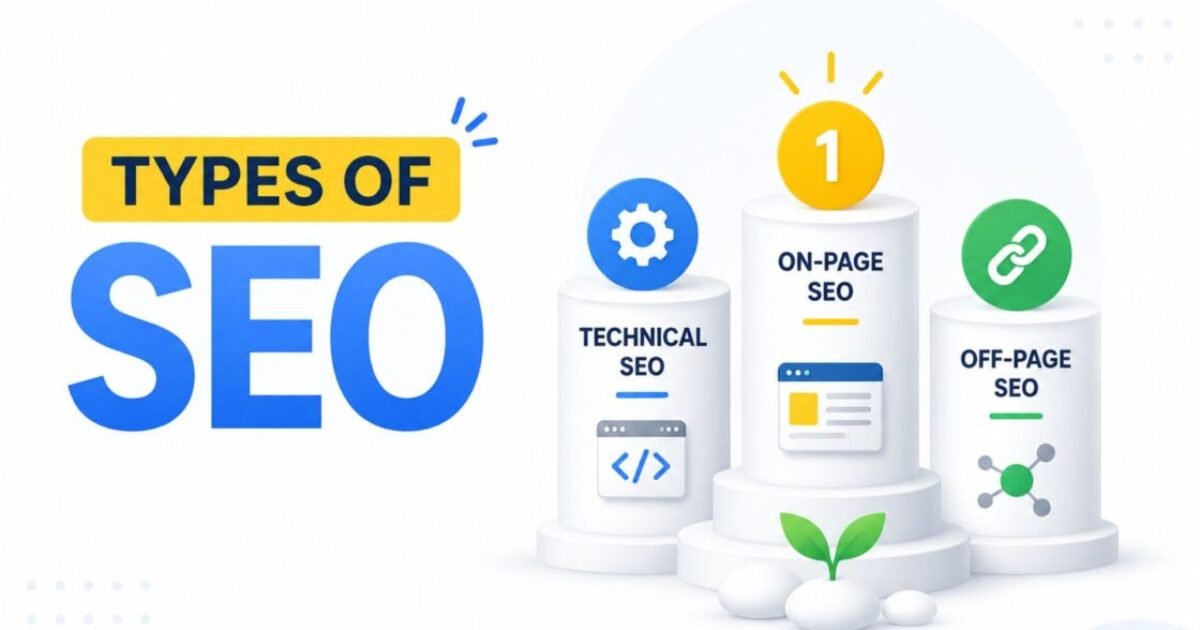
5 Proven Types of SEO Every Beginner Must Know to Rank in 2026
Written by Sougan Kumar Mandi — Digital Marketing Executive at Demech Chemical, founder of Peplio. I’ve personally tested every type of SEO listed in this article on real sites — including making every mistake possible with each one. What follows is what actually worked.Last updated: September 2026
📊 Types of SEO — 2026 At a Glance
5
Core types of SEO every site needs
46%
Of Google searches have local intent (2026)
62.73%
Of global web traffic from mobile (2025 peak)
20%
Of all 2026 searches are voice searches
48%
Of queries trigger Google AI Overviews (March 2026)
96.55%
Of web pages get zero organic traffic
When I first started learning about the types of SEO, I made the same mistake almost every beginner makes: I treated them all as equal and tried to do everything at once. I was optimising title tags (on-page SEO) while ignoring the fact that half my site couldn’t be crawled (technical SEO). I was chasing backlinks (off-page SEO) when my pages weren’t even properly indexed. I was building a local citation strategy for Peplio — which isn’t a local business.
I wasted months going in the wrong direction because nobody explained the order of the types of SEO, not just the list. This guide fixes that. I’ll cover all five core types of SEO, explain exactly what each one does, show you the data behind why each matters in 2026, share the specific mistakes I made with each type, and — most importantly — tell you which type to prioritise first based on where you actually are.
In Episode 2 of Peplio Originals, Sougan didn’t fight the café next door with one weapon — he used storytelling, search, and content together. Types of SEO is that same idea — different weapons, one goal. The mistake is picking one and ignoring the rest.
⚡ Direct Answer: What Are the Types of SEO?
The 5 core types of SEO are: (1) Technical SEO — making your site crawlable and fast; (2) On-Page SEO — optimising individual pages for relevance and intent; (3) Off-Page SEO — building authority through backlinks and brand signals; (4) Local SEO — targeting geographically-specific searches; and (5) Content SEO — creating the depth and quality that earns rankings long-term. In 2026, a sixth discipline has emerged: GEO (Generative Engine Optimisation) — optimising to be cited inside AI-generated answers.
Before diving into each type, it’s worth understanding why the types of SEO exist and how they connect. For the full picture, read my guide on what is SEO and why is it important — and for the mechanical breakdown of how each type actually affects rankings, read how does SEO work. This article builds directly on both.
📋 Table of Contents
- Why Understanding the Types of SEO Changes Everything
- Type 1 — Technical SEO: The Foundation
- Type 2 — On-Page SEO: The Relevance Layer
- Type 3 — Off-Page SEO: The Authority Layer
- Type 4 — Local SEO: The Geographic Layer
- Type 5 — Content SEO: The Long-Term Compounding Layer
- The Emerging Type — GEO (Generative Engine Optimisation)
- Full Comparison: All Types of SEO Side by Side
- Which Type of SEO Should You Start With?
- My Mistakes With Each Type of SEO
- FAQ — Types of SEO
1. Why Understanding the Types of SEO Changes Everything
Most articles that cover the types of SEO treat them like items on a shopping list — equal options you can pick and choose from. That framing is wrong and it leads beginners into exactly the kind of wasted effort I experienced. The types of SEO are not equal and interchangeable. They’re layers that build on each other in a specific order:
- Technical SEO is the foundation — without it, nothing else works
- On-Page SEO builds on top of that foundation — it makes individual pages rankable
- Content SEO deepens that relevance — it builds topical authority over time
- Off-Page SEO amplifies what already exists — it cannot compensate for a weak foundation
- Local SEO is a specialisation on top of all four — only relevant if your business serves a geographic area
- GEO is the newest layer — optimising for AI citation on top of everything else
Understanding this hierarchy is the single biggest insight I can give you about the types of SEO. A business that builds in the right order compounds its SEO gains at every stage. A business that starts with off-page SEO before fixing its technical foundation is spending money to promote a site that Google can barely crawl. According to Ahrefs, 96.55% of all pages get zero organic traffic from Google. The majority of those pages aren’t failing because of one broken type of SEO — they’re failing because no coherent combination of types was applied at all. Let’s change that.
2. Type 1 — Technical SEO: The Foundation
Of all the types of SEO, technical SEO is the one beginners most consistently skip — and the one that, when broken, makes all other SEO work pointless. Technical SEO is the process of ensuring that search engines can discover, crawl, render, and index your website efficiently. It’s everything that happens under the hood — the infrastructure your content sits on.
What Technical SEO Covers
| Technical SEO Element | What It Does | Tool to Check It |
|---|---|---|
| XML Sitemap | Tells Google which pages exist and should be crawled | Google Search Console |
| Robots.txt | Controls which sections Googlebot can and cannot access | Search Console → robots.txt tester |
| Core Web Vitals (LCP, INP, CLS) | Measures page loading, interactivity, and visual stability — confirmed ranking factors | PageSpeed Insights |
| HTTPS / SSL | Secure connection — a confirmed (minor) ranking signal and user trust factor | Browser URL bar + Screaming Frog |
| Mobile-friendliness | Google uses your mobile version for all indexing and ranking (mobile-first indexing) | Google Mobile-Friendly Test |
| Structured data (Schema) | Helps Google understand content type (FAQs, articles, products, reviews) — enables rich results | Google Rich Results Test |
| Canonical tags | Prevents duplicate content issues by telling Google which version of a page is the original | Screaming Frog |
| Site architecture + internal links | How pages are connected — affects crawl efficiency and PageRank distribution | Screaming Frog + Search Console |
Why Technical SEO Matters More Than Ever in 2026
Mobile devices drove 62.73% of all global web traffic in 2025. Google’s mobile-first indexing means your mobile experience is your SEO — a slow or broken mobile site is a direct ranking disadvantage regardless of how good your content is. Core Web Vitals — LCP under 2.5 seconds, INP under 200ms, CLS below 0.1 — are confirmed ranking factors. When I improved Core Web Vitals for a client’s e-commerce site, conversion rates increased by 18% alongside ranking improvements. Technical health and business results are directly linked.
My Technical SEO Failure: I spent three months building content before running a single technical audit. When I finally ran Screaming Frog, I found 47 broken internal links, 3 redirect chains of 4+ hops, and pages loading in 8+ seconds on mobile. None of my content had a real chance at ranking because Google’s crawl signals for Peplio were terrible. The lesson: technical SEO is not something you do after content — it’s the first thing you check before publishing anything.
Who needs to prioritise this type first: Every site — without exception. Technical SEO is the foundation all other types of SEO sit on. Even a 10-page brochure website needs to be crawlable, mobile-friendly, and loading under 3 seconds.
3. Type 2 — On-Page SEO: The Relevance Layer
On-page SEO is the type most beginners start with — and there’s a reason for that. It’s the most directly controllable of all the types of SEO, and the results are some of the fastest to appear after you make changes. On-page SEO refers to all the optimisations you make directly on individual web pages to improve their relevance for target queries, their usability for visitors, and their readability for search engine crawlers.
The Core On-Page SEO Elements
- Title tag: The clickable headline in search results — your single most important on-page SEO element. Include the focus keyword, front-loaded, within 60 characters.
- Meta description: The summary under the title in SERPs. Not a direct ranking factor but directly affects click-through rate. Include the keyword naturally; keep under 160 characters.
- H1 heading: Only one per page. Must include the focus keyword. This is what Google reads first to understand what the page is about.
- H2 and H3 headings: Organise content into scannable sections. Use related terms and secondary keywords naturally. Google uses heading structure to understand content hierarchy.
- Focus keyword placement: In the first paragraph, at least one H2, the URL slug, image alt text, and naturally throughout the body at 1–2% density.
- URL structure: Short, clean, keyword-containing slugs (e.g. /types-of-seo/ not /blog/?p=247). URLs are a minor but confirmed ranking signal.
- Image alt text: Describes images to screen readers and search engines. Include your focus keyword in the primary image alt tag.
- Internal links: Links to other relevant pages on your site — critical for distributing PageRank and helping Google understand your content cluster.
Search Intent — The Most Underrated On-Page Factor
In 2026, on-page SEO is not primarily about keyword placement. It’s about search intent alignment — matching your content format, depth, and angle to what the searcher actually wants to find. Google now categorises queries by intent: informational (70% of all searches), commercial (22%), navigational (7%), transactional (1%). If someone searches “types of SEO,” they want an educational guide — not a sales page for an SEO agency. Serving the wrong format for the intent is an on-page SEO failure, regardless of how well the keyword appears.
My On-Page SEO Failure: For six months I wrote articles that were keyword-optimised but not intent-optimised. I targeted “digital marketing strategy” with a list article — when every ranking result was a step-by-step guide. Google’s algorithm saw that users landing on my list were bouncing back to the search results (a pogo-stick signal), and my rankings stayed low. The fix was rewriting the article to match the guide format the search intent demanded. Rankings improved within 4 weeks.
Who needs to prioritise this type: Everyone who has at least basic technical SEO in place. On-page SEO is the highest-return work for most blogs and small business sites because it’s entirely within your control and changes take effect as soon as Google re-crawls the page.
4. Type 3 — Off-Page SEO: The Authority Layer

Off-page SEO is the type that most people think about when they hear “link building” — but it’s much broader than that, and it’s the type most easily done wrong. Off-page SEO covers everything that happens outside your website that influences how authoritative and trustworthy Google considers your site to be. The primary signal is backlinks — links from other websites pointing to yours — but in 2026 it also includes brand mentions, social signals, and AI citation signals.
What Counts as Off-Page SEO in 2026
- Backlinks: Links from other websites are still the strongest off-page signal. Quality matters exponentially more than quantity — a single link from a relevant, high-authority domain outweighs hundreds from low-quality directories.
- Brand mentions (linked and unlinked): Google tracks references to your brand name across the web — even when they’re not hyperlinked. Consistent, positive brand mentions in relevant publications build what Google calls “entity authority.”
- Guest posting: Publishing original articles on reputable sites in your niche, with a contextual link back to relevant content on your site. Still effective when done with genuine quality content, not as a link factory.
- Digital PR: Getting your data, research, or stories covered by news outlets and industry publications. The highest-quality backlinks typically come from this source.
- Social signals: Not a confirmed direct ranking factor, but social sharing amplifies content visibility, which leads to more organic backlinks — an indirect benefit.
- AI citation signals: In 2026, off-page SEO now partially overlaps with GEO. Being mentioned or cited in AI-generated answers (Google AI Overviews, ChatGPT, Perplexity) requires brand authority signals that are fundamentally off-page in nature.
The Off-Page SEO Reality Check
According to Ahrefs data, 66% of all web pages have zero backlinks. This is a massive opportunity gap — because backlinks remain one of the top three ranking signals. A page with even a handful of quality backlinks has a structural advantage over the majority of competing content. However, off-page SEO is the slowest type to build and the easiest to damage. Google’s algorithms have become very good at detecting manipulative link schemes. Low-quality links can actively harm your rankings — a penalty from a bad link profile can take months to recover from.
My Off-Page SEO Failure: In Peplio’s early months, I accepted a link exchange from an unrelated site in exchange for a link back. Within 6 weeks, both sites saw a rankings drop for our primary keyword clusters. Google’s algorithm flagged the pattern. The lesson: every single backlink you acquire reflects on your site’s reputation. One bad link from a spammy site does more damage than 10 good links do benefit. I now only pursue links from genuinely relevant, reputable sources — even if it means building more slowly.
Who needs to prioritise this type: Sites that have solid technical and on-page foundations but have plateaued in rankings despite good content. Off-page SEO is the amplifier — it accelerates results for sites that are already doing everything else right.
5. Type 4 — Local SEO: The Geographic Layer
Local SEO is the type of SEO most relevant to businesses with a physical location or a defined service area. It’s also one of the highest-ROI types of SEO available — because local searches have extremely high commercial intent. Local SEO is the practice of optimising your online presence to appear in search results for geographically-specific queries — “near me” searches, city-specific service queries, and map-based results (the Google “Local Pack” that appears before organic results).
The Local SEO Data That Makes This Type Unmissable
- 46% of all Google searches have local intent (2026)
- 76% of users visit a business within 24 hours after a local search
- Over 50% of “near me” searches result in a store visit
- Local searches convert at a dramatically higher rate than generic informational searches
These numbers explain why local SEO delivers some of the fastest ROI of all types of SEO — the people searching with local intent are often ready to buy the same day.
The Core Local SEO Tactics
- Google Business Profile (GBP): Claiming and fully optimising your GBP listing is the single most important local SEO action. Complete every field, add photos, post regularly, and respond to every review. This directly determines whether you appear in the Local Pack.
- Local citations: Consistent NAP (Name, Address, Phone number) across directories — Google My Business, Bing Places, Yelp, JustDial (India), Sulekha, and industry-specific directories. Inconsistencies confuse Google and suppress local rankings.
- Location-specific content: Create pages targeting your specific city and service combination — “SEO services in Durgapur” rather than just “SEO services.” Each geographic area you serve deserves its own page.
- Local backlinks: Links from local newspapers, community organisations, and local business directories. These carry disproportionate weight for local ranking signals.
- Reviews: Google uses review quantity, recency, and sentiment as local ranking signals. Actively request reviews from satisfied customers and respond professionally to negative ones.
- Local schema markup: Add LocalBusiness schema to your site — it tells Google your exact location, opening hours, service areas, and contact information in structured format.
Real Local SEO Observation from Durgapur: I’ve seen small shops in Durgapur and Asansol compete directly with larger chains for local queries — purely because they had a complete, actively managed Google Business Profile and their competitors did not. Local SEO is one of the few types of SEO where a small business can genuinely outrank a large one with consistent effort and no budget. The barrier is attention, not money.
Who needs this type: Any business with a physical location, service area, or where customers search for your category with a geographic modifier. If you run a restaurant, clinic, salon, agency, or any service business — local SEO should be your top priority after technical and on-page basics. Who doesn’t need this type: Pure online businesses, SaaS companies, bloggers, and digital-only services with no geographic audience. Peplio, for example, doesn’t do local SEO because our audience is global. Applying local SEO tactics to a non-local business wastes effort better spent on content and off-page work.
6. Type 5 — Content SEO: The Long-Term Compounding Layer
Content SEO is what most people think of when they imagine “doing SEO” — but it’s actually the most misunderstood of all the types of SEO, because its value compounds in ways that aren’t obvious in the short term. Content SEO is the practice of strategically creating, structuring, and maintaining content that earns search rankings, builds topical authority, and satisfies user intent at every stage of the buyer’s journey. It goes beyond “write a blog post” — it’s a systematic approach to owning entire topic areas in your niche.
What Makes Content SEO Different From Just Writing
The key distinction between writing and content SEO is topical authority. In 2026, Google has significantly increased its emphasis on topical authority — websites that comprehensively cover a subject rank better than those with scattered, isolated posts about random topics. This is why the content cluster strategy Peplio uses matters: the pillar page (what is SEO and why is it important) links to supporting cluster articles (like this one, and how does SEO work, and why is SEO important) — all of which link back to the pillar. This structure signals to Google that Peplio has comprehensive knowledge of the SEO topic, which lifts the ranking potential of every article in the cluster.
The Content SEO Framework
- Keyword research: Every piece of content targets a specific query with measurable search volume and achievable competition level. Content without keyword targeting is publishing, not content SEO.
- Search intent matching: The content format (guide, list, comparison, tool, video) must match what the dominant search intent for the target query demands.
- Content depth and comprehensiveness: In 2026, thin content — articles that skim a topic without real depth — loses to comprehensive content that covers every angle of a subject. This is the core of how topical authority is built.
- E-E-A-T signals: Content that demonstrates real Experience, Expertise, Authoritativeness, and Trustworthiness outranks generic content that lacks these signals. Personal case studies, original data, named authors with credentials — these are content SEO signals, not just branding choices.
- Content freshness: Updating existing articles with new data is often higher-ROI than publishing new articles. Google rewards content that stays current and accurate. I review every major Peplio article quarterly.
- Content clusters: Building groups of related articles that interlink and reinforce each other multiplies the SEO value of every piece you publish.
My Content SEO Turning Point: For the first year at Peplio, I published articles on random topics with no cluster strategy — SEO one day, social media the next, tools after that. My organic traffic was flat because Google couldn’t establish what Peplio was about. When I switched to building a focused SEO content cluster — pillar page plus 6+ supporting articles — my impressions tripled in four months. The content hadn’t changed much. What changed was the structure and the topical focus. Content SEO without cluster strategy is just blogging.
Who needs this type: Every website that publishes any content — bloggers, businesses, agencies, and e-commerce sites all benefit from content SEO. It’s the type with the longest payback period but the highest compound returns over 12–24 months.
7. The Emerging Type — GEO (Generative Engine Optimisation)

GEO — Generative Engine Optimisation — is the newest of the types of SEO, and the one that most separates 2026 SEO strategy from what worked even two years ago. GEO is the practice of optimising your content to be cited inside AI-generated answers — Google AI Overviews, ChatGPT, Gemini, Perplexity, and other AI search tools. As of March 2026, AI Overviews appear on 48% of all Google search queries. Being cited within one increases your CTR by up to 80%. Not being cited means your content may be invisible to almost half of all searchers — even if you rank on page one organically.
How GEO Differs From Traditional Types of SEO
Traditional types of SEO optimise for where your page appears in a list of results. GEO optimises for whether your content is trusted enough to be synthesised into an AI’s answer. The algorithm doesn’t just ask “is this page relevant?” — it asks “is this source credible enough to cite as the authority?” Pages with strong E-E-A-T signals are 2.3 times more likely to be cited in AI Overviews. According to Semrush’s AI Visibility Index, the top ChatGPT sources include Wikipedia, Forbes, NerdWallet, and similar highly authoritative publications — all of which have deep E-E-A-T signals.
Practical GEO Tactics
- Structured data and FAQ sections: AI systems extract structured information. FAQ schema, how-to schema, and article schema all increase extraction probability.
- Direct, concise answers early in content: AI Overviews prefer content with direct answers in the first few sentences. The “direct answer box” format used throughout this article and others in the Peplio cluster is specifically designed for this.
- Original data and statistics: AI systems cite sources that provide data they can’t find elsewhere. Original research, case studies with real numbers, and proprietary insights are structurally favoured.
- Clear authorship and credentials: Named authors with verifiable expertise are cited more often than anonymous content farms.
- Brand authority building: Being mentioned across multiple reputable sources — the off-page SEO work — feeds directly into AI citation signals.
GEO is not a separate discipline from the other types of SEO — it’s an additional layer of optimisation on top of everything else. The best technical, on-page, off-page, and content SEO all contribute to GEO performance. You don’t choose between traditional SEO and GEO; you do both.
8. Full Comparison: All Types of SEO Side by Side
| Type of SEO | What It Optimises | Time to See Results | Control Level | Who Needs It | Beginner Priority |
|---|---|---|---|---|---|
| Technical SEO | Crawlability, speed, indexing, mobile, Core Web Vitals | Days to weeks (after fixes) | Full control | Everyone | 🥇 First |
| On-Page SEO | Keywords, titles, headings, intent, internal links, meta | Weeks to 2 months | Full control | Everyone | 🥈 Second |
| Content SEO | Topical authority, depth, clusters, E-E-A-T, freshness | 3–12 months (compounds) | Full control | All content sites | 🥉 Third (ongoing) |
| Off-Page SEO | Backlinks, brand mentions, authority, digital PR | 3–6 months (slow build) | Indirect (you earn it) | All sites past the basics | 4th (after content) |
| Local SEO | GBP, citations, local content, reviews, local backlinks | 1–3 months for Local Pack | Mostly full control | Location-based businesses | 2nd (if local business) |
| GEO (AI SEO) | AI citations, structured data, E-E-A-T, brand authority | Variable — builds with authority | Indirect (you earn citations) | All sites in 2026 | Layer on top of all others |
I tried to do all five types of SEO simultaneously in month one. Predictably, I did none of them properly.
At Peplio I had 47 broken internal links and pages loading in 8 seconds before I even started on keyword research. The technical foundation was broken and everything I built on top of it was wasted effort. The moment I fixed the technical layer first — crawlability, speed, indexing — and then moved to on-page, the same content I had already published started moving in rankings. Nothing changed except the order. Fix the foundation. Then build. The types of SEO only compound when they’re applied in the right sequence.
9. Which Type of SEO Should You Start With?
Here’s the honest answer most guides won’t give you: the right starting type of SEO depends entirely on where you are right now — not on a generic recommended order.
| Your Situation | Start With This Type | Why |
|---|---|---|
| Brand new website, no traffic | Technical SEO + On-Page SEO | Google needs to crawl and index you before anything else matters |
| Local business (restaurant, clinic, salon, agency) | Local SEO + Technical SEO | Your customers search with local intent — Local Pack visibility is your fastest path to customers |
| Blog or content site with some traffic but flat growth | Content SEO cluster strategy | You probably have isolated articles competing against each other — a cluster structure will lift all of them |
| Site with good content but rankings have plateaued | Off-Page SEO (backlinks) | You’ve done the on-page work — authority is now the limiting factor |
| Site ranking page one but traffic declining despite rankings | GEO + On-Page CTR optimisation | AI Overviews are likely intercepting your traffic — optimise for citation and improve title/meta CTR |
| E-commerce site | Technical SEO + On-Page SEO (product pages) | Product page crawlability and intent-matched content are the primary levers for e-commerce rankings |
Whatever your situation, the answer always loops back to this: fix technical SEO first, then on-page, then build content authority, then amplify with off-page. GEO runs as an ongoing layer on top of all of it. The types of SEO are most powerful when they operate together — not in isolation. For the full mechanical explanation of how each type affects the crawl → index → rank pipeline, read my guide on how does SEO work. For the data on why each type drives real business results, read why is SEO important.
⚡ Key Takeaways — Types of SEO
- There are 5 core types of SEO — Technical, On-Page, Off-Page, Local, and Content — plus the emerging GEO layer.
- Technical SEO is always first — without it, all other types are undermined.
- The types of SEO are not equal options to pick from — they are layers that build on each other in a specific order.
- Local SEO is the highest short-term ROI for any business with a physical location.
- Content SEO + cluster strategy has the highest long-term compound return for blogs and content sites.
- GEO is now essential — with 48% of queries triggering AI Overviews, being cited increases CTR by up to 80%.
- 66% of all pages have zero backlinks — off-page SEO remains a massive opportunity gap for sites that get the other types right first.
Frequently Asked Questions — Types of SEO
What are the main types of SEO?
Which type of SEO is most important?
What is the difference between on-page and off-page SEO?
Is local SEO a different type of SEO from regular SEO?
What is GEO and how is it different from other types of SEO?
How many types of SEO are there?
Conclusion — The Types of SEO Work as a System, Not a Menu
The biggest insight from understanding the types of SEO isn’t which one is most important — it’s that they’re not a menu you pick from. They’re a system you build in layers. Technical SEO is the foundation. On-page SEO builds relevance on top of it. Content SEO compounds that relevance into topical authority over time. Off-page SEO amplifies the authority you’ve built. Local SEO adds geographic targeting for businesses that serve specific areas.
And GEO is the new layer every site needs in an AI-first search landscape. The 96.55% of pages that get zero organic traffic aren’t failing because they picked the wrong type. They’re failing because they applied one or two types inconsistently without building the complete system. Understanding all five types — and the order in which they build on each other — is the actual competitive advantage. Your next steps from here:
- Run a technical SEO audit — start with Google PageSpeed Insights and Google Search Console
- Read the full guide on how does SEO work to understand how each type affects the crawl → index → rank pipeline
- Audit your existing content for on-page SEO gaps using the checklist above
- Map out your content cluster — identify your pillar page and the supporting articles it needs
- Start building off-page authority through genuine, relevant content that earns natural links
📚 Continue Your SEO Education — The Full Peplio SEO Cluster
- What Is SEO and Why Is It Important? — The Complete 2026 Guide (Pillar Page)
- How Does SEO Work? 7 Proven Steps From Crawl to Rank in 2026
- Why Is SEO Important? 12 Powerful Reasons That Prove It in 2026
- Is SEO Important in 2026? Honest Answer With Real Data
- SEO Purpose: 7 Proven Reasons Why I Still Rely on It in 2026
- What Does Google Analytics Do? 10 Powerful Things It Revealed About My Website
- Digital Marketing Skills in 2026 — The Proven Roadmap to Rank, Earn, and Grow


