
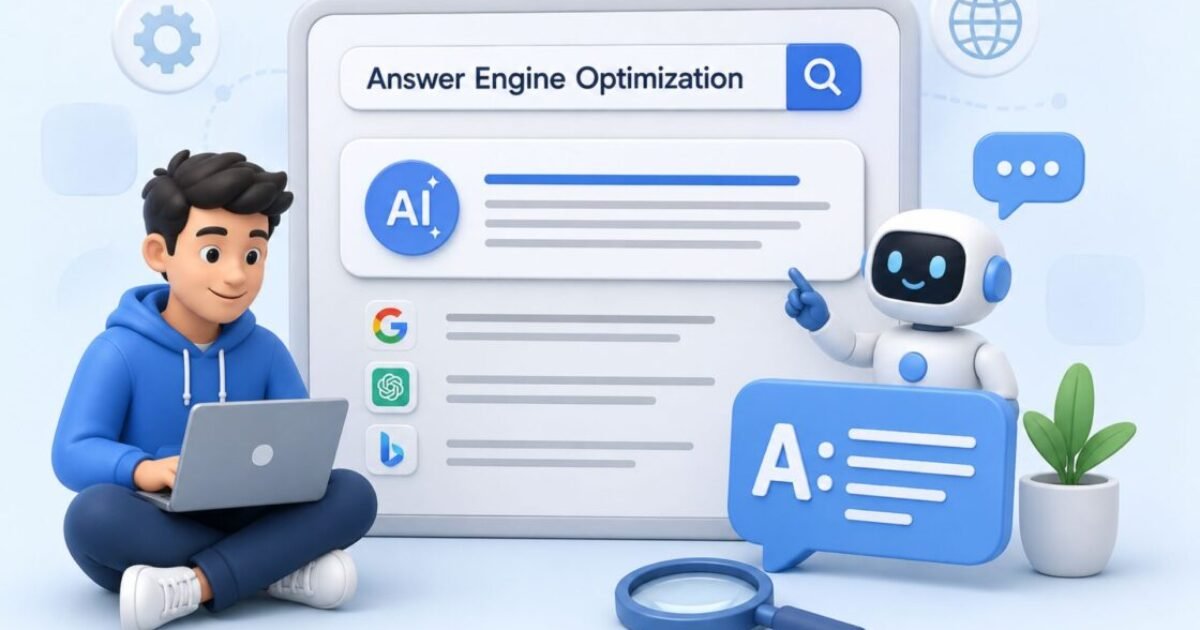
Answer Engine Optimization (AEO) — The Honest Complete Guide for 2026
Sources: AirOps 2026 State of AI Search Report, SparkToro 2026, Frase.io 2026, Princeton/Georgia Tech GEO Study, Semrush 100M Citation Analysis, Bigeye 2026
Let me be honest with you. When I first heard the term answer engine optimization, I thought it was just another marketing buzzword someone invented to sell a course. I am a digital marketing guy from Durgapur — I have seen enough trends come and go to be skeptical of anything with “new SEO” energy. But then I started building Peplio’s AEO Content Scorer tool, and I had to actually understand how AI engines decide what to cite. That changed everything for me.
Answer engine optimization is the practice of structuring your content so AI platforms — ChatGPT, Perplexity, Google AI Overviews, Gemini — select your page as a cited source when generating answers. Traditional SEO gets you ranked in a list of blue links. Answer engine optimization gets you quoted directly inside the AI’s response. In 2026, those are two completely different outcomes, and one of them is growing much faster than the other.
I am writing this because my own Semrush data shows Peplio currently has 0 AI visibility and 0 AI Overview appearances. I am not pretending to be an expert who figured everything out — I am someone actively working to fix that, sharing everything I have learned. If you are starting from zero on answer engine optimization, this is the most honest guide you will find.
- What is answer engine optimization and why does it matter now?
- AEO vs SEO — what is the actual difference?
- How AI engines decide what to cite
- 7 AEO steps you can start today
- Schema markup for answer engine optimization
- How to check your AEO score for free
- AEO for Indian creators — the first-mover window
- FAQ — Answer Engine Optimization
What Is Answer Engine Optimization and Why Does It Matter Right Now?
Answer engine optimization is the discipline of making your content easy for AI systems to find, extract, and present as a direct answer. When someone asks ChatGPT “what is the best free digital marketing tool for beginners in India,” ChatGPT does not show a list of links. It writes a synthesized answer and cites its sources. The sites it cites get the visibility. The sites it does not cite are invisible — even if they rank on page one of Google for the same query.
Answer engine optimization (AEO) = writing and structuring your content in the format AI engines prefer so they quote you — not your competitor — when someone asks about your topic.
The numbers show how fast this is moving. Frase.io’s 2026 analysis found AI-referred web sessions grew 527% year-over-year through mid-2025. SparkToro reports 38% of Google searches now end with zero clicks. And AirOps’ 2026 State of AI Search Report found that structure, freshness, and credible sourcing are the three variables that most reliably predict whether a page gets cited or skipped.
Sources: Frase.io 2026, SparkToro 2026, AirOps 2026, Semrush 100M citation analysis
AEO vs SEO — What Is the Actual Difference?
I get this question a lot, so I want to give you a clear answer instead of the vague “they work together” response most guides use. They DO work together — but the mechanics are genuinely different, and understanding the difference changes how you write every article.
- Rank in a list of blue links
- Success = clicks to your site
- Signal = keyword coverage + backlinks
- Schema: Article, BreadcrumbList
- Freshness: helpful but not critical
- Off-site: backlinks
- Get quoted inside AI responses
- Success = citation frequency
- Signal = direct answer + named sources
- Schema: FAQPage, HowTo, Speakable
- Freshness: CRITICAL — 83% citations <12 months
- Off-site: mentions on Reddit, Quora, forums
The verdict: SEO gets you into the candidate pool that AI engines draw from. Answer engine optimization determines whether the AI picks your page or your competitor’s to quote. You need both — but most people have zero AEO strategy right now.
The important thing to understand: answer engine optimization does not replace SEO. ChatGPT uses Bing’s search index, with 87% overlap between Bing’s top-10 rankings and ChatGPT citations according to AuthorityTech’s research. If you are not ranking, you are probably not getting cited either. Fix the SEO foundation — then layer answer engine optimization on top.
How AI Engines Actually Decide What to Cite
This is the part most guides skip because it requires actually understanding how these systems work. When someone asks ChatGPT or Perplexity a question, the AI does not search for that exact phrase. It breaks the query into multiple sub-queries, retrieves top results, and then extracts specific passages, facts, and data points to synthesize a response. Your content needs to match the sub-queries the AI generates — not just the user’s original question.
7 Answer Engine Optimization Steps You Can Start Today
I applied all of these to Peplio after reviewing my Semrush data and finding 0 AI visibility, 0 AI Overview appearances, and 0 SERP features. These are not theoretical — they are the exact changes I am making right now, one article at a time.
Your first 40–60 words should directly answer the article’s title question. No preamble, no “in this guide we will cover.” Just the answer. I went back and rewrote the openings of Peplio’s top 10 articles following this rule. It is the single highest-impact change for answer engine optimization.
Instead of “Benefits of AEO,” write “What Are the Main Benefits of Answer Engine Optimization?” Question headings match exactly how users phrase queries to AI engines. Every H2 should be a question someone would genuinely ask ChatGPT.
This is non-negotiable for answer engine optimization in 2026. Schema makes your Q&A pairs machine-readable so AI engines can extract individual answers, not just scan your whole page. Make sure the visible text in your article matches the schema text exactly — mismatches cause Google to ignore the markup.
“83% of AI citations come from content updated within 12 months (AirOps, 2026)” — that is citable. “Many experts say freshness matters” — that is not. Go through your existing articles and add proper attribution to every data point you have referenced.
Go to yoursite.com/robots.txt. Look for Disallow rules blocking GPTBot, PerplexityBot, ClaudeBot, Applebot, or OAI-SearchBot. According to AuthorityTech’s checklist, blocking any of these bots = zero citations from that platform. No exceptions.
Semrush’s analysis of 100 million AI citations found Reddit appeared in nearly 10% of all responses. Brand websites got only 5–10%. Genuine participation on Reddit and Quora — with links to your original content — directly improves your answer engine optimization. This is exactly where my Reddit strategy connects to AEO.
Add “Last Updated: [Month Year]” to your byline. Refresh statistics, fix broken links, add new sections. The AirOps data is clear — 83% of AI citations come from pages updated within 12 months. An article you wrote in 2023 and never touched is essentially invisible to AI citation engines in 2026, no matter how good it was.
Schema Markup for Answer Engine Optimization
Schema markup is the technical backbone of answer engine optimization. It does not make your content better — it makes your content readable by machines. Without schema, an AI engine has to guess what type of content your page contains. With schema, you tell it directly.
| Schema Type | What It Does for AEO | Priority |
|---|---|---|
| FAQPage | Makes Q&A pairs machine-readable. AI engines extract individual answers directly from schema. | 🔥 Must Have |
| Article + dateModified | Tells AI crawlers the content type, author, and exact last-update date — a direct freshness signal. | 🔥 Must Have |
| HowTo | AI engines extract individual steps for procedural queries. Essential for any step-by-step content. | ✅ High |
| Person | Links your author identity to your content. Builds E-E-A-T entity authority over time. Add to About page. | ✅ High |
| Speakable | Marks sections suitable for voice assistant reading. Growing importance as voice search increases in India. | Medium |
If you are on WordPress with RankMath, Article schema is partially automated. But FAQPage schema requires you to write the JSON-LD manually and embed it — or use RankMath’s FAQ block and map it correctly. I use manual JSON-LD for all Peplio articles so I have full control over what gets marked up and verified in Google’s Rich Results Test.
How to Check Your AEO Score for Free Before You Publish
Most answer engine optimization tools only audit live URLs — meaning you can only check a page after it is already published and indexed. You have already missed the window to optimize before Google crawls it the first time.
You can also check whether ChatGPT or Perplexity currently mentions your website using Peplio’s free AI Visibility Tracker. For most new sites the result will be zero — which is exactly where I am starting from too. Tracking it monthly as you apply these answer engine optimization principles is how you measure whether the work is actually moving.
Answer Engine Optimization for Indian Creators — The First-Mover Window
Let me say something directly to my fellow Indian content creators: the window for first-mover advantage in answer engine optimization is open right now, and most of us are sleeping on it.
I am building Peplio’s entire B-cluster of articles around this opportunity. The GEO guide, the GEO vs SEO comparison, and this article on answer engine optimization are all designed to establish Peplio as an early authority in this space before the Indian market catches up. If you want to follow the same approach, start with solid technical SEO first — then layer AEO on top of each article you publish.
- ✅ What it is: Structuring content so ChatGPT, Perplexity, and Google AI Overviews cite you — not just rank you
- ✅ AEO vs SEO: SEO gets you into the candidate pool. Answer engine optimization gets you cited from it. You need both.
- ✅ Biggest single fix: Rewrite your opening paragraph to answer the title question directly in 40–60 words
- ✅ Schema essentials: FAQPage and Article with dateModified are non-negotiable
- ✅ Freshness matters hard: 83% of AI citations come from content updated within 12 months
- ✅ Check robots.txt: Allow GPTBot, PerplexityBot, ClaudeBot, OAI-SearchBot or those platforms cannot cite you
- ✅ India opportunity: Almost no Indian content site is doing proper answer engine optimization yet — move now
- ✅ Free score check: peplio.com/free-aeo-checker — score your draft before publishing
Frequently Asked Questions — Answer Engine Optimization
What is answer engine optimization in simple terms?
Answer engine optimization (AEO) is the practice of writing and formatting your content so AI platforms like ChatGPT, Perplexity, and Google AI Overviews quote your page as their source when someone asks a relevant question. Instead of optimizing to appear in a list of search results, you are optimizing to be the answer the AI delivers directly.
Is answer engine optimization the same as SEO?
No, but they work together and you need both. Traditional SEO focuses on ranking in Google’s list of blue links. Answer engine optimization focuses on being cited by AI platforms that synthesize answers. Since most AI engines draw from top-ranked pages, strong SEO gets you into the candidate pool — then AEO signals determine whether AI picks your page or a competitor’s to quote.
What is the difference between AEO and GEO?
AEO (Answer Engine Optimization) is the broad practice of getting cited by any AI-powered answer system, including Google AI Overviews. GEO (Generative Engine Optimization) refers more specifically to optimizing for standalone LLMs like ChatGPT and Perplexity. In practice the techniques overlap heavily. For a deeper comparison, see Peplio’s guide on GEO vs SEO.
How do I know if AI is already citing my website?
Use Peplio’s free AI Visibility Tracker to check whether ChatGPT or Perplexity mention your website in responses to relevant queries. You can also manually ask ChatGPT “what are the best sources for [your topic]?” and see whether your site appears. For Google AI Overviews specifically, check Google Search Console’s Search Appearance report.
How long does answer engine optimization take to show results?
Faster than traditional SEO, but not overnight. Perplexity updates its index near real-time, so AEO changes can show up in citations within days to weeks. Google AI Overviews take 4–8 weeks to reflect changes in Search Console data. Focus on Perplexity and Google AI Overviews first for the fastest measurable results.
Is there a free tool to check my answer engine optimization score?
Yes — Peplio’s AEO Content Scorer is completely free with no login required. Unlike most tools that only audit live URLs, Peplio’s tool scores your draft text before you publish across six categories. It is the only free draft-based AEO scorer currently available.
Does answer engine optimization work for Indian websites and Hindi content?
Yes — and the opportunity is significantly larger in India right now because so few Indian content sites are doing structured answer engine optimization. Google AI Overviews have strong adoption in India and properly structured English content targeting Indian queries can get cited much more easily today than it will once the market catches up in 12–18 months.
What schema types are most important for answer engine optimization?
FAQPage is the most important — it makes your question-answer pairs directly machine-readable. Article schema with the dateModified field communicates content freshness to AI crawlers. HowTo schema is essential for any step-by-step content. Person schema on your About page builds entity authority for the author. All can be implemented on WordPress using RankMath combined with manual JSON-LD for the FAQ sections.
- Free AEO Content Scorer — Check Your Score Before You Publish
- What Is Generative Engine Optimization (GEO)? Complete Guide
- GEO vs SEO — What Is the Difference and Which Should You Focus On?
- Free AI Visibility Tracker — Check If ChatGPT Cites Your Website
- Technical SEO for Beginners — The Complete 2026 Checklist


