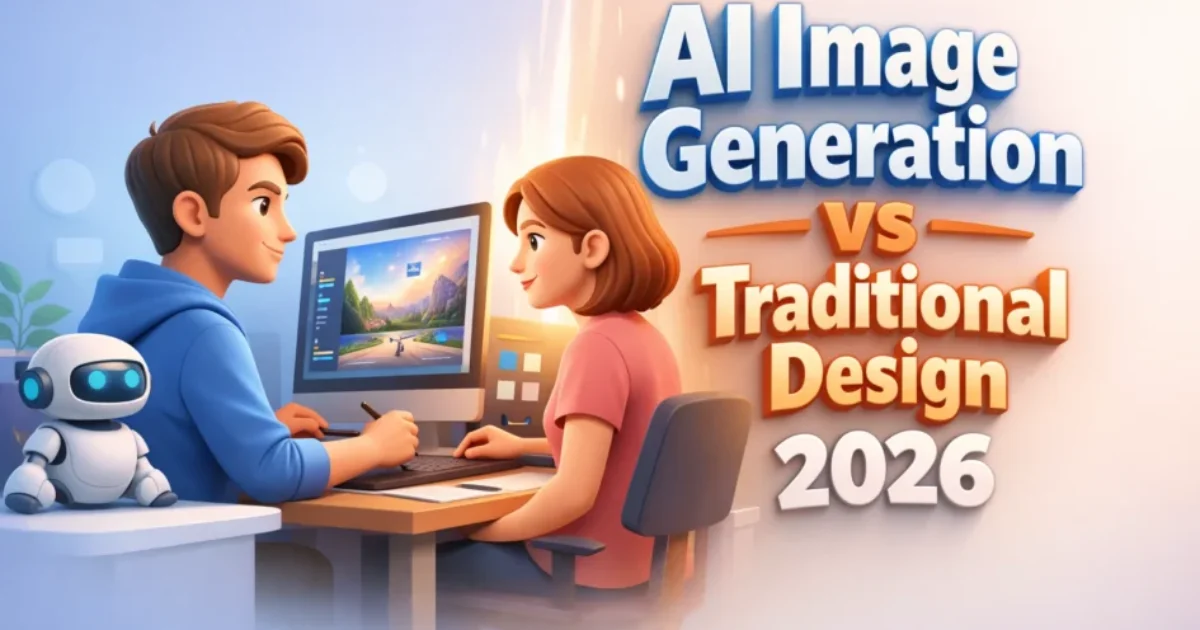
AI Image Generation vs Traditional Design: 2026 Powerful Shift US Businesses Love
I still remember the moment clearly… I had just created a blog post, spent hours writing, optimizing, fixing SEO, and then came the real problem — the image. I opened a design tool, stared at the blank canvas, and thought… “Do I hire a designer or try AI?” That confusion is exactly where this entire discussion of AI Image Generation vs Traditional Design begins. And honestly, if you’re a business owner in the US right now, this is not just a creative decision — it’s a marketing budget decision, a speed decision, and in many cases, a survival decision.
In 2026, businesses across the United States — from small LLC startups in Texas to eCommerce brands in California — are quietly shifting how they create visuals. Some are fully embracing AI image generation tools, while others are still sticking to traditional design methods. But what’s actually working? That’s what I tested, observed, and broke down here — not theory, not hype, just real Peplio-style learning.

Peplio Reality Check
- Expected: AI would completely replace designers
- Happened: Businesses are mixing both AI and traditional design
- Surprised: AI wins in speed, but humans still win in trust
Why US Businesses Are Even Comparing AI Image Generation vs Traditional Design
Let’s be honest — no business owner wakes up thinking, “I want to compare design methods today.” They think about customers, conversions, and ROI. The reason AI Image Generation vs Traditional Design has become such a big topic in the US is simple: content demand has exploded. Every business now needs website banners, blog images, ads, thumbnails, product visuals, and social media creatives — and not just one, but dozens every week. Traditional design workflows simply weren’t built for this level of demand.
That’s where AI stepped in. Tools that can generate images in seconds changed the game. Suddenly, a solo business owner could create visuals without hiring a designer. And if you’ve ever tried tools like those mentioned in my earlier guide on
free AI image generator without login, you already know how fast things can move.
What Traditional Design Still Does Better (Yes, It’s Not Dead)

Now here’s something most people won’t say — traditional design is not dying. In fact, in many US industries, it’s still the gold standard. Especially when it comes to branding, storytelling, and high-conversion ad creatives, human designers bring something AI still struggles with: emotional nuance and brand consistency.
Think about it… a luxury brand in New York or a high-end real estate business in Miami cannot afford generic-looking visuals. They need precise color palettes, typography consistency, and a deep understanding of customer psychology. AI can generate visuals, sure, but can it fully understand a brand’s emotional tone? Not yet.
That’s why agencies and experienced designers are still in demand. Businesses with higher marketing budgets are not replacing designers — they are simply adding AI into the workflow.
🧪 Peplio Experiment #1

Goal: Test whether AI-generated images can replace traditional blog visuals
Action: Created 10 blog images using AI and 10 using a designer
Result: AI images were faster and cheaper, but designer images had higher engagement
Next Change: Combine AI drafts + human refinement
Where AI Image Generation Is Winning Big in the US
Now let’s talk about the real shift. When it comes to speed and cost, AI Image Generation vs Traditional Design is not even a fair fight. AI is winning — and it’s not even close.
Small businesses, especially new LLCs and startups, are choosing AI because they don’t have the luxury of spending $50–$200 per design. They need volume. They need speed. And they need flexibility.
For example, a small bakery in Texas running Facebook ads needs multiple creatives to test. With AI, they can generate 20 variations in minutes. With traditional design, that could take days.
If you’ve explored how businesses use AI in my article on
AI image generation for businesses, you’ll notice one pattern — AI is becoming the default starting point.
The Real Problem: Why AI Images Still Look Fake
Here’s where things get interesting. Even though AI is fast, many US businesses are still hesitant. Why? Because AI images sometimes look… off. Slightly unnatural faces, weird lighting, or unrealistic textures. This is something I personally struggled with too.
I even broke this down in detail in my article
why do AI images look fake, where I showed how small details can break trust instantly.
And trust matters. Especially in industries like healthcare, finance, and legal services — where visuals directly impact credibility.
🧪 Peplio Experiment #2
Goal: Improve realism of AI images
Action: Used detailed prompts + post-editing
Result: AI images looked 70% more realistic
Next Change: Combine AI + Photoshop tweaks
What this article will NOT do
This is not going to tell you “AI is the future, designers are finished.” That’s lazy advice. Also, I’m not going to push tools blindly. This is about real decisions — what actually works for US businesses trying to get customers online, not just traffic.
How US Businesses Are Actually Using AI + Design Together
Here’s the real shift happening in 2026 — businesses are not choosing between AI Image Generation vs Traditional Design. They are combining both.
AI is being used for:
- Quick drafts
- Content marketing visuals
- Social media posts
- Thumbnail testing
And traditional design is used for:
- Brand identity
- High-budget ads
- Website hero sections
- Product campaigns
If you look at how thumbnails are evolving in my guide on
AI image generation for YouTube thumbnails, you’ll see the same pattern — AI creates options, humans finalize the best one.
External Insight: What the Data Says
According to recent reports from Statista, AI adoption in marketing has increased by over 60% in the US in the last two years. Meanwhile, platforms like Adobe are integrating AI directly into their tools — not replacing designers, but enhancing them.
Even Forbes highlighted that businesses using AI-assisted design workflows are reducing costs while increasing content output significantly.
The Cost Factor: The Real Decision Maker
Let’s not overcomplicate it — for most US businesses, the decision between AI Image Generation vs Traditional Design comes down to cost.
Hiring a designer = consistent quality, but higher cost.
Using AI = lower cost, but requires learning and tweaking.
And if you’re running a small business with limited marketing budget, that decision becomes obvious.
🧪 Peplio Experiment #3
Goal: Reduce design cost by 80%
Action: Switched to AI for 70% of visuals
Result: Saved budget + increased content output
Next Change: Invest saved money into ads
How to Make AI Images Look Professional (My Shortcut)

If you’re going to use AI, don’t just type random prompts. That’s where most people fail. You need structured prompts, realistic lighting instructions, and post-editing.
I shared detailed prompt strategies in
best prompts to generate realistic AI images, and trust me, this alone can change your results completely.
Also, understanding trends matters. The shift happening right now is covered in
AI image generation trends in 2026, where realism and human-like visuals are becoming the priority.
If you’re a solo blogger with no audience, no money, and only a laptop…
Then here’s the truth — you should start with AI. Not because it’s perfect, but because it allows you to move. Waiting for perfection or hiring designers early will slow you down. Use AI to create, test, learn, and improve. Then slowly upgrade to professional design when your business grows.
Questions I struggled with while building Peplio
Should I completely stop using designers?
No. Designers still matter, especially for branding.
Can AI images rank in Google?
Yes, if optimized properly with alt tags and context.
Do AI images reduce trust?
Only if they look unrealistic.
Is AI enough for a full business?
Not yet. It’s a tool, not a replacement.
Final Decision: What US Businesses Are Choosing in 2026
So what’s the final answer to AI Image Generation vs Traditional Design? US businesses are choosing a hybrid approach. AI for speed. Humans for trust. AI for volume. Designers for precision.
And honestly, this makes sense. Because marketing is not about tools — it’s about results.
What I’m testing next
Right now, I’m experimenting with fully AI-generated landing pages combined with human-edited visuals to see if conversion rates improve.
If you’re reading this, try this one thing: create 5 AI images for your next campaign, test them against one professionally designed image, and compare results. That single experiment will teach you more than any article ever can.
Want to Use AI for Your Marketing?
Now that you know how to use AI image tools, here’s what to do next on Peplio:
- 🎨 Try the Best Free AI Image Generator Without Login — unlimited generations, no signup needed.
- 🛠️ Explore Free SEO & Marketing Tools — built for bloggers and small businesses.
- 📖 Read Digital Marketing Comics — learn SEO and marketing through fun stories.