

AI-Written Blog Posts Not Ranking in Google: What I Learned the Hard Way
Last updated: September 2026
AI-written blog posts not ranking in Google is not an AI detection problem — it is a trust signal problem. Google does not penalise AI content directly. It withholds ranking because AI content lacks the signals that come from real human experience: failed paths, opinion shifts, uncertainty, and decisions made under real stakes. AI writes explanations. Google ranks judgment. The fix is not to humanise AI output after writing — it is to think first, decide first, and use AI only to clarify language after the real thinking is done.
Every morning at Mitu and Seema Bakery begins with a new problem that sounds logical but never fixes the real issue. One day Mitu believes the shop board font is outdated. The next day Seema wants to rewrite the About Us section because some AI tool said emotional words attract customers. They change things daily — new captions, new offers, new ideas. But the counter stays empty. Customers do not suddenly appear because words changed.
Standing there and watching this routine repeat felt uncomfortable because I had lived the same cycle while building Peplio. Publishing AI-written blogs regularly, convinced consistency and optimisation would eventually force Google to notice. It did not.

I was not lazy. I was not careless. I followed SEO rules, used keywords, wrote long posts. Still, rankings refused to move. That confusion — doing everything right, so why is it not working — is exactly where most AI-written blog strategies break down. This article explains, from direct experience, why AI-written blog posts not ranking in Google happens, what Google is actually reading beneath the surface, and what changed once I stopped letting AI think on my behalf.
- Peplio Reality Check — what I expected vs what happened
- The first big mistake: assuming Google ranks information
- Why humanising AI content does not work
- Google is testing AI content in phases — what I observed
- The missing signal: cost of failure
- Decision-based writing vs explanation-based writing
- Peplio Experiment 1 — AI-written vs decision-written
- Why EEAT is not a checklist — and AI treats it like one
- The time dimension AI cannot fake
- Peplio Experiment 2 — updating vs rewriting
- The Peplio rule on AI content
- How this changed things at Mitu and Seema Bakery
- Sougan’s Take
- Summary
- FAQ
Peplio Reality Check — What I Expected vs What Happened

- What I expected: AI-written articles would rank faster because they were structured, optimised, and followed SEO best practices
- What actually happened: Most posts indexed quickly but stalled. Impressions stayed low. Clicks were inconsistent or zero.
- What surprised me: Even detailed, well-optimised AI articles behaved like low-trust content once Google tested them against real user signals
- The pattern: AI-written blog posts not ranking in Google is not about penalties — it is about Google quietly withholding trust
When people talk about AI-written blog posts not ranking in Google, they often assume penalties or algorithm detection. In my case, it was quieter than that. Posts were indexed, visible, and technically fine — yet stuck without growth. No warnings. No manual actions. Just silence where rankings should have been.
The First Big Mistake: Assuming Google Ranks Information
Most bloggers still believe Google ranks information. That belief made sense years ago. Today it is outdated. Google does not rank information anymore. Information is abundant. AI made it infinite. What Google ranks now is decision credibility.
AI can explain what something is. AI struggles to explain why someone chose one path and rejected another. That difference sounds small until you look at ranking behaviour closely.
When I compared my AI-written Peplio articles with my manually written ones, the difference was not language quality. It was the absence of choice. AI content presents conclusions as if they were inevitable. Human content exposes hesitation, uncertainty, failed routes, and trade-offs. Google sees that. And it values the human version more — not because it prefers humans sentimentally, but because those signals indicate real experience behind the content.
This is the same mistake I kept watching at the bakery — answers everywhere on the board, but no real decisions changing behind the counter. Mitu could write the perfect caption. But she had not decided which product to actually push or which customer to actually serve first. The surface changed daily. The strategy never did.
Why Humanising AI Content Does Not Work
Most advice around AI blogging goes like this: add personal tone, rewrite introductions, change sentence structure, run it through AI detectors. I tried all of it.
I edited paragraphs heavily. I added personal phrases. I broke symmetry. I removed obvious patterns. Rankings did not improve. That is when I realised something uncomfortable:
Editing language does not add experience.
Experience lives before writing begins. Editing happens after thinking is already done. AI content fails because it skips the thinking phase entirely — and no amount of surface-level editing after the fact puts that thinking back in. This is the same mistake Mitu keeps making at the bakery: decorating the shop while ignoring the recipe.
The issue with AI-written blog posts not ranking in Google is not that Google detects AI writing through linguistic fingerprints. It is that AI writing lacks the underneath layer — the judgment, the hesitation, the trade-offs — that human writing produces naturally. You cannot edit that back in after the fact. It has to come before writing starts.
Google Is Testing AI Content in Phases — What I Observed

Through Google Search Console, I started noticing a pattern that explained everything. This slow suppression cycle is one of the clearest reasons AI-written blog posts not ranking in Google feel invisible rather than penalised:
No penalties. No warnings. Just silence. Google does not punish AI content. It withholds trust. Most bloggers think failure means penalty. In reality, failure usually means indifference — which is harder to diagnose and harder to fix than a clear penalty would be.
The Missing Signal: Cost of Failure
AI never waits. Humans do. And waiting leaves marks — on thinking, on writing, and eventually on rankings.
When I made early SEO decisions for Peplio, I lost weeks on strategies that did not work. That delay forced reflection. That reflection changed my approach. That change altered all future content in a direction AI cannot replicate — because AI never experienced the delay, the doubt, or the cost of getting it wrong.
Google tracks the evidence of that experience through content updates, opinion revisions, internal linking behaviour, pacing of content changes, and engagement stabilisation over time. AI content arrives finished. Humans arrive uncertain. Google trusts uncertainty more than polish — because uncertainty is the signature of real experience.
AI content signals
- Arrives complete and confident
- No hesitation, no failed paths shown
- Conclusions presented as inevitable
- Never changes its mind after publishing
- No evidence of lived experience
Human content signals
- Exposes uncertainty and trade-offs
- Documents failed paths alongside what worked
- Shows judgment under real stakes
- Updates and changes opinions over time
- References past mistakes as evidence of learning
Decision-Based Writing vs Explanation-Based Writing
This is the core difference behind why AI-written blog posts not ranking in Google is such a persistent problem.
AI writes explanations
Explanation answers questions. It tells you what something is, how it works, what the steps are. It is complete, structured, and confident. It is also exactly what every other AI article on the same topic says — with minor variation in wording.
Humans document decisions
Decisions reveal judgment. Why I chose this path over that one. What I rejected and why. What I tried that failed. What I would do differently now. That layer of judgment is what Google is trying to measure — and what AI cannot produce.
When I rewrote Peplio content to focus on why I did not do what everyone suggested — the decisions I rejected, the experiments that failed, the approaches I reversed — engagement improved. Not instantly, but steadily. Google does not want perfect answers. It wants earned answers. There is a significant difference between the two, and that difference is why AI-written blog posts not ranking in Google often fail to build trust beyond the first test phase.
Peplio Experiment 1 — AI-Written vs Decision-Written Articles
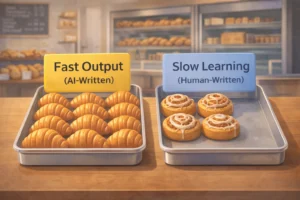
- Goal: Test whether articles built around real decisions outperform AI-written explanations on identical topics
- Action: Published two types — AI-generated, heavily edited articles AND human-written articles starting from confusion and failure. AI helped with structure only after decisions were documented.
- Result: AI-written posts indexed faster but plateaued. Decision-written posts grew slower but held rankings longer and continued gaining impressions after month 3.
- What I changed next: Reduced AI involvement in reasoning completely. Use it only to clarify language after thinking is complete.
This experiment confirmed that AI-written blog posts not ranking in Google is more about missing decision signals than missing optimisation. The AI posts were technically better formatted. The decision posts were messier — but they carried the signal Google was looking for.
I have seen this same pattern outside blog content as well. Strategies driven by observation and real adjustment consistently outperform clean, automated approaches. The Peplio social media growth case study shows how slow decisions and real feedback shaped sustainable results over time — the same principle applied to a different channel.
Why EEAT Is Not a Checklist — And AI Treats It Like One
AI can mention experience. It cannot produce experience. EEAT — Experience, Expertise, Authoritativeness, Trustworthiness — is not about saying “I tested this” or “I analyzed data” or “I have experience.” That is what AI does. EEAT is about evidence leaking naturally into writing as a byproduct of actually having done the thing.
When I mentioned Search Console data casually in a Peplio article — without screenshots, without formally proving anything — those sections performed better than polished, proof-heavy AI paragraphs designed to signal authority. Why? Because humans mention proof accidentally. AI mentions proof intentionally. The intentionality is the tell. Treating EEAT as a checklist is another reason AI-written blog posts not ranking in Google continue to struggle — the checklist signals show through even after heavy editing.
Google knows the difference. This idea of earning trust slowly rather than claiming it immediately also applies to organic traffic strategy. Building trust through genuine content is covered in full in the guide on free traffic with SEO for new blogs — especially how new blogs can grow without automation or volume publishing, by focusing on signals Google actually respects.
The Time Dimension AI Cannot Fake
Some lessons only appear after weeks of silence — both in Search Console and in a quiet bakery. One of the strongest ranking signals I noticed across Peplio content was content evolution.
Human articles over time
- Change opinions as understanding deepens
- Contradict earlier versions honestly
- Update assumptions when data changes
- Reference past mistakes as part of the story
AI articles over time
- Stay frozen at the original output
- Remain confident forever regardless of what changes
- Never age, never revise, never doubt
- No evidence of learning from results
Google values content that changes its mind. That is a brutal disadvantage for AI-only blogs — and one that no amount of editing at publication time can fix. It can only be fixed through genuine ongoing engagement with the topic over time.
I also noticed that publishing more AI content was an illusion of productivity. I published multiple AI articles weekly at one point. Traffic did not grow. Authority did not grow. Then I slowed down. I rewrote existing articles instead of adding new ones. I documented failures instead of hiding them. Rankings stabilised. More content does not equal more value — and for AI-written blog posts not ranking in Google, adding more of what is not working is the most common mistake bloggers make in response to the problem.
Peplio Experiment 2 — Updating AI Content vs Rewriting From Scratch
- Goal: See whether updating existing AI articles improves rankings enough to justify the effort
- Action: Updated old AI articles with better structure and clarity. Separately, rewrote one article completely from real experience and documented failures.
- Result: Updated AI articles barely moved in rankings. Rewritten article slowly gained impressions over 6 weeks and held them.
- What I changed next: Rewrite instead of repair. Editing AI output is not the same as replacing the thinking behind it.
Why does editing AI content feel productive but not produce results? Because editing feels like work but avoids the hard part. The hard part is deciding what not to include, what advice did not actually apply, what failed and why. AI avoids that discomfort. Humans should not — and for competitive niches especially, that discomfort is exactly what differentiates content that ranks from content that stalls.
In low-competition niches, AI content tolerates longer. In competitive niches it fails faster — because when many pages explain the same thing, Google has to rank based on judgment quality. AI repeats consensus. Humans diverge. Consensus rarely ranks first.
The Peplio Rule on AI Content

Use AI to
- Structure content after decisions are made
- Summarise research you have already done
- Clarify language after thinking is complete
- Format and organise — not originate
Never let AI
- Decide the angle or argument
- Judge what to include or exclude
- Conclude what the reader should do
- Replace the thinking that earns trust
That boundary changed everything on Peplio. One strong human article beats ten clean AI articles because it creates something Google cannot replicate — and cannot withhold trust from. Before publishing your next blog post, ask one question: what decision did I make here that AI would not have made? If you cannot answer that, the post is not ready.
How This Changed Things at Mitu and Seema Bakery
After working through all of this, I stopped treating the bakery as just a metaphor and actually applied the same thinking there. Instead of rewriting boards or chasing new captions, I asked Mitu and Seema one simple question: what is the one decision we are avoiding because it feels slow?
The answer was uncomfortable but obvious. They were changing messages daily without ever waiting long enough to see what worked. So we froze everything — no new offers, no new captions, no redesigns — and focused on one experiment only. One single change, tracked quietly, with a commitment not to touch anything else for weeks.
At first nothing happened. That silence made them nervous, just like Search Console silence used to make me panic. But slowly, patterns started showing up. A few repeat customers. Familiar faces. Not a rush, not viral growth — just enough signal to tell us we were finally doing something right. The bakery did not transform overnight. But the confusion stopped. Mitu stopped blaming the board. Seema stopped chasing every new idea. That calm clarity — the same feeling I now look for in Peplio analytics — was the real result. Not growth, not numbers, but confidence that the next decision would be based on learning, not guessing.
The same thinking that explained AI-written blog posts not ranking in Google also reduced confusion at the bakery — by slowing decisions instead of chasing surface fixes. Both problems had the same root: changing the visible layer constantly while the underlying system stayed broken.
AI did not kill blogging. It exposed shallow blogging. And that is exactly why AI-written blog posts are not ranking in Google.
I use AI every day. I am not against it. What I am against is letting AI think on my behalf — because the moment AI makes the decision instead of me, the content loses the only thing Google cannot find anywhere else: my judgment under real stakes, built from real failures, on a real blog that has been through real silence. Google has infinite information available to rank. What it does not have infinite supply of is trustworthy judgment. That is what humans bring. That is what AI cannot fake regardless of how well it writes. Build that into every article and the ranking problem solves itself over time. Skip it and no amount of optimisation, AI humanisation, or volume publishing will compensate.
See the moment when doing everything right still was not enough
Episode 9 — Jab Speed Ruki — shows Mitu and Seema’s bakery hitting the same wall most bloggers hit: everything looks correct on the surface, but growth has stopped. The fix was not a new trick. It was understanding what was actually missing underneath. Follow the full Peplio comic universe to see every digital marketing lesson played out through the bakery story.
Summary: AI-Written Blog Posts Not Ranking in Google
- Google does not penalise AI content directly — it withholds trust from content that lacks human judgment signals
- AI posts index fast but stall because engagement signals are shallow — users scan and leave, no dwell time, no return visits
- Humanising AI output after writing does not fix the problem — experience must come before writing, not be edited in after
- Google ranks decision credibility, not information — AI writes explanations, humans document decisions
- EEAT is not a checklist — it is evidence that leaks naturally from real experience and cannot be inserted artificially
- Rewriting from scratch outperforms updating AI articles — editing improves language, not the underlying thinking
- The Peplio rule: use AI to structure, summarise, and clarify — never to decide, judge, or conclude
- One strong human article beats ten clean AI articles in competitive niches where Google must rank by judgment quality
People Also Asked
Is Google penalising AI-written blog posts in 2026?
Not through direct penalties or manual actions. From what I observed across Peplio, Google does not issue warnings for AI content. Instead it withholds trust — the content stays indexed and visible but never grows in rankings. There is no penalty notice, no drop in Search Console. Just silence where growth should be. That indifference is harder to diagnose than a penalty and harder to recover from because most bloggers do not realise it is happening until months have passed.
Can AI-written blog posts ever rank on Google?
Yes — in low-competition niches and temporarily in competitive ones. But ranking and sustaining rankings are two different things. AI posts can rank initially when Google gives them light impressions during the testing phase. What they cannot do consistently is hold and grow those rankings once Google measures engagement quality — because the absence of human judgment signals shows up in how users interact with the content.
What is the right way to use AI for blog posts that rank in 2026?
Think first, decide first, use AI last. The correct sequence: define your angle from real experience, decide what to include and what to reject, document what failed alongside what worked, then use AI to structure the outline, clarify the language, and organise the content. In that setup the content is yours — the judgment, the decisions, the experience — and AI is a formatting tool rather than the author. That is the version that ranks and holds rankings.
FAQ: AI-Written Blog Posts Not Ranking in Google
How does Google know a blog post is AI-written?
I do not think Google is detecting AI the way third-party tools claim. What Google detects is the absence of human signals — no hesitation, no failed paths, no opinion shifts, no content evolution over time. AI content is characterised by confidence without uncertainty, conclusions without trade-offs, and permanence without revision. That pattern appears very clearly in AI-only blogs and is what Google’s quality systems respond to — not a linguistic fingerprint of AI writing specifically.
Is editing AI-written content enough to make it rank?
In my experience, no. I edited multiple AI articles heavily on Peplio — better structure, stronger language, more personal phrases — and rankings did not improve. Editing improves language, not thinking. The underlying absence of real decision-making and lived experience that editing cannot insert comes through in user engagement signals even when the writing surface looks human. Once I rewrote from actual decisions and documented failures, results slowly changed.
Should I delete old AI-written blog posts?
I did not delete mine. I either rewrote them completely from experience or left them and focused new energy on stronger content. Deleting did not feel necessary — rewriting the most important ones mattered more. If a post covers a keyword you need and gets impressions but no clicks or rankings, rewrite it from experience rather than deleting. If it gets zero impressions and covers a topic you no longer care about, noindex it rather than delete.
How much AI usage is safe for blogging in 2026?
I no longer think in terms of percentage of AI usage. The question I ask instead is: who made the decision here — me or the AI? If AI decided the angle, argument, and conclusion, that is risky regardless of how much I edited the language afterwards. If AI helped structure and clarify after my decisions were already made, that is safe regardless of how much AI text appears in the final article. The boundary is about ownership of judgment, not percentage of words.
Why do AI articles index fast but not rank?
Indexing is technical — it means Google’s crawler found and processed the page, which AI content handles fine because it is structurally clean. Ranking is behavioural — it depends on how users interact with the page once Google sends test traffic. AI content satisfies crawlers but often fails to satisfy users in ways that translate to strong engagement signals. Users land, scan the clean AI structure, find no friction or personality or judgment to engage with, and leave. Google reads that engagement pattern and withholds further ranking push.
Are long AI-written articles better than short ones for ranking?
Length did not help in my experience. I had long, detailed AI articles that still failed to rank. Depth comes from decisions, not word count. A shorter article with lived experience and documented failures outperformed longer AI explanations on Peplio consistently. The metric that matters is signal density — how much thinking exists per paragraph — not how many paragraphs there are in total.
Data sources and references: Google Search Console | Google Helpful Content Guidelines | Google E-E-A-T Documentation. All observations and experiment data from Peplio.com, September 2026. This article reflects Sougan’s direct experience and does not claim to represent Google’s internal systems.
Related Articles from Peplio
- Google AI Search Guide SEO 2026
- AEO vs SEO vs GEO — The Complete 2026 Guide
- ChatGPT for SEO — 25 Proven Prompts That Actually Work
- What Is SEO and Why Is It Important
- On-Page SEO Checklist — Everything to Check Before Publishing
- How to Get Free Traffic With SEO for New Blogs
- Peplio Social Media Growth Case Study
AI-written blog posts not ranking in Google is one of the most searched and least honestly answered questions in the blogging community right now. Most answers focus on AI detection, language patterns, or percentage of AI usage — none of which address the actual problem. AI-written blog posts not ranking in Google is fundamentally a signal problem: Google’s ranking systems are built to surface content that demonstrates real human judgment under real stakes, and AI content — however well structured and keyword-optimised — does not carry those signals regardless of how much it is edited after generation. Understanding this changes everything about how you approach content creation, because the fix is not in the editing phase at all.
The pattern behind AI-written blog posts not ranking in Google follows a predictable cycle that I watched play out on Peplio across multiple articles: fast indexing, light impressions, shallow engagement, ranking plateau, and then quiet removal from SERP growth — no penalty, no warning, just silence. Recognising this cycle is the first step to breaking it. AI-written blog posts not ranking in Google is not a punishment Google imposes — it is a trust decision Google makes based on what it observes about how users interact with the content once it gets its initial test exposure. Changing that outcome requires changing what the content signals, not changing how it looks on the surface.
For bloggers facing AI-written blog posts not ranking in Google, the honest answer is uncomfortable but clear: the content needs to carry the signature of your real thinking — your hesitations, your rejected options, your documented failures, your changed opinions over time. These are not stylistic additions you can insert during editing. They are the natural output of actually thinking through a problem rather than generating an answer to it. AI-written blog posts not ranking in Google will remain a problem for any blogger who skips that thinking phase and relies on AI to supply what can only come from living through the subject — not reading about it, not generating a summary of it, but actually doing the work, getting it wrong, and writing about what that taught you.


