
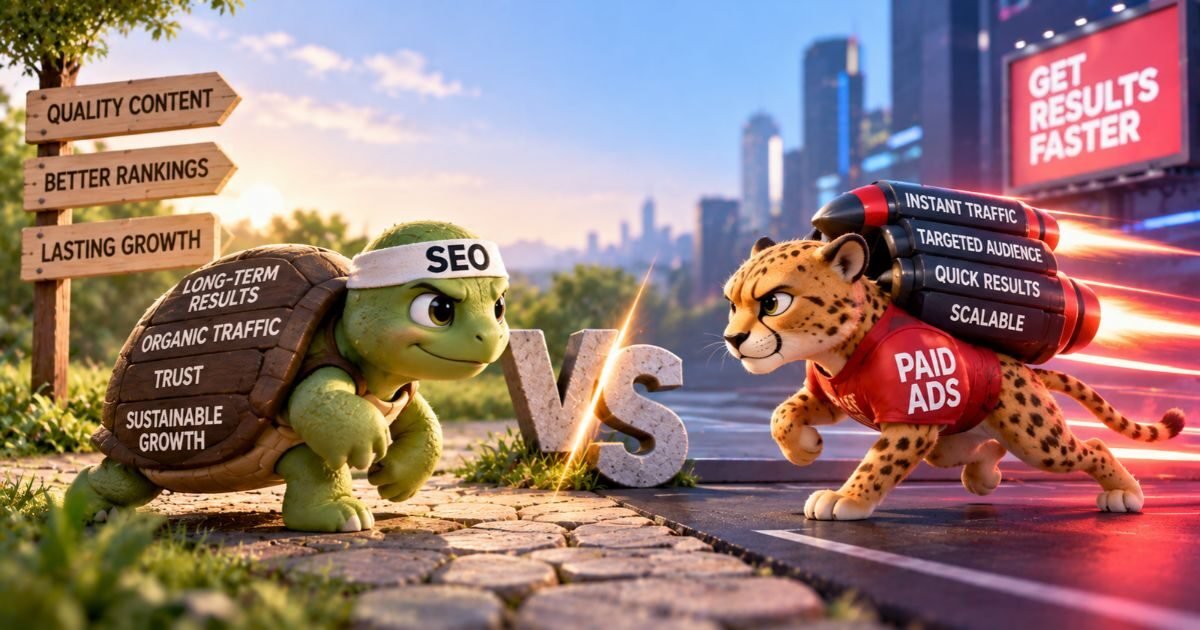
SEO vs Paid Ads in 2026: The Honest Comparison for Indian Small Businesses
Sougan Kumar Mandi | Founder, Peplio | Digital Marketing Executive, Demech Chemical Products, Durgapur | Last updated: September 2026
If you need leads in the next 30 days: paid ads. If you have 6 months and want sustainable low-cost growth: SEO. For most Indian small businesses with a budget above ₹20,000/month: start paid ads immediately while building SEO in parallel — then shift the balance toward organic as rankings mature. SEO compounds. Paid ads don’t. The moment your budget stops, paid traffic stops the same day. SEO traffic keeps coming.
SEO vs paid ads — I have been on both sides of this decision and I can give you a straight answer. At Peplio, I built the entire audience through SEO — zero paid ads, purely organic content. At Demech Chemical Products, I run both: Google Ads for immediate industrial leads and SEO for long-term search visibility. The experience across both has made one thing clear: this is not an either/or debate. It is a timing and budget question. And most articles avoid giving you the actual answer. This one will not.
India’s digital advertising market is projected to cross ₹70,000 crore in 2026 — one of the fastest-growing digital economies in Asia. Yet a significant portion of that spend goes to the wrong channel, at the wrong time, for the wrong stage of business. This guide exists to fix that.
Table of Contents
- SEO vs paid ads — what each actually is
- The 6 key differences that decide the choice
- Real costs in India — SEO vs paid ads in 2026
- When SEO wins — and what type of business should choose it first
- When paid ads win — and when to use them immediately
- The combined strategy — how to run both without wasting budget
- Sougan’s Take
- Summary
- FAQ: SEO vs paid ads
SEO vs paid ads — what each actually is, stripped of jargon
SEO (Search Engine Optimisation) is the process of making your website appear organically — for free — on Google’s first page when someone searches for your product or service. If someone in Pune types “best CA near me” and your accounting firm appears without you paying for that click, that is SEO working. The click is free. The ranking took time and effort to earn.
Paid ads (Google Ads, Meta Ads, Instagram Ads) is exactly what it sounds like — you pay to appear at the top of search results or social media feeds. You set a budget, bid on keywords or audiences, and your ad appears immediately. The moment you stop paying, the traffic stops. Same day. No residual.
The fundamental difference between SEO vs paid ads is not about which is better — it is about what you are buying. With SEO, you are building an asset. Rankings you earn compound over time, keep generating traffic without additional spend, and often get stronger with age. With paid ads, you are renting visibility. The visibility is immediate and controllable — but it disappears the moment the budget stops.
The 6 key differences that decide the SEO vs paid ads choice
| Factor | SEO | Paid Ads |
|---|---|---|
| Time to first result | 3-6 months minimum (Tier 2 cities); 6-12 months for competitive keywords | 24-48 hours from campaign launch |
| Cost structure | Fixed monthly effort; free traffic per click once ranking | Pay per click (₹10-250/click depending on keyword and industry) |
| Traffic when you stop | Continues — rankings don’t disappear overnight | Stops immediately — zero residual traffic |
| Long-term ROI | 748% median 3-year ROI — compounds over time | 200% median 3-year ROI — linear, not compounding |
| Trust signal | 70% more clicks vs paid — organic results trusted more | Labelled as “Sponsored” — some users skip ads by default |
| Control | Limited — rankings depend on algorithm; can’t guarantee position | Full — set budget, targeting, bid, ad copy at any time |
| Best for | Long-term authority, consistent low-cost leads, content businesses | Immediate leads, product launches, seasonal offers, testing |
Data: Devout Growth SEO vs Paid Ads India 2026, WordStream 2026 Google Ads benchmarks, All Growth Media India small business study.
Real costs in India — SEO vs paid ads in 2026
Most comparisons use US or UK numbers. Here are the actual Indian market rates for 2026:
SEO Costs in India (2026)
- DIY SEO tools: ₹0 (Google Search Console, Analytics free)
- Basic SEO retainer: ₹8,000-15,000/month
- Mid-level SEO agency: ₹15,000-40,000/month
- Technical audit (one-time): ₹5,000-20,000
- Content writing per article: ₹1,500-8,000
- Time to ROI: 4-8 months typically
- Cost per click once ranking: ₹0
Paid Ads Costs in India (2026)
- Minimum effective budget: ₹10,000-20,000/month
- Local service keywords CPC: ₹10-30/click
- Competitive B2C keywords CPC: ₹30-80/click
- B2B / finance keywords CPC: ₹80-250+/click
- Agency management fee: ₹5,000-20,000/month
- Time to first lead: 24-48 hours
- Cost per click every month, forever
The number that matters most when comparing SEO vs paid ads for Indian small businesses: businesses that rely solely on paid ads spend an average of 3 to 5 times more per lead over 24 months compared to businesses that invest in SEO alongside paid ads. The upfront cost of SEO looks higher in month 1. By month 18, the economics reverse dramatically.
When SEO wins — and which Indian businesses should choose it first
SEO is the right first investment when any of these are true:
You can wait 4-6 months
You have existing revenue or savings to operate during the SEO ramp-up period. You are not counting on search traffic for this month’s revenue.
Your business is local
A local service business in a Tier 2 Indian city with a fully optimised Google Business Profile and basic SEO can dominate local search in 60-90 days. Local SEO is the highest ROI form of SEO in India right now.
You’re building a content brand
Blogs, educational platforms, digital media, niche publications — content businesses grow almost exclusively through SEO. Peplio is a direct example: zero paid ads, 100% organic growth through consistent SEO-led content.
Your customers research before buying
B2B services, professional services, high-ticket products — buyers research extensively before purchasing. Ranking on the informational queries they search during research stage builds trust and reduces CPA by the time they reach your conversion page.
Business types in India where SEO should be the primary channel: coaching centres, CA and legal firms, digital marketing agencies, SaaS and EdTech businesses, local service businesses (salons, plumbers, electricians), manufacturing companies doing content marketing, and any business where the buyer’s journey includes significant research before purchase. For the full local SEO setup: SEO for small business India.
SEO vs paid ads — realistic SEO timeline for Indian businesses
When paid ads win — and when to use them immediately
Paid ads are the right first investment — or the immediate priority — when any of these are true:
You need leads this month
A new restaurant opening, a product launch, a seasonal campaign, a business that is running out of runway. Paid ads are the only realistic channel when the timeline is 30 days or less.
You’re testing a new offer
Paid ads let you validate whether an offer converts before investing months of SEO effort. ₹10,000 in Google Ads to test a new service gives you conversion data that would take 6 months to get from organic traffic.
High-intent buyers ready to purchase
Google Search Ads target people actively searching for exactly what you sell — “emergency plumber Pune” or “wedding photographer Jaipur”. The intent is commercial and immediate. Paid ads intercept this intent before SEO has time to.
Retargeting warm audiences
People who visited your site but didn’t convert are your warmest audience. Meta and Google remarketing campaigns that retarget these visitors typically have 3-5x higher conversion rates than cold audience ads and are extremely cost-efficient.
What happens with paid ads only
Consistent leads while budget runs. Month 6: cash flow tightens, reduce budget by 50%. Leads drop 50% instantly. Month 8: pause ads for two weeks. Pipeline goes to zero. Restart — take 2 weeks to rebuild momentum. Budget dependency never breaks.
What happens with SEO + paid ads combined
Month 1-6: paid ads carry lead flow while SEO builds. Month 7+: organic traffic starts. Month 12: reduce paid budget by 30% as organic fills the gap. Month 18: SEO delivers 60% of leads. Paid budget now funds only retargeting — 3x cheaper per conversion.
The combined SEO vs paid ads strategy — how to run both without wasting budget
The answer to the SEO vs paid ads question for most Indian small businesses in 2026 is not “choose one.” It is “start with paid ads for immediate revenue, build SEO in parallel for long-term cost reduction, then shift the balance as organic rankings mature.” Here is the practical framework:
| Business Stage | SEO Budget Allocation | Paid Ads Allocation | Rationale |
|---|---|---|---|
| Month 1-6 (Launch) | 30% — basics only: GBP, on-page, content | 70% — Google Ads for immediate leads | Revenue needed now. SEO building in background. |
| Month 7-12 (Growth) | 50% — content cluster, link building | 50% — maintain ads while organic builds | First organic leads arriving. Reduce paid dependency. |
| Month 13-24 (Maturity) | 70% — expand content, build authority | 30% — retargeting only + new product launches | SEO now cheaper per lead. Paid reserved for retargeting. |
| Month 24+ (Scale) | 80% — SEO compounding, lower per-click cost | 20% — high-intent keywords only + remarketing | SEO delivers most leads. Paid for precision targeting. |
Budget allocation is a starting framework. Adjust based on your actual cost-per-lead data from each channel monthly.
The single most important SEO action to run in parallel with paid ads: Google Business Profile. It is free, takes one day to set up properly, and starts producing local organic leads within 4-8 weeks — often before any other SEO work shows results. If you are spending ₹15,000/month on Google Ads and have not claimed your GBP, you are paying for traffic you could be getting for free. Full setup guide: SEO for small business India.
For businesses choosing which paid platform to start with, the Instagram vs Facebook comparison is a separate decision with its own set of factors. See the full guide: Instagram vs Facebook ads for small businesses.
At Peplio, I chose SEO over paid ads from Day 1 — and at Demech Chemical, I run both. The decision was different each time, and that’s exactly the point.
Peplio is a content brand. The entire business model depends on ranking for informational keywords that compound over time. Paid ads would have produced visitors, not readers — and I needed readers who would come back. At Demech Chemical, B2B industrial buyers search with high commercial intent: “protective coating supplier West Bengal,” “industrial paint manufacturer Durgapur.” Google Ads captures that intent immediately. SEO builds the long-term presence alongside it. The practical rule I follow: if the business needs revenue in the next 60 days, start with paid ads and build SEO in parallel. If the business can operate on existing revenue for 6 months, go SEO-first and add paid ads only for seasonal campaigns or new product launches. Never choose based on which sounds better. Choose based on your actual timeline.
See what happens after the Boost button stops working
In Episode 7 — Boost Ke Baad — Mitu’s ads slow down and she reaches for the Boost button again. Seema stops her. Sougan explains the shift from acquisition to retention — the same shift from paid ads to SEO that every growing business eventually has to make. Follow the full Peplio comic universe to see the strategy unfold.
Summary: SEO vs paid ads in 2026
- SEO = buying an asset that compounds. Paid ads = renting visibility that stops when the budget stops
- SEO: 748% median 3-year ROI. Paid ads: 200% — the economics favour SEO at 12+ months
- Paid ads: leads in 24 hours. SEO: 3-6 months minimum — choose based on your actual timeline, not the ideal answer
- Businesses relying solely on paid ads spend 3-5x more per lead over 24 months vs SEO + PPC combined
- India CPC rates: ₹10-30 for local services, ₹30-80 for competitive B2C, ₹80-250+ for B2B and finance
- When to start with SEO: local business, content brand, B2B service, 6+ month runway
- When to start with paid ads: new launch, seasonal offer, immediate revenue need, offer validation
- The combined strategy: paid ads for months 1-6, shift to 50/50 by month 12, SEO-primary by month 18-24
- Google Business Profile is the one SEO action to run immediately alongside any paid campaign — free and fast
People Also Asked
Is SEO better than paid ads for small businesses in India?
Long-term: yes. SEO’s 748% median 3-year ROI vs 200% for paid ads makes the economics clear once rankings mature. Short-term: it depends on your timeline. If you need leads this month, paid ads are the only realistic option. For most Indian small businesses, the right answer is SEO-first if you have a 6-month runway, paid ads-first if you need immediate revenue, and both simultaneously if the budget allows. The businesses that grow fastest run paid ads for immediate leads while SEO compounds in the background.
How long does SEO take to produce results compared to paid ads?
Paid ads: 24-48 hours from campaign launch. SEO: 3-6 months for Tier 2 Indian cities with low competition; 6-12 months for competitive metro keywords. The timeline is not a weakness of SEO — it is the time required to build genuine authority that compounds for years afterward. A page that reaches page 1 of Google typically stays there with maintenance, generating free traffic indefinitely. A paid ad generates traffic only while the budget is running.
Can a small business in India afford to run both SEO and paid ads simultaneously?
Yes, even on a limited budget. The minimum effective approach: ₹8,000-12,000/month on basic SEO (content + GBP optimisation) alongside ₹10,000-15,000/month on Google Ads targeting your highest-intent local keywords. That is ₹18,000-27,000/month total — a realistic investment for any business generating above ₹3-5 lakh monthly revenue. The SEO spend reduces over time as organic rankings mature; the paid spend can be redirected to retargeting at a fraction of the acquisition cost.
FAQ: SEO vs paid ads in 2026
Does SEO still work in 2026 with AI search changing everything?
Yes — and in some ways SEO matters more in 2026 because AI search platforms like Perplexity and Google AI Overviews preferentially cite well-structured, authoritative content from trusted sources. The SEO signals that get you ranking on traditional Google — good content, backlinks, E-E-A-T — are the same signals that get you cited by AI search. The difference: AI search rewards original data and direct answers even more than traditional SEO does. See the full guide: how to optimize content for AI Overview.
What is the minimum budget for Google Ads in India in 2026?
For the campaign to exit the learning phase and produce meaningful conversion data: ₹10,000-15,000/month minimum for local service keywords (₹10-30 CPC range). Below this, the campaign often doesn’t get enough click volume for the algorithm to optimise. For B2C or B2B keywords with higher CPC (₹50-250+), double the minimum to ₹20,000-30,000/month or the data will be too thin to make good decisions. Add agency management fees of ₹5,000-15,000/month if outsourcing.
Should a brand new website focus on SEO or paid ads first?
For a brand new website: paid ads for immediate traffic and offer validation, SEO in parallel for long-term organic growth. New websites have no domain authority and will take longer to rank than established sites. The first 3-6 months: use paid ads to test which keywords convert, validate your offer and landing pages, and generate initial revenue while the SEO foundation builds. Then apply keyword learnings from paid data to your SEO content strategy — you now know which terms produce leads, not just clicks.
Do paid ads help SEO rankings?
Paid ads do not directly improve organic rankings — Google has confirmed that running Google Ads does not affect your Search ranking. However, paid ads can indirectly support SEO through increased brand visibility and awareness (more branded searches, which is a positive authority signal), testing which content and messaging resonates before investing in SEO content, and driving traffic to new pages that haven’t earned organic rankings yet — which can accelerate their indexing and initial authority.
When should I reduce paid ads spending and shift more to SEO?
Three triggers: (1) Your organic traffic is consistently generating leads at a lower cost-per-acquisition than paid traffic — time to shift budget toward more SEO content. (2) Your paid ads are reaching 3+ frequency on the same audience — creative fatigue is setting in and you’re paying for diminishing returns. (3) Your SEO rankings are on page 1 for 3+ target keywords with commercial intent — this organic presence now covers some of the search volume you were previously buying. Track CAC monthly by channel in a simple spreadsheet. When organic CAC is below paid CAC for the same keyword type, shift budget accordingly.
Is SEO or paid ads better for B2B businesses in India?
For B2B in India: SEO is the higher-ROI long-term channel because B2B buyers research extensively before making contact — often reading 5-10 articles, comparing suppliers, and looking for authority signals before picking up the phone. A company ranking for “protective coating manufacturer India” or “industrial valve supplier West Bengal” earns enormous trust during that research phase. I apply this directly at Demech Chemical — we run Google Ads for immediate enquiries on high-intent keywords while our SEO content builds the long-term authority that positions us as a trusted supplier in the buyer’s research phase.
Data sources and references: Devout Growth — SEO vs Paid Ads India 2026 | StepNGroow — SEO vs Paid Ads ROI Small Business 2026 | All Growth Media — SEO vs Paid Ads India | HivePulse Media — SEO vs Paid Ads 2026 | OmmDigital — SEO vs Paid Ads 2026. All cost data based on Indian market rates, September 2026. Peplio is not affiliated with any agencies listed.
SEO vs paid ads is the most common digital marketing question Indian small business owners ask in 2026 — and the honest answer depends on your timeline, not on which channel sounds better. The SEO vs paid ads decision at Peplio was SEO-first because we are a content brand. The SEO vs paid ads decision at Demech Chemical was both simultaneously because B2B industrial leads need both immediate capture and long-term authority building. Understanding SEO vs paid ads at this level — not as an ideological debate but as a practical budget and timeline decision — is what separates businesses that grow sustainably from businesses that remain permanently dependent on ad spend.
The SEO vs paid ads debate ends the same way for most Indian businesses: start with whichever channel your current timeline demands, build the other in parallel as soon as budget allows, and shift the balance toward SEO as organic rankings mature. That is the SEO vs paid ads strategy that produces the lowest long-term cost per lead — and the most resilient marketing system for any small business in India in 2026.


Zomato Case Study 2026: The Surprising Truth Behind ₹20,243 Cr Revenue
September 16, 2026 @ 9:50 am
[…] SEO vs Paid Ads — Which One When in 2026 […]