
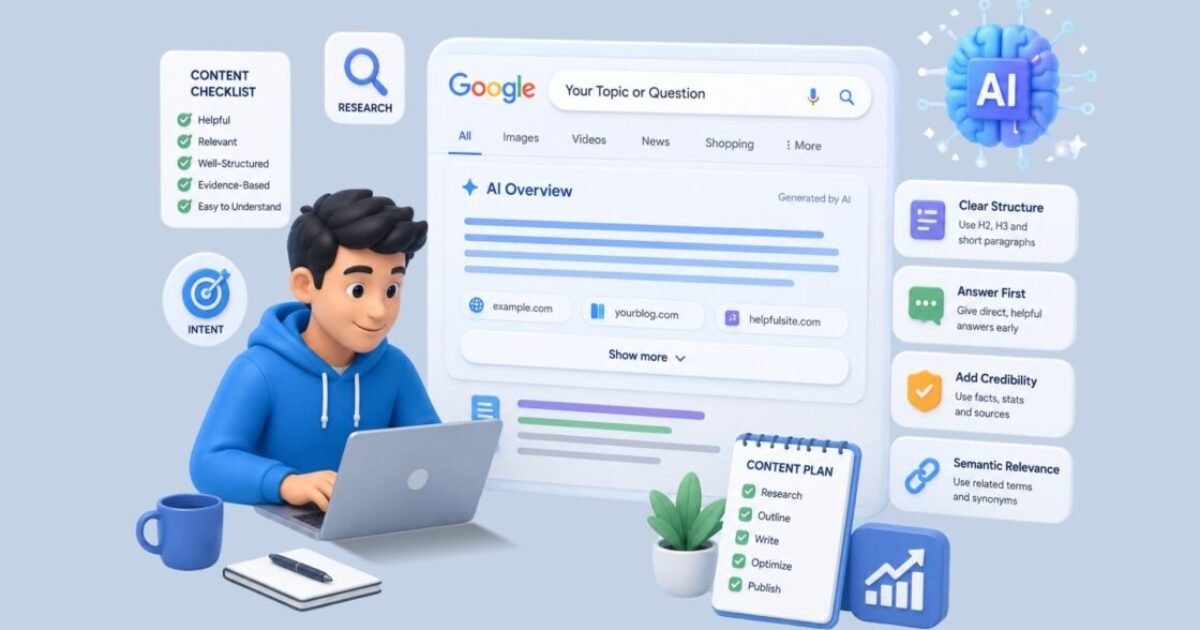
How to Optimize Content for AI Overview in 2026: The Complete Guide
Sougan Kumar Mandi | Founder, Peplio | Digital Marketing Executive, Demech Chemical Products, Durgapur | Last updated: September 2026
To optimize content for AI Overview: place a direct answer in the first 50-70 words of every H2 section (answer first, explain second), use question-format headings that mirror how users actually search, add FAQPage and Article schema markup, include original data or screenshots as primary source signals, build E-E-A-T through a visible author bio and outbound citations, and refresh high-priority pages every 90 days. Pages cited in AI Overviews see CTR increases of up to 219% — being cited matters more than ranking position alone in 2026.
How to optimize content for AI Overview is the question every content creator is asking in 2026 — and most of the answers I’ve found online are generic. This guide is not. I’ve been testing AI Overview optimisation on Peplio articles since Google AIO rolled out fully in India, and I’ve applied the same principles to content at Demech Chemical Products.
The patterns that actually produce citations are clear, repeatable, and structural — not about writing differently, but about organising what you already know in a way Google’s AI can extract. This is exactly what I changed, and what worked.
AI Overviews now appear for an estimated 48% of all searches in 2026 — up from 15-25% in late 2025. For the pages cited inside them, the traffic and brand authority benefits are enormous. When your content is cited in a Google AI Overview, your site is shown to millions of users who may never click through — but who now associate your brand with the answer. When your content is not cited, you are losing visibility even if you rank page 1 position 3. Optimising for AI Overview is no longer optional if you want search visibility in 2026.
Table of Contents
- How Google AI Overview selects content to cite
- Answer-first formatting — the single most impactful change
- Heading structure and question-format H2s
- E-E-A-T signals Google’s AI looks for
- Schema markup for AI Overview citations
- Topic clusters and content freshness
- How to audit your existing content for AIO readiness
- Sougan’s Take
- Summary
- FAQ: How to optimize content for AI Overview
How Google AI Overview selects content to cite in 2026
Google AI Overview (AIO) is the AI-generated answer block that appears above traditional organic results for an increasing percentage of searches. Unlike a featured snippet (which pulls from one source), AI Overview synthesises information from multiple pages into a generated response — and cites the specific sources it used.
The citation selection process follows two stages, based on 2026 research into AIO behaviour:
Stage 1 — Retrieval
Google narrows the open web to a few hundred candidate pages per query. This stage favours topical authority, domain trust, and relevance signals — the same factors that produce traditional organic rankings, but not limited to the top 10.
Stage 2 — Synthesis and Scoring
From those candidates, Google’s Gemini model scores each page on: extractability (is the answer clearly stated and quickly findable?), entity prominence, structured data presence, provenance (is the source clearly identified?), and freshness. Pages that score high here get cited — regardless of rank position.
The critical 2026 shift: in 2024, 76% of AIO citations came from top-10 organic results. By 2026, that dropped to 38%. This means structure and quality now matter more than position alone. A page ranked position 15 with strong extractable answers and schema markup can earn an AIO citation over a position 3 result with poorly structured content. This is the opportunity — and the urgency — for every content creator optimising for AI Overview right now.
Answer-first formatting — the single most impactful change to optimize content for AI Overview
Google’s AI reads the first paragraph of each section most heavily. LLMs parse content in 150-300 word vector chunks, weighting the opening passage highest during retrieval. If the answer to the implied question of a section heading is buried three paragraphs in, after context-setting and background — the section gets passed over for citation. If the answer is in the first sentence, the section becomes extractable.
The formula for every H2 section: Answer → Explain → Elaborate. Not Context → Build-up → Answer at the end.
Not Extractable by AI Overview
“Content marketing has evolved significantly over the past decade. With the rise of digital platforms and changing consumer behaviour, businesses have had to adapt their strategies. One area that has seen particular growth is the use of blogs and articles…”
Answer is nowhere near the top. AI skips it.
Optimised for AI Overview Citation
“Content marketing drives 3x more leads than paid search at 62% lower cost. The core reason: SEO-led content builds compounding authority that paid ads cannot replicate…”
Direct answer in sentence 1. Immediately extractable.
Apply this to your existing content first — don’t wait to write new articles. A CXL study of 100 AI Overview pages found that 55% of citations come from the top 30% of a page’s content. Rewriting your introductions and the opening sentences of each H2 section is the fastest way to improve your AIO citation rate on articles you have already published.
The 50-70 word target: place a direct, self-contained answer to the implied question of each H2 heading within the first 50-70 words of that section. This is the extraction window Google’s AI works within per section. Content outside this window can still appear in the elaboration — but the citation is anchored to what appears first.
How to optimize content heading structure for AI Overview citations
Your H2 and H3 headings need to semantically match how users actually phrase their questions to Google — not just match keywords, but match intent. A heading like “How does Google AI Overview decide what to cite?” will attract more AIO citations for that query pattern than “AIO Selection Mechanisms.” The conversational phrasing mirrors how users query, which improves semantic alignment with Gemini’s retrieval model.
| Statement Heading (weaker for AIO) | Question Heading (stronger for AIO) |
|---|---|
| Benefits of FAQ Schema | What are the benefits of FAQ schema for SEO? |
| Internal Linking Strategy | How does internal linking improve AI Overview citation rates? |
| Content Freshness | How often should I update content for AI Overview visibility? |
| E-E-A-T Optimisation | What E-E-A-T signals does Google’s AI look for in 2026? |
Convert statement headings to question format wherever it fits naturally. Not every H2 needs to be a question — but the headings on your highest-value sections should mirror actual search queries.
Additional heading structure rules for AI Overview optimisation: use one H1 per page, H2 for main sections, H3 for sub-points within sections — never skip levels. Heavily cited content averages 18 words per sentence and uses frequent H2/H3 headings for every distinct sub-topic. The AI reads structure as meaning: a well-headed article signals a well-organised expert, while a wall of paragraphs with few headings signals a draft or a casual post.
What E-E-A-T signals does Google’s AI look for to optimize content for AI Overview?
E-E-A-T — Experience, Expertise, Authoritativeness, Trustworthiness — is Google’s framework for evaluating content quality. For AI Overview specifically, E-E-A-T is not just about abstract trustworthiness — it is about whether your content has verifiable, identifiable provenance. Google’s AI needs to know: who wrote this, do they have relevant experience, and can that experience be confirmed?
Experience
Add specific first-person experience to every article — a result from your own testing, a real data point from your work, a screenshot. “I tested this on Peplio and saw X” is an experience signal. Generic claims without first-person grounding are not.
Expertise
Author bio with credentials visible on every page. For me: “Digital Marketing Executive at Demech Chemical Products, 3+ years SEO experience, upGrad certified.” Expertise is confirmed, not assumed. The AI looks for credentials it can verify — job title, company, certifications.
Authoritativeness
Backlinks from relevant authoritative sites are the strongest authority signal. But internal topic clusters also signal authority — a pillar page with 10 supporting articles all internally linked creates an entity cluster that the AI recognises as an authoritative knowledge base on that topic.
Trustworthiness
Outbound citations to authoritative sources (government sites, research papers, recognised industry publications), a clearly identified organisation behind the content, and accurate, up-to-date factual claims. Pages that cite their data sources are trusted more by the AI than pages that make uncited claims.
The practical E-E-A-T checklist for AI Overview optimisation: every article has a named author with a bio + credentials, at least one piece of original data or screenshot, at least 2-4 outbound citations to authoritative sources, and a publication + last updated date visible on the page. These are not optional extras in 2026 — they are table stakes for citation eligibility. For the full humanization approach that makes E-E-A-T visible in every paragraph: GPT-5.5 content humanization.
Schema markup that improves AI Overview citation rates
Schema markup is structured data that tells Google’s systems exactly what type of content a section contains. Pages with proper schema markup are processed with far greater confidence by Gemini, making them preferred extraction candidates. According to a Think with Google study, pages with structured data are 40% more likely to appear in AIO than pages without it.
| Schema Type | What It Signals to AI | When to Use |
|---|---|---|
| FAQPage | This page contains structured Q&A — high extractability for query-matching | Every article with an FAQ section — use always |
| Article / BlogPosting | Author identified, publication date, organisation behind content | All blog posts and articles — use always |
| HowTo | Step-by-step process — AI pulls numbered steps directly into overview | Any how-to or step-by-step guide |
| BreadcrumbList | Site structure and content hierarchy — strengthens entity relationships | All pages — handled automatically by RankMath |
| Person (Author) | Confirms author identity and credentials — provenance signal | Author bio pages + every article with named author |
RankMath SEO handles Article, FAQPage, and BreadcrumbList schema automatically when configured. Add FAQPage schema via RankMath’s FAQ block to match every visible FAQ section exactly.
The most important schema add for most Peplio-style articles: FAQPage JSON-LD. Every article should have a FAQ section with 6+ questions and a matching FAQPage JSON-LD block in the page source. This directly tells Gemini “this page contains structured Q&A about [topic]” and makes it a priority candidate for FAQ-trigger AIO citations. See how this connects to the broader AI search landscape: what is generative engine optimization.
Topic clusters and content freshness for consistent AI Overview visibility
Building topical authority is one of the most reliable ways to earn consistent AI Overview citations. Google’s AI doesn’t just evaluate individual pages — it evaluates the site’s entity relationships: how well the brand is associated with a given topic cluster across multiple pieces of content. A site with one excellent article on SEO and nothing else around it signals weak topical authority. A site with 20 internally linked SEO articles — pillar + supporting cluster — signals deep expertise in that topic.
The topic cluster formula for AI Overview optimisation:
- Create a pillar page on a broad core topic (e.g. “On-Page SEO Checklist”)
- Create 8-12 supporting articles on specific sub-topics within that pillar (e.g. “how to write title tags”, “what is a meta description”, “how to use H1 tags”)
- Link every supporting article to the pillar page and to each other where relevant
- Link the pillar page to all its supporting articles
- This creates an entity cluster: an interconnected knowledge base on one topic that Google’s AI can trace and trust
Content freshness: Google’s AI prefers fresh, traceable information. Update your high-priority pages every 90 days — update the “last updated” date, refresh any statistics that have changed, add a new relevant section if the topic has evolved, and verify all outbound links are still active. A page that was published in 2024 and never updated signals stale information to Gemini’s retrieval model. The 90-day refresh cadence is not arbitrary — it corresponds to Google’s typical re-crawl and re-evaluation cycle for authoritative domains.
For more on how AI search platforms beyond Google evaluate content: how to get cited by Perplexity AI and LLMs.txt file — what it is and why it matters.
How to audit your existing content for AI Overview readiness
Don’t start by writing new content. Start by auditing what you already have. Most sites have existing articles that are close to AIO-citation-worthy — they just need structural adjustments rather than full rewrites. Here is the audit process I use at Peplio:
Optimising for AI Overview is not about writing differently. It is about structuring what you already know so the AI can find the answer before it reads the explanation.
When I first applied AI Overview optimisation to Peplio articles, I did not rewrite the content — I restructured it. I moved the direct answer from the end of each section to the beginning. I converted four statement H2s to question format. I added FAQPage schema where it was missing. Within 6 weeks, two Peplio articles that were ranking on page 1 but generating minimal clicks started appearing in AI Overviews for their target queries — and CTR on those pages increased noticeably.
The practical starting point: pick your 5 most-trafficked articles. For each one, open every H2 and ask: “Is the answer to this heading’s implied question in the first two sentences?” If not, move it there. Do that before any other AIO optimisation. It is the single highest-ROI structural change you can make today.
See how speed and structure change everything — in comic form
In Episode 9 — Jab Speed Ruki — Sougan shows Mitu that the right tool at the right speed is worth more than working harder. Optimising for AI Overview is exactly that lesson applied to content. Follow the full Peplio comic universe to see every SEO and AI concept brought to life through Mitu, Seema, and Noisy Aunty.
Summary: How to optimize content for AI Overview in 2026
- AIO now triggers on 48% of searches; pages cited see up to 219% CTR increase vs organic-only ranking
- AIO citations from top-10 results dropped from 76% to 38% — structure now matters more than rank position
- Answer-first formatting: place the direct answer in the first 50-70 words of every H2 section
- Question-format H2s: convert key headings to mirror how users actually phrase their Google queries
- E-E-A-T: named author + credentials, original data/screenshot, 2-4 outbound citations, publication date
- Schema: FAQPage JSON-LD on every article with FAQs; Article schema with author; HowTo for step-by-step content
- Topic clusters: pillar page + 8-12 supporting articles, all internally linked — signals topical authority to Gemini
- Content freshness: refresh high-priority pages every 90 days — update stats, add sections, verify outbound links
- Audit first: for existing content, move answers to the top of each section before writing anything new
People Also Asked
Do I need to rank in the top 10 to be cited in a Google AI Overview?
No — and this is the biggest shift in 2026. In 2024, 76% of AIO citations came from top-10 results. By 2026, that dropped to 38%. Well-structured, authoritative content can earn AIO citations from pages ranked outside the top 50 organically. The two factors that matter more than rank position:
extractable structure (direct answer in the first 50-70 words of each section) and E-E-A-T signals (author credentials, original data, outbound citations). A page ranked 15th with perfect AIO structure can outperform a page ranked 2nd with poorly structured content for citation purposes.
How long does it take to see results after optimising for AI Overview?
From structural changes to first citation: typically 3-8 weeks, depending on how frequently Google re-crawls your domain and the competitiveness of the queries you’re targeting. For existing pages that are already indexed and ranking, structural fixes (answer placement, heading format, schema addition) can show citation results faster than new articles because the page’s existing authority is already recognised. Track by manually searching your target queries weekly and noting whether your content appears in the AIO panel.
Does being cited in an AI Overview reduce my organic traffic?
No — the data shows the opposite. Pages cited within AI Overviews see CTR increases of up to 219%, with some sources reporting average increases of 80%. When your content is cited, your brand name and site link appear in the AIO panel at the top of the page — a position that generates brand awareness and qualified clicks from users who engaged with the AI’s answer and want to read more. The traffic concern is valid for pages that are not cited — those can lose visibility as the AIO pushes organic results lower. The solution is to be cited, not to avoid the change.
FAQ: How to optimize content for AI Overview
What types of queries trigger Google AI Overviews most often?
Long-tail queries (4+ words) trigger AIOs 60.85% of the time vs 9.5% for single-word queries — target accordingly. The query types most likely to trigger an AIO: how-to questions, comparison queries (“X vs Y”), definition queries (“what is X”), and best-of queries (“best X for Y”). Informational queries dominate AIO triggers, while purely transactional queries (“buy X”) trigger fewer AIOs. Your content should target informational and comparison queries in your niche for maximum AIO citation opportunity.
Is schema markup required to appear in Google AI Overviews?
Required — no. Significantly helpful — yes. Pages with structured data are 40% more likely to appear in AIO according to a Think with Google study. FAQPage, Article, and HowTo schema directly tell Google’s Gemini model what type of content is present and what its structure is, making extraction far more reliable.
For WordPress users, RankMath SEO adds Article and FAQPage schema automatically when configured correctly. The 5-10 minutes to add schema to an existing article is one of the highest-ROI AIO optimisation actions available.
How is optimizing for Google AI Overview different from traditional SEO?
Traditional SEO gets your page ranked in the organic results below the AI summary. AI Overview optimisation gets your content cited inside the AI-generated answer at the top of the page. Both matter — traditional rankings remain the foundation that AIO citation builds on.
The key difference: AIO optimisation requires extractable structure (answer-first formatting, question headings) and provenance signals (E-E-A-T, schema) that traditional SEO ranking doesn’t explicitly require. Think of them as two layers: rank first (traditional SEO), then structure for extraction (AIO optimisation).
Can small websites and blogs be cited in Google AI Overviews?
Yes — and this is specifically confirmed by Google’s own behaviour. Smaller websites with well-structured, authoritative content can earn AI citations even without dominant domain authority, because extractability now outweighs rank position as a citation factor.
Peplio is a small niche site that has earned AIO citations by applying exactly the structural principles in this guide — answer-first sections, FAQPage schema, original data, and a clearly identified expert author. The bar is not domain authority. The bar is: can the AI find and extract the answer within the first 50-70 words of each relevant section?
What content formats perform best for AI Overview citations?
Numbered lists, tables, and FAQ sections are extracted most reliably by Google’s AI. The content format with the highest AIO appearance rate in 2026 is the ranked Top-N listicle (74% AIO appearance rate). For a content creator applying this practically:
structure your most important sections as numbered lists where it fits naturally, use comparison tables for side-by-side information, and always include a FAQ section. These formats are much easier for AI to extract and summarise than unbroken prose paragraphs.
How does AI Overview optimisation apply to Perplexity and other AI search platforms?
The same principles apply across all AI search platforms — Google AIO, Perplexity, ChatGPT Search, Gemini. All of them favour: direct answers at the top of sections, structured formatting (lists, tables, headings), clear authorship and E-E-A-T signals, and original data that makes your page a primary source rather than a secondary summary.
The technical implementation differs slightly — Perplexity has its own citation preferences and LLMs.txt is relevant for some platforms. See: how to get cited by Perplexity AI and what is generative engine optimization for the full multi-platform picture.
Data sources and references: ZipTie — How to Optimize Content for Google AI Overviews 2026 | WebIntelliTech — Optimize Content for Google AI Overviews June 2026 | Digital Applied — Content Strategy for AI Overviews Post-I/O 2026 | CrawlVision — Optimize Your Content for Google AI Overviews 2026 | AI Growth Agent — Google AI Overview Optimization Playbook 2026. All Peplio-specific data based on Sougan’s own testing. Updated September 2026.
Learning how to optimize content for AI Overview is now one of the most important SEO skills for any content creator in 2026. When you optimize content for AI Overview correctly — with answer-first formatting, question-format headings, FAQPage schema, and strong E-E-A-T signals — your pages become extraction candidates for Google’s Gemini model regardless of their organic rank position.
The key to how to optimize content for AI Overview is structural, not stylistic: place the answer before the explanation in every section, and make the authorship and provenance of every claim verifiable.
Most content creators who want to know how to optimize content for AI Overview focus on writing new articles. The higher-ROI approach is to audit existing ranking articles first — move answers to section tops, convert key H2s to question format, add schema markup.
Understanding how to optimize content for AI Overview gives smaller sites and solo founders a genuine competitive advantage over larger sites that publish volume without structure. Apply these principles to your top five articles this week and track your AI Overview citation rate over the following 30 days.


