
AEO vs SEO vs GEO: Why Indian Bloggers Are Losing the AI Search Race in 2026
Founder, Peplio · Digital Marketing Executive, Demech Chemical Products · Last updated: September 2026 — Updated with real AEO audit data from 15 Indian blogs
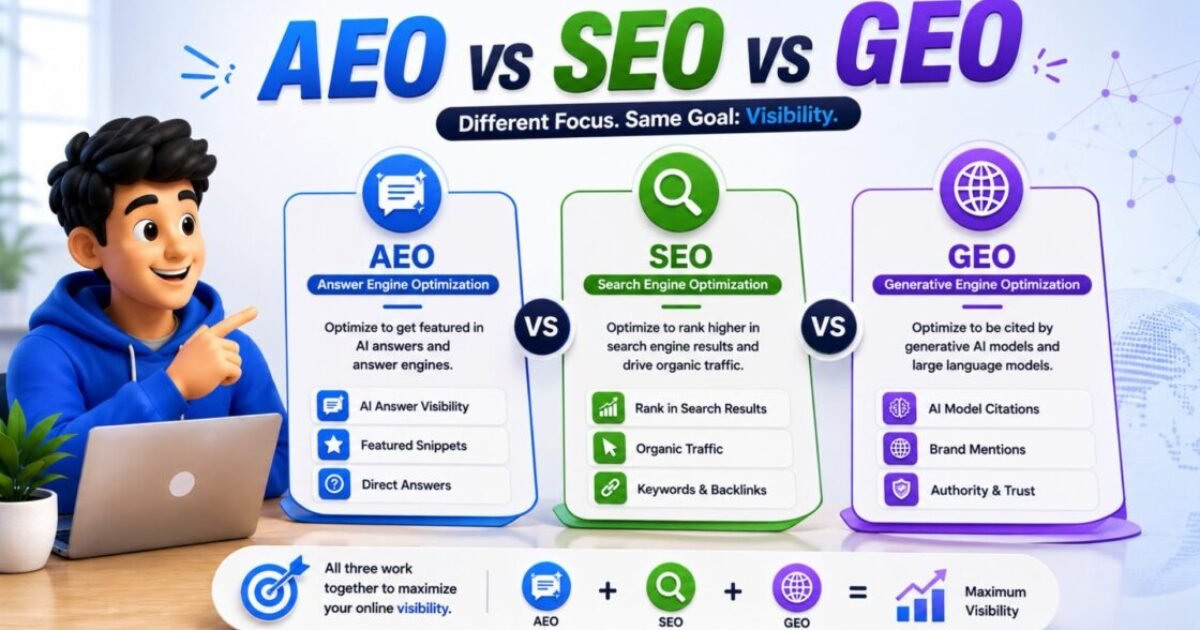
- SEO = ranking in Google’s 10 blue links — keywords, backlinks, technical health
- AEO = getting cited in Google AI Overviews above position 1
- GEO = getting recommended by ChatGPT, Perplexity, and Gemini
- All three are required in 2026 — none replaces the others
- Priority: SEO first → AEO from month 2 → GEO signals from day 1
- India gap: Average AEO score of Indian blogs = just 61.4/100 — see the full audit
Peplio published India’s first AEO audit — 15 Indian digital marketing blogs scored using the Peplio AEO Content Scorer. Average AEO score: 61.4/100. Only 4 of 15 sites crossed the 70-point threshold. The #1 weakness on 13 of 15 sites: missing direct answer in first 100 words. Read the full AEO score audit of Indian blogs
The AEO vs SEO vs GEO comparison is the most important framework for Indian digital marketers in 2026. I am Sougan Kumar Mandi, founder of Peplio.com and Digital Marketing Executive at Demech Chemical Products, Durgapur. I run all three — SEO, AEO, and GEO — on Peplio every single day. I have 709 organic keywords (SEO), a free AEO Content Scorer tool, and a free AI Visibility Tracker. This guide is the AEO vs SEO vs GEO comparison I wish existed when I started.
Most guides on AEO vs SEO vs GEO say either “all three are the same” or “SEO is dead, do GEO now.” Both are wrong. According to BrightEdge’s 2026 channel performance research, 53% of all website traffic still comes from organic search — SEO is far from dead. At the same time, Search Engine Journal reports that 48% of Google queries now trigger an AI Overview. And ConvertMate’s GEO study found Perplexity-referred visitors convert at 10.5% vs 1.76% for Google organic. All three channels matter simultaneously.
AEO vs SEO vs GEO — Simple Definitions in One Sentence Each
Before the full AEO vs SEO vs GEO comparison, here are the clearest possible definitions so every reader starts on the same page.
SEO (Search Engine Optimization) means ranking your web pages in Google’s 10 blue link results so users find and click through to your site. Success looks like position 1–10 for your target keyword. According to Moz’s SEO Beginners Guide, SEO covers three pillars: technical health, on-page optimization, and backlink authority.
AEO (Answer Engine Optimization) means structuring your content to be selected as the direct answer in Google AI Overviews and Featured Snippets above position 1. Success looks like your article being cited in the AI Overview summary that appears before the blue links. Ahrefs research confirms that AI Overviews pull almost exclusively from content that answers questions directly in the first 100 words.
GEO (Generative Engine Optimization) means building brand authority signals that cause ChatGPT, Perplexity, and Gemini to cite and recommend your content in AI responses. Success looks like ChatGPT mentioning your brand by name when a user asks about your topic. LLM Pulse’s 2026 analysis found that Reddit and YouTube mentions correlate 0.737 with AI visibility vs 0.266 for Domain Rating.
One-line summary of AEO vs SEO vs GEO: SEO gets you found. AEO gets you selected as the answer. GEO gets you recommended by AI. In 2026 users search in all three places — you need visibility in all three.
How AEO vs SEO vs GEO Are Fundamentally Different
The AEO vs SEO vs GEO debate misses the most important point: these three disciplines target three completely different user behaviours that happen simultaneously in 2026. Search has split into three distinct surfaces and most Indian teams are still optimising for only one.
SEO user behaviour: User opens Google → types a query → scans 10 links → clicks the most relevant one → reads your article. You compete for the click against 9 other results on the same page. This is still 53% of web traffic according to BrightEdge 2026.
AEO user behaviour: User opens Google → types a question → reads the AI Overview summary at the top — often without scrolling to the blue links at all. You compete to be one of 3–5 cited sources in that summary. 48% of Google queries now trigger this layer.
GEO user behaviour: User opens ChatGPT or Perplexity directly → asks a question conversationally → reads the AI-generated answer → clicks a cited source if they want more detail. You compete to be mentioned by name or cited as a source. Perplexity-referred visitors convert at 10.5% vs 1.76% for Google organic — six times better.
Understanding this difference is the foundation of the entire AEO vs SEO vs GEO strategy. You are not choosing between three channels — you are managing three different user journeys that lead to your content.
Full AEO vs SEO vs GEO Comparison Table
Here is every important dimension of the AEO vs SEO vs GEO comparison in one table for easy reference.
| Dimension | SEO | AEO | GEO |
|---|---|---|---|
| Where it shows | Google blue links pos 1–10 | AI Overview above pos 1 | ChatGPT, Perplexity, Gemini |
| Success metric | Keyword ranking position | Cited in AI Overview | Brand mentioned by AI |
| Main content tactic | Keywords, topical authority | Direct answer + FAQ schema | Brand mentions, Reddit |
| Speed to results | 3–6 months | 4–8 weeks | Days (Perplexity) to months |
| Traffic conversion | 1.76% avg | High brand visibility | 10.5% Perplexity avg |
| Cost to start | Free tools available | Free tools available | Free — Reddit, LinkedIn |
| Free tool to measure | Google Search Console | Peplio AEO Scorer | Peplio AI Tracker |
| Control level | High — mostly on-site | High — content + schema | Medium — off-site signals |
Where AEO vs SEO vs GEO Overlap — Do This Once, Benefit All Three
The most efficient part of running AEO vs SEO vs GEO together is the overlapping core. According to Google’s helpful content guidelines, E-E-A-T signals benefit traditional search rankings, AI Overview eligibility, and AI brand recognition simultaneously. These four things improve all three disciplines at once:
1. E-E-A-T signals: A real author box with credentials, first-hand experience in content, and transparent authorship improves Google trust (SEO), AI Overview eligibility (AEO), and ChatGPT brand recognition (GEO). One change, three benefits.
2. Content freshness: Updating articles every 30–45 days with new statistics and a visible “Last Updated” date improves Google rankings, AEO eligibility, and Perplexity citations simultaneously. Perplexity has the strongest recency bias of any AI engine — as documented in Perplexity’s own indexing guide.
3. Specific data with named sources: Statistics attributed to real sources with a year improve SEO E-E-A-T, AEO citation selection, and GEO credibility with all AI platforms. “60% higher engagement (Semrush 2026)” beats vague claims in all three disciplines. Semrush’s SEO statistics report is a reliable free source for cited data.
4. Page speed and crawlability: Fast pages pass Core Web Vitals (SEO), get indexed faster (AEO), and get crawled by PerplexityBot without timeout errors (GEO). Technical health is shared infrastructure for all three. Use Peplio’s free Website Speed Analyzer to check your Core Web Vitals.
AEO vs SEO vs GEO — Which Should You Focus on First?
In the AEO vs SEO vs GEO priority debate, here is the honest answer based on building Peplio from zero as a solo founder from Durgapur.
1st — SEO (months 1–3): Without SEO, there is nothing for AEO or GEO to build on. Google needs to crawl, index, and trust your pages before AI systems consider them for citations. If your domain authority is under 10 and you have few backlinks, AEO and GEO produce minimal results because all AI systems factor site credibility into citations. In the AEO vs SEO vs GEO sequence, SEO always comes first — not because it is most important, but because it is the prerequisite. Read our complete SEO guide for Indian bloggers.
2nd — AEO (from month 2 onwards): AEO is mostly on-page work — restructuring content, adding FAQ schema, rewriting opening paragraphs to lead with direct answers. You can apply AEO principles to every new article at zero additional cost. The same article ranking at position 15 can also appear in the AI Overview above position 1 if structured correctly. Check every article before publishing using Peplio’s free AEO Content Scorer. For the complete approach, read our Answer Engine Optimization guide.
3rd — GEO (from day 1, ongoing): GEO’s primary levers are off-site — Reddit mentions, authority publications, brand consistency. You can start GEO from day one even with a new site because Reddit posts and Quora answers do not require domain authority. GEO brand signals are the slowest to produce results but the most durable once established. Read our guide on how to get cited by Perplexity AI.
The honest exception: If your domain is already established (Authority Score 10+, 100+ articles), skip to AEO and GEO immediately. Established sites should be spending 40% on AEO and 30% on GEO right now — that is where the under-competition exists in the AEO vs SEO vs GEO landscape in 2026.
AEO vs SEO vs GEO for Indian Creators — What Makes India Different
The AEO vs SEO vs GEO landscape in India has specific characteristics that shift the priority order compared to Western markets. Here is what every Indian digital marketer needs to know.
SEO in India: Indian keywords have 60–80% lower competition than the same keywords globally. “Digital marketing strategy India” has a keyword difficulty of 18 vs 85 for “digital marketing strategy” globally. The India modifier approach — same topic, fraction of the competition — makes AEO vs SEO vs GEO SEO work significantly faster. Learn how to find low competition keywords specifically for Indian content.
AEO in India — the biggest gap: Almost no Indian content is structured for AEO. Search any India-specific question in Google AI Overviews and the citations are mostly US and UK publications. This is the largest untapped opportunity in Indian digital marketing. Our September 2026 audit confirmed this — the average AEO vs SEO vs GEO AEO score of Indian blogs is just 61.4/100, with Direct Answer averaging only 29.5%.
GEO in India — first-mover window: Indian usage of ChatGPT, Perplexity, and Gemini is growing rapidly. When Indian users ask AI tools about digital marketing, almost none of the cited sources are Indian. Getting into this citation pool now is a 12–18 month window in the AEO vs SEO vs GEO race that will not reopen once Indian GEO becomes competitive. Read our complete GEO guide for Indian creators.
Mobile-first reality: 76% of Indian searches happen on mobile. Think with Google’s India insights confirm mobile dominance. Fast-loading mobile pages improve Core Web Vitals (SEO), AI Overview eligibility (AEO), and Perplexity crawling (GEO) simultaneously — the highest-leverage shared improvement in Indian AEO vs SEO vs GEO strategy.
Real Data: AEO Score of Indian Blogs — What the Numbers Actually Show
The AEO vs SEO vs GEO AEO gap for Indian creators is not just theoretical. In September 2026, Peplio conducted India’s first structured AEO audit — scoring 15 Indian digital marketing blogs using the Peplio AEO Content Scorer across all 6 AEO signals. Here is what the AEO vs SEO vs GEO data actually shows for Indian blogs.
The most striking AEO vs SEO vs GEO finding: Indian blogs scored 82% average on Citations and Stats — excellent research habits built for traditional SEO. But they averaged only 29.5% on Direct Answer — the most important AEO signal. Indian bloggers already write well for SEO but have not yet adapted their structure for AEO. This is the exact gap the AEO vs SEO vs GEO framework predicts.
| Blog | AEO Score | Direct Ans | FAQ Schema | AI Ready? |
|---|---|---|---|---|
| Digital Vidya — What is DM | 82/100 | 12/20 | Yes | High |
| Teja Nair — Structured Data | 74/100 | 11/20 | Yes | High |
| Digital Vidya — Intro to DM | 73/100 | 3/20 | Yes | High |
| IIDE — Interview Questions | 68/100 | 3/20 | Yes | Medium |
| BloggersPassion | 61/100 | 8/20 | No | Medium |
| Digital Scholar | 61/100 | 3/20 | No | Medium |
| Digital Deepak | 58/100 | 8/20 | No | Medium |
| SocialBeat | 57/100 | 8/20 | No | Medium |
| AVERAGE (15 sites) | 61.4/100 | 5.9/20 | 4/15 | Medium |
Read the complete AEO score audit: all 15 Indian blogs with full data, 5 findings, and 3 fixes
How to Run AEO vs SEO vs GEO Together — The Unified Workflow
The answer to AEO vs SEO vs GEO is not choosing between them — it is running them as one unified system. Here is exactly how I run all three on Peplio as a solo founder from Durgapur, West Bengal.
Before writing (SEO): Research keyword with KD under 25 using Google Search Console and autocomplete. Set focus keyword in RankMath. Plan title with a sentiment word and number. Set slug before publishing — never change it after. This is the SEO layer of the AEO vs SEO vs GEO workflow.
While writing (AEO): Write a direct answer in the first 80 words. Use question-based H2 headings matching Google “People Also Ask.” Include statistics with named sources every 150 words. Add FAQPage JSON-LD schema with 6+ Q&As. Check your score in Peplio’s AEO Content Scorer before publishing. This is the AEO layer of AEO vs SEO vs GEO.
After publishing (GEO): Post a summary on Reddit in a relevant subreddit with a link. Write a LinkedIn post with key takeaway and link. Verify your robots.txt allows AI bots — check Peplio’s robots.txt generator. Verify Bing indexing at Bing Webmaster Tools. Monitor perplexity.ai referral traffic in GA4 weekly. This is the GEO layer of AEO vs SEO vs GEO.
Every 30–45 days (all three): Update the article with new data. Refresh the “Last Updated” date. Add a new FAQ. Resubmit to GSC. Check AI Overview appearance for your target keyword. Check AI Visibility Tracker for new citations. This refresh cycle is what separates active practitioners from passive publishers in the AEO vs SEO vs GEO race.
Most Indian bloggers are already doing the hardest part of AEO without knowing it — citing sources, adding data, writing structured content. The only piece missing is the direct answer in the first 80 words. Fix that one thing and your AEO score jumps immediately.
When I ran the AEO audit of 15 Indian blogs, I expected to find that Indian content was weak across all six AEO signals. That is not what the data showed. Indian blogs averaged 82% on Citations and Stats — better than many Western blogs I have seen. The failure was structural, not a quality problem. Nobody was leading with the direct answer. Fix the first paragraph, add FAQ schema, and the same article that took months to write immediately becomes AEO-ready. I now check every single Peplio article in the AEO Scorer before publishing. It takes four minutes. The difference in AI Overview appearances after implementing this across Peplio’s articles was visible within six weeks.
Mitu and Seema are learning AEO vs SEO vs GEO the hard way
Follow India’s first Digital Marketing Comic Universe — where Mitu’s bakery blog and Seema’s content hustle deal with SEO, AEO, and GEO every episode.
Read Comics Get eBooks- SEO = Google blue links — keywords, backlinks, Core Web Vitals — the foundation
- AEO = Google AI Overviews — direct answers, FAQ schema, question H2s
- GEO = ChatGPT/Perplexity citations — brand mentions, Reddit, authority publications
- Right order in AEO vs SEO vs GEO: SEO first → AEO from month 2 → GEO from day 1
- India AEO reality: Average AEO score of Indian blogs = 61.4/100 — huge gap to fill
- Biggest quick win: FAQ schema adds +17 points to AEO score on average
- India GEO window: 12–18 months before competition arrives — move now
What is the difference between AEO vs SEO vs GEO?
In the AEO vs SEO vs GEO comparison: SEO ranks your pages in Google blue links through keywords, backlinks, and technical health. AEO structures your content to be selected as the direct answer in Google AI Overviews above position 1. GEO builds brand authority signals that cause ChatGPT, Perplexity, and Gemini to cite your content. All three target different user behaviours in 2026. Read the complete AEO vs SEO vs GEO comparison.
What is the average AEO score of Indian blogs in 2026?
Based on Peplio’s September 2026 audit of 15 Indian digital marketing blogs, the average AEO score is 61.4/100. Only 4 of 15 sites scored above 70. The #1 weakness was Direct Answer, averaging just 29.5%. Read the full AEO score audit of Indian blogs
Which is more important in 2026 for Indian creators — AEO vs SEO vs GEO?
In the AEO vs SEO vs GEO importance ranking for Indian creators, AEO is the most underinvested discipline right now. 48% of Google queries trigger AI Overviews that appear above position 1, yet the average AEO score of Indian blogs is just 61.4/100. This gap is the largest AEO vs SEO vs GEO opportunity available to Indian digital marketers in 2026.
Frequently Asked Questions — AEO vs SEO vs GEO
What is the difference between AEO vs SEO vs GEO?
In the AEO vs SEO vs GEO comparison: SEO ranks your pages in Google’s blue links through keywords, backlinks, and technical health. AEO structures your content to be selected as the direct answer in Google AI Overviews above position 1. GEO builds brand authority signals that cause ChatGPT, Perplexity, and Gemini to cite your content. All three target different user behaviours happening simultaneously in 2026 — none replaces the others.
Which is more important in 2026 — AEO vs SEO vs GEO?
SEO remains the foundation in AEO vs SEO vs GEO. But AEO is the most underinvested discipline in 2026 for Indian creators. 48% of Google queries now trigger AI Overviews above position 1. Getting cited in these while most competitors are not targeting them is the highest-leverage AEO vs SEO vs GEO action available right now. GEO delivers 10.5% conversion rate from Perplexity but takes longest to establish.
Is GEO the same as Local SEO?
No — this is one of the most common confusions in the AEO vs SEO vs GEO space. In digital marketing, GEO stands for Generative Engine Optimization — getting cited by ChatGPT, Perplexity, and Gemini. Local SEO is a completely different discipline focused on ranking in Google Maps and local search for location-based queries. GEO and geographic SEO share the same three letters but are entirely different strategies.
Can I do AEO without doing SEO first?
Technically yes, but practically no. In the AEO vs SEO vs GEO sequence, AEO requires that your pages are indexed and trusted by Google before they can be selected for AI Overviews. If your site has technical SEO problems — slow loading, poor mobile experience, broken sitemap — Google will not surface your content in AI Overviews regardless of how well you have structured it for AEO. Fix SEO fundamentals first, then apply AEO structure to every article.
How much time should I spend on AEO vs SEO vs GEO?
For a new Indian website (under 12 months, Authority Score under 10), the recommended AEO vs SEO vs GEO time allocation is: 50% SEO, 35% AEO, 15% GEO. For an established site (12+ months, Authority Score 15+): 30% SEO, 40% AEO, 30% GEO. The more established your domain, the more value AEO and GEO generate per hour invested.
What free tools can I use to measure AEO vs SEO vs GEO?
For the complete AEO vs SEO vs GEO measurement stack at zero cost: SEO — Google Search Console and GA4. AEO — Peplio’s free AEO Content Scorer to check every article. GEO — GA4 referral traffic filtered for perplexity.ai and chatgpt.com, plus Peplio’s free AI Visibility Tracker. Total cost: zero rupees.
- AEO Score of Indian Blogs: Why 11 Out of 15 Sites Failed the AI Search Test (2026 Data)
- Answer Engine Optimization (AEO) — The Complete 2026 Guide
- What Is Generative Engine Optimization (GEO)? Complete Guide
- GEO vs SEO — What Is the Difference?
- How to Get Cited by Perplexity AI — 9 Steps That Work in 2026
- How to Optimize Content for Google AI Overviews — 8 Steps
- Free AEO Content Scorer — Check Your Article Before Publishing
- Free AI Visibility Tracker — Check If ChatGPT Cites Your Site
Data sources: BrightEdge 2026 Channel Performance Report, Search Engine Journal AI Overview research, ConvertMate GEO Study, LLM Pulse AEO vs GEO vs SEO Analysis 2026, Google Helpful Content Guidelines, Ahrefs Featured Snippets Study, Moz Beginners Guide to SEO, Think with Google India Mobile Insights. Updated September 2026.
The AEO vs SEO vs GEO framework is the most important visibility strategy for Indian content creators in 2026. Understanding AEO vs SEO vs GEO means recognising that search has split into three surfaces simultaneously — Google blue links, Google AI Overviews, and AI platforms like ChatGPT and Perplexity — and that each surface requires a different optimisation approach. The AEO vs SEO vs GEO priority order for new sites is always SEO first to establish crawlability and trust, AEO from month two to capture AI Overview citations, and GEO from day one through Reddit and LinkedIn brand signals.
What makes the AEO vs SEO vs GEO gap so significant for Indian creators is confirmed by real audit data: the average AEO score of Indian blogs is just 61.4 out of 100, despite Indian blogs performing well on citations and statistics. The AEO vs SEO vs GEO opportunity is structural — Indian blogs write well but do not lead with direct answers, the single most important AEO signal. Adding a direct answer in the first 80 words and implementing FAQ schema are the two highest-impact AEO vs SEO vs GEO changes any Indian creator can make today, at zero cost, to existing articles.
Founder, Peplio · Digital Marketing Executive, Demech Chemical Products · Last updated: September 2026 — Updated with real AEO audit data from 15 Indian blogs
- SEO = ranking in Google’s 10 blue links — keywords, backlinks, technical health
- AEO = getting cited in Google AI Overviews above position 1
- GEO = getting recommended by ChatGPT, Perplexity, and Gemini
- All three are required in 2026 — none replaces the others
- Priority: SEO first → AEO from month 2 → GEO signals from day 1
- India gap: Average AEO score of Indian blogs = just 61.4/100 — see the full audit
Peplio published India’s first AEO audit — 15 Indian digital marketing blogs scored using the Peplio AEO Content Scorer. Average AEO score: 61.4/100. Only 4 of 15 sites crossed the 70-point threshold. The #1 weakness on 13 of 15 sites: missing direct answer in first 100 words. Read the full AEO score audit of Indian blogs
The AEO vs SEO vs GEO comparison is the most important framework for Indian digital marketers in 2026. I am Sougan Kumar Mandi, founder of Peplio.com and Digital Marketing Executive at Demech Chemical Products, Durgapur. I run all three — SEO, AEO, and GEO — on Peplio every single day. I have 709 organic keywords (SEO), a free AEO Content Scorer tool, and a free AI Visibility Tracker. This guide is the AEO vs SEO vs GEO comparison I wish existed when I started.
Most guides on AEO vs SEO vs GEO say either “all three are the same” or “SEO is dead, do GEO now.” Both are wrong. According to BrightEdge’s 2026 channel performance research, 53% of all website traffic still comes from organic search — SEO is far from dead. At the same time, Search Engine Journal reports that 48% of Google queries now trigger an AI Overview. And ConvertMate’s GEO study found Perplexity-referred visitors convert at 10.5% vs 1.76% for Google organic. All three channels matter simultaneously.
AEO vs SEO vs GEO — Simple Definitions in One Sentence Each
Before the full AEO vs SEO vs GEO comparison, here are the clearest possible definitions so every reader starts on the same page.
SEO (Search Engine Optimization) means ranking your web pages in Google’s 10 blue link results so users find and click through to your site. Success looks like position 1–10 for your target keyword. According to Moz’s SEO Beginners Guide, SEO covers three pillars: technical health, on-page optimization, and backlink authority.
AEO (Answer Engine Optimization) means structuring your content to be selected as the direct answer in Google AI Overviews and Featured Snippets above position 1. Success looks like your article being cited in the AI Overview summary that appears before the blue links. Ahrefs research confirms that AI Overviews pull almost exclusively from content that answers questions directly in the first 100 words.
GEO (Generative Engine Optimization) means building brand authority signals that cause ChatGPT, Perplexity, and Gemini to cite and recommend your content in AI responses. Success looks like ChatGPT mentioning your brand by name when a user asks about your topic. LLM Pulse’s 2026 analysis found that Reddit and YouTube mentions correlate 0.737 with AI visibility vs 0.266 for Domain Rating.
One-line summary of AEO vs SEO vs GEO: SEO gets you found. AEO gets you selected as the answer. GEO gets you recommended by AI. In 2026 users search in all three places — you need visibility in all three.
How AEO vs SEO vs GEO Are Fundamentally Different
The AEO vs SEO vs GEO debate misses the most important point: these three disciplines target three completely different user behaviours that happen simultaneously in 2026. Search has split into three distinct surfaces and most Indian teams are still optimising for only one.
SEO user behaviour: User opens Google → types a query → scans 10 links → clicks the most relevant one → reads your article. You compete for the click against 9 other results on the same page. This is still 53% of web traffic according to BrightEdge 2026.
AEO user behaviour: User opens Google → types a question → reads the AI Overview summary at the top — often without scrolling to the blue links at all. You compete to be one of 3–5 cited sources in that summary. 48% of Google queries now trigger this layer.
GEO user behaviour: User opens ChatGPT or Perplexity directly → asks a question conversationally → reads the AI-generated answer → clicks a cited source if they want more detail. You compete to be mentioned by name or cited as a source. Perplexity-referred visitors convert at 10.5% vs 1.76% for Google organic — six times better.
Understanding this difference is the foundation of the entire AEO vs SEO vs GEO strategy. You are not choosing between three channels — you are managing three different user journeys that lead to your content.
Full AEO vs SEO vs GEO Comparison Table
Here is every important dimension of the AEO vs SEO vs GEO comparison in one table for easy reference.
| Dimension | SEO | AEO | GEO |
|---|---|---|---|
| Where it shows | Google blue links pos 1–10 | AI Overview above pos 1 | ChatGPT, Perplexity, Gemini |
| Success metric | Keyword ranking position | Cited in AI Overview | Brand mentioned by AI |
| Main content tactic | Keywords, topical authority | Direct answer + FAQ schema | Brand mentions, Reddit |
| Speed to results | 3–6 months | 4–8 weeks | Days (Perplexity) to months |
| Traffic conversion | 1.76% avg | High brand visibility | 10.5% Perplexity avg |
| Cost to start | Free tools available | Free tools available | Free — Reddit, LinkedIn |
| Free tool to measure | Google Search Console | Peplio AEO Scorer | Peplio AI Tracker |
| Control level | High — mostly on-site | High — content + schema | Medium — off-site signals |
Where AEO vs SEO vs GEO Overlap — Do This Once, Benefit All Three
The most efficient part of running AEO vs SEO vs GEO together is the overlapping core. According to Google’s helpful content guidelines, E-E-A-T signals benefit traditional search rankings, AI Overview eligibility, and AI brand recognition simultaneously. These four things improve all three disciplines at once:
1. E-E-A-T signals: A real author box with credentials, first-hand experience in content, and transparent authorship improves Google trust (SEO), AI Overview eligibility (AEO), and ChatGPT brand recognition (GEO). One change, three benefits.
2. Content freshness: Updating articles every 30–45 days with new statistics and a visible “Last Updated” date improves Google rankings, AEO eligibility, and Perplexity citations simultaneously. Perplexity has the strongest recency bias of any AI engine — as documented in Perplexity’s own indexing guide.
3. Specific data with named sources: Statistics attributed to real sources with a year improve SEO E-E-A-T, AEO citation selection, and GEO credibility with all AI platforms. “60% higher engagement (Semrush 2026)” beats vague claims in all three disciplines. Semrush’s SEO statistics report is a reliable free source for cited data.
4. Page speed and crawlability: Fast pages pass Core Web Vitals (SEO), get indexed faster (AEO), and get crawled by PerplexityBot without timeout errors (GEO). Technical health is shared infrastructure for all three. Use Peplio’s free Website Speed Analyzer to check your Core Web Vitals.
AEO vs SEO vs GEO — Which Should You Focus on First?
In the AEO vs SEO vs GEO priority debate, here is the honest answer based on building Peplio from zero as a solo founder from Durgapur.
1st — SEO (months 1–3): Without SEO, there is nothing for AEO or GEO to build on. Google needs to crawl, index, and trust your pages before AI systems consider them for citations. If your domain authority is under 10 and you have few backlinks, AEO and GEO produce minimal results because all AI systems factor site credibility into citations. In the AEO vs SEO vs GEO sequence, SEO always comes first — not because it is most important, but because it is the prerequisite. Read our complete SEO guide for Indian bloggers.
2nd — AEO (from month 2 onwards): AEO is mostly on-page work — restructuring content, adding FAQ schema, rewriting opening paragraphs to lead with direct answers. You can apply AEO principles to every new article at zero additional cost. The same article ranking at position 15 can also appear in the AI Overview above position 1 if structured correctly. Check every article before publishing using Peplio’s free AEO Content Scorer. For the complete approach, read our Answer Engine Optimization guide.
3rd — GEO (from day 1, ongoing): GEO’s primary levers are off-site — Reddit mentions, authority publications, brand consistency. You can start GEO from day one even with a new site because Reddit posts and Quora answers do not require domain authority. GEO brand signals are the slowest to produce results but the most durable once established. Read our guide on how to get cited by Perplexity AI.
The honest exception: If your domain is already established (Authority Score 10+, 100+ articles), skip to AEO and GEO immediately. Established sites should be spending 40% on AEO and 30% on GEO right now — that is where the under-competition exists in the AEO vs SEO vs GEO landscape in 2026.
AEO vs SEO vs GEO for Indian Creators — What Makes India Different
The AEO vs SEO vs GEO landscape in India has specific characteristics that shift the priority order compared to Western markets. Here is what every Indian digital marketer needs to know.
SEO in India: Indian keywords have 60–80% lower competition than the same keywords globally. “Digital marketing strategy India” has a keyword difficulty of 18 vs 85 for “digital marketing strategy” globally. The India modifier approach — same topic, fraction of the competition — makes AEO vs SEO vs GEO SEO work significantly faster. Learn how to find low competition keywords specifically for Indian content.
AEO in India — the biggest gap: Almost no Indian content is structured for AEO. Search any India-specific question in Google AI Overviews and the citations are mostly US and UK publications. This is the largest untapped opportunity in Indian digital marketing. Our September 2026 audit confirmed this — the average AEO vs SEO vs GEO AEO score of Indian blogs is just 61.4/100, with Direct Answer averaging only 29.5%.
GEO in India — first-mover window: Indian usage of ChatGPT, Perplexity, and Gemini is growing rapidly. When Indian users ask AI tools about digital marketing, almost none of the cited sources are Indian. Getting into this citation pool now is a 12–18 month window in the AEO vs SEO vs GEO race that will not reopen once Indian GEO becomes competitive. Read our complete GEO guide for Indian creators.
Mobile-first reality: 76% of Indian searches happen on mobile. Think with Google’s India insights confirm mobile dominance. Fast-loading mobile pages improve Core Web Vitals (SEO), AI Overview eligibility (AEO), and Perplexity crawling (GEO) simultaneously — the highest-leverage shared improvement in Indian AEO vs SEO vs GEO strategy.
Real Data: AEO Score of Indian Blogs — What the Numbers Actually Show
The AEO vs SEO vs GEO AEO gap for Indian creators is not just theoretical. In September 2026, Peplio conducted India’s first structured AEO audit — scoring 15 Indian digital marketing blogs using the Peplio AEO Content Scorer across all 6 AEO signals. Here is what the AEO vs SEO vs GEO data actually shows for Indian blogs.
The most striking AEO vs SEO vs GEO finding: Indian blogs scored 82% average on Citations and Stats — excellent research habits built for traditional SEO. But they averaged only 29.5% on Direct Answer — the most important AEO signal. Indian bloggers already write well for SEO but have not yet adapted their structure for AEO. This is the exact gap the AEO vs SEO vs GEO framework predicts.
| Blog | AEO Score | Direct Ans | FAQ Schema | AI Ready? |
|---|---|---|---|---|
| Digital Vidya — What is DM | 82/100 | 12/20 | Yes | High |
| Teja Nair — Structured Data | 74/100 | 11/20 | Yes | High |
| Digital Vidya — Intro to DM | 73/100 | 3/20 | Yes | High |
| IIDE — Interview Questions | 68/100 | 3/20 | Yes | Medium |
| BloggersPassion | 61/100 | 8/20 | No | Medium |
| Digital Scholar | 61/100 | 3/20 | No | Medium |
| Digital Deepak | 58/100 | 8/20 | No | Medium |
| SocialBeat | 57/100 | 8/20 | No | Medium |
| AVERAGE (15 sites) | 61.4/100 | 5.9/20 | 4/15 | Medium |
Read the complete AEO score audit: all 15 Indian blogs with full data, 5 findings, and 3 fixes
How to Run AEO vs SEO vs GEO Together — The Unified Workflow
The answer to AEO vs SEO vs GEO is not choosing between them — it is running them as one unified system. Here is exactly how I run all three on Peplio as a solo founder from Durgapur, West Bengal.
Before writing (SEO): Research keyword with KD under 25 using Google Search Console and autocomplete. Set focus keyword in RankMath. Plan title with a sentiment word and number. Set slug before publishing — never change it after. This is the SEO layer of the AEO vs SEO vs GEO workflow.
While writing (AEO): Write a direct answer in the first 80 words. Use question-based H2 headings matching Google “People Also Ask.” Include statistics with named sources every 150 words. Add FAQPage JSON-LD schema with 6+ Q&As. Check your score in Peplio’s AEO Content Scorer before publishing. This is the AEO layer of AEO vs SEO vs GEO.
After publishing (GEO): Post a summary on Reddit in a relevant subreddit with a link. Write a LinkedIn post with key takeaway and link. Verify your robots.txt allows AI bots — check Peplio’s robots.txt generator. Verify Bing indexing at Bing Webmaster Tools. Monitor perplexity.ai referral traffic in GA4 weekly. This is the GEO layer of AEO vs SEO vs GEO.
Every 30–45 days (all three): Update the article with new data. Refresh the “Last Updated” date. Add a new FAQ. Resubmit to GSC. Check AI Overview appearance for your target keyword. Check AI Visibility Tracker for new citations. This refresh cycle is what separates active practitioners from passive publishers in the AEO vs SEO vs GEO race.
Most Indian bloggers are already doing the hardest part of AEO without knowing it — citing sources, adding data, writing structured content. The only piece missing is the direct answer in the first 80 words. Fix that one thing and your AEO score jumps immediately.
When I ran the AEO audit of 15 Indian blogs, I expected to find that Indian content was weak across all six AEO signals. That is not what the data showed. Indian blogs averaged 82% on Citations and Stats — better than many Western blogs I have seen. The failure was structural, not a quality problem. Nobody was leading with the direct answer. Fix the first paragraph, add FAQ schema, and the same article that took months to write immediately becomes AEO-ready. I now check every single Peplio article in the AEO Scorer before publishing. It takes four minutes. The difference in AI Overview appearances after implementing this across Peplio’s articles was visible within six weeks.
Mitu and Seema are learning AEO vs SEO vs GEO the hard way
Follow India’s first Digital Marketing Comic Universe — where Mitu’s bakery blog and Seema’s content hustle deal with SEO, AEO, and GEO every episode.
Read Comics Get eBooks- SEO = Google blue links — keywords, backlinks, Core Web Vitals — the foundation
- AEO = Google AI Overviews — direct answers, FAQ schema, question H2s
- GEO = ChatGPT/Perplexity citations — brand mentions, Reddit, authority publications
- Right order in AEO vs SEO vs GEO: SEO first → AEO from month 2 → GEO from day 1
- India AEO reality: Average AEO score of Indian blogs = 61.4/100 — huge gap to fill
- Biggest quick win: FAQ schema adds +17 points to AEO score on average
- India GEO window: 12–18 months before competition arrives — move now
What is the difference between AEO vs SEO vs GEO?
In the AEO vs SEO vs GEO comparison: SEO ranks your pages in Google blue links through keywords, backlinks, and technical health. AEO structures your content to be selected as the direct answer in Google AI Overviews above position 1. GEO builds brand authority signals that cause ChatGPT, Perplexity, and Gemini to cite your content. All three target different user behaviours in 2026. Read the complete AEO vs SEO vs GEO comparison.
What is the average AEO score of Indian blogs in 2026?
Based on Peplio’s September 2026 audit of 15 Indian digital marketing blogs, the average AEO score is 61.4/100. Only 4 of 15 sites scored above 70. The #1 weakness was Direct Answer, averaging just 29.5%. Read the full AEO score audit of Indian blogs
Which is more important in 2026 for Indian creators — AEO vs SEO vs GEO?
In the AEO vs SEO vs GEO importance ranking for Indian creators, AEO is the most underinvested discipline right now. 48% of Google queries trigger AI Overviews that appear above position 1, yet the average AEO score of Indian blogs is just 61.4/100. This gap is the largest AEO vs SEO vs GEO opportunity available to Indian digital marketers in 2026.
Frequently Asked Questions — AEO vs SEO vs GEO
What is the difference between AEO vs SEO vs GEO?
In the AEO vs SEO vs GEO comparison: SEO ranks your pages in Google’s blue links through keywords, backlinks, and technical health. AEO structures your content to be selected as the direct answer in Google AI Overviews above position 1. GEO builds brand authority signals that cause ChatGPT, Perplexity, and Gemini to cite your content. All three target different user behaviours happening simultaneously in 2026 — none replaces the others.
Which is more important in 2026 — AEO vs SEO vs GEO?
SEO remains the foundation in AEO vs SEO vs GEO. But AEO is the most underinvested discipline in 2026 for Indian creators. 48% of Google queries now trigger AI Overviews above position 1. Getting cited in these while most competitors are not targeting them is the highest-leverage AEO vs SEO vs GEO action available right now. GEO delivers 10.5% conversion rate from Perplexity but takes longest to establish.
Is GEO the same as Local SEO?
No — this is one of the most common confusions in the AEO vs SEO vs GEO space. In digital marketing, GEO stands for Generative Engine Optimization — getting cited by ChatGPT, Perplexity, and Gemini. Local SEO is a completely different discipline focused on ranking in Google Maps and local search for location-based queries. GEO and geographic SEO share the same three letters but are entirely different strategies.
Can I do AEO without doing SEO first?
Technically yes, but practically no. In the AEO vs SEO vs GEO sequence, AEO requires that your pages are indexed and trusted by Google before they can be selected for AI Overviews. If your site has technical SEO problems — slow loading, poor mobile experience, broken sitemap — Google will not surface your content in AI Overviews regardless of how well you have structured it for AEO. Fix SEO fundamentals first, then apply AEO structure to every article.
How much time should I spend on AEO vs SEO vs GEO?
For a new Indian website (under 12 months, Authority Score under 10), the recommended AEO vs SEO vs GEO time allocation is: 50% SEO, 35% AEO, 15% GEO. For an established site (12+ months, Authority Score 15+): 30% SEO, 40% AEO, 30% GEO. The more established your domain, the more value AEO and GEO generate per hour invested.
What free tools can I use to measure AEO vs SEO vs GEO?
For the complete AEO vs SEO vs GEO measurement stack at zero cost: SEO — Google Search Console and GA4. AEO — Peplio’s free AEO Content Scorer to check every article. GEO — GA4 referral traffic filtered for perplexity.ai and chatgpt.com, plus Peplio’s free AI Visibility Tracker. Total cost: zero rupees.
- AEO Score of Indian Blogs: Why 11 Out of 15 Sites Failed the AI Search Test (2026 Data)
- Answer Engine Optimization (AEO) — The Complete 2026 Guide
- What Is Generative Engine Optimization (GEO)? Complete Guide
- GEO vs SEO — What Is the Difference?
- How to Get Cited by Perplexity AI — 9 Steps That Work in 2026
- How to Optimize Content for Google AI Overviews — 8 Steps
- Free AEO Content Scorer — Check Your Article Before Publishing
- Free AI Visibility Tracker — Check If ChatGPT Cites Your Site
Data sources: BrightEdge 2026 Channel Performance Report, Search Engine Journal AI Overview research, ConvertMate GEO Study, LLM Pulse AEO vs GEO vs SEO Analysis 2026, Google Helpful Content Guidelines, Ahrefs Featured Snippets Study, Moz Beginners Guide to SEO, Think with Google India Mobile Insights. Updated September 2026.
The AEO vs SEO vs GEO framework is the most important visibility strategy for Indian content creators in 2026. Understanding AEO vs SEO vs GEO means recognising that search has split into three surfaces simultaneously — Google blue links, Google AI Overviews, and AI platforms like ChatGPT and Perplexity — and that each surface requires a different optimisation approach. The AEO vs SEO vs GEO priority order for new sites is always SEO first to establish crawlability and trust, AEO from month two to capture AI Overview citations, and GEO from day one through Reddit and LinkedIn brand signals.
What makes the AEO vs SEO vs GEO gap so significant for Indian creators is confirmed by real audit data: the average AEO score of Indian blogs is just 61.4 out of 100, despite Indian blogs performing well on citations and statistics. The AEO vs SEO vs GEO opportunity is structural — Indian blogs write well but do not lead with direct answers, the single most important AEO signal. Adding a direct answer in the first 80 words and implementing FAQ schema are the two highest-impact AEO vs SEO vs GEO changes any Indian creator can make today, at zero cost, to existing articles.
Founder, Peplio · Digital Marketing Executive, Demech Chemical Products · Last updated: September 2026 — Updated with real AEO audit data from 15 Indian blogs
- SEO = ranking in Google’s 10 blue links — keywords, backlinks, technical health
- AEO = getting cited in Google AI Overviews above position 1
- GEO = getting recommended by ChatGPT, Perplexity, and Gemini
- All three are required in 2026 — none replaces the others
- Priority: SEO first → AEO from month 2 → GEO signals from day 1
- India gap: Average AEO score of Indian blogs = just 61.4/100 — see the full audit
Peplio published India’s first AEO audit — 15 Indian digital marketing blogs scored using the Peplio AEO Content Scorer. Average AEO score: 61.4/100. Only 4 of 15 sites crossed the 70-point threshold. The #1 weakness on 13 of 15 sites: missing direct answer in first 100 words. Read the full AEO score audit of Indian blogs
The AEO vs SEO vs GEO comparison is the most important framework for Indian digital marketers in 2026. I am Sougan Kumar Mandi, founder of Peplio.com and Digital Marketing Executive at Demech Chemical Products, Durgapur. I run all three — SEO, AEO, and GEO — on Peplio every single day. I have 709 organic keywords (SEO), a free AEO Content Scorer tool, and a free AI Visibility Tracker. This guide is the AEO vs SEO vs GEO comparison I wish existed when I started.
Most guides on AEO vs SEO vs GEO say either “all three are the same” or “SEO is dead, do GEO now.” Both are wrong. According to BrightEdge’s 2026 channel performance research, 53% of all website traffic still comes from organic search — SEO is far from dead. At the same time, Search Engine Journal reports that 48% of Google queries now trigger an AI Overview. And ConvertMate’s GEO study found Perplexity-referred visitors convert at 10.5% vs 1.76% for Google organic. All three channels matter simultaneously.
AEO vs SEO vs GEO — Simple Definitions in One Sentence Each
Before the full AEO vs SEO vs GEO comparison, here are the clearest possible definitions so every reader starts on the same page.
SEO (Search Engine Optimization) means ranking your web pages in Google’s 10 blue link results so users find and click through to your site. Success looks like position 1–10 for your target keyword. According to Moz’s SEO Beginners Guide, SEO covers three pillars: technical health, on-page optimization, and backlink authority.
AEO (Answer Engine Optimization) means structuring your content to be selected as the direct answer in Google AI Overviews and Featured Snippets above position 1. Success looks like your article being cited in the AI Overview summary that appears before the blue links. Ahrefs research confirms that AI Overviews pull almost exclusively from content that answers questions directly in the first 100 words.
GEO (Generative Engine Optimization) means building brand authority signals that cause ChatGPT, Perplexity, and Gemini to cite and recommend your content in AI responses. Success looks like ChatGPT mentioning your brand by name when a user asks about your topic. LLM Pulse’s 2026 analysis found that Reddit and YouTube mentions correlate 0.737 with AI visibility vs 0.266 for Domain Rating.
One-line summary of AEO vs SEO vs GEO: SEO gets you found. AEO gets you selected as the answer. GEO gets you recommended by AI. In 2026 users search in all three places — you need visibility in all three.
How AEO vs SEO vs GEO Are Fundamentally Different
The AEO vs SEO vs GEO debate misses the most important point: these three disciplines target three completely different user behaviours that happen simultaneously in 2026. Search has split into three distinct surfaces and most Indian teams are still optimising for only one.
SEO user behaviour: User opens Google → types a query → scans 10 links → clicks the most relevant one → reads your article. You compete for the click against 9 other results on the same page. This is still 53% of web traffic according to BrightEdge 2026.
AEO user behaviour: User opens Google → types a question → reads the AI Overview summary at the top — often without scrolling to the blue links at all. You compete to be one of 3–5 cited sources in that summary. 48% of Google queries now trigger this layer.
GEO user behaviour: User opens ChatGPT or Perplexity directly → asks a question conversationally → reads the AI-generated answer → clicks a cited source if they want more detail. You compete to be mentioned by name or cited as a source. Perplexity-referred visitors convert at 10.5% vs 1.76% for Google organic — six times better.
Understanding this difference is the foundation of the entire AEO vs SEO vs GEO strategy. You are not choosing between three channels — you are managing three different user journeys that lead to your content.
Full AEO vs SEO vs GEO Comparison Table
Here is every important dimension of the AEO vs SEO vs GEO comparison in one table for easy reference.
| Dimension | SEO | AEO | GEO |
|---|---|---|---|
| Where it shows | Google blue links pos 1–10 | AI Overview above pos 1 | ChatGPT, Perplexity, Gemini |
| Success metric | Keyword ranking position | Cited in AI Overview | Brand mentioned by AI |
| Main content tactic | Keywords, topical authority | Direct answer + FAQ schema | Brand mentions, Reddit |
| Speed to results | 3–6 months | 4–8 weeks | Days (Perplexity) to months |
| Traffic conversion | 1.76% avg | High brand visibility | 10.5% Perplexity avg |
| Cost to start | Free tools available | Free tools available | Free — Reddit, LinkedIn |
| Free tool to measure | Google Search Console | Peplio AEO Scorer | Peplio AI Tracker |
| Control level | High — mostly on-site | High — content + schema | Medium — off-site signals |
Where AEO vs SEO vs GEO Overlap — Do This Once, Benefit All Three
The most efficient part of running AEO vs SEO vs GEO together is the overlapping core. According to Google’s helpful content guidelines, E-E-A-T signals benefit traditional search rankings, AI Overview eligibility, and AI brand recognition simultaneously. These four things improve all three disciplines at once:
1. E-E-A-T signals: A real author box with credentials, first-hand experience in content, and transparent authorship improves Google trust (SEO), AI Overview eligibility (AEO), and ChatGPT brand recognition (GEO). One change, three benefits.
2. Content freshness: Updating articles every 30–45 days with new statistics and a visible “Last Updated” date improves Google rankings, AEO eligibility, and Perplexity citations simultaneously. Perplexity has the strongest recency bias of any AI engine — as documented in Perplexity’s own indexing guide.
3. Specific data with named sources: Statistics attributed to real sources with a year improve SEO E-E-A-T, AEO citation selection, and GEO credibility with all AI platforms. “60% higher engagement (Semrush 2026)” beats vague claims in all three disciplines. Semrush’s SEO statistics report is a reliable free source for cited data.
4. Page speed and crawlability: Fast pages pass Core Web Vitals (SEO), get indexed faster (AEO), and get crawled by PerplexityBot without timeout errors (GEO). Technical health is shared infrastructure for all three. Use Peplio’s free Website Speed Analyzer to check your Core Web Vitals.
AEO vs SEO vs GEO — Which Should You Focus on First?
In the AEO vs SEO vs GEO priority debate, here is the honest answer based on building Peplio from zero as a solo founder from Durgapur.
1st — SEO (months 1–3): Without SEO, there is nothing for AEO or GEO to build on. Google needs to crawl, index, and trust your pages before AI systems consider them for citations. If your domain authority is under 10 and you have few backlinks, AEO and GEO produce minimal results because all AI systems factor site credibility into citations. In the AEO vs SEO vs GEO sequence, SEO always comes first — not because it is most important, but because it is the prerequisite. Read our complete SEO guide for Indian bloggers.
2nd — AEO (from month 2 onwards): AEO is mostly on-page work — restructuring content, adding FAQ schema, rewriting opening paragraphs to lead with direct answers. You can apply AEO principles to every new article at zero additional cost. The same article ranking at position 15 can also appear in the AI Overview above position 1 if structured correctly. Check every article before publishing using Peplio’s free AEO Content Scorer. For the complete approach, read our Answer Engine Optimization guide.
3rd — GEO (from day 1, ongoing): GEO’s primary levers are off-site — Reddit mentions, authority publications, brand consistency. You can start GEO from day one even with a new site because Reddit posts and Quora answers do not require domain authority. GEO brand signals are the slowest to produce results but the most durable once established. Read our guide on how to get cited by Perplexity AI.
The honest exception: If your domain is already established (Authority Score 10+, 100+ articles), skip to AEO and GEO immediately. Established sites should be spending 40% on AEO and 30% on GEO right now — that is where the under-competition exists in the AEO vs SEO vs GEO landscape in 2026.
AEO vs SEO vs GEO for Indian Creators — What Makes India Different
The AEO vs SEO vs GEO landscape in India has specific characteristics that shift the priority order compared to Western markets. Here is what every Indian digital marketer needs to know.
SEO in India: Indian keywords have 60–80% lower competition than the same keywords globally. “Digital marketing strategy India” has a keyword difficulty of 18 vs 85 for “digital marketing strategy” globally. The India modifier approach — same topic, fraction of the competition — makes AEO vs SEO vs GEO SEO work significantly faster. Learn how to find low competition keywords specifically for Indian content.
AEO in India — the biggest gap: Almost no Indian content is structured for AEO. Search any India-specific question in Google AI Overviews and the citations are mostly US and UK publications. This is the largest untapped opportunity in Indian digital marketing. Our September 2026 audit confirmed this — the average AEO vs SEO vs GEO AEO score of Indian blogs is just 61.4/100, with Direct Answer averaging only 29.5%.
GEO in India — first-mover window: Indian usage of ChatGPT, Perplexity, and Gemini is growing rapidly. When Indian users ask AI tools about digital marketing, almost none of the cited sources are Indian. Getting into this citation pool now is a 12–18 month window in the AEO vs SEO vs GEO race that will not reopen once Indian GEO becomes competitive. Read our complete GEO guide for Indian creators.
Mobile-first reality: 76% of Indian searches happen on mobile. Think with Google’s India insights confirm mobile dominance. Fast-loading mobile pages improve Core Web Vitals (SEO), AI Overview eligibility (AEO), and Perplexity crawling (GEO) simultaneously — the highest-leverage shared improvement in Indian AEO vs SEO vs GEO strategy.
Real Data: AEO Score of Indian Blogs — What the Numbers Actually Show
The AEO vs SEO vs GEO AEO gap for Indian creators is not just theoretical. In September 2026, Peplio conducted India’s first structured AEO audit — scoring 15 Indian digital marketing blogs using the Peplio AEO Content Scorer across all 6 AEO signals. Here is what the AEO vs SEO vs GEO data actually shows for Indian blogs.
The most striking AEO vs SEO vs GEO finding: Indian blogs scored 82% average on Citations and Stats — excellent research habits built for traditional SEO. But they averaged only 29.5% on Direct Answer — the most important AEO signal. Indian bloggers already write well for SEO but have not yet adapted their structure for AEO. This is the exact gap the AEO vs SEO vs GEO framework predicts.
| Blog | AEO Score | Direct Ans | FAQ Schema | AI Ready? |
|---|---|---|---|---|
| Digital Vidya — What is DM | 82/100 | 12/20 | Yes | High |
| Teja Nair — Structured Data | 74/100 | 11/20 | Yes | High |
| Digital Vidya — Intro to DM | 73/100 | 3/20 | Yes | High |
| IIDE — Interview Questions | 68/100 | 3/20 | Yes | Medium |
| BloggersPassion | 61/100 | 8/20 | No | Medium |
| Digital Scholar | 61/100 | 3/20 | No | Medium |
| Digital Deepak | 58/100 | 8/20 | No | Medium |
| SocialBeat | 57/100 | 8/20 | No | Medium |
| AVERAGE (15 sites) | 61.4/100 | 5.9/20 | 4/15 | Medium |
Read the complete AEO score audit: all 15 Indian blogs with full data, 5 findings, and 3 fixes
How to Run AEO vs SEO vs GEO Together — The Unified Workflow
The answer to AEO vs SEO vs GEO is not choosing between them — it is running them as one unified system. Here is exactly how I run all three on Peplio as a solo founder from Durgapur, West Bengal.
Before writing (SEO): Research keyword with KD under 25 using Google Search Console and autocomplete. Set focus keyword in RankMath. Plan title with a sentiment word and number. Set slug before publishing — never change it after. This is the SEO layer of the AEO vs SEO vs GEO workflow.
While writing (AEO): Write a direct answer in the first 80 words. Use question-based H2 headings matching Google “People Also Ask.” Include statistics with named sources every 150 words. Add FAQPage JSON-LD schema with 6+ Q&As. Check your score in Peplio’s AEO Content Scorer before publishing. This is the AEO layer of AEO vs SEO vs GEO.
After publishing (GEO): Post a summary on Reddit in a relevant subreddit with a link. Write a LinkedIn post with key takeaway and link. Verify your robots.txt allows AI bots — check Peplio’s robots.txt generator. Verify Bing indexing at Bing Webmaster Tools. Monitor perplexity.ai referral traffic in GA4 weekly. This is the GEO layer of AEO vs SEO vs GEO.
Every 30–45 days (all three): Update the article with new data. Refresh the “Last Updated” date. Add a new FAQ. Resubmit to GSC. Check AI Overview appearance for your target keyword. Check AI Visibility Tracker for new citations. This refresh cycle is what separates active practitioners from passive publishers in the AEO vs SEO vs GEO race.
Most Indian bloggers are already doing the hardest part of AEO without knowing it — citing sources, adding data, writing structured content. The only piece missing is the direct answer in the first 80 words. Fix that one thing and your AEO score jumps immediately.
When I ran the AEO audit of 15 Indian blogs, I expected to find that Indian content was weak across all six AEO signals. That is not what the data showed. Indian blogs averaged 82% on Citations and Stats — better than many Western blogs I have seen. The failure was structural, not a quality problem. Nobody was leading with the direct answer. Fix the first paragraph, add FAQ schema, and the same article that took months to write immediately becomes AEO-ready. I now check every single Peplio article in the AEO Scorer before publishing. It takes four minutes. The difference in AI Overview appearances after implementing this across Peplio’s articles was visible within six weeks.
Mitu and Seema are learning AEO vs SEO vs GEO the hard way
Follow India’s first Digital Marketing Comic Universe — where Mitu’s bakery blog and Seema’s content hustle deal with SEO, AEO, and GEO every episode.
Read Comics Get eBooks- SEO = Google blue links — keywords, backlinks, Core Web Vitals — the foundation
- AEO = Google AI Overviews — direct answers, FAQ schema, question H2s
- GEO = ChatGPT/Perplexity citations — brand mentions, Reddit, authority publications
- Right order in AEO vs SEO vs GEO: SEO first → AEO from month 2 → GEO from day 1
- India AEO reality: Average AEO score of Indian blogs = 61.4/100 — huge gap to fill
- Biggest quick win: FAQ schema adds +17 points to AEO score on average
- India GEO window: 12–18 months before competition arrives — move now
What is the difference between AEO vs SEO vs GEO?
In the AEO vs SEO vs GEO comparison: SEO ranks your pages in Google blue links through keywords, backlinks, and technical health. AEO structures your content to be selected as the direct answer in Google AI Overviews above position 1. GEO builds brand authority signals that cause ChatGPT, Perplexity, and Gemini to cite your content. All three target different user behaviours in 2026. Read the complete AEO vs SEO vs GEO comparison.
What is the average AEO score of Indian blogs in 2026?
Based on Peplio’s September 2026 audit of 15 Indian digital marketing blogs, the average AEO score is 61.4/100. Only 4 of 15 sites scored above 70. The #1 weakness was Direct Answer, averaging just 29.5%. Read the full AEO score audit of Indian blogs
Which is more important in 2026 for Indian creators — AEO vs SEO vs GEO?
In the AEO vs SEO vs GEO importance ranking for Indian creators, AEO is the most underinvested discipline right now. 48% of Google queries trigger AI Overviews that appear above position 1, yet the average AEO score of Indian blogs is just 61.4/100. This gap is the largest AEO vs SEO vs GEO opportunity available to Indian digital marketers in 2026.
Frequently Asked Questions — AEO vs SEO vs GEO
What is the difference between AEO vs SEO vs GEO?
In the AEO vs SEO vs GEO comparison: SEO ranks your pages in Google’s blue links through keywords, backlinks, and technical health. AEO structures your content to be selected as the direct answer in Google AI Overviews above position 1. GEO builds brand authority signals that cause ChatGPT, Perplexity, and Gemini to cite your content. All three target different user behaviours happening simultaneously in 2026 — none replaces the others.
Which is more important in 2026 — AEO vs SEO vs GEO?
SEO remains the foundation in AEO vs SEO vs GEO. But AEO is the most underinvested discipline in 2026 for Indian creators. 48% of Google queries now trigger AI Overviews above position 1. Getting cited in these while most competitors are not targeting them is the highest-leverage AEO vs SEO vs GEO action available right now. GEO delivers 10.5% conversion rate from Perplexity but takes longest to establish.
Is GEO the same as Local SEO?
No — this is one of the most common confusions in the AEO vs SEO vs GEO space. In digital marketing, GEO stands for Generative Engine Optimization — getting cited by ChatGPT, Perplexity, and Gemini. Local SEO is a completely different discipline focused on ranking in Google Maps and local search for location-based queries. GEO and geographic SEO share the same three letters but are entirely different strategies.
Can I do AEO without doing SEO first?
Technically yes, but practically no. In the AEO vs SEO vs GEO sequence, AEO requires that your pages are indexed and trusted by Google before they can be selected for AI Overviews. If your site has technical SEO problems — slow loading, poor mobile experience, broken sitemap — Google will not surface your content in AI Overviews regardless of how well you have structured it for AEO. Fix SEO fundamentals first, then apply AEO structure to every article.
How much time should I spend on AEO vs SEO vs GEO?
For a new Indian website (under 12 months, Authority Score under 10), the recommended AEO vs SEO vs GEO time allocation is: 50% SEO, 35% AEO, 15% GEO. For an established site (12+ months, Authority Score 15+): 30% SEO, 40% AEO, 30% GEO. The more established your domain, the more value AEO and GEO generate per hour invested.
What free tools can I use to measure AEO vs SEO vs GEO?
For the complete AEO vs SEO vs GEO measurement stack at zero cost: SEO — Google Search Console and GA4. AEO — Peplio’s free AEO Content Scorer to check every article. GEO — GA4 referral traffic filtered for perplexity.ai and chatgpt.com, plus Peplio’s free AI Visibility Tracker. Total cost: zero rupees.
- AEO Score of Indian Blogs: Why 11 Out of 15 Sites Failed the AI Search Test (2026 Data)
- Answer Engine Optimization (AEO) — The Complete 2026 Guide
- What Is Generative Engine Optimization (GEO)? Complete Guide
- GEO vs SEO — What Is the Difference?
- How to Get Cited by Perplexity AI — 9 Steps That Work in 2026
- How to Optimize Content for Google AI Overviews — 8 Steps
- Free AEO Content Scorer — Check Your Article Before Publishing
- Free AI Visibility Tracker — Check If ChatGPT Cites Your Site
Data sources: BrightEdge 2026 Channel Performance Report, Search Engine Journal AI Overview research, ConvertMate GEO Study, LLM Pulse AEO vs GEO vs SEO Analysis 2026, Google Helpful Content Guidelines, Ahrefs Featured Snippets Study, Moz Beginners Guide to SEO, Think with Google India Mobile Insights. Updated September 2026.
The AEO vs SEO vs GEO framework is the most important visibility strategy for Indian content creators in 2026. Understanding AEO vs SEO vs GEO means recognising that search has split into three surfaces simultaneously — Google blue links, Google AI Overviews, and AI platforms like ChatGPT and Perplexity — and that each surface requires a different optimisation approach. The AEO vs SEO vs GEO priority order for new sites is always SEO first to establish crawlability and trust, AEO from month two to capture AI Overview citations, and GEO from day one through Reddit and LinkedIn brand signals.
What makes the AEO vs SEO vs GEO gap so significant for Indian creators is confirmed by real audit data: the average AEO score of Indian blogs is just 61.4 out of 100, despite Indian blogs performing well on citations and statistics. The AEO vs SEO vs GEO opportunity is structural — Indian blogs write well but do not lead with direct answers, the single most important AEO signal. Adding a direct answer in the first 80 words and implementing FAQ schema are the two highest-impact AEO vs SEO vs GEO changes any Indian creator can make today, at zero cost, to existing articles.
Founder, Peplio · Digital Marketing Executive, Demech Chemical Products · Last updated: September 2026 — Updated with real AEO audit data from 15 Indian blogs
- SEO = ranking in Google’s 10 blue links — keywords, backlinks, technical health
- AEO = getting cited in Google AI Overviews above position 1
- GEO = getting recommended by ChatGPT, Perplexity, and Gemini
- All three are required in 2026 — none replaces the others
- Priority: SEO first → AEO from month 2 → GEO signals from day 1
- India gap: Average AEO score of Indian blogs = just 61.4/100 — see the full audit
Peplio published India’s first AEO audit — 15 Indian digital marketing blogs scored using the Peplio AEO Content Scorer. Average AEO score: 61.4/100. Only 4 of 15 sites crossed the 70-point threshold. The #1 weakness on 13 of 15 sites: missing direct answer in first 100 words. Read the full AEO score audit of Indian blogs
The AEO vs SEO vs GEO comparison is the most important framework for Indian digital marketers in 2026. I am Sougan Kumar Mandi, founder of Peplio.com and Digital Marketing Executive at Demech Chemical Products, Durgapur. I run all three — SEO, AEO, and GEO — on Peplio every single day. I have 709 organic keywords (SEO), a free AEO Content Scorer tool, and a free AI Visibility Tracker. This guide is the AEO vs SEO vs GEO comparison I wish existed when I started.
Most guides on AEO vs SEO vs GEO say either “all three are the same” or “SEO is dead, do GEO now.” Both are wrong. According to BrightEdge’s 2026 channel performance research, 53% of all website traffic still comes from organic search — SEO is far from dead. At the same time, Search Engine Journal reports that 48% of Google queries now trigger an AI Overview. And ConvertMate’s GEO study found Perplexity-referred visitors convert at 10.5% vs 1.76% for Google organic. All three channels matter simultaneously.
AEO vs SEO vs GEO — Simple Definitions in One Sentence Each
Before the full AEO vs SEO vs GEO comparison, here are the clearest possible definitions so every reader starts on the same page.
SEO (Search Engine Optimization) means ranking your web pages in Google’s 10 blue link results so users find and click through to your site. Success looks like position 1–10 for your target keyword. According to Moz’s SEO Beginners Guide, SEO covers three pillars: technical health, on-page optimization, and backlink authority.
AEO (Answer Engine Optimization) means structuring your content to be selected as the direct answer in Google AI Overviews and Featured Snippets above position 1. Success looks like your article being cited in the AI Overview summary that appears before the blue links. Ahrefs research confirms that AI Overviews pull almost exclusively from content that answers questions directly in the first 100 words.
GEO (Generative Engine Optimization) means building brand authority signals that cause ChatGPT, Perplexity, and Gemini to cite and recommend your content in AI responses. Success looks like ChatGPT mentioning your brand by name when a user asks about your topic. LLM Pulse’s 2026 analysis found that Reddit and YouTube mentions correlate 0.737 with AI visibility vs 0.266 for Domain Rating.
One-line summary of AEO vs SEO vs GEO: SEO gets you found. AEO gets you selected as the answer. GEO gets you recommended by AI. In 2026 users search in all three places — you need visibility in all three.
How AEO vs SEO vs GEO Are Fundamentally Different
The AEO vs SEO vs GEO debate misses the most important point: these three disciplines target three completely different user behaviours that happen simultaneously in 2026. Search has split into three distinct surfaces and most Indian teams are still optimising for only one.
SEO user behaviour: User opens Google → types a query → scans 10 links → clicks the most relevant one → reads your article. You compete for the click against 9 other results on the same page. This is still 53% of web traffic according to BrightEdge 2026.
AEO user behaviour: User opens Google → types a question → reads the AI Overview summary at the top — often without scrolling to the blue links at all. You compete to be one of 3–5 cited sources in that summary. 48% of Google queries now trigger this layer.
GEO user behaviour: User opens ChatGPT or Perplexity directly → asks a question conversationally → reads the AI-generated answer → clicks a cited source if they want more detail. You compete to be mentioned by name or cited as a source. Perplexity-referred visitors convert at 10.5% vs 1.76% for Google organic — six times better.
Understanding this difference is the foundation of the entire AEO vs SEO vs GEO strategy. You are not choosing between three channels — you are managing three different user journeys that lead to your content.
Full AEO vs SEO vs GEO Comparison Table
Here is every important dimension of the AEO vs SEO vs GEO comparison in one table for easy reference.
| Dimension | SEO | AEO | GEO |
|---|---|---|---|
| Where it shows | Google blue links pos 1–10 | AI Overview above pos 1 | ChatGPT, Perplexity, Gemini |
| Success metric | Keyword ranking position | Cited in AI Overview | Brand mentioned by AI |
| Main content tactic | Keywords, topical authority | Direct answer + FAQ schema | Brand mentions, Reddit |
| Speed to results | 3–6 months | 4–8 weeks | Days (Perplexity) to months |
| Traffic conversion | 1.76% avg | High brand visibility | 10.5% Perplexity avg |
| Cost to start | Free tools available | Free tools available | Free — Reddit, LinkedIn |
| Free tool to measure | Google Search Console | Peplio AEO Scorer | Peplio AI Tracker |
| Control level | High — mostly on-site | High — content + schema | Medium — off-site signals |
Where AEO vs SEO vs GEO Overlap — Do This Once, Benefit All Three
The most efficient part of running AEO vs SEO vs GEO together is the overlapping core. According to Google’s helpful content guidelines, E-E-A-T signals benefit traditional search rankings, AI Overview eligibility, and AI brand recognition simultaneously. These four things improve all three disciplines at once:
1. E-E-A-T signals: A real author box with credentials, first-hand experience in content, and transparent authorship improves Google trust (SEO), AI Overview eligibility (AEO), and ChatGPT brand recognition (GEO). One change, three benefits.
2. Content freshness: Updating articles every 30–45 days with new statistics and a visible “Last Updated” date improves Google rankings, AEO eligibility, and Perplexity citations simultaneously. Perplexity has the strongest recency bias of any AI engine — as documented in Perplexity’s own indexing guide.
3. Specific data with named sources: Statistics attributed to real sources with a year improve SEO E-E-A-T, AEO citation selection, and GEO credibility with all AI platforms. “60% higher engagement (Semrush 2026)” beats vague claims in all three disciplines. Semrush’s SEO statistics report is a reliable free source for cited data.
4. Page speed and crawlability: Fast pages pass Core Web Vitals (SEO), get indexed faster (AEO), and get crawled by PerplexityBot without timeout errors (GEO). Technical health is shared infrastructure for all three. Use Peplio’s free Website Speed Analyzer to check your Core Web Vitals.
AEO vs SEO vs GEO — Which Should You Focus on First?
In the AEO vs SEO vs GEO priority debate, here is the honest answer based on building Peplio from zero as a solo founder from Durgapur.
1st — SEO (months 1–3): Without SEO, there is nothing for AEO or GEO to build on. Google needs to crawl, index, and trust your pages before AI systems consider them for citations. If your domain authority is under 10 and you have few backlinks, AEO and GEO produce minimal results because all AI systems factor site credibility into citations. In the AEO vs SEO vs GEO sequence, SEO always comes first — not because it is most important, but because it is the prerequisite. Read our complete SEO guide for Indian bloggers.
2nd — AEO (from month 2 onwards): AEO is mostly on-page work — restructuring content, adding FAQ schema, rewriting opening paragraphs to lead with direct answers. You can apply AEO principles to every new article at zero additional cost. The same article ranking at position 15 can also appear in the AI Overview above position 1 if structured correctly. Check every article before publishing using Peplio’s free AEO Content Scorer. For the complete approach, read our Answer Engine Optimization guide.
3rd — GEO (from day 1, ongoing): GEO’s primary levers are off-site — Reddit mentions, authority publications, brand consistency. You can start GEO from day one even with a new site because Reddit posts and Quora answers do not require domain authority. GEO brand signals are the slowest to produce results but the most durable once established. Read our guide on how to get cited by Perplexity AI.
The honest exception: If your domain is already established (Authority Score 10+, 100+ articles), skip to AEO and GEO immediately. Established sites should be spending 40% on AEO and 30% on GEO right now — that is where the under-competition exists in the AEO vs SEO vs GEO landscape in 2026.
AEO vs SEO vs GEO for Indian Creators — What Makes India Different
The AEO vs SEO vs GEO landscape in India has specific characteristics that shift the priority order compared to Western markets. Here is what every Indian digital marketer needs to know.
SEO in India: Indian keywords have 60–80% lower competition than the same keywords globally. “Digital marketing strategy India” has a keyword difficulty of 18 vs 85 for “digital marketing strategy” globally. The India modifier approach — same topic, fraction of the competition — makes AEO vs SEO vs GEO SEO work significantly faster. Learn how to find low competition keywords specifically for Indian content.
AEO in India — the biggest gap: Almost no Indian content is structured for AEO. Search any India-specific question in Google AI Overviews and the citations are mostly US and UK publications. This is the largest untapped opportunity in Indian digital marketing. Our September 2026 audit confirmed this — the average AEO vs SEO vs GEO AEO score of Indian blogs is just 61.4/100, with Direct Answer averaging only 29.5%.
GEO in India — first-mover window: Indian usage of ChatGPT, Perplexity, and Gemini is growing rapidly. When Indian users ask AI tools about digital marketing, almost none of the cited sources are Indian. Getting into this citation pool now is a 12–18 month window in the AEO vs SEO vs GEO race that will not reopen once Indian GEO becomes competitive. Read our complete GEO guide for Indian creators.
Mobile-first reality: 76% of Indian searches happen on mobile. Think with Google’s India insights confirm mobile dominance. Fast-loading mobile pages improve Core Web Vitals (SEO), AI Overview eligibility (AEO), and Perplexity crawling (GEO) simultaneously — the highest-leverage shared improvement in Indian AEO vs SEO vs GEO strategy.
Real Data: AEO Score of Indian Blogs — What the Numbers Actually Show
The AEO vs SEO vs GEO AEO gap for Indian creators is not just theoretical. In September 2026, Peplio conducted India’s first structured AEO audit — scoring 15 Indian digital marketing blogs using the Peplio AEO Content Scorer across all 6 AEO signals. Here is what the AEO vs SEO vs GEO data actually shows for Indian blogs.
The most striking AEO vs SEO vs GEO finding: Indian blogs scored 82% average on Citations and Stats — excellent research habits built for traditional SEO. But they averaged only 29.5% on Direct Answer — the most important AEO signal. Indian bloggers already write well for SEO but have not yet adapted their structure for AEO. This is the exact gap the AEO vs SEO vs GEO framework predicts.
| Blog | AEO Score | Direct Ans | FAQ Schema | AI Ready? |
|---|---|---|---|---|
| Digital Vidya — What is DM | 82/100 | 12/20 | Yes | High |
| Teja Nair — Structured Data | 74/100 | 11/20 | Yes | High |
| Digital Vidya — Intro to DM | 73/100 | 3/20 | Yes | High |
| IIDE — Interview Questions | 68/100 | 3/20 | Yes | Medium |
| BloggersPassion | 61/100 | 8/20 | No | Medium |
| Digital Scholar | 61/100 | 3/20 | No | Medium |
| Digital Deepak | 58/100 | 8/20 | No | Medium |
| SocialBeat | 57/100 | 8/20 | No | Medium |
| AVERAGE (15 sites) | 61.4/100 | 5.9/20 | 4/15 | Medium |
Read the complete AEO score audit: all 15 Indian blogs with full data, 5 findings, and 3 fixes
How to Run AEO vs SEO vs GEO Together — The Unified Workflow
The answer to AEO vs SEO vs GEO is not choosing between them — it is running them as one unified system. Here is exactly how I run all three on Peplio as a solo founder from Durgapur, West Bengal.
Before writing (SEO): Research keyword with KD under 25 using Google Search Console and autocomplete. Set focus keyword in RankMath. Plan title with a sentiment word and number. Set slug before publishing — never change it after. This is the SEO layer of the AEO vs SEO vs GEO workflow.
While writing (AEO): Write a direct answer in the first 80 words. Use question-based H2 headings matching Google “People Also Ask.” Include statistics with named sources every 150 words. Add FAQPage JSON-LD schema with 6+ Q&As. Check your score in Peplio’s AEO Content Scorer before publishing. This is the AEO layer of AEO vs SEO vs GEO.
After publishing (GEO): Post a summary on Reddit in a relevant subreddit with a link. Write a LinkedIn post with key takeaway and link. Verify your robots.txt allows AI bots — check Peplio’s robots.txt generator. Verify Bing indexing at Bing Webmaster Tools. Monitor perplexity.ai referral traffic in GA4 weekly. This is the GEO layer of AEO vs SEO vs GEO.
Every 30–45 days (all three): Update the article with new data. Refresh the “Last Updated” date. Add a new FAQ. Resubmit to GSC. Check AI Overview appearance for your target keyword. Check AI Visibility Tracker for new citations. This refresh cycle is what separates active practitioners from passive publishers in the AEO vs SEO vs GEO race.
Most Indian bloggers are already doing the hardest part of AEO without knowing it — citing sources, adding data, writing structured content. The only piece missing is the direct answer in the first 80 words. Fix that one thing and your AEO score jumps immediately.
When I ran the AEO audit of 15 Indian blogs, I expected to find that Indian content was weak across all six AEO signals. That is not what the data showed. Indian blogs averaged 82% on Citations and Stats — better than many Western blogs I have seen. The failure was structural, not a quality problem. Nobody was leading with the direct answer. Fix the first paragraph, add FAQ schema, and the same article that took months to write immediately becomes AEO-ready. I now check every single Peplio article in the AEO Scorer before publishing. It takes four minutes. The difference in AI Overview appearances after implementing this across Peplio’s articles was visible within six weeks.
Mitu and Seema are learning AEO vs SEO vs GEO the hard way
Follow India’s first Digital Marketing Comic Universe — where Mitu’s bakery blog and Seema’s content hustle deal with SEO, AEO, and GEO every episode.
Read Comics Get eBooks- SEO = Google blue links — keywords, backlinks, Core Web Vitals — the foundation
- AEO = Google AI Overviews — direct answers, FAQ schema, question H2s
- GEO = ChatGPT/Perplexity citations — brand mentions, Reddit, authority publications
- Right order in AEO vs SEO vs GEO: SEO first → AEO from month 2 → GEO from day 1
- India AEO reality: Average AEO score of Indian blogs = 61.4/100 — huge gap to fill
- Biggest quick win: FAQ schema adds +17 points to AEO score on average
- India GEO window: 12–18 months before competition arrives — move now
What is the difference between AEO vs SEO vs GEO?
In the AEO vs SEO vs GEO comparison: SEO ranks your pages in Google blue links through keywords, backlinks, and technical health. AEO structures your content to be selected as the direct answer in Google AI Overviews above position 1. GEO builds brand authority signals that cause ChatGPT, Perplexity, and Gemini to cite your content. All three target different user behaviours in 2026. Read the complete AEO vs SEO vs GEO comparison.
What is the average AEO score of Indian blogs in 2026?
Based on Peplio’s September 2026 audit of 15 Indian digital marketing blogs, the average AEO score is 61.4/100. Only 4 of 15 sites scored above 70. The #1 weakness was Direct Answer, averaging just 29.5%. Read the full AEO score audit of Indian blogs
Which is more important in 2026 for Indian creators — AEO vs SEO vs GEO?
In the AEO vs SEO vs GEO importance ranking for Indian creators, AEO is the most underinvested discipline right now. 48% of Google queries trigger AI Overviews that appear above position 1, yet the average AEO score of Indian blogs is just 61.4/100. This gap is the largest AEO vs SEO vs GEO opportunity available to Indian digital marketers in 2026.
Frequently Asked Questions — AEO vs SEO vs GEO
What is the difference between AEO vs SEO vs GEO?
In the AEO vs SEO vs GEO comparison: SEO ranks your pages in Google’s blue links through keywords, backlinks, and technical health. AEO structures your content to be selected as the direct answer in Google AI Overviews above position 1. GEO builds brand authority signals that cause ChatGPT, Perplexity, and Gemini to cite your content. All three target different user behaviours happening simultaneously in 2026 — none replaces the others.
Which is more important in 2026 — AEO vs SEO vs GEO?
SEO remains the foundation in AEO vs SEO vs GEO. But AEO is the most underinvested discipline in 2026 for Indian creators. 48% of Google queries now trigger AI Overviews above position 1. Getting cited in these while most competitors are not targeting them is the highest-leverage AEO vs SEO vs GEO action available right now. GEO delivers 10.5% conversion rate from Perplexity but takes longest to establish.
Is GEO the same as Local SEO?
No — this is one of the most common confusions in the AEO vs SEO vs GEO space. In digital marketing, GEO stands for Generative Engine Optimization — getting cited by ChatGPT, Perplexity, and Gemini. Local SEO is a completely different discipline focused on ranking in Google Maps and local search for location-based queries. GEO and geographic SEO share the same three letters but are entirely different strategies.
Can I do AEO without doing SEO first?
Technically yes, but practically no. In the AEO vs SEO vs GEO sequence, AEO requires that your pages are indexed and trusted by Google before they can be selected for AI Overviews. If your site has technical SEO problems — slow loading, poor mobile experience, broken sitemap — Google will not surface your content in AI Overviews regardless of how well you have structured it for AEO. Fix SEO fundamentals first, then apply AEO structure to every article.
How much time should I spend on AEO vs SEO vs GEO?
For a new Indian website (under 12 months, Authority Score under 10), the recommended AEO vs SEO vs GEO time allocation is: 50% SEO, 35% AEO, 15% GEO. For an established site (12+ months, Authority Score 15+): 30% SEO, 40% AEO, 30% GEO. The more established your domain, the more value AEO and GEO generate per hour invested.
What free tools can I use to measure AEO vs SEO vs GEO?
For the complete AEO vs SEO vs GEO measurement stack at zero cost: SEO — Google Search Console and GA4. AEO — Peplio’s free AEO Content Scorer to check every article. GEO — GA4 referral traffic filtered for perplexity.ai and chatgpt.com, plus Peplio’s free AI Visibility Tracker. Total cost: zero rupees.
- AEO Score of Indian Blogs: Why 11 Out of 15 Sites Failed the AI Search Test (2026 Data)
- Answer Engine Optimization (AEO) — The Complete 2026 Guide
- What Is Generative Engine Optimization (GEO)? Complete Guide
- GEO vs SEO — What Is the Difference?
- How to Get Cited by Perplexity AI — 9 Steps That Work in 2026
- How to Optimize Content for Google AI Overviews — 8 Steps
- Free AEO Content Scorer — Check Your Article Before Publishing
- Free AI Visibility Tracker — Check If ChatGPT Cites Your Site
Data sources: BrightEdge 2026 Channel Performance Report, Search Engine Journal AI Overview research, ConvertMate GEO Study, LLM Pulse AEO vs GEO vs SEO Analysis 2026, Google Helpful Content Guidelines, Ahrefs Featured Snippets Study, Moz Beginners Guide to SEO, Think with Google India Mobile Insights. Updated September 2026.
The AEO vs SEO vs GEO framework is the most important visibility strategy for Indian content creators in 2026. Understanding AEO vs SEO vs GEO means recognising that search has split into three surfaces simultaneously — Google blue links, Google AI Overviews, and AI platforms like ChatGPT and Perplexity — and that each surface requires a different optimisation approach. The AEO vs SEO vs GEO priority order for new sites is always SEO first to establish crawlability and trust, AEO from month two to capture AI Overview citations, and GEO from day one through Reddit and LinkedIn brand signals.
What makes the AEO vs SEO vs GEO gap so significant for Indian creators is confirmed by real audit data: the average AEO score of Indian blogs is just 61.4 out of 100, despite Indian blogs performing well on citations and statistics. The AEO vs SEO vs GEO opportunity is structural — Indian blogs write well but do not lead with direct answers, the single most important AEO signal. Adding a direct answer in the first 80 words and implementing FAQ schema are the two highest-impact AEO vs SEO vs GEO changes any Indian creator can make today, at zero cost, to existing articles.


