
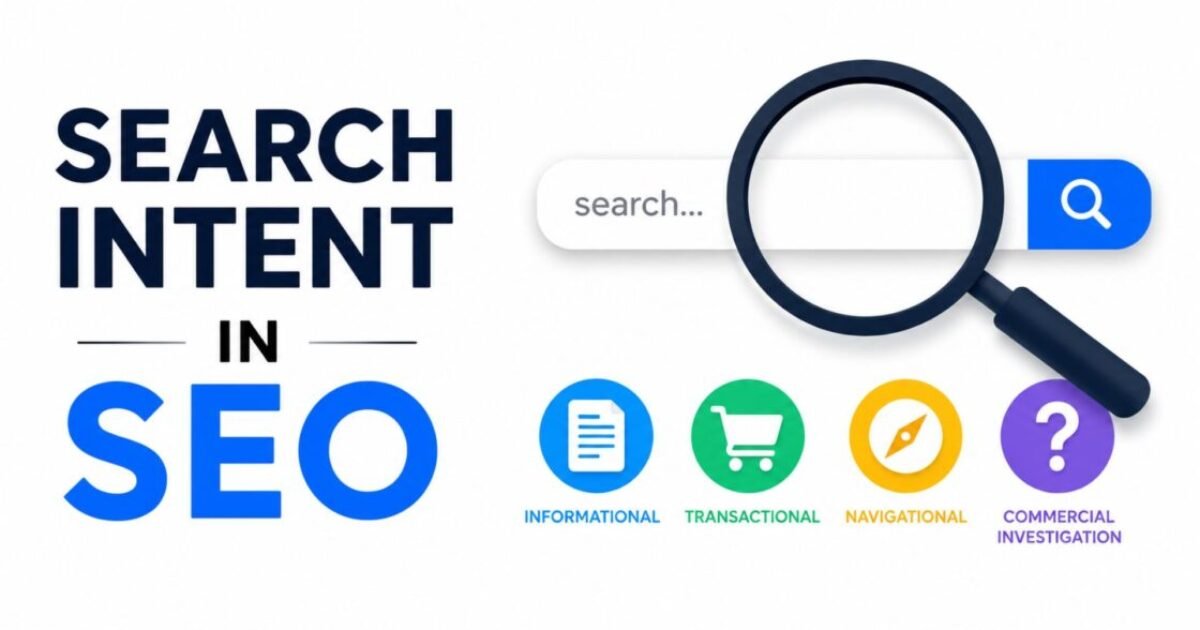
Search Intent in SEO — The Complete Guide to All 4 Types (2026)
Sources: Google Search documentation, Moz, Ahrefs, Semrush industry research, Peplio analysis 2026
Search intent in SEO is the real reason behind every search query — what the person actually wants to accomplish, not just the words they typed. Search intent in SEO is why two pages can target the exact same keyword and one ranks on page one while the other sits on page five doing nothing useful for anyone.
If your content does not match the search intent in SEO terms, Google will not rank it. Not because your writing is bad, not because your backlinks are weak — because you answered the wrong question for that searcher. This is one of the most important ideas in modern SEO, and most beginners never hear about it until they have spent months wondering why a perfectly optimised post refuses to move.
In this guide, I will break down the 4 types of search intent in SEO, show you real examples of each, and walk you through exactly how to match your content to the right intent before you write a single word. If you are new to SEO and want to understand the full picture first, read my guide on what SEO is and why it matters before continuing here.
- What is search intent in SEO?
- The 4 types of search intent in SEO explained
- Informational intent
- Navigational intent
- Commercial investigation intent
- Transactional intent
- How to identify search intent for any keyword
- Search intent mismatch — the most common reason pages fail
- How search intent in SEO connects to keyword research
- Search intent in SEO in 2026 — what AI search changes
- FAQ
What Is Search Intent in SEO?
Search intent in SEO — also called user intent or keyword intent — is the goal behind a search query. When someone types something into Google, they are not just looking for words that match. They are trying to accomplish something specific: learn something, find a website, compare options, or buy something right now.
Google has spent years getting extremely good at understanding that goal. According to Google’s own Search documentation, the search engine evaluates whether content actually satisfies the underlying need behind a query — not just whether the keywords appear. It reads the query, looks at the context, and decides what type of content would truly satisfy that searcher. Then it ranks pages that deliver exactly that.
This is why your content can be well-written, properly structured, and full of the right keywords — and still fail to rank. If it is the wrong type of content for the query, Google will filter it out. A service page will not rank for a “how to” keyword. A blog post will not rank for a “buy now” keyword. The format has to match the search intent in SEO terms.
Understanding search intent in SEO is also one of the fastest ways to fix pages that are stuck. Before you spend weeks building backlinks or rewriting paragraphs, check whether your content type is even correct for the keyword. If there is a search intent mismatch, that is your real problem — and fixing it is much faster than any other SEO work you could do.
The 4 Types of Search Intent in SEO Explained
Search intent in SEO is divided into four recognised categories. Every keyword you target falls into one of these — and knowing which one tells you the format, depth, word count, and style of the content you need to create. Get this wrong and no amount of on-page optimisation will fix the ranking. Semrush’s search intent guide and Moz’s user intent overview both confirm these four categories as the industry standard framework used across professional SEO.
1. Informational Intent
Informational search intent in SEO means the person wants to learn something. They have a question and they want an answer. They are not ready to buy anything and they are not looking for a specific site — they want to understand something better.
Informational queries are the most common type of search on the internet — estimated to make up over 80% of all searches globally. They are usually phrased as questions or broad topic searches, and they dominate AI Overviews, People Also Ask boxes, and featured snippets in the SERP.
Examples of informational search intent in SEO:
- what is search intent in seo
- how does keyword research work
- why is my website not ranking on google
- what are backlinks and why do they matter
- how long does seo take to show results
What content works for informational search intent: Educational articles, comprehensive guides, explainers, how-to posts, and FAQ pages. The goal is to answer the question clearly and completely. Structure matters here — use H2 and H3 headings, short paragraphs, and direct answers at the top because Google frequently pulls informational content into AI Overviews and featured snippets.
The mistake to avoid: Publishing a sales page or product comparison for an informational search intent keyword. If someone searches “what is on-page SEO”, they want an explanation — not a pitch. Pushing a sales message at an informational searcher is a classic search intent mismatch and Google will not rank it well regardless of how optimised the page is.
2. Navigational Intent
Navigational search intent in SEO means the person already knows where they want to go. They are using Google as a shortcut to reach a specific website or page — not to discover new information or compare options.
These searchers have already decided on their destination. The search engine is simply faster than typing a full URL or digging through bookmarks.
Examples of navigational search intent in SEO:
- google search console login
- peplio free ai tools
- semrush pricing page
- ahrefs keyword explorer
- canva sign in
What content works for navigational search intent: For your own brand terms, make sure your homepage and key pages rank first for their own names. For competitor brand terms, you can sometimes appear with a comparison article — but navigational search intent keywords generally do not convert well for third parties because the searcher is going somewhere specific and does not want a detour.
Practical note: Navigational search intent in SEO tells you whether your site is strong enough to own its own brand terms in Google. If your homepage is not ranking #1 for your own brand name, that is a domain authority or technical problem worth fixing before anything else.
3. Commercial Investigation Intent
Commercial investigation search intent in SEO means the person is in research mode before a purchase or decision. They are comparing options, reading reviews, and figuring out which product, service, or tool best fits their situation. They are not ready to buy right now — but they are getting very close.
This is one of the most valuable search intent types in SEO for content creators and affiliate marketers because these searchers are high-value and near conversion. A well-built comparison article captures them at exactly the right moment.
Examples of commercial investigation search intent in SEO:
- best free ai image generator no login
- semrush vs ahrefs which is better
- best seo tools for beginners 2026
- free midjourney alternatives compared
- rank math vs yoast seo plugin
What content works for commercial investigation search intent: Comparison articles, honest review roundups, side-by-side tables, “best X” lists with a clear verdict. The searcher needs help making a decision — your content should actively help them make it. Include pros, cons, pricing, and a specific recommendation. Leaving them with “it depends” is a missed opportunity.
The mistake to avoid: Writing a purely informational article for a commercial investigation search intent keyword. If someone searches “best free AI image generator”, they do not want the history of AI image technology — they want a ranked list and a top pick. Give them exactly that, matched to this search intent.
4. Transactional Intent
Transactional search intent in SEO means the person is ready to act right now. They want to use a tool, make a purchase, sign up for something, or download something immediately. The decision is already made — they just need to complete the action.
Transactional search intent keywords carry the highest commercial value because the searcher is at the very bottom of the funnel. In paid advertising, these keywords cost the most per click for exactly this reason. In organic SEO, they drive the highest conversion rates.
Examples of transactional search intent in SEO:
- free ai image generator without login
- ai background remover free no sign up
- ai headshot generator free
- sign up semrush free trial
- canva free download for pc
What content works for transactional search intent: Tool pages, landing pages, free-resource pages, and sign-up pages. Content should get out of the way quickly and let the person do what they came to do. Minimal friction, a clear and visible call to action, and fast page load time. Long introductions kill conversions on transactional search intent pages — the tool or action should appear at the top.
How to Identify Search Intent in SEO for Any Keyword
The most reliable method to identify search intent in SEO is simple: search the keyword yourself and read the top 5 results. Google has already decided the intent for that query — the SERP is showing you exactly what it rewards. If the top results are all how-to guides, write a how-to guide. If they are all comparison lists, write a comparison list. Do not fight the SERP.
Do not try to guess search intent in SEO from the keyword alone. Some keywords look informational but Google ranks transactional content for them. Some look commercial but are dominated by educational articles. The live SERP is the only reliable signal — your intuition is not. Ahrefs confirms this in their search intent research: the top results are the ground truth for intent classification.
A quick SERP analysis checklist for identifying search intent in SEO before writing:
- What content format dominates the top 5 results? (guides, lists, reviews, tool pages, product pages)
- What is the approximate word count of ranking pages for this search intent?
- Are there featured snippets, People Also Ask boxes, or AI Overviews? If yes, format your answer to target those placements.
- What angle do the titles use? (how-to, best X, what is X, free X, X vs Y)
- Is the dominant tone educational, comparison-based, or action-driven?
Match your content to those answers every time. If you build a page that mirrors the format of what is already ranking for that search intent — with more depth, better structure, and more useful detail — you are giving yourself a genuine shot at the top positions.
Search Intent Mismatch — The Most Common Reason Pages Fail to Rank
A search intent mismatch in SEO happens when your content type does not match what the searcher actually wants for that query. According to Semrush’s analysis of ranking factors, search intent alignment is consistently among the top reasons pages either rank well or fail entirely — regardless of backlink count or technical health. It is also the fastest fix available in SEO.
Here are the three most common search intent mismatches in SEO and exactly how to fix each one:
Search intent mismatch 1: A sales page for an informational keyword.
You write a page promoting your services for the keyword “what is technical SEO.” The search intent here is informational — the searcher wants an explanation, not a pitch. Fix: rewrite the page as an educational guide and move any CTA to the bottom as a soft close, not the main focus of the page.
Search intent mismatch 2: A blog post for a transactional keyword.
You write a long article about “free AI image generators” but there is no actual working tool or direct access on the page. The search intent is transactional — they want to use a tool, not read 2,000 words about tools. Fix: embed the tool or add direct links to working free tools at the very top of the page, before any article content starts.
Search intent mismatch 3: A basic overview for a commercial investigation keyword.
You write “what is Semrush?” for the keyword “semrush vs ahrefs.” The search intent is commercial investigation — the searcher wants a side-by-side comparison and a clear verdict, not a product description. Fix: restructure as a proper comparison article with a table and a specific recommendation at the end.
Once you fix a search intent mismatch in SEO, pages can jump multiple positions within weeks — sometimes faster. Before you spend any time on link building or content rewrites, check whether the content type is correct for the search intent behind the keyword. That check takes five minutes and can save months of wasted work.
Once your search intent is matched correctly, run everything else through the on-page SEO checklist to make sure the technical fundamentals are also clean.
How Search Intent in SEO Connects to Keyword Research
Search intent in SEO is not a separate step from keyword research — it is built directly into every keyword you find. If you do keyword research without identifying the search intent behind each keyword, you will end up with a list of topics and no idea what type of content to actually create for them.
The correct process is: find the keyword → identify the search intent in SEO → decide the content format. In that order, every single time. Here is how search intent changes your keyword decisions in practice:
- Informational search intent keywords → educational articles and guides. Great for building topical authority and appearing in AI Overviews and featured snippets across your niche.
- Commercial investigation search intent keywords → comparison and review content. Great for affiliate commissions and capturing high-intent readers who are close to a decision.
- Transactional search intent keywords → tool pages, landing pages, free-resource pages. Great for direct conversions and high-value traffic that engages immediately.
- Navigational search intent keywords → brand and product pages. Essential for owning your own brand terms in Google search results.
A well-built content plan across a topic cluster includes all four search intent types working together. Your pillar page targets informational search intent. Cluster articles mix informational and commercial search intent. Free tool pages target transactional search intent. This is the structure behind every well-ranking site in any competitive niche — and the framework Peplio is building across the AI image, SEO, and GEO content clusters right now.
Read the full guide on keyword research basics to understand how to find and sort keywords by search intent before you write anything.
- Informational search intent: Person wants to learn — write educational guides, explainers, FAQs
- Navigational search intent: Person wants a specific site — optimise your own brand and product pages
- Commercial investigation search intent: Person wants to compare — write comparisons, review roundups, ranked lists
- Transactional search intent: Person wants to act now — tool pages and landing pages with zero friction
- How to identify search intent in SEO: Search the keyword and read the top 5 SERP results — Google already knows
- Fastest SEO fix available: Finding and correcting search intent mismatches on pages that are stuck
Search Intent in SEO in 2026 — What AI Search Changes
The four search intent categories in SEO still hold in 2026 — but AI search engines like ChatGPT, Perplexity, and Google’s AI Overviews are adding a new layer to how search intent in SEO works in practice.
AI search engines pull content into their generated answers based on how closely it matches the search intent and how clearly it is structured. Informational content written in plain, direct language — with headers, definitions, and short factual answers near the top — gets cited more often. Content that buries the answer deep in background paragraphs tends to get skipped entirely, regardless of how well it matches search intent in SEO on paper.
According to Google’s guidance on AI Overviews, content that clearly answers the question at the top of the page — before expanding into detail — is most likely to be pulled into AI-generated summaries. This is search intent in SEO applied at a content structure level, not just a keyword level.
In practical terms, search intent in SEO now shapes both what you write and how you structure it:
- For informational search intent: Answer the question in the first paragraph, then expand. Do not save the answer for the conclusion.
- For commercial investigation search intent: Use comparison tables and explicit verdicts. AI engines cite structured comparisons more often than paragraph-based opinions.
- For transactional search intent: Make the action obvious immediately above the fold. AI engines will not summarise your CTA — the searcher needs to see it the moment they land on the page.
Search intent in SEO was already the most important on-page concept in traditional Google ranking. In the AI search era, it matters even more — because AI engines are applying search intent matching at a deeper semantic level than keyword matching ever reached. A page that perfectly matches search intent in SEO and structures its answer clearly now earns two advantages simultaneously: ranking in traditional Google results and being cited inside AI-generated search answers.
Frequently Asked Questions About Search Intent in SEO
What is search intent in SEO?
Search intent in SEO is the goal behind a search query — what the person actually wants to find or accomplish, not just the words they typed. Google uses search intent in SEO to decide which type of content to rank for each keyword. If your content type does not match the search intent, it will not rank consistently regardless of how well optimised it is otherwise.
What are the 4 types of search intent in SEO?
The 4 types of search intent in SEO are: informational (want to learn something), navigational (want to find a specific website), commercial investigation (want to compare options before deciding), and transactional (want to take action right now). Every keyword you target falls into one of these four search intent categories, and that determines the correct content format to create.
Why does search intent in SEO matter for rankings?
Because Google ranks content that matches what the searcher actually wants — not just content that contains the right keywords. If you create the wrong content type for a keyword’s search intent in SEO, Google will not rank it well regardless of writing quality or technical optimisation. Search intent in SEO is the foundation that everything else builds on.
How do I identify search intent in SEO for a keyword?
Search the keyword in Google and look at the top 5 results. The content format that dominates those results tells you what search intent in SEO Google has assigned to that keyword. Match your content type to what is already ranking — then make yours more detailed and better structured. Never assume search intent in SEO from the keyword wording alone.
What is a search intent mismatch in SEO?
A search intent mismatch in SEO is when your content type does not match the goal behind a search query. For example, publishing a sales page for a keyword where the search intent is clearly informational. Search intent mismatches are the single most common reason pages fail to rank despite clean technical SEO and good writing quality.
Can one page target multiple search intent types in SEO?
Sometimes, but it is risky. Most keywords have one dominant search intent in SEO that Google is rewarding. If you try to split a page across two search intent types, it usually satisfies neither well. Identify the primary search intent in SEO and build the entire page around that — then add secondary elements carefully so they do not dilute the main purpose.
Does search intent in SEO change over time?
Yes. As search behaviour evolves, Google’s interpretation of search intent in SEO for specific keywords can shift. A keyword that used to trigger informational results may start triggering commercial results as searcher expectations change. Check the SERP for your most important keywords every few months to make sure your content type is still aligned with the current search intent in SEO that Google is rewarding.


