CiteScore checks whether AI answer engines like ChatGPT, Perplexity and Google AI Overviews can find, read and cite your website. The free checker at citescore.vercel.app/free-check needs no signup: paste a URL to see AI crawler access in robots.txt, llms.txt, structured data, and the content signals that make a page quotable, with concrete fixes. It also offers free llms.txt, robots.txt AI-crawler and FAQ schema generators. For a deeper review there is an optional paid GEO audit. Built for bloggers, marketers and small business owners who want their pages cited in AI search.
Generative engine optimization (GEO) is how you get your website cited inside AI answers from Google AI Overviews, AI Mode, ChatGPT, Gemini and Perplexity. This generative engine optimization guide uses real research, Google’s own rules and free tools you can use today.
By Sougan Kumar Mandi, founder of Peplio and Digital Marketing Executive at Demech Chemical Products Last updated: October 29, 2026 · Next update: Monday, November 2, 2026 · Updated every Monday
Quick Answer
Generative engine optimization (GEO) means making your content easy for AI search tools like Google AI Overviews, AI Mode, ChatGPT, Gemini and Perplexity to find, trust and cite. The research that named GEO found that adding quotations, statistics and source citations can raise visibility in AI answers by up to 40%, while keyword stuffing hurts. Google says no special files or markup are needed: strong SEO plus unique, useful content is the base. Use the free checker, calculator and llms.txt generator below to start generative engine optimization today.
Here is a real number from my own site. Peplio’s Google Search Console shows 883 impressions for “generative engine optimization” and zero clicks, and Semrush counts 9 Peplio pages cited by ChatGPT but none by Google’s AI Overviews. That gap is exactly what generative engine optimization is about. This page is a living hub: every Monday I add what changed in AI search, and the update log at the bottom shows what is new. Everything here is tested on Peplio first.
AI Search PulseUPDATED WEEKLY · Week of Oct 26, 2026
Oct 15, 2026
Google adds 5 link changes to AI Mode and AI Overviews
Inline links appear higher, end-of-answer links get thumbnails, timely news carousels expand, and Google is testing an “official sites” section and clickable creator names.
For you: clear titles, a strong featured image and an obvious author name now matter inside AI answers too.
Generative engine optimization is the practice of shaping your content so AI search engines use it and cite it when they write answers. Classic SEO wins you a blue link. GEO wins you a mention or a source link inside the AI answer itself. The term comes from a 2023 research paper by Princeton University and IIT Delhi researchers, presented at KDD 2024.
SEO
AEO
GEO
Goal
Rank in search results
Be the direct answer (snippets, voice)
Be cited inside AI-written answers
Where
Google, Bing results
Featured snippets, People Also Ask
AI Overviews, AI Mode, ChatGPT, Gemini, Perplexity, Copilot
What Actually Works in Generative Engine Optimization
There is a lot of GEO noise online. Here is what two strong sources say: the original GEO study, and Google’s own May 2026 guide for AI features in Search.
Tactic
Verdict
Evidence
Add quotations from real people
Works
Best method in the GEO study, about 41% above baseline
Add statistics with numbers
Works
Strong lift in the GEO study
Cite your sources
Works
Strong lift in the GEO study
Unique, non-commodity content
Works
Google calls this the most important factor over time
Crawlable, indexable, fast pages
Required
Google: AI features use the same Search index
Keyword stuffing
Hurts
Lowered visibility below baseline in the GEO study
llms.txt file
Not needed for Google
Google says no AI text files are needed; some other AI tools read it
Chopping pages into tiny chunks
Not needed
Google says its systems handle full pages
Special “AI schema”
Not needed
Google says no special schema exists for AI features
AI Search Readiness Checker: Score Your Site in 1 Minute
Tick everything that is true for your website. You get a score and your top 3 fixes. Your answers are saved in your browser.
Crawlable: Googlebot and Bingbot are not blocked in robots.txt
Indexed: your key pages show as indexed in Search Console
Answer first: every article opens with a short, direct answer
Statistics: pages include real numbers with dates
Quotations: pages quote real people or experts
Sources: claims link to original sources
Unique: you publish data, tests or experience nobody else has
Author: real author name, bio and last-updated date are visible
Mentions: other trusted sites mention your brand
Tracking: you track AI referrals in GA4 and citations in Bing
Tick the boxes to see your score.
AI Overview Click-Loss Calculator
How many clicks could AI summaries cost you? The defaults come from Pew Research’s study of real Google searches (March 2025, US users): AI summaries appeared on 18% of searches, and people clicked a result 8% of the time with a summary versus 15% without. Change them to fit your niche.
Full explainer: what an llms.txt file is. Google says you do not need llms.txt for its AI features. Some other AI tools and agents do read it, and it takes two minutes, so here is a generator. Write one page per line as Title | URL.
2. See AI traffic in Google Analytics 4
In GA4, go to Admin, then Channel groups, then create a new channel called “AI Search” where Session source matches this regex, and place it above Referral:
Pay for “AI ranking” tools that promise guaranteed citations
Do
Write naturally and answer the question first
Earn real mentions on trusted sites
Build deep pages with data, quotes and sources
Test prompts yourself every month for free
Sougan’s Take
Generative engine optimization is not a new trick. It is SEO plus proof.
Peplio’s own numbers show the gap clearly: Semrush counts 9 pages cited by ChatGPT but none by Google’s AI Overviews or AI Mode, and “generative engine optimization” brought 883 impressions with zero clicks. So I am doing exactly what this hub tells you: answer first, add real numbers and sources, publish things only Peplio has, and test prompts every month. I will post my own before and after numbers in the update log.
AI Referral Traffic Data (Benchmark Table)
How big is AI traffic really? These are the best public numbers so far. They are estimates from single vendors, not audited figures.
October 29, 2026: Hub launched with the AI Search Pulse, readiness checker, click-loss calculator, 12-step checklist, llms.txt generator, GA4 AI channel regex, test prompts, CSV export, benchmark table, 3 templates and 3 infographics.
When the bakery’s website slowed down in Episode 9: Jab Speed Ruki, Mitu and Seema learned that technical basics come first. Generative engine optimization starts the same way: no crawl, no citation.
Learn marketing the fun way
Peplio’s comic stories teach SEO and AI search through a bakery that learns everything the hard way. Start with the comic stories or grab the comic eBooks.
Summary
Generative engine optimization helps your content get cited inside AI answers.
The GEO study found quotations, statistics and cited sources lift visibility by up to 40%; keyword stuffing hurts.
Google says no llms.txt, chunking or special schema is needed: strong SEO plus unique content is the base.
AI summaries cut clicks from 15% to 8% in Pew’s study, so citations inside answers matter.
Track AI traffic in GA4, citations in Bing Webmaster Tools, and test prompts monthly.
People Also Asked
Is generative engine optimization replacing SEO?
No. Google says its AI features pull from the same Search index, so SEO is the foundation and GEO builds on it. Start with our SEO basics guide.
How do I get cited in Google AI Overviews?
Be indexed and snippet-eligible, answer the question clearly, and offer unique facts with sources. See our guide on optimizing content for AI Overviews.
Can I turn off AI answers for my site?
You can limit snippets with nosnippet or max-snippet, but that also limits normal results. Readers can hide AI Mode for themselves: how to turn off AI Mode.
FAQ About Generative Engine Optimization
What is generative engine optimization?
Generative engine optimization (GEO) is making your content easy for AI search tools like Google AI Overviews, ChatGPT, Gemini and Perplexity to find, trust and cite in their answers.
Who invented the term GEO?
Researchers from Princeton University and IIT Delhi introduced it in the 2023 paper “GEO: Generative Engine Optimization,” presented at KDD 2024.
What works best for generative engine optimization?
In the original study, adding quotations, statistics and source citations raised visibility the most, by up to 40%. Keyword stuffing lowered it.
Do I need an llms.txt file?
Not for Google. Google says no AI text files are needed for AI Overviews or AI Mode. Some other AI tools and agents read llms.txt, so it is an optional extra.
How do I track AI search traffic?
Create an “AI Search” channel in GA4 using a source regex for ChatGPT, Perplexity, Gemini, Copilot and Claude, and check citations in Bing Webmaster Tools’ AI Performance report.
How long does generative engine optimization take?
It varies. Fixing technical basics and adding clear answers can help as soon as pages are recrawled, while building brand trust across AI answers takes months of consistent, unique content. Test your prompts monthly to see progress.
Data sources and transparency
Fact check: the 40% lift and method results come from the GEO paper itself (arXiv, KDD 2024). Google’s position comes from its own documentation and the May 15, 2026 guide (confirmed by two independent reports). Pew numbers via Search Engine Roundtable. Traffic shares from SE Ranking and Similarweb via Digital Applied, which are single-vendor estimates.
All data as of October 29, 2026. Peplio is not affiliated with Google, OpenAI, Microsoft or any source listed and receives no commission. Peplio’s own numbers come from its Google Search Console and Semrush.
Generative engine optimization is not a replacement for SEO. Google says its AI features pull pages from the same Search index, so generative engine optimization starts with pages that are crawlable, indexed and fast. Once that base is ready, generative engine optimization is about making your pages the easiest and most trustworthy source for an AI to quote.
The research behind generative engine optimization is clear. In the original GEO study, adding quotations, statistics and source citations raised visibility in AI answers by up to 40%, while keyword stuffing lowered it. So the best generative engine optimization strategy is simple: answer the question first, back it with real numbers, quote real people and link the original sources.
Measure your generative engine optimization work every month. Create an AI Search channel in GA4, check citations in Bing Webmaster Tools, and test your key prompts in ChatGPT, Gemini and Perplexity. If you are a small business or a blogger, generative engine optimization gives you a fair chance, because AI answers reward unique, useful pages over big brand budgets.
Bookmark this generative engine optimization hub. It is updated every Monday with the latest AI search changes, so your generative engine optimization plan always matches how Google, ChatGPT and Perplexity work today.

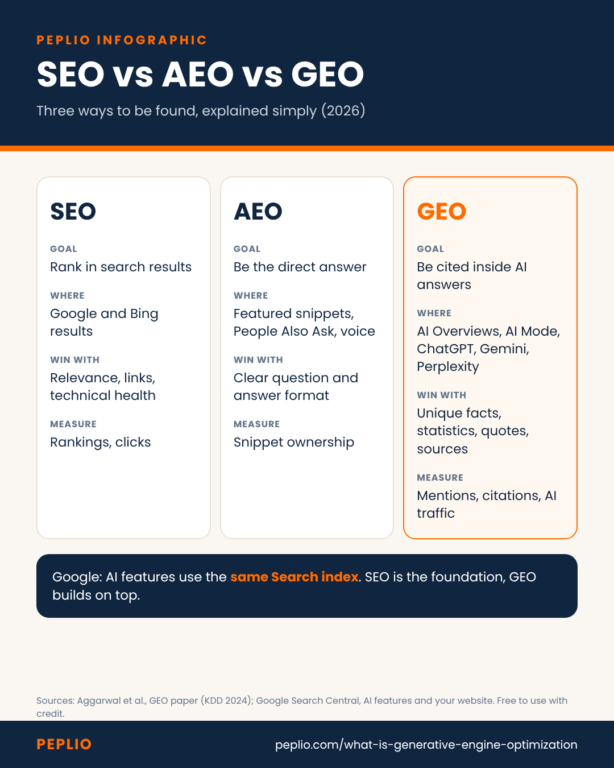 SEO vs AEO vs GEO at a glance. Free to use on your site, slides or social posts with credit.
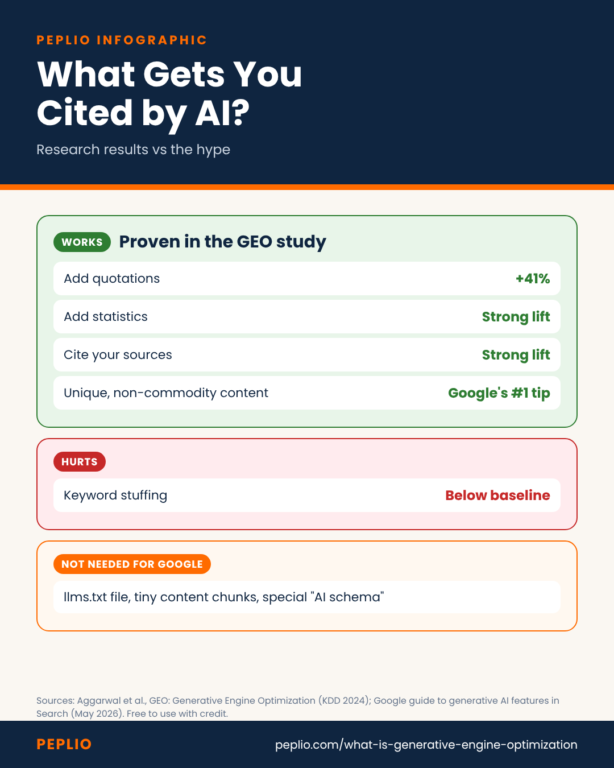 What really gets you cited by AI. Free to use on your site, slides or social posts with credit.
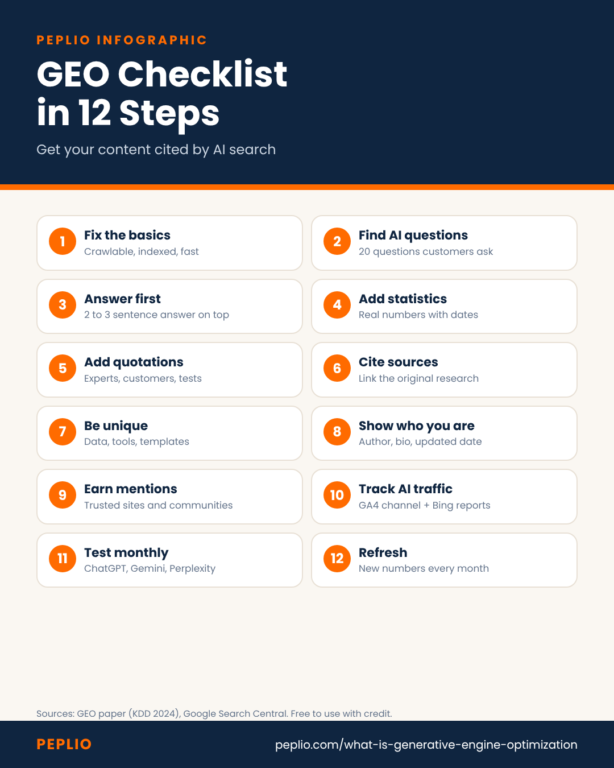 GEO checklist in 12 steps. Free to use on your site, slides or social posts with credit.


