
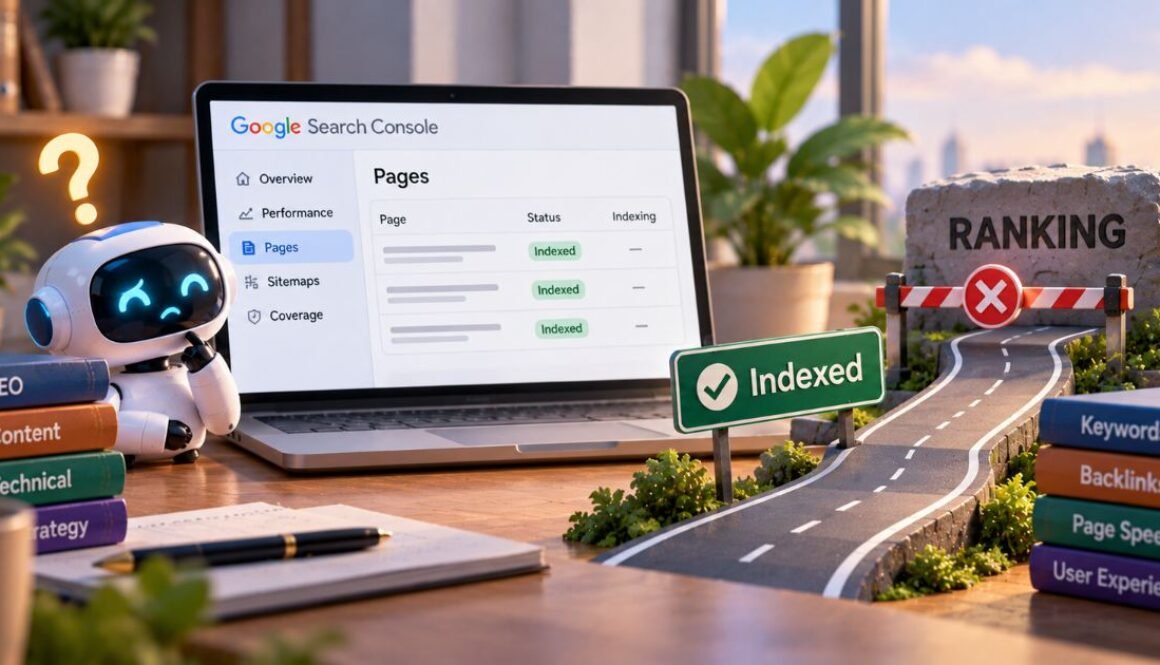
Why Google Indexed My Page but Not Ranking It? Brutal Truths for 2026
Founder, Peplio · Digital Marketing Executive, Demech Chemical Products · Last updated: October 2026 — Written from repeated personal experience of Google indexing Peplio pages and then not ranking them for weeks
- Indexing is not approval — it is permission to be evaluated. Google indexed your page but not ranking it means the evaluation has not yet produced a confident query match
- The 6 real reasons: no competitive differentiation, wrong search intent match, zero user signals, no internal linking context, thin E-E-A-T signals, and content that explains rather than decides
- The most common fix: rewrite only the first 300 words to directly match the emotional state of someone searching that query — that is where ranking movement usually starts
- Do NOT delete indexed but non-ranking pages — update them. Add context, improve intent match, add internal links, add personal experience
- Indexing equals crawl and store. Ranking equals trust and usefulness. Trust requires signals that accumulate over time — you cannot shortcut it, only accelerate it
- Google doesn’t rank new pages. It ranks new signals — your job is to reduce uncertainty for Google, not to publish more content
When I first saw a Peplio page marked as indexed in Google Search Console, I felt genuine relief. I thought: Google accepted my page. Ranking is just a matter of time now. Then days passed. Then weeks. No impressions. No clicks. Not even my own page appearing when I searched the exact title. That experience — Google indexed my page but not ranking it — happened not once but repeatedly across different Peplio articles. Each time it happened, I resisted the standard advice (“just wait,” “build backlinks,” “publish more”) and instead started observing what was actually different between pages that ranked and pages that stayed invisible despite being indexed. This article documents what I found — six real reasons based on actual Peplio experiments, not SEO theory.
- Indexing vs ranking — why they are completely different things
- Peplio experiments — what I tested and what failed
- The 6 real reasons Google indexed your page but not ranking it
- What to fix first — the exact process I now use at Peplio
- What NOT to do when your page is indexed but not ranking
- Sougan’s Take
- FAQ
Indexing vs Ranking — Why They Are Completely Different Things
The most important mindset shift I made after facing this problem repeatedly: indexing is not approval. It is permission to be evaluated. This single reframing changed my entire approach to the problem of Google indexed my page but not ranking it. Once I accepted this, I stopped asking “why am I not ranking?” and started asking “what signal am I missing?” — and that is where the actual answers were.
According to Google’s official Search Central documentation, the search process has three distinct stages: crawling (Google discovers your page), indexing (Google stores and categorises your content), and ranking (Google decides which indexed pages to show for which queries). A page can complete stage one and two without ever making meaningful progress in stage three. Indexing means Google has read, understood, and stored your page. Ranking means Google has decided your page is more useful than competing pages for a specific query — which requires a completely different set of signals.
The simplest way to remember this: indexing equals crawl and store. Ranking equals trust and usefulness. Trust requires signals that accumulate over time — internal links from related pages, user engagement metrics, E-E-A-T signals that demonstrate genuine expertise, and search intent alignment that tells Google your page satisfies what the searcher actually needed. When Google indexed my page but not ranking it happens, the problem is almost never at the crawl or index stage. It is always at the trust and usefulness evaluation stage. Read the complete guide on how SEO works for the full three-stage breakdown.
Peplio Experiments — What I Tested and What Failed
Experiment 1 — Does indexing alone bring impressions?
Goal: Understand if indexing alone brings any impressions over 14 days. Action: Published a 3,000-word article, confirmed it indexed within 24 hours, then did nothing else — no internal links, no updates, no promotion. Result after 14 days: Indexed yes, impressions zero, clicks zero. Lesson: Indexing alone produces nothing. Google needs competitive signals to decide when and where to show the page. Stop treating indexing as a ranking signal — it is not.
Experiment 2 — Does adding internal links and rewriting the intro help?
Goal: Test whether internal linking context and search intent alignment moves indexed pages toward ranking. Action: Added internal links from 3 older Peplio articles using relevant anchor text. Rewrote the first 200 words to directly address the search intent behind the query rather than opening with general context. Added a “why this matters” section addressing the specific frustration the reader was feeling. Result after 21 days: Impressions slowly appeared — very low volume, but visible for the first time. Still no stable ranking position. Lesson: Internal linking and intent alignment produced the first signal movement. But search intent match was still incomplete — the article was still explaining the topic rather than directly addressing the reader’s confusion.
Experiment 3 — Does rewriting for search emotion produce faster movement?
Goal: Test whether rewriting the opening 300 words to match the emotional state of the searcher — confused, frustrated, doubting — produces faster impression growth than structural SEO changes alone. Action: Rewrote just the first 300 words of a different indexed non-ranking article to directly acknowledge the reader’s frustration and confusion in the first paragraph, added one block of real Peplio experience, and resubmitted to Search Console. Result: Impressions appeared within 12 days, faster than any previous experiment. Lesson: Google increasingly prefers content that demonstrates genuine understanding of the searcher’s emotional state — not just the technical topic. This is the E-E-A-T “Experience” signal applied to understanding the reader, not just the subject.
The 6 Real Reasons Google Indexed Your Page But Not Ranking It
Reason 1 — Your page has no competitive differentiation. Google indexes billions of pages. Ranking is comparative — Google is deciding which indexed page best answers a specific query, not whether any single page deserves to rank. If your article covers the same topic with the same angle and the same structure as every other page already ranking, Google has no reason to surface yours over theirs. This is the most common reason for the Google indexed my page but not ranking it problem. The fix is not better SEO optimisation of the same content — it is finding a genuine angle that existing results do not cover. At Peplio, this meant switching from “here are the reasons pages don’t rank” to “here is what I specifically tested on Peplio, what failed, and what changed.” The specificity of real experience is what creates the competitive differentiation.
Reason 2 — Wrong search intent match. Google categorises every query by intent type — informational (what, how, why), navigational (brand), commercial (best, reviews), transactional (buy, get). If your content type does not match the dominant intent pattern for your target query, it will not rank regardless of technical quality. For the query “google indexed my page but not ranking,” searchers are confused and frustrated — they want to understand why and what to do about it, in plain language from someone who has experienced it. A technically optimised article that reads like an SEO checklist does not match this intent. An article that opens with the exact emotional experience of seeing indexed but zero impressions matches it precisely.
Reason 3 — Zero user signals. As a new blogger or new article, there are no brand searches for your page, no return visitors, no engagement data. Google has nothing to validate whether your page satisfied the searcher’s need. According to Ahrefs’ ranking factors research, user engagement signals including click-through rate, dwell time, and return visits influence ranking position especially for pages without established authority. Without these signals — which can only accumulate after people actually find and engage with your page — Google treats the page as unproven. This is why the first impressions from a non-ranking indexed page are so important: they are the beginning of the signal accumulation that eventually produces stable ranking.
Reason 4 — No internal linking context. Orphan pages — pages with no internal links pointing to them from other pages on your site — are treated as low priority by Google’s crawl and evaluation systems. Internal links do three things: they signal which pages on your site are important, they pass authority from established pages to newer ones, and they tell Google how the page relates to other content on the site. A well-written article with no internal links pointing to it is like a great shop in a location nobody knows exists. The on-page SEO checklist makes internal linking a mandatory step before publishing any article — precisely because the absence of internal links is one of the most common and most easily fixable causes of the indexed-but-not-ranking problem.
Reason 5 — Thin E-E-A-T signals. Google’s E-E-A-T framework — Experience, Expertise, Authoritativeness, Trustworthiness — evaluates whether content demonstrates genuine expertise from someone who actually knows the subject from real experience. An article about “why pages don’t rank” written without any specific examples from real indexed pages the author managed, without named statistics from cited sources, and without a visible named author provides very weak E-E-A-T signals. Google’s December 2025 Core Update specifically targeted thin E-E-A-T content — pages that discuss topics without demonstrating real first-hand knowledge of them. This is why adding one block of real Peplio experience to an indexed non-ranking article produced faster impression movement than structural SEO changes alone.
Reason 6 — Content that explains rather than decides. Many indexed pages fail because they only explain — they present information about a topic without helping the reader make a decision or take a specific action. The query “google indexed my page but not ranking it” comes from someone who needs to make a decision: what do I change, in what order, starting where? An article that explains what indexing is and what ranking is without clearly telling the reader what to do next addresses the topic but does not satisfy the need. Google increasingly rewards content that helps users complete their task, not just understand the topic. The shift from explanatory to decisional content — from “here are the concepts” to “here is exactly what to do first” — is often the missing piece for indexed non-ranking pages in competitive niches.
What to Fix First — The Exact Process I Now Use at Peplio
When I identify a Peplio page that is indexed but not ranking or showing very low impressions, I now follow a specific sequence. This sequence is based on what produced the fastest signal movement across multiple experiments — not on generic SEO advice.
The sequence matters. Fixing the emotional resonance of the opening comes before structural SEO changes because it is the most direct way to improve search intent alignment — and search intent alignment is what Google evaluates first when deciding whether to rank a page. Use the free AEO Checker to verify that updated content has the structured signals Google needs before resubmitting.
What NOT to Do When Your Page Is Indexed But Not Ranking
| Common Mistake | Why It Does Not Work | What to Do Instead |
|---|---|---|
| Delete the non-ranking page | Loses any existing signals and crawl history — the page may be building toward ranking without visible impressions yet | Update it — add context, improve intent match, add internal links |
| Publish more content on the same topic | Creates keyword cannibalization — multiple pages compete against each other and split whatever authority signals exist | Consolidate — update the existing page rather than creating a competing one |
| Keep requesting indexing repeatedly | Reindexing the same unchanged content produces the same result — Google evaluates content quality, not how many times you submitted it | Make a genuine content change first, then resubmit once |
| Wait passively without changes | Some pages do eventually rank through patience alone — but only when the content is genuinely competitive. Most indexed non-ranking pages need active signal improvement | Follow the four-step fix sequence above — do not wait more than 30 days without making at least one targeted change |
| Add keywords to try to force ranking | Keyword presence is not the ranking problem for indexed pages — competitive differentiation and trust signals are | Focus on search intent alignment and E-E-A-T signals rather than keyword density |
If Google indexed your page but not ranking it, you are not rejected. You are unproven. And unproven is fixable — but only by adding the signals Google is missing, not by waiting for them to appear on their own.
I faced this problem on Peplio more times than I can count. The most frustrating version was when I could see in Search Console that Google had crawled and indexed a page I was genuinely proud of — and then watched it sit at zero impressions for 6 weeks. The temptation was to delete it and start over. The correct action was to ask what signal was missing. Almost every time the answer was the same: the page was well-written but it was not demonstrating genuine experience, it was not internally linked from related Peplio articles, and the opening paragraph was explaining the topic rather than acknowledging the emotion of the person searching it.
Fixing those three things — emotional opening, internal linking, and one real Peplio experience block — produced the first impression movement in every case. The lesson I now apply to every indexed non-ranking page: Google doesn’t rank new pages, it ranks new signals. Your job is to reduce uncertainty for Google, not to publish more content. Every update that adds a genuine signal — internal link, personal experience, FAQ schema, updated statistics — is more valuable than a new article that adds another orphan page to the site.
Mitu’s bakery website is indexed and getting zero visitors — Episode 9 shows exactly what to fix and why
Follow India’s first Digital Marketing Comic Universe — where every real SEO lesson comes to life through story.
Read the Comics Get the eBooks- Indexing is permission to be evaluated — not approval to rank. These are completely different stages
- The 6 real reasons: no competitive differentiation, wrong intent match, zero user signals, no internal links, thin E-E-A-T, explanatory not decisional content
- Peplio Experiment 1: indexed in 24 hours, zero impressions after 14 days with no changes made
- Peplio Experiment 2: internal links plus intent rewrite produced first impressions after 21 days
- Peplio Experiment 3: rewriting first 300 words for search emotion produced impressions within 12 days
- Fix sequence: emotional opening rewrite, real experience block, internal links, FAQ schema, resubmit
- Never delete indexed non-ranking pages — always update them with targeted signal improvements
- Google doesn’t rank new pages — it ranks new signals. Your job is to reduce uncertainty, not publish more
Why are my pages indexed but showing zero impressions in Search Console?
Zero impressions after indexing means Google has not yet found a confident query match for your page — it has not decided which searches your page should appear for, or it has decided competing pages satisfy those searches better. The most common causes are no competitive differentiation from existing results, wrong search intent alignment, and no internal linking context from related pages. The fastest fix is rewriting the first 300 words to directly match the emotional state of the searcher, adding one block of real personal experience, and adding internal links from 2 to 3 related articles.
Should I delete indexed pages that are not ranking?
No — never delete indexed non-ranking pages unless the content is completely off-topic for your site. Deleting loses whatever crawl history and minimal signals have accumulated. The correct approach is to update: improve search intent alignment, add internal links from related pages, add personal experience blocks, and add FAQ schema. Updated content often starts gaining impressions within 2 to 4 weeks of meaningful changes. Deleting and rewriting from scratch wastes the crawl history and resets the evaluation entirely.
How long should I wait before updating an indexed but non-ranking page?
Do not wait more than 30 days without at least one targeted change. If a page has been indexed for 30 days with zero impressions, it needs active signal improvement — not more patience. Check Search Console for the specific coverage status, verify the page has internal links pointing to it, and make at least one meaningful content change before resubmitting. Pages that gain any impressions within 30 days should be given more time — impressions indicate Google is evaluating the page, even if ranking position is not yet visible.
Frequently Asked Questions — Google Indexed My Page But Not Ranking It
What is the difference between indexing and ranking?
Indexing means Google has crawled, read, understood, and stored your page in its database — it is available to appear in search results. Ranking means Google has decided your page is more useful than competing indexed pages for a specific query and has assigned it a position in the search results. A page can be indexed without ranking for any query. Google indexed my page but not ranking it is the normal state for pages that are indexed but have not yet accumulated sufficient trust signals, competitive differentiation, or search intent alignment to earn a ranking position.
Does AI-written content cause the indexed but not ranking problem?
Generic AI-written content causes this problem because it typically lacks the E-E-A-T signals Google rewards — specifically the Experience signal (first-hand knowledge of the topic). AI-written content that is heavily edited to include personal experience, specific real examples, named statistics with sources, and genuine expert insight can rank — the problem is purely AI content without these human experience layers. Google indexed my page but not ranking it is especially common for AI content after the December 2025 Core Update, which specifically targeted pages lacking genuine first-hand expertise.
How important are internal links for getting indexed pages to rank?
Very important — internal links are one of the fastest and most controllable fixes for the Google indexed my page but not ranking it problem. Internal links signal to Google which pages on your site are important, pass authority from established pages to newer ones, and provide context about how the page relates to the rest of your site. In Peplio Experiment 2, adding internal links from 3 related articles was part of what produced the first impression movement after 21 days of zero results. Every indexed page should have at least 2 to 3 internal links pointing to it before waiting for ranking movement.
Is the indexed but not ranking problem worse for new websites?
Yes — new websites have lower domain authority, fewer existing pages to provide internal linking context, and no brand search history. These absences make every ranking evaluation harder because Google has less evidence to trust. Google indexed my page but not ranking it is the normal state for most new website content during the first 3 to 6 months. The solution is the same regardless of domain age: reduce uncertainty by adding the missing signals — internal links, E-E-A-T signals, search intent alignment, and FAQ schema. New sites should focus on low-competition long-tail keywords where these signal improvements can overcome the authority deficit.
What does “Google is testing my page silently” mean?
Google often shows newly indexed pages for a small number of queries at very low positions to observe how users respond — this is called a ranking test or evaluation phase. During this phase, the page may get a few impressions at positions 40 to 100 before either moving up or being deprioritised based on the engagement signals it receives. This explains why some pages show very low impressions for weeks before suddenly appearing at position 15 to 25. It also explains why improving search intent alignment and E-E-A-T signals during this phase is critical — the first impressions during the test phase are when Google is deciding whether to invest in ranking the page further.
Should I keep requesting indexing for non-ranking pages?
Request indexing once after making a meaningful content change — not repeatedly for unchanged content. Google evaluates content quality, not the number of submission requests. If you have made genuine improvements (rewritten introduction for intent match, added personal experience block, added internal links, added FAQ schema), one resubmission is appropriate and will prompt Google to recrawl and re-evaluate the updated content. Submitting without making changes is not harmful but it is also not helpful — the evaluation will produce the same result as before.
- How Does SEO Work — The Complete Crawl, Index, Rank Guide
- On-Page SEO Checklist — 15 Steps Before Every Publish
- Importance of SEO in 2026 — Why It Matters More Than Ever
- How to Write a Blog Post That Ranks and Converts
- AEO vs SEO vs GEO — The Complete 2026 Comparison
- Digital Marketing for Beginners — The Complete Starting Guide
- How to Increase Website Traffic — 9 Strategies That Work
Data sources: Google Search Central — How Search Works, Ahrefs Google Ranking Factors Research, Google Helpful Content Guidelines. Personal experiment data from Peplio Search Console 2025 to 2026. Updated October 2026.
The situation where Google indexed my page but not ranking it is one of the most common and most frustrating experiences for bloggers and small business owners building organic search presence in 2026. When Google indexed my page but not ranking it happens, the natural reaction is to assume the content was rejected — but indexing is not rejection, and Google indexed my page but not ranking it is not a final verdict. It is the beginning of an evaluation process that requires specific signals to complete. The six causes documented from Peplio experiments — no competitive differentiation, wrong intent match, zero user signals, missing internal links, thin E-E-A-T, and explanatory-not-decisional content — cover the vast majority of cases where Google indexed my page but not ranking it persists beyond 30 days.
The most important thing to understand when Google indexed my page but not ranking it: your job is to reduce Google’s uncertainty about your page, not to wait for Google to spontaneously discover its value. Every targeted change that adds a genuine signal — an internal link, a personal experience block, FAQ schema, a rewritten opening that matches search emotion — moves the evaluation forward.
Google indexed my page but not ranking it is fixable in most cases by following the four-step update sequence: emotional opening rewrite, real experience addition, internal link building, and FAQ schema implementation. The pages that stay stuck in the Google indexed my page but not ranking it status permanently are the ones where no targeted signal improvements were ever made — where the response to zero impressions was patience rather than action.
Founder, Peplio · Digital Marketing Executive, Demech Chemical Products · Last updated: October 2026 — Written from repeated personal experience of Google indexing Peplio pages and then not ranking them for weeks
- Indexing is not approval — it is permission to be evaluated. Google indexed your page but not ranking it means the evaluation has not yet produced a confident query match
- The 6 real reasons: no competitive differentiation, wrong search intent match, zero user signals, no internal linking context, thin E-E-A-T signals, and content that explains rather than decides
- The most common fix: rewrite only the first 300 words to directly match the emotional state of someone searching that query — that is where ranking movement usually starts
- Do NOT delete indexed but non-ranking pages — update them. Add context, improve intent match, add internal links, add personal experience
- Indexing equals crawl and store. Ranking equals trust and usefulness. Trust requires signals that accumulate over time — you cannot shortcut it, only accelerate it
- Google doesn’t rank new pages. It ranks new signals — your job is to reduce uncertainty for Google, not to publish more content
When I first saw a Peplio page marked as indexed in Google Search Console, I felt genuine relief. I thought: Google accepted my page. Ranking is just a matter of time now. Then days passed. Then weeks. No impressions. No clicks. Not even my own page appearing when I searched the exact title. That experience — Google indexed my page but not ranking it — happened not once but repeatedly across different Peplio articles. Each time it happened, I resisted the standard advice (“just wait,” “build backlinks,” “publish more”) and instead started observing what was actually different between pages that ranked and pages that stayed invisible despite being indexed. This article documents what I found — six real reasons based on actual Peplio experiments, not SEO theory.
- Indexing vs ranking — why they are completely different things
- Peplio experiments — what I tested and what failed
- The 6 real reasons Google indexed your page but not ranking it
- What to fix first — the exact process I now use at Peplio
- What NOT to do when your page is indexed but not ranking
- Sougan’s Take
- FAQ
Indexing vs Ranking — Why They Are Completely Different Things
The most important mindset shift I made after facing this problem repeatedly: indexing is not approval. It is permission to be evaluated. This single reframing changed my entire approach to the problem of Google indexed my page but not ranking it. Once I accepted this, I stopped asking “why am I not ranking?” and started asking “what signal am I missing?” — and that is where the actual answers were.
According to Google’s official Search Central documentation, the search process has three distinct stages: crawling (Google discovers your page), indexing (Google stores and categorises your content), and ranking (Google decides which indexed pages to show for which queries). A page can complete stage one and two without ever making meaningful progress in stage three. Indexing means Google has read, understood, and stored your page. Ranking means Google has decided your page is more useful than competing pages for a specific query — which requires a completely different set of signals.
The simplest way to remember this: indexing equals crawl and store. Ranking equals trust and usefulness. Trust requires signals that accumulate over time — internal links from related pages, user engagement metrics, E-E-A-T signals that demonstrate genuine expertise, and search intent alignment that tells Google your page satisfies what the searcher actually needed. When Google indexed my page but not ranking it happens, the problem is almost never at the crawl or index stage. It is always at the trust and usefulness evaluation stage. Read the complete guide on how SEO works for the full three-stage breakdown.
Peplio Experiments — What I Tested and What Failed
Experiment 1 — Does indexing alone bring impressions?
Goal: Understand if indexing alone brings any impressions over 14 days. Action: Published a 3,000-word article, confirmed it indexed within 24 hours, then did nothing else — no internal links, no updates, no promotion. Result after 14 days: Indexed yes, impressions zero, clicks zero. Lesson: Indexing alone produces nothing. Google needs competitive signals to decide when and where to show the page. Stop treating indexing as a ranking signal — it is not.
Experiment 2 — Does adding internal links and rewriting the intro help?
Goal: Test whether internal linking context and search intent alignment moves indexed pages toward ranking. Action: Added internal links from 3 older Peplio articles using relevant anchor text. Rewrote the first 200 words to directly address the search intent behind the query rather than opening with general context. Added a “why this matters” section addressing the specific frustration the reader was feeling. Result after 21 days: Impressions slowly appeared — very low volume, but visible for the first time. Still no stable ranking position. Lesson: Internal linking and intent alignment produced the first signal movement. But search intent match was still incomplete — the article was still explaining the topic rather than directly addressing the reader’s confusion.
Experiment 3 — Does rewriting for search emotion produce faster movement?
Goal: Test whether rewriting the opening 300 words to match the emotional state of the searcher — confused, frustrated, doubting — produces faster impression growth than structural SEO changes alone. Action: Rewrote just the first 300 words of a different indexed non-ranking article to directly acknowledge the reader’s frustration and confusion in the first paragraph, added one block of real Peplio experience, and resubmitted to Search Console. Result: Impressions appeared within 12 days, faster than any previous experiment. Lesson: Google increasingly prefers content that demonstrates genuine understanding of the searcher’s emotional state — not just the technical topic. This is the E-E-A-T “Experience” signal applied to understanding the reader, not just the subject.
The 6 Real Reasons Google Indexed Your Page But Not Ranking It
Reason 1 — Your page has no competitive differentiation. Google indexes billions of pages. Ranking is comparative — Google is deciding which indexed page best answers a specific query, not whether any single page deserves to rank. If your article covers the same topic with the same angle and the same structure as every other page already ranking, Google has no reason to surface yours over theirs. This is the most common reason for the Google indexed my page but not ranking it problem. The fix is not better SEO optimisation of the same content — it is finding a genuine angle that existing results do not cover. At Peplio, this meant switching from “here are the reasons pages don’t rank” to “here is what I specifically tested on Peplio, what failed, and what changed.” The specificity of real experience is what creates the competitive differentiation.
Reason 2 — Wrong search intent match. Google categorises every query by intent type — informational (what, how, why), navigational (brand), commercial (best, reviews), transactional (buy, get). If your content type does not match the dominant intent pattern for your target query, it will not rank regardless of technical quality. For the query “google indexed my page but not ranking,” searchers are confused and frustrated — they want to understand why and what to do about it, in plain language from someone who has experienced it. A technically optimised article that reads like an SEO checklist does not match this intent. An article that opens with the exact emotional experience of seeing indexed but zero impressions matches it precisely.
Reason 3 — Zero user signals. As a new blogger or new article, there are no brand searches for your page, no return visitors, no engagement data. Google has nothing to validate whether your page satisfied the searcher’s need. According to Ahrefs’ ranking factors research, user engagement signals including click-through rate, dwell time, and return visits influence ranking position especially for pages without established authority. Without these signals — which can only accumulate after people actually find and engage with your page — Google treats the page as unproven. This is why the first impressions from a non-ranking indexed page are so important: they are the beginning of the signal accumulation that eventually produces stable ranking.
Reason 4 — No internal linking context. Orphan pages — pages with no internal links pointing to them from other pages on your site — are treated as low priority by Google’s crawl and evaluation systems. Internal links do three things: they signal which pages on your site are important, they pass authority from established pages to newer ones, and they tell Google how the page relates to other content on the site. A well-written article with no internal links pointing to it is like a great shop in a location nobody knows exists. The on-page SEO checklist makes internal linking a mandatory step before publishing any article — precisely because the absence of internal links is one of the most common and most easily fixable causes of the indexed-but-not-ranking problem.
Reason 5 — Thin E-E-A-T signals. Google’s E-E-A-T framework — Experience, Expertise, Authoritativeness, Trustworthiness — evaluates whether content demonstrates genuine expertise from someone who actually knows the subject from real experience. An article about “why pages don’t rank” written without any specific examples from real indexed pages the author managed, without named statistics from cited sources, and without a visible named author provides very weak E-E-A-T signals. Google’s December 2025 Core Update specifically targeted thin E-E-A-T content — pages that discuss topics without demonstrating real first-hand knowledge of them. This is why adding one block of real Peplio experience to an indexed non-ranking article produced faster impression movement than structural SEO changes alone.
Reason 6 — Content that explains rather than decides. Many indexed pages fail because they only explain — they present information about a topic without helping the reader make a decision or take a specific action. The query “google indexed my page but not ranking it” comes from someone who needs to make a decision: what do I change, in what order, starting where? An article that explains what indexing is and what ranking is without clearly telling the reader what to do next addresses the topic but does not satisfy the need. Google increasingly rewards content that helps users complete their task, not just understand the topic. The shift from explanatory to decisional content — from “here are the concepts” to “here is exactly what to do first” — is often the missing piece for indexed non-ranking pages in competitive niches.
What to Fix First — The Exact Process I Now Use at Peplio
When I identify a Peplio page that is indexed but not ranking or showing very low impressions, I now follow a specific sequence. This sequence is based on what produced the fastest signal movement across multiple experiments — not on generic SEO advice.
The sequence matters. Fixing the emotional resonance of the opening comes before structural SEO changes because it is the most direct way to improve search intent alignment — and search intent alignment is what Google evaluates first when deciding whether to rank a page. Use the free AEO Checker to verify that updated content has the structured signals Google needs before resubmitting.
What NOT to Do When Your Page Is Indexed But Not Ranking
| Common Mistake | Why It Does Not Work | What to Do Instead |
|---|---|---|
| Delete the non-ranking page | Loses any existing signals and crawl history — the page may be building toward ranking without visible impressions yet | Update it — add context, improve intent match, add internal links |
| Publish more content on the same topic | Creates keyword cannibalization — multiple pages compete against each other and split whatever authority signals exist | Consolidate — update the existing page rather than creating a competing one |
| Keep requesting indexing repeatedly | Reindexing the same unchanged content produces the same result — Google evaluates content quality, not how many times you submitted it | Make a genuine content change first, then resubmit once |
| Wait passively without changes | Some pages do eventually rank through patience alone — but only when the content is genuinely competitive. Most indexed non-ranking pages need active signal improvement | Follow the four-step fix sequence above — do not wait more than 30 days without making at least one targeted change |
| Add keywords to try to force ranking | Keyword presence is not the ranking problem for indexed pages — competitive differentiation and trust signals are | Focus on search intent alignment and E-E-A-T signals rather than keyword density |
If Google indexed your page but not ranking it, you are not rejected. You are unproven. And unproven is fixable — but only by adding the signals Google is missing, not by waiting for them to appear on their own.
I faced this problem on Peplio more times than I can count. The most frustrating version was when I could see in Search Console that Google had crawled and indexed a page I was genuinely proud of — and then watched it sit at zero impressions for 6 weeks. The temptation was to delete it and start over. The correct action was to ask what signal was missing. Almost every time the answer was the same: the page was well-written but it was not demonstrating genuine experience, it was not internally linked from related Peplio articles, and the opening paragraph was explaining the topic rather than acknowledging the emotion of the person searching it.
Fixing those three things — emotional opening, internal linking, and one real Peplio experience block — produced the first impression movement in every case. The lesson I now apply to every indexed non-ranking page: Google doesn’t rank new pages, it ranks new signals. Your job is to reduce uncertainty for Google, not to publish more content. Every update that adds a genuine signal — internal link, personal experience, FAQ schema, updated statistics — is more valuable than a new article that adds another orphan page to the site.
Mitu’s bakery website is indexed and getting zero visitors — Episode 9 shows exactly what to fix and why
Follow India’s first Digital Marketing Comic Universe — where every real SEO lesson comes to life through story.
Read the Comics Get the eBooks- Indexing is permission to be evaluated — not approval to rank. These are completely different stages
- The 6 real reasons: no competitive differentiation, wrong intent match, zero user signals, no internal links, thin E-E-A-T, explanatory not decisional content
- Peplio Experiment 1: indexed in 24 hours, zero impressions after 14 days with no changes made
- Peplio Experiment 2: internal links plus intent rewrite produced first impressions after 21 days
- Peplio Experiment 3: rewriting first 300 words for search emotion produced impressions within 12 days
- Fix sequence: emotional opening rewrite, real experience block, internal links, FAQ schema, resubmit
- Never delete indexed non-ranking pages — always update them with targeted signal improvements
- Google doesn’t rank new pages — it ranks new signals. Your job is to reduce uncertainty, not publish more
Why are my pages indexed but showing zero impressions in Search Console?
Zero impressions after indexing means Google has not yet found a confident query match for your page — it has not decided which searches your page should appear for, or it has decided competing pages satisfy those searches better. The most common causes are no competitive differentiation from existing results, wrong search intent alignment, and no internal linking context from related pages. The fastest fix is rewriting the first 300 words to directly match the emotional state of the searcher, adding one block of real personal experience, and adding internal links from 2 to 3 related articles.
Should I delete indexed pages that are not ranking?
No — never delete indexed non-ranking pages unless the content is completely off-topic for your site. Deleting loses whatever crawl history and minimal signals have accumulated. The correct approach is to update: improve search intent alignment, add internal links from related pages, add personal experience blocks, and add FAQ schema. Updated content often starts gaining impressions within 2 to 4 weeks of meaningful changes. Deleting and rewriting from scratch wastes the crawl history and resets the evaluation entirely.
How long should I wait before updating an indexed but non-ranking page?
Do not wait more than 30 days without at least one targeted change. If a page has been indexed for 30 days with zero impressions, it needs active signal improvement — not more patience. Check Search Console for the specific coverage status, verify the page has internal links pointing to it, and make at least one meaningful content change before resubmitting. Pages that gain any impressions within 30 days should be given more time — impressions indicate Google is evaluating the page, even if ranking position is not yet visible.
Frequently Asked Questions — Google Indexed My Page But Not Ranking It
What is the difference between indexing and ranking?
Indexing means Google has crawled, read, understood, and stored your page in its database — it is available to appear in search results. Ranking means Google has decided your page is more useful than competing indexed pages for a specific query and has assigned it a position in the search results. A page can be indexed without ranking for any query. Google indexed my page but not ranking it is the normal state for pages that are indexed but have not yet accumulated sufficient trust signals, competitive differentiation, or search intent alignment to earn a ranking position.
Does AI-written content cause the indexed but not ranking problem?
Generic AI-written content causes this problem because it typically lacks the E-E-A-T signals Google rewards — specifically the Experience signal (first-hand knowledge of the topic). AI-written content that is heavily edited to include personal experience, specific real examples, named statistics with sources, and genuine expert insight can rank — the problem is purely AI content without these human experience layers. Google indexed my page but not ranking it is especially common for AI content after the December 2025 Core Update, which specifically targeted pages lacking genuine first-hand expertise.
How important are internal links for getting indexed pages to rank?
Very important — internal links are one of the fastest and most controllable fixes for the Google indexed my page but not ranking it problem. Internal links signal to Google which pages on your site are important, pass authority from established pages to newer ones, and provide context about how the page relates to the rest of your site. In Peplio Experiment 2, adding internal links from 3 related articles was part of what produced the first impression movement after 21 days of zero results. Every indexed page should have at least 2 to 3 internal links pointing to it before waiting for ranking movement.
Is the indexed but not ranking problem worse for new websites?
Yes — new websites have lower domain authority, fewer existing pages to provide internal linking context, and no brand search history. These absences make every ranking evaluation harder because Google has less evidence to trust. Google indexed my page but not ranking it is the normal state for most new website content during the first 3 to 6 months. The solution is the same regardless of domain age: reduce uncertainty by adding the missing signals — internal links, E-E-A-T signals, search intent alignment, and FAQ schema. New sites should focus on low-competition long-tail keywords where these signal improvements can overcome the authority deficit.
What does “Google is testing my page silently” mean?
Google often shows newly indexed pages for a small number of queries at very low positions to observe how users respond — this is called a ranking test or evaluation phase. During this phase, the page may get a few impressions at positions 40 to 100 before either moving up or being deprioritised based on the engagement signals it receives. This explains why some pages show very low impressions for weeks before suddenly appearing at position 15 to 25. It also explains why improving search intent alignment and E-E-A-T signals during this phase is critical — the first impressions during the test phase are when Google is deciding whether to invest in ranking the page further.
Should I keep requesting indexing for non-ranking pages?
Request indexing once after making a meaningful content change — not repeatedly for unchanged content. Google evaluates content quality, not the number of submission requests. If you have made genuine improvements (rewritten introduction for intent match, added personal experience block, added internal links, added FAQ schema), one resubmission is appropriate and will prompt Google to recrawl and re-evaluate the updated content. Submitting without making changes is not harmful but it is also not helpful — the evaluation will produce the same result as before.
- How Does SEO Work — The Complete Crawl, Index, Rank Guide
- On-Page SEO Checklist — 15 Steps Before Every Publish
- Importance of SEO in 2026 — Why It Matters More Than Ever
- How to Write a Blog Post That Ranks and Converts
- AEO vs SEO vs GEO — The Complete 2026 Comparison
- Digital Marketing for Beginners — The Complete Starting Guide
- How to Increase Website Traffic — 9 Strategies That Work
Data sources: Google Search Central — How Search Works, Ahrefs Google Ranking Factors Research, Google Helpful Content Guidelines. Personal experiment data from Peplio Search Console 2025 to 2026. Updated October 2026.
The situation where Google indexed my page but not ranking it is one of the most common and most frustrating experiences for bloggers and small business owners building organic search presence in 2026. When Google indexed my page but not ranking it happens, the natural reaction is to assume the content was rejected — but indexing is not rejection, and Google indexed my page but not ranking it is not a final verdict. It is the beginning of an evaluation process that requires specific signals to complete. The six causes documented from Peplio experiments — no competitive differentiation, wrong intent match, zero user signals, missing internal links, thin E-E-A-T, and explanatory-not-decisional content — cover the vast majority of cases where Google indexed my page but not ranking it persists beyond 30 days.
The most important thing to understand when Google indexed my page but not ranking it: your job is to reduce Google’s uncertainty about your page, not to wait for Google to spontaneously discover its value. Every targeted change that adds a genuine signal — an internal link, a personal experience block, FAQ schema, a rewritten opening that matches search emotion — moves the evaluation forward.
Google indexed my page but not ranking it is fixable in most cases by following the four-step update sequence: emotional opening rewrite, real experience addition, internal link building, and FAQ schema implementation. The pages that stay stuck in the Google indexed my page but not ranking it status permanently are the ones where no targeted signal improvements were ever made — where the response to zero impressions was patience rather than action.
Founder, Peplio · Digital Marketing Executive, Demech Chemical Products · Last updated: October 2026 — Written from repeated personal experience of Google indexing Peplio pages and then not ranking them for weeks
- Indexing is not approval — it is permission to be evaluated. Google indexed your page but not ranking it means the evaluation has not yet produced a confident query match
- The 6 real reasons: no competitive differentiation, wrong search intent match, zero user signals, no internal linking context, thin E-E-A-T signals, and content that explains rather than decides
- The most common fix: rewrite only the first 300 words to directly match the emotional state of someone searching that query — that is where ranking movement usually starts
- Do NOT delete indexed but non-ranking pages — update them. Add context, improve intent match, add internal links, add personal experience
- Indexing equals crawl and store. Ranking equals trust and usefulness. Trust requires signals that accumulate over time — you cannot shortcut it, only accelerate it
- Google doesn’t rank new pages. It ranks new signals — your job is to reduce uncertainty for Google, not to publish more content
When I first saw a Peplio page marked as indexed in Google Search Console, I felt genuine relief. I thought: Google accepted my page. Ranking is just a matter of time now. Then days passed. Then weeks. No impressions. No clicks. Not even my own page appearing when I searched the exact title. That experience — Google indexed my page but not ranking it — happened not once but repeatedly across different Peplio articles. Each time it happened, I resisted the standard advice (“just wait,” “build backlinks,” “publish more”) and instead started observing what was actually different between pages that ranked and pages that stayed invisible despite being indexed. This article documents what I found — six real reasons based on actual Peplio experiments, not SEO theory.
- Indexing vs ranking — why they are completely different things
- Peplio experiments — what I tested and what failed
- The 6 real reasons Google indexed your page but not ranking it
- What to fix first — the exact process I now use at Peplio
- What NOT to do when your page is indexed but not ranking
- Sougan’s Take
- FAQ
Indexing vs Ranking — Why They Are Completely Different Things
The most important mindset shift I made after facing this problem repeatedly: indexing is not approval. It is permission to be evaluated. This single reframing changed my entire approach to the problem of Google indexed my page but not ranking it. Once I accepted this, I stopped asking “why am I not ranking?” and started asking “what signal am I missing?” — and that is where the actual answers were.
According to Google’s official Search Central documentation, the search process has three distinct stages: crawling (Google discovers your page), indexing (Google stores and categorises your content), and ranking (Google decides which indexed pages to show for which queries). A page can complete stage one and two without ever making meaningful progress in stage three. Indexing means Google has read, understood, and stored your page. Ranking means Google has decided your page is more useful than competing pages for a specific query — which requires a completely different set of signals.
The simplest way to remember this: indexing equals crawl and store. Ranking equals trust and usefulness. Trust requires signals that accumulate over time — internal links from related pages, user engagement metrics, E-E-A-T signals that demonstrate genuine expertise, and search intent alignment that tells Google your page satisfies what the searcher actually needed. When Google indexed my page but not ranking it happens, the problem is almost never at the crawl or index stage. It is always at the trust and usefulness evaluation stage. Read the complete guide on how SEO works for the full three-stage breakdown.
Peplio Experiments — What I Tested and What Failed
Experiment 1 — Does indexing alone bring impressions?
Goal: Understand if indexing alone brings any impressions over 14 days. Action: Published a 3,000-word article, confirmed it indexed within 24 hours, then did nothing else — no internal links, no updates, no promotion. Result after 14 days: Indexed yes, impressions zero, clicks zero. Lesson: Indexing alone produces nothing. Google needs competitive signals to decide when and where to show the page. Stop treating indexing as a ranking signal — it is not.
Experiment 2 — Does adding internal links and rewriting the intro help?
Goal: Test whether internal linking context and search intent alignment moves indexed pages toward ranking. Action: Added internal links from 3 older Peplio articles using relevant anchor text. Rewrote the first 200 words to directly address the search intent behind the query rather than opening with general context. Added a “why this matters” section addressing the specific frustration the reader was feeling. Result after 21 days: Impressions slowly appeared — very low volume, but visible for the first time. Still no stable ranking position. Lesson: Internal linking and intent alignment produced the first signal movement. But search intent match was still incomplete — the article was still explaining the topic rather than directly addressing the reader’s confusion.
Experiment 3 — Does rewriting for search emotion produce faster movement?
Goal: Test whether rewriting the opening 300 words to match the emotional state of the searcher — confused, frustrated, doubting — produces faster impression growth than structural SEO changes alone. Action: Rewrote just the first 300 words of a different indexed non-ranking article to directly acknowledge the reader’s frustration and confusion in the first paragraph, added one block of real Peplio experience, and resubmitted to Search Console. Result: Impressions appeared within 12 days, faster than any previous experiment. Lesson: Google increasingly prefers content that demonstrates genuine understanding of the searcher’s emotional state — not just the technical topic. This is the E-E-A-T “Experience” signal applied to understanding the reader, not just the subject.
The 6 Real Reasons Google Indexed Your Page But Not Ranking It
Reason 1 — Your page has no competitive differentiation. Google indexes billions of pages. Ranking is comparative — Google is deciding which indexed page best answers a specific query, not whether any single page deserves to rank. If your article covers the same topic with the same angle and the same structure as every other page already ranking, Google has no reason to surface yours over theirs. This is the most common reason for the Google indexed my page but not ranking it problem. The fix is not better SEO optimisation of the same content — it is finding a genuine angle that existing results do not cover. At Peplio, this meant switching from “here are the reasons pages don’t rank” to “here is what I specifically tested on Peplio, what failed, and what changed.” The specificity of real experience is what creates the competitive differentiation.
Reason 2 — Wrong search intent match. Google categorises every query by intent type — informational (what, how, why), navigational (brand), commercial (best, reviews), transactional (buy, get). If your content type does not match the dominant intent pattern for your target query, it will not rank regardless of technical quality. For the query “google indexed my page but not ranking,” searchers are confused and frustrated — they want to understand why and what to do about it, in plain language from someone who has experienced it. A technically optimised article that reads like an SEO checklist does not match this intent. An article that opens with the exact emotional experience of seeing indexed but zero impressions matches it precisely.
Reason 3 — Zero user signals. As a new blogger or new article, there are no brand searches for your page, no return visitors, no engagement data. Google has nothing to validate whether your page satisfied the searcher’s need. According to Ahrefs’ ranking factors research, user engagement signals including click-through rate, dwell time, and return visits influence ranking position especially for pages without established authority. Without these signals — which can only accumulate after people actually find and engage with your page — Google treats the page as unproven. This is why the first impressions from a non-ranking indexed page are so important: they are the beginning of the signal accumulation that eventually produces stable ranking.
Reason 4 — No internal linking context. Orphan pages — pages with no internal links pointing to them from other pages on your site — are treated as low priority by Google’s crawl and evaluation systems. Internal links do three things: they signal which pages on your site are important, they pass authority from established pages to newer ones, and they tell Google how the page relates to other content on the site. A well-written article with no internal links pointing to it is like a great shop in a location nobody knows exists. The on-page SEO checklist makes internal linking a mandatory step before publishing any article — precisely because the absence of internal links is one of the most common and most easily fixable causes of the indexed-but-not-ranking problem.
Reason 5 — Thin E-E-A-T signals. Google’s E-E-A-T framework — Experience, Expertise, Authoritativeness, Trustworthiness — evaluates whether content demonstrates genuine expertise from someone who actually knows the subject from real experience. An article about “why pages don’t rank” written without any specific examples from real indexed pages the author managed, without named statistics from cited sources, and without a visible named author provides very weak E-E-A-T signals. Google’s December 2025 Core Update specifically targeted thin E-E-A-T content — pages that discuss topics without demonstrating real first-hand knowledge of them. This is why adding one block of real Peplio experience to an indexed non-ranking article produced faster impression movement than structural SEO changes alone.
Reason 6 — Content that explains rather than decides. Many indexed pages fail because they only explain — they present information about a topic without helping the reader make a decision or take a specific action. The query “google indexed my page but not ranking it” comes from someone who needs to make a decision: what do I change, in what order, starting where? An article that explains what indexing is and what ranking is without clearly telling the reader what to do next addresses the topic but does not satisfy the need. Google increasingly rewards content that helps users complete their task, not just understand the topic. The shift from explanatory to decisional content — from “here are the concepts” to “here is exactly what to do first” — is often the missing piece for indexed non-ranking pages in competitive niches.
What to Fix First — The Exact Process I Now Use at Peplio
When I identify a Peplio page that is indexed but not ranking or showing very low impressions, I now follow a specific sequence. This sequence is based on what produced the fastest signal movement across multiple experiments — not on generic SEO advice.
The sequence matters. Fixing the emotional resonance of the opening comes before structural SEO changes because it is the most direct way to improve search intent alignment — and search intent alignment is what Google evaluates first when deciding whether to rank a page. Use the free AEO Checker to verify that updated content has the structured signals Google needs before resubmitting.
What NOT to Do When Your Page Is Indexed But Not Ranking
| Common Mistake | Why It Does Not Work | What to Do Instead |
|---|---|---|
| Delete the non-ranking page | Loses any existing signals and crawl history — the page may be building toward ranking without visible impressions yet | Update it — add context, improve intent match, add internal links |
| Publish more content on the same topic | Creates keyword cannibalization — multiple pages compete against each other and split whatever authority signals exist | Consolidate — update the existing page rather than creating a competing one |
| Keep requesting indexing repeatedly | Reindexing the same unchanged content produces the same result — Google evaluates content quality, not how many times you submitted it | Make a genuine content change first, then resubmit once |
| Wait passively without changes | Some pages do eventually rank through patience alone — but only when the content is genuinely competitive. Most indexed non-ranking pages need active signal improvement | Follow the four-step fix sequence above — do not wait more than 30 days without making at least one targeted change |
| Add keywords to try to force ranking | Keyword presence is not the ranking problem for indexed pages — competitive differentiation and trust signals are | Focus on search intent alignment and E-E-A-T signals rather than keyword density |
If Google indexed your page but not ranking it, you are not rejected. You are unproven. And unproven is fixable — but only by adding the signals Google is missing, not by waiting for them to appear on their own.
I faced this problem on Peplio more times than I can count. The most frustrating version was when I could see in Search Console that Google had crawled and indexed a page I was genuinely proud of — and then watched it sit at zero impressions for 6 weeks. The temptation was to delete it and start over. The correct action was to ask what signal was missing. Almost every time the answer was the same: the page was well-written but it was not demonstrating genuine experience, it was not internally linked from related Peplio articles, and the opening paragraph was explaining the topic rather than acknowledging the emotion of the person searching it.
Fixing those three things — emotional opening, internal linking, and one real Peplio experience block — produced the first impression movement in every case. The lesson I now apply to every indexed non-ranking page: Google doesn’t rank new pages, it ranks new signals. Your job is to reduce uncertainty for Google, not to publish more content. Every update that adds a genuine signal — internal link, personal experience, FAQ schema, updated statistics — is more valuable than a new article that adds another orphan page to the site.
Mitu’s bakery website is indexed and getting zero visitors — Episode 9 shows exactly what to fix and why
Follow India’s first Digital Marketing Comic Universe — where every real SEO lesson comes to life through story.
Read the Comics Get the eBooks- Indexing is permission to be evaluated — not approval to rank. These are completely different stages
- The 6 real reasons: no competitive differentiation, wrong intent match, zero user signals, no internal links, thin E-E-A-T, explanatory not decisional content
- Peplio Experiment 1: indexed in 24 hours, zero impressions after 14 days with no changes made
- Peplio Experiment 2: internal links plus intent rewrite produced first impressions after 21 days
- Peplio Experiment 3: rewriting first 300 words for search emotion produced impressions within 12 days
- Fix sequence: emotional opening rewrite, real experience block, internal links, FAQ schema, resubmit
- Never delete indexed non-ranking pages — always update them with targeted signal improvements
- Google doesn’t rank new pages — it ranks new signals. Your job is to reduce uncertainty, not publish more
Why are my pages indexed but showing zero impressions in Search Console?
Zero impressions after indexing means Google has not yet found a confident query match for your page — it has not decided which searches your page should appear for, or it has decided competing pages satisfy those searches better. The most common causes are no competitive differentiation from existing results, wrong search intent alignment, and no internal linking context from related pages. The fastest fix is rewriting the first 300 words to directly match the emotional state of the searcher, adding one block of real personal experience, and adding internal links from 2 to 3 related articles.
Should I delete indexed pages that are not ranking?
No — never delete indexed non-ranking pages unless the content is completely off-topic for your site. Deleting loses whatever crawl history and minimal signals have accumulated. The correct approach is to update: improve search intent alignment, add internal links from related pages, add personal experience blocks, and add FAQ schema. Updated content often starts gaining impressions within 2 to 4 weeks of meaningful changes. Deleting and rewriting from scratch wastes the crawl history and resets the evaluation entirely.
How long should I wait before updating an indexed but non-ranking page?
Do not wait more than 30 days without at least one targeted change. If a page has been indexed for 30 days with zero impressions, it needs active signal improvement — not more patience. Check Search Console for the specific coverage status, verify the page has internal links pointing to it, and make at least one meaningful content change before resubmitting. Pages that gain any impressions within 30 days should be given more time — impressions indicate Google is evaluating the page, even if ranking position is not yet visible.
Frequently Asked Questions — Google Indexed My Page But Not Ranking It
What is the difference between indexing and ranking?
Indexing means Google has crawled, read, understood, and stored your page in its database — it is available to appear in search results. Ranking means Google has decided your page is more useful than competing indexed pages for a specific query and has assigned it a position in the search results. A page can be indexed without ranking for any query. Google indexed my page but not ranking it is the normal state for pages that are indexed but have not yet accumulated sufficient trust signals, competitive differentiation, or search intent alignment to earn a ranking position.
Does AI-written content cause the indexed but not ranking problem?
Generic AI-written content causes this problem because it typically lacks the E-E-A-T signals Google rewards — specifically the Experience signal (first-hand knowledge of the topic). AI-written content that is heavily edited to include personal experience, specific real examples, named statistics with sources, and genuine expert insight can rank — the problem is purely AI content without these human experience layers. Google indexed my page but not ranking it is especially common for AI content after the December 2025 Core Update, which specifically targeted pages lacking genuine first-hand expertise.
How important are internal links for getting indexed pages to rank?
Very important — internal links are one of the fastest and most controllable fixes for the Google indexed my page but not ranking it problem. Internal links signal to Google which pages on your site are important, pass authority from established pages to newer ones, and provide context about how the page relates to the rest of your site. In Peplio Experiment 2, adding internal links from 3 related articles was part of what produced the first impression movement after 21 days of zero results. Every indexed page should have at least 2 to 3 internal links pointing to it before waiting for ranking movement.
Is the indexed but not ranking problem worse for new websites?
Yes — new websites have lower domain authority, fewer existing pages to provide internal linking context, and no brand search history. These absences make every ranking evaluation harder because Google has less evidence to trust. Google indexed my page but not ranking it is the normal state for most new website content during the first 3 to 6 months. The solution is the same regardless of domain age: reduce uncertainty by adding the missing signals — internal links, E-E-A-T signals, search intent alignment, and FAQ schema. New sites should focus on low-competition long-tail keywords where these signal improvements can overcome the authority deficit.
What does “Google is testing my page silently” mean?
Google often shows newly indexed pages for a small number of queries at very low positions to observe how users respond — this is called a ranking test or evaluation phase. During this phase, the page may get a few impressions at positions 40 to 100 before either moving up or being deprioritised based on the engagement signals it receives. This explains why some pages show very low impressions for weeks before suddenly appearing at position 15 to 25. It also explains why improving search intent alignment and E-E-A-T signals during this phase is critical — the first impressions during the test phase are when Google is deciding whether to invest in ranking the page further.
Should I keep requesting indexing for non-ranking pages?
Request indexing once after making a meaningful content change — not repeatedly for unchanged content. Google evaluates content quality, not the number of submission requests. If you have made genuine improvements (rewritten introduction for intent match, added personal experience block, added internal links, added FAQ schema), one resubmission is appropriate and will prompt Google to recrawl and re-evaluate the updated content. Submitting without making changes is not harmful but it is also not helpful — the evaluation will produce the same result as before.
- How Does SEO Work — The Complete Crawl, Index, Rank Guide
- On-Page SEO Checklist — 15 Steps Before Every Publish
- Importance of SEO in 2026 — Why It Matters More Than Ever
- How to Write a Blog Post That Ranks and Converts
- AEO vs SEO vs GEO — The Complete 2026 Comparison
- Digital Marketing for Beginners — The Complete Starting Guide
- How to Increase Website Traffic — 9 Strategies That Work
Data sources: Google Search Central — How Search Works, Ahrefs Google Ranking Factors Research, Google Helpful Content Guidelines. Personal experiment data from Peplio Search Console 2025 to 2026. Updated October 2026.
The situation where Google indexed my page but not ranking it is one of the most common and most frustrating experiences for bloggers and small business owners building organic search presence in 2026. When Google indexed my page but not ranking it happens, the natural reaction is to assume the content was rejected — but indexing is not rejection, and Google indexed my page but not ranking it is not a final verdict. It is the beginning of an evaluation process that requires specific signals to complete. The six causes documented from Peplio experiments — no competitive differentiation, wrong intent match, zero user signals, missing internal links, thin E-E-A-T, and explanatory-not-decisional content — cover the vast majority of cases where Google indexed my page but not ranking it persists beyond 30 days.
The most important thing to understand when Google indexed my page but not ranking it: your job is to reduce Google’s uncertainty about your page, not to wait for Google to spontaneously discover its value. Every targeted change that adds a genuine signal — an internal link, a personal experience block, FAQ schema, a rewritten opening that matches search emotion — moves the evaluation forward.
Google indexed my page but not ranking it is fixable in most cases by following the four-step update sequence: emotional opening rewrite, real experience addition, internal link building, and FAQ schema implementation. The pages that stay stuck in the Google indexed my page but not ranking it status permanently are the ones where no targeted signal improvements were ever made — where the response to zero impressions was patience rather than action.
Founder, Peplio · Digital Marketing Executive, Demech Chemical Products · Last updated: October 2026 — Written from repeated personal experience of Google indexing Peplio pages and then not ranking them for weeks
- Indexing is not approval — it is permission to be evaluated. Google indexed your page but not ranking it means the evaluation has not yet produced a confident query match
- The 6 real reasons: no competitive differentiation, wrong search intent match, zero user signals, no internal linking context, thin E-E-A-T signals, and content that explains rather than decides
- The most common fix: rewrite only the first 300 words to directly match the emotional state of someone searching that query — that is where ranking movement usually starts
- Do NOT delete indexed but non-ranking pages — update them. Add context, improve intent match, add internal links, add personal experience
- Indexing equals crawl and store. Ranking equals trust and usefulness. Trust requires signals that accumulate over time — you cannot shortcut it, only accelerate it
- Google doesn’t rank new pages. It ranks new signals — your job is to reduce uncertainty for Google, not to publish more content
When I first saw a Peplio page marked as indexed in Google Search Console, I felt genuine relief. I thought: Google accepted my page. Ranking is just a matter of time now. Then days passed. Then weeks. No impressions. No clicks. Not even my own page appearing when I searched the exact title. That experience — Google indexed my page but not ranking it — happened not once but repeatedly across different Peplio articles. Each time it happened, I resisted the standard advice (“just wait,” “build backlinks,” “publish more”) and instead started observing what was actually different between pages that ranked and pages that stayed invisible despite being indexed. This article documents what I found — six real reasons based on actual Peplio experiments, not SEO theory.
- Indexing vs ranking — why they are completely different things
- Peplio experiments — what I tested and what failed
- The 6 real reasons Google indexed your page but not ranking it
- What to fix first — the exact process I now use at Peplio
- What NOT to do when your page is indexed but not ranking
- Sougan’s Take
- FAQ
Indexing vs Ranking — Why They Are Completely Different Things
The most important mindset shift I made after facing this problem repeatedly: indexing is not approval. It is permission to be evaluated. This single reframing changed my entire approach to the problem of Google indexed my page but not ranking it. Once I accepted this, I stopped asking “why am I not ranking?” and started asking “what signal am I missing?” — and that is where the actual answers were.
According to Google’s official Search Central documentation, the search process has three distinct stages: crawling (Google discovers your page), indexing (Google stores and categorises your content), and ranking (Google decides which indexed pages to show for which queries). A page can complete stage one and two without ever making meaningful progress in stage three. Indexing means Google has read, understood, and stored your page. Ranking means Google has decided your page is more useful than competing pages for a specific query — which requires a completely different set of signals.
The simplest way to remember this: indexing equals crawl and store. Ranking equals trust and usefulness. Trust requires signals that accumulate over time — internal links from related pages, user engagement metrics, E-E-A-T signals that demonstrate genuine expertise, and search intent alignment that tells Google your page satisfies what the searcher actually needed. When Google indexed my page but not ranking it happens, the problem is almost never at the crawl or index stage. It is always at the trust and usefulness evaluation stage. Read the complete guide on how SEO works for the full three-stage breakdown.
Peplio Experiments — What I Tested and What Failed
Experiment 1 — Does indexing alone bring impressions?
Goal: Understand if indexing alone brings any impressions over 14 days. Action: Published a 3,000-word article, confirmed it indexed within 24 hours, then did nothing else — no internal links, no updates, no promotion. Result after 14 days: Indexed yes, impressions zero, clicks zero. Lesson: Indexing alone produces nothing. Google needs competitive signals to decide when and where to show the page. Stop treating indexing as a ranking signal — it is not.
Experiment 2 — Does adding internal links and rewriting the intro help?
Goal: Test whether internal linking context and search intent alignment moves indexed pages toward ranking. Action: Added internal links from 3 older Peplio articles using relevant anchor text. Rewrote the first 200 words to directly address the search intent behind the query rather than opening with general context. Added a “why this matters” section addressing the specific frustration the reader was feeling. Result after 21 days: Impressions slowly appeared — very low volume, but visible for the first time. Still no stable ranking position. Lesson: Internal linking and intent alignment produced the first signal movement. But search intent match was still incomplete — the article was still explaining the topic rather than directly addressing the reader’s confusion.
Experiment 3 — Does rewriting for search emotion produce faster movement?
Goal: Test whether rewriting the opening 300 words to match the emotional state of the searcher — confused, frustrated, doubting — produces faster impression growth than structural SEO changes alone. Action: Rewrote just the first 300 words of a different indexed non-ranking article to directly acknowledge the reader’s frustration and confusion in the first paragraph, added one block of real Peplio experience, and resubmitted to Search Console. Result: Impressions appeared within 12 days, faster than any previous experiment. Lesson: Google increasingly prefers content that demonstrates genuine understanding of the searcher’s emotional state — not just the technical topic. This is the E-E-A-T “Experience” signal applied to understanding the reader, not just the subject.
The 6 Real Reasons Google Indexed Your Page But Not Ranking It
Reason 1 — Your page has no competitive differentiation. Google indexes billions of pages. Ranking is comparative — Google is deciding which indexed page best answers a specific query, not whether any single page deserves to rank. If your article covers the same topic with the same angle and the same structure as every other page already ranking, Google has no reason to surface yours over theirs. This is the most common reason for the Google indexed my page but not ranking it problem. The fix is not better SEO optimisation of the same content — it is finding a genuine angle that existing results do not cover. At Peplio, this meant switching from “here are the reasons pages don’t rank” to “here is what I specifically tested on Peplio, what failed, and what changed.” The specificity of real experience is what creates the competitive differentiation.
Reason 2 — Wrong search intent match. Google categorises every query by intent type — informational (what, how, why), navigational (brand), commercial (best, reviews), transactional (buy, get). If your content type does not match the dominant intent pattern for your target query, it will not rank regardless of technical quality. For the query “google indexed my page but not ranking,” searchers are confused and frustrated — they want to understand why and what to do about it, in plain language from someone who has experienced it. A technically optimised article that reads like an SEO checklist does not match this intent. An article that opens with the exact emotional experience of seeing indexed but zero impressions matches it precisely.
Reason 3 — Zero user signals. As a new blogger or new article, there are no brand searches for your page, no return visitors, no engagement data. Google has nothing to validate whether your page satisfied the searcher’s need. According to Ahrefs’ ranking factors research, user engagement signals including click-through rate, dwell time, and return visits influence ranking position especially for pages without established authority. Without these signals — which can only accumulate after people actually find and engage with your page — Google treats the page as unproven. This is why the first impressions from a non-ranking indexed page are so important: they are the beginning of the signal accumulation that eventually produces stable ranking.
Reason 4 — No internal linking context. Orphan pages — pages with no internal links pointing to them from other pages on your site — are treated as low priority by Google’s crawl and evaluation systems. Internal links do three things: they signal which pages on your site are important, they pass authority from established pages to newer ones, and they tell Google how the page relates to other content on the site. A well-written article with no internal links pointing to it is like a great shop in a location nobody knows exists. The on-page SEO checklist makes internal linking a mandatory step before publishing any article — precisely because the absence of internal links is one of the most common and most easily fixable causes of the indexed-but-not-ranking problem.
Reason 5 — Thin E-E-A-T signals. Google’s E-E-A-T framework — Experience, Expertise, Authoritativeness, Trustworthiness — evaluates whether content demonstrates genuine expertise from someone who actually knows the subject from real experience. An article about “why pages don’t rank” written without any specific examples from real indexed pages the author managed, without named statistics from cited sources, and without a visible named author provides very weak E-E-A-T signals. Google’s December 2025 Core Update specifically targeted thin E-E-A-T content — pages that discuss topics without demonstrating real first-hand knowledge of them. This is why adding one block of real Peplio experience to an indexed non-ranking article produced faster impression movement than structural SEO changes alone.
Reason 6 — Content that explains rather than decides. Many indexed pages fail because they only explain — they present information about a topic without helping the reader make a decision or take a specific action. The query “google indexed my page but not ranking it” comes from someone who needs to make a decision: what do I change, in what order, starting where? An article that explains what indexing is and what ranking is without clearly telling the reader what to do next addresses the topic but does not satisfy the need. Google increasingly rewards content that helps users complete their task, not just understand the topic. The shift from explanatory to decisional content — from “here are the concepts” to “here is exactly what to do first” — is often the missing piece for indexed non-ranking pages in competitive niches.
What to Fix First — The Exact Process I Now Use at Peplio
When I identify a Peplio page that is indexed but not ranking or showing very low impressions, I now follow a specific sequence. This sequence is based on what produced the fastest signal movement across multiple experiments — not on generic SEO advice.
The sequence matters. Fixing the emotional resonance of the opening comes before structural SEO changes because it is the most direct way to improve search intent alignment — and search intent alignment is what Google evaluates first when deciding whether to rank a page. Use the free AEO Checker to verify that updated content has the structured signals Google needs before resubmitting.
What NOT to Do When Your Page Is Indexed But Not Ranking
| Common Mistake | Why It Does Not Work | What to Do Instead |
|---|---|---|
| Delete the non-ranking page | Loses any existing signals and crawl history — the page may be building toward ranking without visible impressions yet | Update it — add context, improve intent match, add internal links |
| Publish more content on the same topic | Creates keyword cannibalization — multiple pages compete against each other and split whatever authority signals exist | Consolidate — update the existing page rather than creating a competing one |
| Keep requesting indexing repeatedly | Reindexing the same unchanged content produces the same result — Google evaluates content quality, not how many times you submitted it | Make a genuine content change first, then resubmit once |
| Wait passively without changes | Some pages do eventually rank through patience alone — but only when the content is genuinely competitive. Most indexed non-ranking pages need active signal improvement | Follow the four-step fix sequence above — do not wait more than 30 days without making at least one targeted change |
| Add keywords to try to force ranking | Keyword presence is not the ranking problem for indexed pages — competitive differentiation and trust signals are | Focus on search intent alignment and E-E-A-T signals rather than keyword density |
If Google indexed your page but not ranking it, you are not rejected. You are unproven. And unproven is fixable — but only by adding the signals Google is missing, not by waiting for them to appear on their own.
I faced this problem on Peplio more times than I can count. The most frustrating version was when I could see in Search Console that Google had crawled and indexed a page I was genuinely proud of — and then watched it sit at zero impressions for 6 weeks. The temptation was to delete it and start over. The correct action was to ask what signal was missing. Almost every time the answer was the same: the page was well-written but it was not demonstrating genuine experience, it was not internally linked from related Peplio articles, and the opening paragraph was explaining the topic rather than acknowledging the emotion of the person searching it.
Fixing those three things — emotional opening, internal linking, and one real Peplio experience block — produced the first impression movement in every case. The lesson I now apply to every indexed non-ranking page: Google doesn’t rank new pages, it ranks new signals. Your job is to reduce uncertainty for Google, not to publish more content. Every update that adds a genuine signal — internal link, personal experience, FAQ schema, updated statistics — is more valuable than a new article that adds another orphan page to the site.
Mitu’s bakery website is indexed and getting zero visitors — Episode 9 shows exactly what to fix and why
Follow India’s first Digital Marketing Comic Universe — where every real SEO lesson comes to life through story.
Read the Comics Get the eBooks- Indexing is permission to be evaluated — not approval to rank. These are completely different stages
- The 6 real reasons: no competitive differentiation, wrong intent match, zero user signals, no internal links, thin E-E-A-T, explanatory not decisional content
- Peplio Experiment 1: indexed in 24 hours, zero impressions after 14 days with no changes made
- Peplio Experiment 2: internal links plus intent rewrite produced first impressions after 21 days
- Peplio Experiment 3: rewriting first 300 words for search emotion produced impressions within 12 days
- Fix sequence: emotional opening rewrite, real experience block, internal links, FAQ schema, resubmit
- Never delete indexed non-ranking pages — always update them with targeted signal improvements
- Google doesn’t rank new pages — it ranks new signals. Your job is to reduce uncertainty, not publish more
Why are my pages indexed but showing zero impressions in Search Console?
Zero impressions after indexing means Google has not yet found a confident query match for your page — it has not decided which searches your page should appear for, or it has decided competing pages satisfy those searches better. The most common causes are no competitive differentiation from existing results, wrong search intent alignment, and no internal linking context from related pages. The fastest fix is rewriting the first 300 words to directly match the emotional state of the searcher, adding one block of real personal experience, and adding internal links from 2 to 3 related articles.
Should I delete indexed pages that are not ranking?
No — never delete indexed non-ranking pages unless the content is completely off-topic for your site. Deleting loses whatever crawl history and minimal signals have accumulated. The correct approach is to update: improve search intent alignment, add internal links from related pages, add personal experience blocks, and add FAQ schema. Updated content often starts gaining impressions within 2 to 4 weeks of meaningful changes. Deleting and rewriting from scratch wastes the crawl history and resets the evaluation entirely.
How long should I wait before updating an indexed but non-ranking page?
Do not wait more than 30 days without at least one targeted change. If a page has been indexed for 30 days with zero impressions, it needs active signal improvement — not more patience. Check Search Console for the specific coverage status, verify the page has internal links pointing to it, and make at least one meaningful content change before resubmitting. Pages that gain any impressions within 30 days should be given more time — impressions indicate Google is evaluating the page, even if ranking position is not yet visible.
Frequently Asked Questions — Google Indexed My Page But Not Ranking It
What is the difference between indexing and ranking?
Indexing means Google has crawled, read, understood, and stored your page in its database — it is available to appear in search results. Ranking means Google has decided your page is more useful than competing indexed pages for a specific query and has assigned it a position in the search results. A page can be indexed without ranking for any query. Google indexed my page but not ranking it is the normal state for pages that are indexed but have not yet accumulated sufficient trust signals, competitive differentiation, or search intent alignment to earn a ranking position.
Does AI-written content cause the indexed but not ranking problem?
Generic AI-written content causes this problem because it typically lacks the E-E-A-T signals Google rewards — specifically the Experience signal (first-hand knowledge of the topic). AI-written content that is heavily edited to include personal experience, specific real examples, named statistics with sources, and genuine expert insight can rank — the problem is purely AI content without these human experience layers. Google indexed my page but not ranking it is especially common for AI content after the December 2025 Core Update, which specifically targeted pages lacking genuine first-hand expertise.
How important are internal links for getting indexed pages to rank?
Very important — internal links are one of the fastest and most controllable fixes for the Google indexed my page but not ranking it problem. Internal links signal to Google which pages on your site are important, pass authority from established pages to newer ones, and provide context about how the page relates to the rest of your site. In Peplio Experiment 2, adding internal links from 3 related articles was part of what produced the first impression movement after 21 days of zero results. Every indexed page should have at least 2 to 3 internal links pointing to it before waiting for ranking movement.
Is the indexed but not ranking problem worse for new websites?
Yes — new websites have lower domain authority, fewer existing pages to provide internal linking context, and no brand search history. These absences make every ranking evaluation harder because Google has less evidence to trust. Google indexed my page but not ranking it is the normal state for most new website content during the first 3 to 6 months. The solution is the same regardless of domain age: reduce uncertainty by adding the missing signals — internal links, E-E-A-T signals, search intent alignment, and FAQ schema. New sites should focus on low-competition long-tail keywords where these signal improvements can overcome the authority deficit.
What does “Google is testing my page silently” mean?
Google often shows newly indexed pages for a small number of queries at very low positions to observe how users respond — this is called a ranking test or evaluation phase. During this phase, the page may get a few impressions at positions 40 to 100 before either moving up or being deprioritised based on the engagement signals it receives. This explains why some pages show very low impressions for weeks before suddenly appearing at position 15 to 25. It also explains why improving search intent alignment and E-E-A-T signals during this phase is critical — the first impressions during the test phase are when Google is deciding whether to invest in ranking the page further.
Should I keep requesting indexing for non-ranking pages?
Request indexing once after making a meaningful content change — not repeatedly for unchanged content. Google evaluates content quality, not the number of submission requests. If you have made genuine improvements (rewritten introduction for intent match, added personal experience block, added internal links, added FAQ schema), one resubmission is appropriate and will prompt Google to recrawl and re-evaluate the updated content. Submitting without making changes is not harmful but it is also not helpful — the evaluation will produce the same result as before.
- How Does SEO Work — The Complete Crawl, Index, Rank Guide
- On-Page SEO Checklist — 15 Steps Before Every Publish
- Importance of SEO in 2026 — Why It Matters More Than Ever
- How to Write a Blog Post That Ranks and Converts
- AEO vs SEO vs GEO — The Complete 2026 Comparison
- Digital Marketing for Beginners — The Complete Starting Guide
- How to Increase Website Traffic — 9 Strategies That Work
Data sources: Google Search Central — How Search Works, Ahrefs Google Ranking Factors Research, Google Helpful Content Guidelines. Personal experiment data from Peplio Search Console 2025 to 2026. Updated October 2026.
The situation where Google indexed my page but not ranking it is one of the most common and most frustrating experiences for bloggers and small business owners building organic search presence in 2026. When Google indexed my page but not ranking it happens, the natural reaction is to assume the content was rejected — but indexing is not rejection, and Google indexed my page but not ranking it is not a final verdict. It is the beginning of an evaluation process that requires specific signals to complete. The six causes documented from Peplio experiments — no competitive differentiation, wrong intent match, zero user signals, missing internal links, thin E-E-A-T, and explanatory-not-decisional content — cover the vast majority of cases where Google indexed my page but not ranking it persists beyond 30 days.
The most important thing to understand when Google indexed my page but not ranking it: your job is to reduce Google’s uncertainty about your page, not to wait for Google to spontaneously discover its value. Every targeted change that adds a genuine signal — an internal link, a personal experience block, FAQ schema, a rewritten opening that matches search emotion — moves the evaluation forward.
Google indexed my page but not ranking it is fixable in most cases by following the four-step update sequence: emotional opening rewrite, real experience addition, internal link building, and FAQ schema implementation. The pages that stay stuck in the Google indexed my page but not ranking it status permanently are the ones where no targeted signal improvements were ever made — where the response to zero impressions was patience rather than action.