
Do Indian Websites Block AI Crawlers? We Checked 300 Sites
Most Indian websites do not block AI crawlers. Peplio checked 300 well-known Indian sites on November 1, 2026: only 39 of 230 readable robots.txt files (17%) fully block at least one AI crawler. News sites are the big exception at 55%, while government sites block none. At the same time, 84 of the 300 sites (28%) publish an llms.txt file that invites AI systems in.
- 7 key findings on AI crawlers in India
- Which AI crawlers Indian websites block
- Which sectors block AI crawlers most
- Who blocks what: 12 big Indian websites
- Look up any of the 300 sites
- The ChatGPT search trap
- The llms.txt surprise
- What this means for you, plus a free AI crawler rules builder
- Free dataset, policy pack and press kit
- Method and limits
- FAQ
7 Key Findings on AI Crawlers and Indian Websites
- Blocking AI crawlers is still the minority choice in India. 39 of 230 readable robots.txt files (17%) fully block at least one of the 14 AI crawlers we tracked. The other 191 do not fully block any of them.
- News publishers are the exception. 24 of 44 news and media sites (55%) fully block at least one AI crawler. No other sector goes above 14%.
- The most blocked AI crawlers are not OpenAI’s. ByteDance’s Bytespider and Common Crawl’s CCBot are blocked by 22 sites each, Meta’s crawler by 21, and OpenAI’s GPTBot and Anthropic’s ClaudeBot by 20 each.
- 11 sites also block ChatGPT search. They block OAI-SearchBot, which OpenAI says keeps a site out of ChatGPT search answers.
- More sites invite AI than block it. 84 of 300 sites publish an llms.txt file, four times the 20 that block GPTBot.
- Nobody has adopted the new shared opt-out rule yet. None of the 230 files used the
__usage_ai-trainingtoken that Google, Microsoft, OpenAI and Anthropic backed on October 30, 2026. - 1 in 12 sites turned our check away. 25 of the 300 sites refused a normal request for their public robots.txt file, which shows how aggressive bot protection has become.
Which AI Crawlers Do Indian Websites Block?
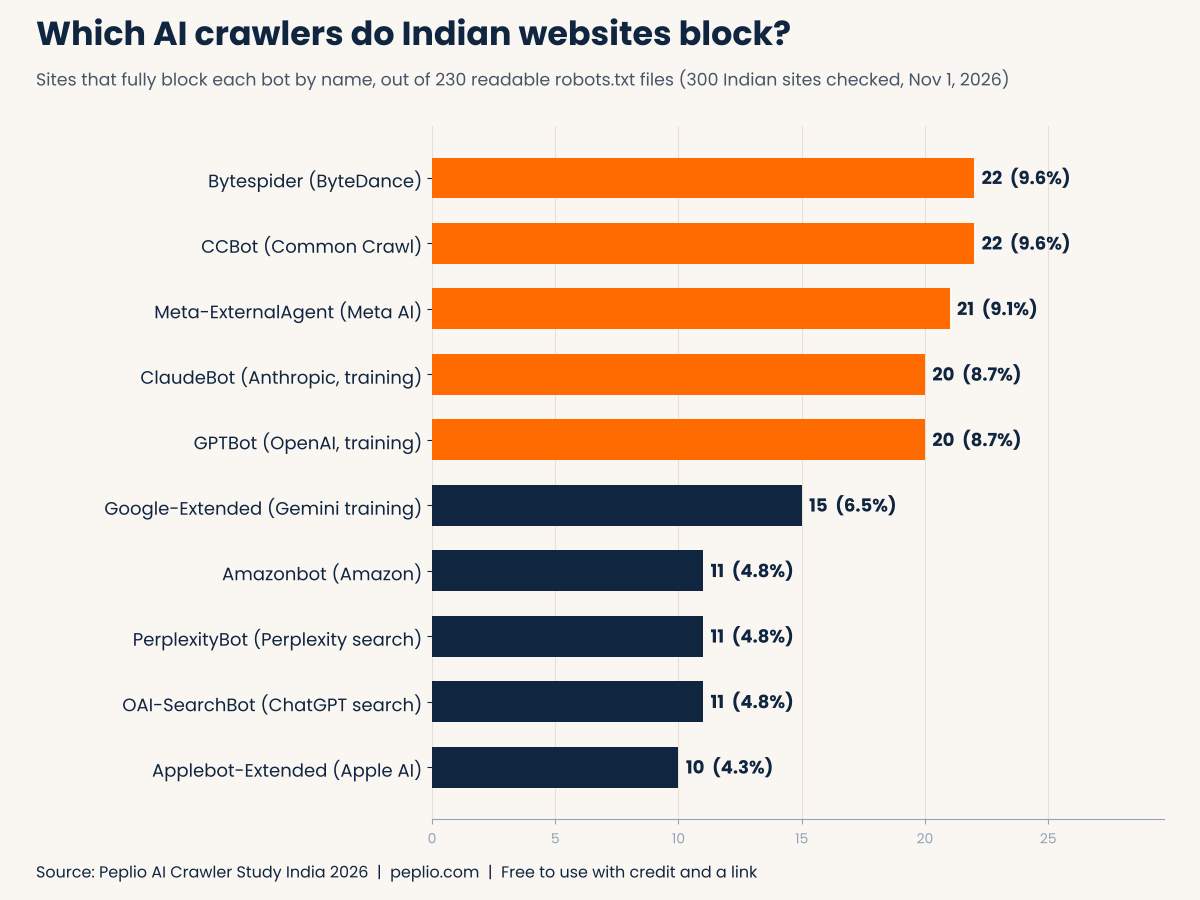
We counted a site as blocking an AI crawler when its robots.txt names that bot and tells itDisallow: /, which means “do not read any page”. Here is how often each of the main AI crawlers is fully blocked across the 230 readable files.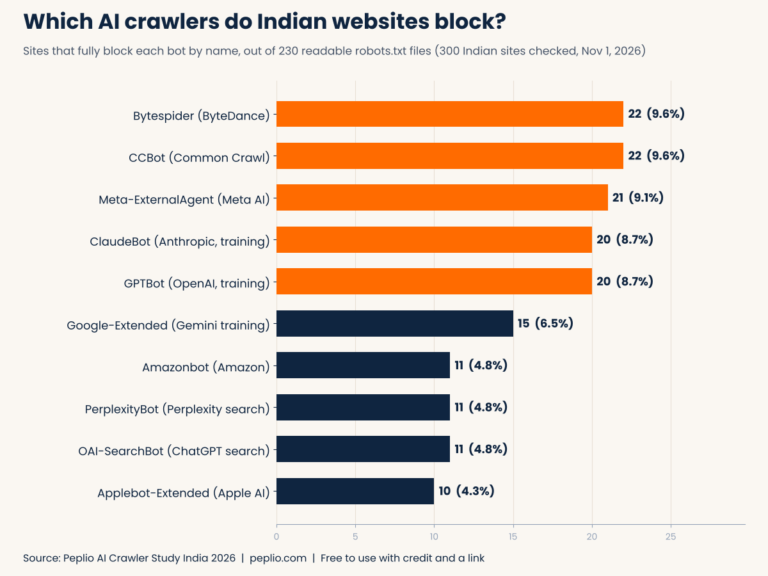
| AI crawler | Run by | What it does | Fully blocked | Partly blocked | Named and allowed |
|---|---|---|---|---|---|
| Bytespider | ByteDance | Training | 22 | 2 | 3 |
| CCBot | Common Crawl | Open dataset used for AI training | 22 | 12 | 7 |
| meta-externalagent | Meta | Training | 21 | 9 | 9 |
| GPTBot | OpenAI | Training | 20 | 16 | 22 |
| ClaudeBot | Anthropic | Training | 20 | 15 | 19 |
| Google-Extended | Gemini training control | 15 | 19 | 17 | |
| OAI-SearchBot | OpenAI | ChatGPT search | 11 | 14 | 17 |
| PerplexityBot | Perplexity | Perplexity search | 11 | 16 | 23 |
| Amazonbot | Amazon | Alexa and Amazon services | 11 | 6 | 8 |
| Applebot-Extended | Apple | Apple Intelligence training control | 10 | 4 | 5 |
| __usage_ai-training | Shared rule | New training opt-out token | 0 | 0 | 0 |
Out of 230 readable robots.txt files. “Partly blocked” means the bot is named with some Disallow rules but not the whole site. Bot purposes from OpenAI, Anthropic, Perplexity, Common Crawl, Apple and Meta.
One pattern stands out: Indian sites that block AI crawlers usually block the less known training bots first. Bytespider, CCBot and Meta’s crawler send no visitors back, so blocking them costs nothing. OpenAI’s and Anthropic’s bots come next. Search-style bots such as PerplexityBot are named and allowed more often (23 sites) than they are blocked (11).Which Indian Sectors Block AI Crawlers Most?
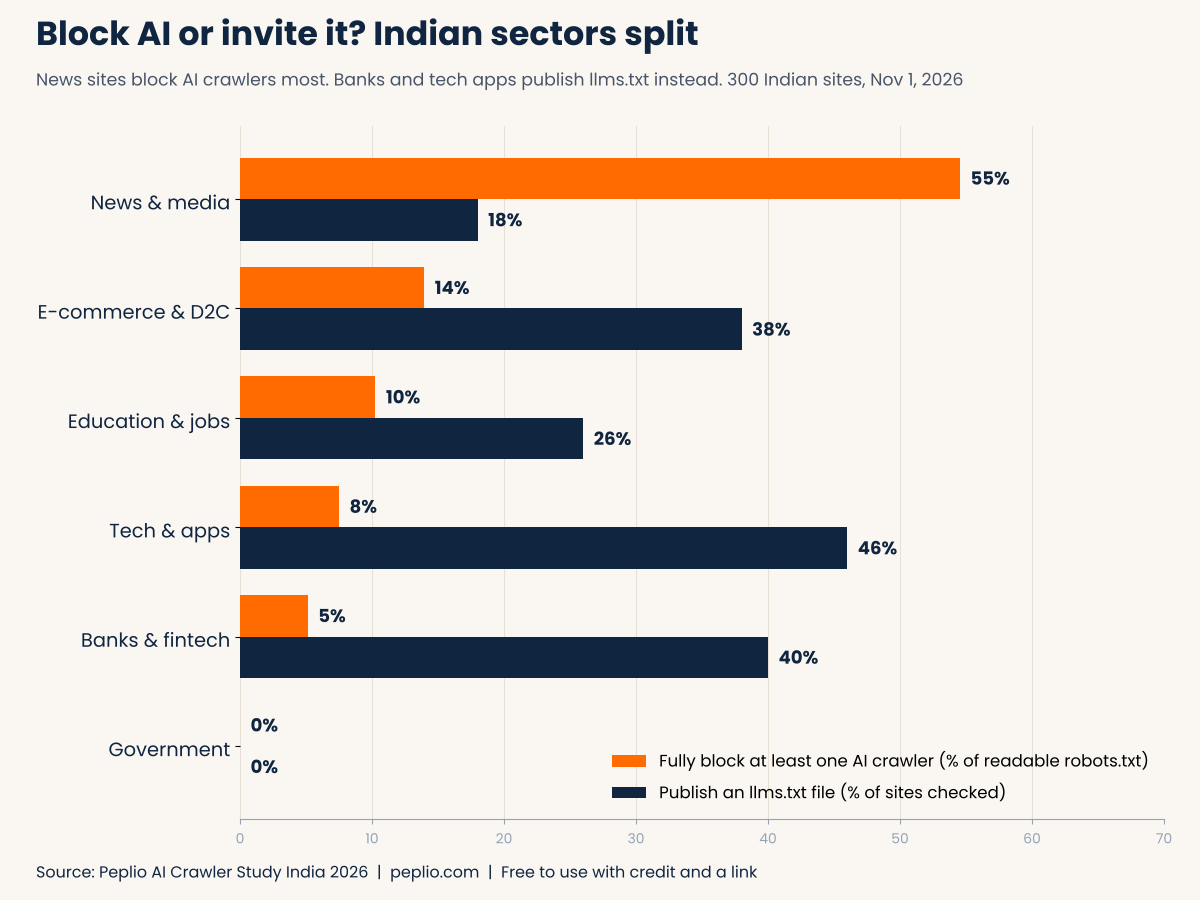
The difference between sectors is the biggest finding of this study. News publishers want to protect their journalism from AI training. Banks, fintech apps and tech companies want AI tools to recommend them, so they do the opposite.| Sector | Sites checked | Readable robots.txt | Block at least one AI crawler | Block GPTBot | Publish llms.txt |
|---|---|---|---|---|---|
| News and media | 50 | 44 | 24 (55%) | 14 | 9 (18%) |
| E-commerce and D2C brands | 50 | 43 | 6 (14%) | 4 | 19 (38%) |
| Education, edtech and jobs | 50 | 39 | 4 (10%) | 2 | 13 (26%) |
| Tech, travel and consumer apps | 50 | 40 | 3 (8%) | 0 | 23 (46%) |
| Banks, fintech and insurance | 50 | 39 | 2 (5%) | 0 | 20 (40%) |
| Government and public bodies | 50 | 25 | 0 (0%) | 0 | 0 (0%) |
| All 300 sites | 300 | 230 | 39 (17%) | 20 | 84 (28%) |
Blocking percentages use readable robots.txt files; llms.txt percentages use all sites checked. Source: Peplio AI Crawler Study India 2026.
Government sites stand apart in a different way: only 25 of 50 had a readable robots.txt at all. Seven returned a web page instead of a robots.txt file, six had no file, four refused our request and eight did not respond or returned an error. None of the 25 readable government files names a single AI crawler.Who Blocks Which AI Crawlers: 12 Big Indian Websites
These are the exact rules we found in each site’s public robots.txt on November 1, 2026. Sites change these files often, so check the live file before quoting a single site.| Website | Fully blocks | What stands out |
|---|---|---|
| bhaskar.com | All 14 AI crawlers we tracked | The strictest file in the study |
| amazon.in | 12 AI crawlers, including GPTBot, OAI-SearchBot, ClaudeBot, Google-Extended and PerplexityBot | Blocks AI search bots too, not only training |
| naukri.com | 12 AI crawlers | Also publishes an llms.txt file |
| zomato.com | GPTBot, OAI-SearchBot, ChatGPT-User, ClaudeBot, Claude-SearchBot, Claude-User, Google-Extended, PerplexityBot, Perplexity-User | Blocks all unnamed bots too, yet publishes an llms.txt file |
| thehindu.com | GPTBot, OAI-SearchBot, ChatGPT-User, ClaudeBot, PerplexityBot, CCBot, Meta, Bytespider, Amazonbot | Leaves Google-Extended alone |
| news18.com and firstpost.com | GPTBot, OAI-SearchBot, ChatGPT-User, ClaudeBot, Google-Extended, CCBot, Bytespider | Identical lists on both sites |
| yourstory.com | GPTBot, ClaudeBot, Google-Extended, CCBot, Applebot-Extended, Meta, Bytespider, Amazonbot | Blocks training but keeps ChatGPT search open |
| moneycontrol.com | GPTBot, ChatGPT-User, Google-Extended, CCBot | Keeps OAI-SearchBot open |
| indianexpress.com | ClaudeBot, PerplexityBot, Applebot-Extended, Meta, Bytespider | Does not block GPTBot |
| timesofindia.indiatimes.com | Meta’s crawler only | Publishes an llms.txt file |
| jio.com | CCBot, Meta, Bytespider | Names GPTBot, ClaudeBot, Google-Extended and PerplexityBot and allows them |
| flipkart.com | None by name | None of the 14 AI crawlers we tracked is named in its robots.txt |
Source: each site’s public robots.txt, read on November 1, 2026. Full rules for all 300 sites are in the free dataset below.
Look Up Any of the 300 Sites
Type a domain from the study to see which AI crawlers it blocks, whether it shuts out ChatGPT search, and whether it publishes llms.txt.Create a clean robots.txt and sitemap for your own website in a minute.
The ChatGPT Search Trap: Blocking the Wrong AI Crawler
OpenAI runs three different bots, and they do different jobs. GPTBot collects training data. OAI-SearchBot decides which sites appear in ChatGPT search. ChatGPT-User opens a page when a person asks ChatGPT to. OpenAI’s documentation is clear about the second one: “Sites that are opted out of OAI-SearchBot will not be shown in ChatGPT search answers.”In our study, 11 sites block OAI-SearchBot as well as GPTBot: The Hindu, News18, Firstpost, Deccan Herald, Dainik Bhaskar, Mathrubhumi, Eenadu, Amazon.in, Zomato, Internshala and Naukri. That may be a deliberate choice, but it also means ChatGPT search cannot cite them.9 sites split it the smart way: Moneycontrol, Manorama Online, Dinamalar, Oneindia, Inc42, YourStory, MediaNama, Decathlon India and Country Delight block GPTBot from training but leave OAI-SearchBot open, so they can still appear and be cited in ChatGPT search. If you want to protect your content from AI training without disappearing from AI answers, this is the pattern to copy. Learn how citations work in our guide on how to get cited by Perplexity.The llms.txt Surprise: Indian Websites Are Inviting AI Crawlers In
An llms.txt file is a plain text guide that tells AI systems what a website is about and which pages matter. Our llms.txt guide explains how it works. We expected few Indian sites to have one. Instead, 84 of 300 sites (28%) publish an llms.txt file, four times the number that block GPTBot.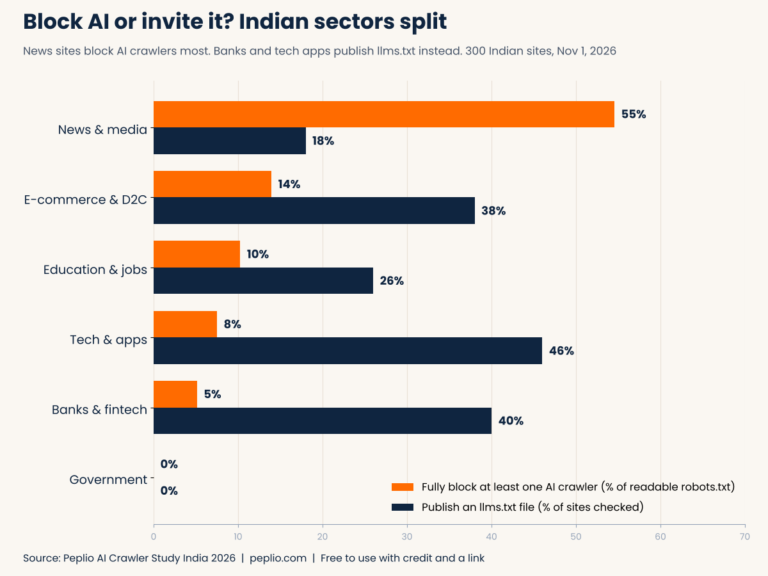
Zero Indian Sites Use the New Shared Opt-Out for AI Crawlers
On October 30, 2026, Google, Microsoft, OpenAI and Anthropic backed one shared robots.txt token,__usage_ai-training, that tells all of them at once not to train on a site. Microsoft will honour it from February 1, 2027 and Google from early 2027, according to PPC Land. Two days later, none of the 230 Indian robots.txt files we read used it. That gives a clean starting point: we will run this AI crawlers study again and report how fast Indian sites adopt it.What This AI Crawlers Study Means for You
| You are | What the data suggests |
|---|---|
| Blogger or creator | Most Indian sites keep AI crawlers allowed. If you want AI answers to cite you, keep search bots (OAI-SearchBot, PerplexityBot, Claude-SearchBot) open and publish an llms.txt file. |
| Brand or D2C business | Banks, fintech and tech apps chose visibility over blocking. Block cart, checkout and account pages for every bot, not whole AI crawlers. |
| News publisher | Your peers block training bots. Copy the split used by Moneycontrol and YourStory: block GPTBot, keep OAI-SearchBot, so you protect content without leaving ChatGPT search. |
| PR agency | If a client blocks AI search bots, AI tools cannot read or cite their press releases. Check the client’s robots.txt before an AI visibility campaign. |
Build your own AI crawler rules
Tick the AI crawlers you want to block. Use a preset to start. The rules update instantly; copy them to the top of your robots.txt file.- GPTBot OpenAI training
- ClaudeBot Anthropic training
- Google-Extended Gemini training (does not affect Google Search)
- CCBot Common Crawl dataset
- Applebot-Extended Apple Intelligence training
- meta-externalagent Meta AI training
- Bytespider ByteDance training
- OAI-SearchBot ChatGPT search
- ChatGPT-User visits when a ChatGPT user asks
- Claude-SearchBot Claude search
- PerplexityBot Perplexity search
- Amazonbot Alexa and Amazon services
Never block Googlebot or Bingbot to stop AI training. That removes you from search. Google-Extended is the right control for Gemini training, according to Google’s crawler documentation.
Free Downloads: AI Crawlers Dataset, Policy Pack and Press Kit
Everything from this study is free for bloggers, journalists, PR agencies, brands and researchers. No signup. Please credit Peplio and link to this page when you use it.Every site, every AI crawler rule, llms.txt status and check time. Excel with live summary sheets, plus CSV.
Download Excelor download CSV6 ready robots.txt files: news publisher, online store, SaaS, blogger, agency portfolio and paid courses, plus a one-page guide.
Download packBoth charts in high resolution, key numbers with sources, the method in one paragraph and a suggested credit line.
Download press kitEvery AI bot name, who runs it, what it does, its official documentation and how many Indian sites block it.
Download PDFHow to cite: Peplio AI Crawler Study India 2026, peplio.com/indian-websites-block-ai-crawlers-study/
How We Ran This AI Crawlers Study (Method and Limits)
- Sites: 300 well-known Indian websites, 50 in each of 6 sectors, chosen by Peplio from leading Indian publishers, listed companies, banks, unicorn startups, universities and government portals. The full list is in the dataset.
- Date and method: on November 1, 2026, a script downloaded each site’s public
/robots.txtand/llms.txtonce, from a home internet connection in India, using a standard browser user agent. If the plain domain failed, it tried the www version. - Blocking rule: a bot counts as fully blocked when a robots.txt group that names it contains
Disallow: /. Wildcard rules (User-agent: *) were recorded separately; only zomato.com and data.gov.in block all unnamed bots this way. - llms.txt rule: counted only when the file returned plain text, not a web page or robots rules.
- Not readable: 70 sites. 25 refused our request (403), 20 did not respond, 14 returned a web page instead of robots.txt, 8 had no file, and 3 returned other errors.
- Limits: robots.txt shows a site’s stated wishes, not which bots actually visit or obey. 300 sites is a focused sample of well-known Indian websites, not every website in India. Files change often, so we will repeat the study and date every update.
Allowing AI crawlers is step one. Check whether AI can actually understand and quote your page.
India’s businesses are betting on AI visibility, while news publishers are protecting their journalism. Both choices make sense.
The data is clear for most businesses: banks, fintech apps and tech companies are writing llms.txt files that welcome AI systems by name. For Peplio and for most small businesses, I think that is the right call: block cart and account pages, block the training bots that send nothing back if you want, but keep AI search bots open. Blocking OAI-SearchBot by accident is the one mistake I would fix today.
Peplio’s comic stories teach SEO and AI search through a bakery that learns everything the hard way. Start reading the digital marketing comic stories.
- Peplio checked 300 Indian websites on November 1, 2026; 230 robots.txt files were readable.
- 17% (39 of 230) fully block at least one AI crawler; news sites lead at 55%.
- The most blocked AI crawlers are Bytespider and CCBot (22 each), Meta (21), GPTBot and ClaudeBot (20 each).
- 11 sites block OAI-SearchBot, which keeps them out of ChatGPT search answers.
- 28% of sites publish llms.txt, four times the number that block GPTBot. No site uses the new shared opt-out rule yet.
Should I block AI crawlers on my website?
Most Indian businesses in this study do not. Block training bots if you want to protect original content, but keep AI search bots open if you want to be cited. Our AEO vs SEO vs GEO guide explains the difference.Does blocking AI crawlers hurt Google rankings?
Blocking Google-Extended does not affect Google Search, according to Google. Blocking Googlebot does. Learn the basics in what is SEO and why it is important.How do I get my site into AI Overviews and AI answers?
Stay crawlable, answer questions clearly and publish unique data. Start with how to optimize content for AI Overviews.FAQ About AI Crawlers and Indian Websites
How many Indian websites block AI crawlers?
In Peplio’s November 1, 2026 study, 39 of 230 readable robots.txt files from 300 well-known Indian websites (17%) fully blocked at least one AI crawler.Which Indian websites block AI crawlers the most?
News and media sites. 24 of 44 news sites (55%) fully block at least one AI crawler, compared with 0 of 25 government sites and 2 of 39 banks and fintech sites.Which AI crawler is blocked most in India?
Bytespider (ByteDance) and CCBot (Common Crawl), each fully blocked by 22 sites, followed by Meta’s crawler (21), GPTBot and ClaudeBot (20 each).What is the difference between GPTBot and OAI-SearchBot?
GPTBot collects data for training OpenAI models. OAI-SearchBot decides which sites appear in ChatGPT search, and OpenAI says sites that block it will not be shown in ChatGPT search answers.Do Indian websites use llms.txt?
Yes. 84 of the 300 sites (28%) publish an llms.txt file, led by tech and consumer apps (23) and banks and fintech (20).Can I use this AI crawlers data in my article?
Yes. The dataset, charts and press kit are free to use. Please credit the Peplio AI Crawler Study India 2026 and link to peplio.com/indian-websites-block-ai-crawlers-study/.Fact check: every number about Indian websites comes from Peplio’s own check of public robots.txt and llms.txt files on November 1, 2026, published in full in the dataset above. Bot purposes come from each company’s own documentation. The shared opt-out dates come from PPC Land’s report of the October 30, 2026 announcement.
All data as of November 1, 2026. Peplio is not affiliated with any website or AI company named here and receives no payment from them. Robots.txt files change, so check a site’s live file before quoting it.