
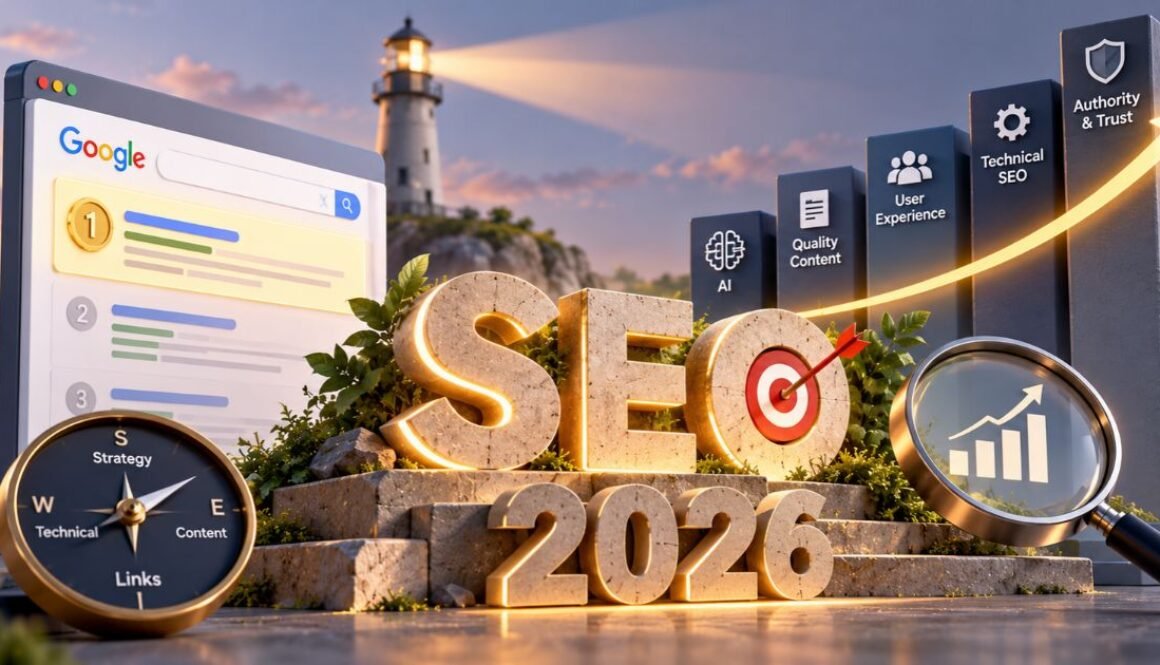
Importance of SEO in 2026: Why It Matters More Than Ever (Real Data + Experience)
Quick Answer
- The importance of SEO in 2026 is higher than ever — 53% of all web traffic still comes from organic search despite AI tools (BrightEdge 2026)
- SEO is now the foundation of AI visibility — Google AI Overviews, ChatGPT, and Perplexity all pull from SEO-optimised, indexed content
- 48% of Google queries trigger an AI Overview above position 1 — without SEO, you are invisible in both traditional and AI search
- Local SEO is the fastest win for Indian small businesses in 2026 — local intent searches have high conversion rates and low competition
- One well-optimised article can bring leads for years — paid ads stop the moment you stop paying; SEO compounds
- Technical SEO, E-E-A-T signals, and content freshness are the three pillars Google rewards most in 2026
The importance of SEO in 2026 is something I understand not from theory, but from real experience building Peplio from Durgapur, West Bengal. I still remember one morning staring at Google Analytics watching traffic drop for no obvious reason — no algorithm update alert, no manual action, nothing visible. That day taught me the most important lesson about the importance of SEO in 2026: when SEO fundamentals are strong, recovery is fast. When they are not, even great content fails. I am Sougan Kumar Mandi, founder of Peplio.com and Digital Marketing Executive at Demech Chemical Products. This guide covers everything I have learned about why SEO matters more in 2026 than it ever did before — and why the people saying “AI will kill SEO” are more wrong every year.
Table of Contents
- Why the importance of SEO in 2026 is higher than ever
- SEO is now the foundation of AI visibility
- How search has changed in 2026
- Importance of SEO for small businesses in India
- Technical SEO — silent but powerful
- E-E-A-T — the trust signals Google rewards
- SEO vs paid ads in 2026
- Common SEO mistakes I still see in 2026
- My simple SEO workflow in 2026
- Sougan’s Take
- FAQ
Why the Importance of SEO in 2026 Is Higher Than Ever
People keep saying AI will kill SEO. I have heard this every year since 2018. Funny thing — every year, organic search keeps sending the most stable, highest-quality traffic of any digital channel. According to BrightEdge’s 2026 channel performance research, 53% of all web traffic still comes from organic search. That number has not dropped — it has held steady even as AI tools have grown. The importance of SEO in 2026 is not diminished by AI — it is amplified by it. In 2026, search has not disappeared. It has evolved and split into three surfaces simultaneously. People search on Google’s blue links. They search inside AI tools like ChatGPT and Perplexity. They search on YouTube, Reddit, and Quora. And behind every one of these surfaces, the same fundamentals apply: structured content, topical authority, E-E-A-T signals, and technical health. SEO in 2026 is not about ranking a keyword — it is about being the best answer everywhere people search.
Without understanding the importance of SEO in 2026, no digital marketing strategy works effectively in any of those channels. When I started Peplio, I obsessed over keyword density. I wrote robotic sentences just to fit a phrase. Rankings came briefly and then vanished. What stayed were the articles where I spoke like a human — where I shared genuine confusion, real mistakes, and small wins from actually doing digital marketing at Demech Chemical Products and on Peplio simultaneously. That is when I understood the real importance of SEO in 2026: search engines now reward clarity, experience, and intent — not manipulation. Read the complete foundation in the SEO fundamentals guide for 2026.
SEO Is Now the Foundation of AI Visibility — Not a Separate Channel
This is the most important shift in the importance of SEO in 2026 that most marketers are still missing. AI tools do not invent answers from nothing — they pull from indexed, well-structured, trusted content. Search Engine Journal confirms that 48% of Google queries now trigger an AI Overview — a summary that appears above all traditional blue links. If your content is not SEO-optimised, Google’s AI cannot extract and cite it. You become invisible in both traditional search and AI search simultaneously. The structural requirements for AI visibility are identical to good SEO practice. You need clear headings that answer specific questions. You need structured data markup so AI can parse your content accurately. You need named statistics with source attribution that AI systems can verify.
You need FAQPage JSON-LD schema that tells Google exactly which questions your article answers. Every article on Peplio now includes all of these signals — and since implementing them, Peplio pages have started appearing in AI Overview citations even at positions 15 to 20 in traditional search. Building a strong AI and SEO strategy in 2026 requires a mindset shift. I have learned that AI does not replace SEO — it depends on it. When I improved heading clarity, internal links, and author presence on Peplio, some pages started appearing in AI-generated summaries within 6 weeks. That is the importance of SEO in 2026 in the most practical sense: without it, AI cannot find you, cite you, or recommend you. Read the complete AEO vs SEO vs GEO comparison and the guide to optimising content for Google AI Overviews.
How Search Has Changed in 2026 — and Why SEO Fundamentals Still Win
Zero-click searches are rising — but brand recall still matters. Yes, many searches end without clicks in 2026. But brands mentioned in AI Overview answers still get remembered. Authority sites still get indirect traffic from users who saw the brand cited and searched for it directly later. Long-tail, problem-based searches still drive clicks because users need more detail than an AI summary provides.
The importance of SEO in 2026 in a zero-click environment is about visibility and recall, not just immediate clicks. Local SEO is exploding in India. From Durgapur to Delhi, local intent searches are growing faster than any other category. Searches like “best digital marketing help near me,” “SEO expert for small business in Pune,” and “website traffic problem solution India” have high conversion rates and manageable competition. If your site is not optimised for local SEO — Google Business Profile, location-specific keywords, service area pages — you are missing the easiest wins available in Indian digital marketing in 2026. Google’s SEO Starter Guide confirms that local relevance signals are among the fastest to impact rankings for service-based businesses.
Content freshness is now a direct ranking signal. One of the most practical demonstrations of the importance of SEO in 2026 I have experienced personally: I updated one Peplio article with current 2026 data, improved the introduction to lead with a direct answer, and added FAQ schema. No new backlinks. No new promotion. Traffic increased 3x within 45 days. Google’s algorithm in 2026 actively rewards content that is updated, dated visibly, and expanded with new information — making content freshness a standalone ranking factor that did not exist with the same weight even 18 months ago.
The Importance of SEO in 2026 for Small Businesses in India
I have worked with small brands and businesses that had no ads budget, no fancy design, and no social media presence. SEO changed everything for them — and the reason is simple: SEO works 24 hours a day, 7 days a week, and does not stop when you stop paying. One good article can bring leads for years. Paid ads cannot do that.
The importance of SEO in 2026 for small businesses is especially high because the Indian digital advertising market crossed 49,000 crore in FY2025 and is growing at 20% year-on-year — but the competition for paid ad slots has grown with it, pushing CPCs up and making organic search the only affordable long-term channel for most small businesses. For Indian small businesses specifically, local SEO is the highest-return starting point. When you mention your city, service area, and real-world experience in your content, search engines connect the dots between your expertise and the user’s local need. People searching locally are usually ready to take action, not just read — making local search traffic convert at higher rates than any other organic channel.
The importance of SEO in 2026 for a local business in Durgapur, Jaipur, or Coimbatore is the same as for a national brand — Google treats local relevance as a quality signal that applies to all rankings, not just map listings. At Demech Chemical Products, I apply the same SEO principles I use on Peplio. B2B chemical manufacturing and a digital marketing blog have completely different audiences and topics — but the fundamentals of the importance of SEO in 2026 apply equally: understand what your customer is searching for, structure your content to answer that clearly, demonstrate expertise through named authorship and cited data, and update content regularly. The results compound in both contexts.
Technical SEO — The Silent Foundation of the Importance of SEO in 2026
Technical SEO is like plumbing. You do not see it — but ignore it and everything leaks. The importance of SEO in 2026 cannot be understood without understanding technical SEO, because Google uses technical health as a domain-wide quality signal. A mobile performance score below 50 causes Google to crawl your entire site less frequently — not just the slow pages. Broken internal links, duplicate content from pagination or parameter URLs, and missing canonical tags can all suppress rankings across your entire domain without any visible warning in Google Search Console. The technical SEO elements that matter most in 2026 are Core Web Vitals (Largest Contentful Paint under 2.5 seconds, Total Blocking Time under 200ms, Cumulative Layout Shift under 0.1), mobile-first design (Google indexes the mobile version of your site first), clean URL structure (no unnecessary parameters or date-format duplicates), proper canonical tags (telling Google which version of a page is the authoritative one), and XML sitemap accuracy (only including pages you actually want indexed). Check your technical foundation using Peplio’s free Website Speed Analyzer and the on-page SEO checklist before publishing any new content.
E-E-A-T — The Trust Signals That Define the Importance of SEO in 2026
Google, Bing, and AI systems now evaluate content like a human would: who wrote this, do they have real experience, is this content helpful or just filler, and would I trust this site again? These are the four questions at the heart of Google’s E-E-A-T framework — Experience, Expertise, Authoritativeness, and Trustworthiness. Understanding E-E-A-T is central to understanding the importance of SEO in 2026 because it explains why generic AI-generated content fails even when it is technically correct. The E-E-A-T signals I implement on every Peplio article: a named author box with role, company, location, and last-updated date; first-person experience woven into every major section (not just the introduction); named statistics with linked source attribution from authoritative external sources; outbound reference paragraphs citing at least 8 external sources; and FAQ JSON-LD schema that structured data parsers can read directly. Google’s helpful content guidelines explicitly state that E-E-A-T signals are used to evaluate every page that appears in search results — making them inseparable from the importance of SEO in 2026. When you sign your work with your real name and real credentials, you write better — and Google notices. Accountability in authorship is not just a branding exercise. It is one of the highest-impact E-E-A-T signals available to individual bloggers and small business content teams. I use my full name — Sougan Kumar Mandi — naturally throughout Peplio content. Not for branding drama. For accountability. And it directly affects how Google evaluates the trustworthiness of every page on the site.
SEO vs Paid Ads in 2026 — Why the Importance of SEO Keeps Growing
Paid ads are great for two things: fast results and scalability. But the importance of SEO in 2026 over paid ads comes down to one fundamental difference — SEO builds compound authority that paid ads never can. I have run ads for Peplio, paused them, restarted them. Every time I pause ads, traffic stops immediately. SEO traffic behaves completely differently: once a page ranks well, organic traffic becomes predictable and cost-effective even during months when I publish nothing new. According to Backlinko’s CTR research, the #1 organic result gets 27.6% of all clicks for a keyword. The #1 paid ad gets 2.1%. For informational and research queries — which represent the majority of searches on topics like digital marketing, SEO, and business tools — organic results dramatically outperform paid ads in both volume and trust. Users trust organic results more than ads, which is why the importance of SEO in 2026 for brand building is higher than any paid channel can achieve. Smart brands in 2026 run both SEO and paid ads — but SEO is the foundation. Ads amplify content that SEO has established as authoritative. Running ads without SEO foundation means paying full price for every visitor with no compounding benefit. Running SEO without any amplification means slower initial growth. The combination wins — but the importance of SEO in 2026 as the permanent, compounding base is non-negotiable for any brand serious about long-term growth. Read the complete SEO vs paid ads comparison for 2026.
Common SEO Mistakes I Still See in 2026 — and How to Fix Them
Mistake 1 — Writing for algorithms, not people. Keyword stuffing, robotic sentence structure, and content built around exact-match keyword repetition still appear everywhere. Google’s Natural Language Processing in 2026 is sophisticated enough to identify this pattern and penalise it. The fix: write the way you would explain something to a friend, then check that your focus keyword appears naturally in the title, first paragraph, at least 3 H2 headings, and the conclusion. That is enough.
Mistake 2 — Publishing AI content without genuine editing. Raw AI-generated articles, even technically accurate ones, lack the first-hand experience signals that Google’s E-E-A-T framework rewards. They rank briefly and then drop as Google’s quality evaluators assess whether the content demonstrates genuine expertise. The fix: use AI to generate outlines and drafts, then rewrite every section with your own experience, data, and examples. The final article should be unrecognisable as AI-generated.
Mistake 3 — Ignoring internal linking. I have fixed this mistake on Peplio and seen direct ranking improvements within 30 days. Pages that were getting zero impressions started appearing in Search Console within two weeks of receiving internal links from stronger pages. Internal linking tells Google which pages are important, passes authority from stronger to weaker pages, and keeps visitors on your site longer — all of which are direct ranking signals. Every article should link to at least 5 other articles naturally within the content.
Mistake 4 — Never updating old content. Content freshness is a direct ranking signal in 2026. Old articles with outdated statistics, broken external links, and no “Last Updated” date signal to Google that the page is not being maintained. The fix: audit your top 10 articles by impressions every quarter, update statistics with current data, add a visible last-updated date, and resubmit to Google Search Console. This alone can recover rankings without writing any new content.
Mistake 5 — No technical audit. Most SEOs focus entirely on content and ignore the technical foundation. Duplicate URLs from category pagination, broken canonical tags, slow mobile performance, and missing XML sitemap entries all suppress rankings site-wide. Run a technical audit using Peplio’s free Website Speed Analyzer and Google Search Console’s Coverage report at least once per quarter.
My Simple SEO Workflow in 2026 — What I Do for Every Peplio Article
The importance of SEO in 2026 is not about gaming Google — it is about being genuinely useful in a way that both humans and machines can recognise.
I have watched my Peplio traffic rise, drop, and rise again multiple times since I started. What I have consistently noticed: when I focused on shortcuts — keyword density, thin AI content, ignoring technical issues — traffic dropped. When I focused on fundamentals — clear answers, genuine experience, updated content, strong internal linking — traffic recovered and grew past where it was before the drop. At Demech Chemical Products, the same pattern holds for B2B content.
The importance of SEO in 2026 is the same as it was in 2016 at its core: be the most helpful, most trusted, most clearly structured answer to a real question. The tools to measure and implement that have evolved dramatically. The principle has not. If you are building a blog, a business, or a personal brand in India right now — do not ignore SEO. Not because it is trendy, but because it is the only digital channel that rewards patience and quality with permanent, compounding results.
Mitu’s bakery website lost all its traffic overnight — and learned why SEO foundation matters more than content alone
Follow the full story in India’s first Digital Marketing Comic Universe — where every technical SEO lesson comes to life through real characters and real consequences.
Importance of SEO in 2026 — Complete Summary
- 53% of all web traffic still comes from organic search in 2026 — SEO is not declining, it is evolving
- 48% of Google queries trigger AI Overviews — without SEO optimisation, you are invisible in AI search too
- SEO is now the foundation of AI visibility — ChatGPT, Perplexity, and Google AI all pull from indexed content
- Local SEO is the fastest win for Indian small businesses — high intent, manageable competition
- Technical SEO affects your entire domain — one slow page or duplicate URL issue suppresses all rankings
- E-E-A-T signals (named author, first-hand experience, cited data) are what Google rewards over AI content
- Content freshness is a direct ranking signal — update existing articles before writing new ones
- SEO compounds over time; paid ads stop the moment you stop paying — SEO is the permanent foundation
- My simple SEO workflow: research intent, write for humans, add structure signals, internal link, submit and distribute
People Also Asked
Is SEO still worth it in 2026?
Yes — the importance of SEO in 2026 is higher than in any previous year. 53% of all web traffic comes from organic search, and SEO is now also the foundation of AI visibility. Google AI Overviews, ChatGPT, and Perplexity all pull from SEO-optimised, indexed content. Without SEO, you are invisible in both traditional search and AI-generated answers. Read the complete SEO fundamentals guide.
How long does SEO take to work in 2026?
For a new site targeting low-competition keywords, first impressions typically appear in 30 days, first real clicks in 60 to 90 days, and compounding traffic from month 3 onwards. For established sites updating existing content with current data and FAQ schema, improvements can appear in as little as 3 to 4 weeks. For highly competitive keywords, 6 to 12 months is a realistic timeline for significant ranking positions.
Does AI-generated content rank in 2026?
Only if it is heavily edited to include first-hand experience, named statistics with sources, and genuine expertise that Google’s E-E-A-T framework can evaluate. Raw AI content alone — which lacks the “first E” of Experience — ranks briefly and then drops as Google’s quality evaluators assess the page. The importance of SEO in 2026 for AI content is that the structural signals must be even stronger when the writing started with AI, not weaker.
Frequently Asked Questions — Importance of SEO in 2026
What is the importance of SEO in 2026 for a new website?
For a new website, the importance of SEO in 2026 starts with three foundations: technical health (fast loading, clean URL structure, proper indexing), content targeting low-competition keywords with clear direct answers in the first paragraph, and internal linking to connect every published page to at least 3 others. New sites should avoid chasing high-competition keywords and instead target queries where forums or thin content is currently ranking — those are the open slots where new sites can appear quickly. Read the guide on how to increase website traffic for new sites.
How has the importance of SEO changed with AI in 2026?
AI has made the importance of SEO in 2026 greater, not lesser. Google AI Overviews (appearing in 48% of queries), ChatGPT, and Perplexity all pull answers from indexed, well-structured content. If your content is not SEO-optimised — no structured headings, no FAQ schema, no named statistics, no clear direct answer — AI systems cannot extract and cite it. AI search visibility is dependent on traditional SEO fundamentals: indexability, structure, and E-E-A-T signals.
Is local SEO important in 2026 for small Indian businesses?
Yes — local SEO is one of the highest-return channels for Indian small businesses in 2026. Local intent searches (including “near me” queries and city-specific service searches) have high conversion rates because users searching locally are usually ready to take action. Competition for local keywords is still manageable compared to national keywords. Optimising Google Business Profile, adding location-specific content, and mentioning service areas in page titles are the three fastest local SEO wins for any Indian small business.
What is E-E-A-T and why does it matter for the importance of SEO in 2026?
E-E-A-T stands for Experience, Expertise, Authoritativeness, and Trustworthiness — the four dimensions Google uses to evaluate content quality in 2026. The “first E” (Experience) was added in 2023 specifically to reward content written by people who have actually done the thing they are writing about. For the importance of SEO in 2026, E-E-A-T means: name your author prominently, share first-hand experiences in every major section, cite named statistics with linked sources, and update content regularly with a visible last-updated date.
Can SEO help with AI visibility in tools like ChatGPT and Perplexity?
Yes — and this is one of the most important aspects of the importance of SEO in 2026. AI tools like ChatGPT, Perplexity, and Google AI Overviews pull from indexed, well-structured, authoritative content. The same SEO signals that help you rank in traditional search — clear headings, FAQ schema, named statistics, E-E-A-T signals, and topical authority — also increase the probability of being cited by AI systems. Read the complete guide on how to get cited by Perplexity AI.
What is the importance of SEO in 2026 for someone with no technical background?
You do not need to be a developer to implement the most important SEO in 2026 signals. The highest-impact actions require no coding: writing direct answers in the first paragraph, using question-based H2 headings, adding FAQ sections to every article, citing named statistics with links, naming your author prominently, and submitting updated articles to Google Search Console for reindexing. Plugins like RankMath handle the technical schema automatically. Start with content quality and structure — the technical details can be learned gradually alongside consistent publishing.
Related Reading on the Importance of SEO in 2026
- What Is SEO and Why Is It Important — The Complete 2026 Guide
- On-Page SEO Checklist — 15 Steps Before Every Publish
- AEO vs SEO vs GEO — The Complete 2026 Comparison
- Technical SEO for Beginners — What You Need to Know
- How to Increase Website Traffic — 9 Strategies That Actually Work
- SEO vs Paid Ads — Which Is Better for Indian Businesses in 2026
- How to Optimise Content for Google AI Overviews — 8 Steps
Data sources: BrightEdge 2026 Channel Performance Report, Search Engine Journal AI Overview research, Google Helpful Content Guidelines, Google SEO Starter Guide, Backlinko CTR Research, Search Engine Journal. Updated October 2026.
The importance of SEO in 2026 cannot be overstated for any business or blog that depends on digital visibility. The importance of SEO in 2026 goes beyond traditional Google rankings to encompass AI search visibility — because 48% of Google queries now trigger an AI Overview that appears above all blue links, and both traditional and AI search pull from the same pool of SEO-optimised, indexed content. Understanding the importance of SEO in 2026 means recognising that every digital marketing channel — social media, email, paid ads, influencer partnerships — performs better when SEO foundation is strong, because SEO builds the domain authority and content structure that every other channel benefits from.
For Indian businesses specifically, the importance of SEO in 2026 is tied directly to the 20% year-on-year growth of the Indian digital advertising market and the 40% gap between demand for skilled digital marketers and supply. The businesses that will capture the most organic traffic in India over the next 3 to 5 years are the ones building SEO foundations right now — not waiting until competition increases further. The importance of SEO in 2026 is the same message I communicate to every small business owner and blogger I work with: start with the fundamentals, be consistent, update content regularly, and trust that the compounding effect of good SEO will deliver results that no paid channel can match in the long run.